

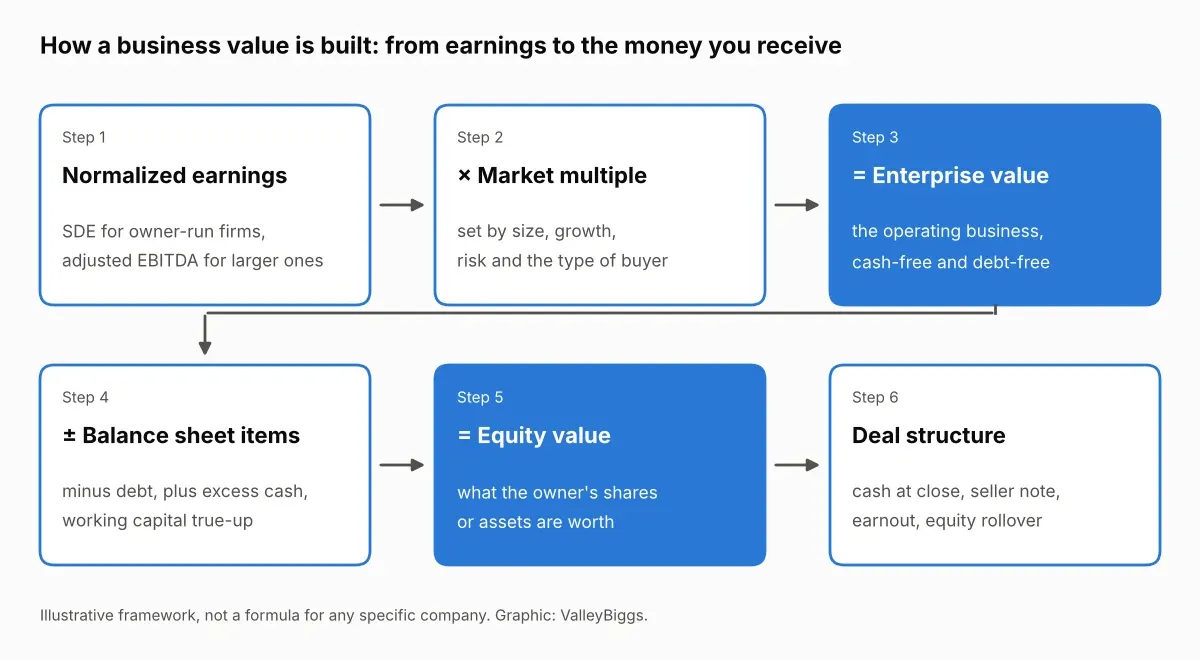
How much is a business worth? For most privately held companies, the answer is normalized annual earnings multiplied by a market multiple, then adjusted for debt, cash and the way the buyer pays. A small owner-run firm is usually priced on seller’s discretionary earnings, while larger companies are priced on adjusted EBITDA at higher multiples.
That formula sounds simple, but the inputs decide everything: which earnings figure buyers accept, which multiple your size and sector support, and how much of the price arrives at closing. This guide explains each input with sourced market data, a hypothetical worked example and a checklist you can use before talking to buyers in 2027.
Key Takeaways
- Value is driven by normalized earnings times a multiple, not by revenue alone. Revenue multiples are a rough cross-check at best.
- Owner-operated businesses are usually priced on SDE. Companies with a management team and roughly $1 million or more in profit are usually priced on adjusted EBITDA.
- Closed small-business sales reported to BizBuySell for 2025 averaged roughly 2x to 5x cash flow across most subsectors, while private equity deals tracked by GF Data averaged about 7x adjusted EBITDA in mid-2026.
- The headline number is enterprise value. What you keep depends on debt payoff, working capital, taxes and how much is paid in cash at close versus notes or earnouts.
- Clean financials, low customer concentration, recurring revenue and a business that runs without you are the most reliable ways to move the multiple up.
How Much Is a Business Worth? The Short Answer
A business is worth what an informed buyer will pay for its future cash flow, adjusted for the risk that the cash flow will not show up. The IRS describes fair market value in Revenue Ruling 59-60 as the price a willing buyer and a willing seller would agree on when both understand the relevant facts and neither is forced to act. Appraisers, lenders and acquirers all start from that idea.
In practice, owners who ask “what is my business worth” are really asking three separate questions:
- What earnings will a buyer underwrite? Reported profit is rarely the number. Buyers rebuild it after removing one-time costs and owner perks.
- What multiple fits a company like mine? Size, growth, margins, customer mix and industry all shift the multiple.
- What will I actually receive? Debt, taxes, working capital targets and deal structure sit between the headline price and your bank account.
SDE or EBITDA: Which Earnings Figure Applies to You
The first decision in any valuation is which earnings measure fits the business. Using the wrong one is the most common reason owners and buyers end up far apart on price.
Seller’s discretionary earnings (SDE)
SDE starts with pre-tax profit and adds back one owner’s full compensation, interest, depreciation, amortization and genuine one-time or discretionary expenses. It shows the total cash benefit available to a single owner-operator. Buyers of smaller companies, often individuals using SBA financing, think in SDE because they plan to replace you in the day-to-day role.
Adjusted EBITDA
Adjusted EBITDA assumes the business pays a market salary to whoever runs it. It adds back interest, taxes, depreciation, amortization and non-recurring items, but not the cost of management. Private equity firms, family offices and strategic acquirers price on this figure because they will install or keep a management team rather than run the company themselves.
As a rule of thumb, once a company produces about $1 million or more in profit and has managers who handle daily operations, buyers shift from SDE to adjusted EBITDA. Our article on what a $10 million company is worth walks through that lower middle market tier in more depth.
| SDE | Adjusted EBITDA | |
|---|---|---|
| Owner pay | Fully added back | Replaced with a market-rate manager salary |
| Typical business | Owner-operated, smaller profit base | Management team in place, larger profit base |
| Typical buyer | Individual buyers, often with SBA loans | Private equity, family offices, strategic acquirers |
| Multiples it supports | Lower, reflecting key-person risk | Higher, reflecting transferable operations |
| Common mistake | Adding back expenses the business still needs | Counting one-time items that recur every year |
What Multiples Do Businesses Actually Sell For?
Multiples are not set by formula. They come from completed transactions, and the available data shows a clear step-up as companies get larger and less dependent on their owners.
Small businesses priced on SDE
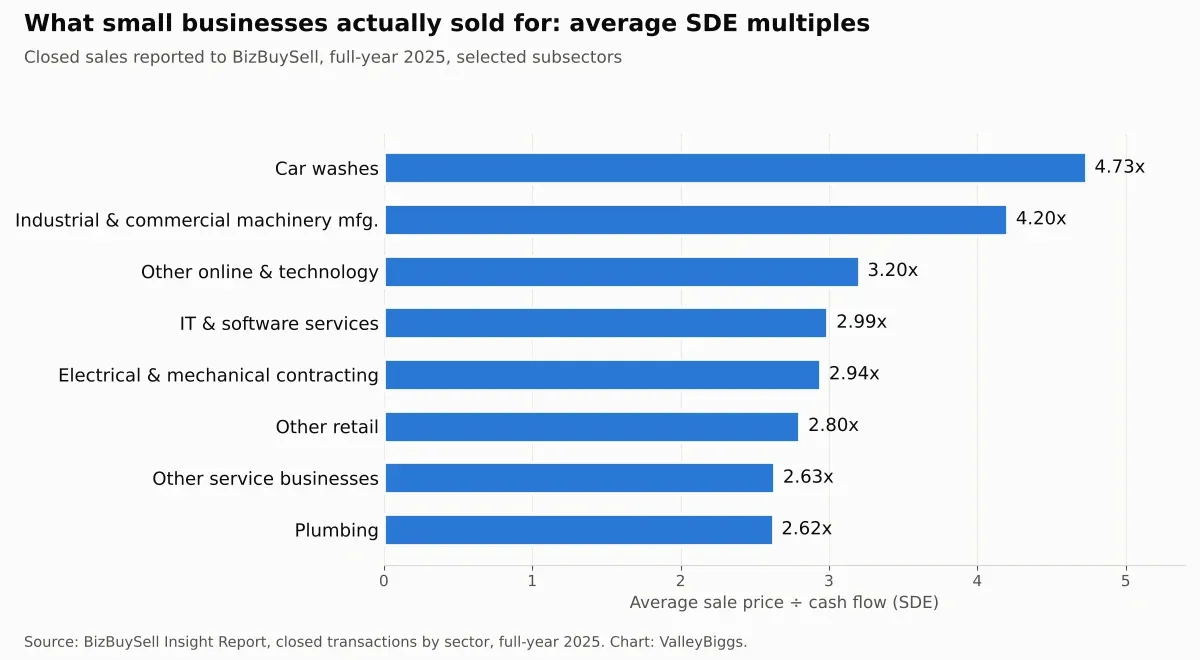
BizBuySell’s closed-transaction data for full-year 2025 shows that most small-business subsectors sold for an average of roughly 2x to 3.5x cash flow, which BizBuySell defines in SDE terms. Asset-heavy or highly recurring niches sat higher: car washes averaged about 4.7x and industrial and commercial machinery manufacturers about 4.2x. Within the technology segment, IT and software service businesses averaged about 3.0x and other online and technology businesses about 3.2x.
Lower middle market companies priced on EBITDA
For larger companies, GF Data tracks private equity-backed acquisitions with enterprise values between $10 million and $500 million. According to GF Data figures reported by the Association for Corporate Growth, the average purchase multiple was about 7.0x trailing twelve-month adjusted EBITDA in the second quarter of 2026, down from about 7.3x in the first quarter. GF Data has also reported that the smallest bracket it tracks, $10 million to $25 million in deal value, averaged closer to 6x.
Treat these figures as context, not a quote for your company. Averages hide wide ranges, and a single deal can land well above or below them depending on growth, margins and how many serious buyers compete.
| Business profile | Earnings measure | Who usually buys | What the data shows |
|---|---|---|---|
| Owner-operated, under about $1M in profit | SDE | Individuals, owner-operators, SBA-backed buyers | Most BizBuySell subsectors averaged about 2x to 3.5x SDE in 2025 |
| Growing company, roughly $1M to $3M in profit | Adjusted EBITDA | Search funds, family offices, PE add-ons, strategic buyers | Usually priced between small-business and GF Data levels; depends heavily on transferability |
| Lower middle market, $10M to $500M deal value | Adjusted EBITDA | Private equity platforms and strategic acquirers | GF Data average about 7.0x in Q2 2026; about 6x in the $10M to $25M bracket |
Can You Value a Business on Revenue?
Owners often ask “how much can I sell my business for” with only a revenue figure in mind. Revenue multiples exist, but they are a blunt tool, because two companies with the same sales can have completely different profit. BizBuySell’s 2025 data shows most small-business subsectors selling for about 0.4x to 1.3x annual revenue on average, with IT and software service businesses near 1.1x and other online and technology businesses near 1.3x.
Revenue becomes the primary yardstick mainly in high-growth software, where buyers may pay for recurring revenue before profits are fully visible. If you run a subscription business, our guide to the SaaS business model explains the metrics, such as retention and recurring revenue, that buyers look at before they look at the bottom line.
What Moves the Multiple Up or Down
Two businesses with identical earnings can sell for very different prices. Buyers adjust the multiple for anything that changes how confident they are in future cash flow. The IRS lists similar factors in Revenue Ruling 59-60, including the nature and history of the business, the economic outlook for its industry, its earning capacity and the value of its goodwill.
- Owner dependence. If customers, suppliers or key staff only deal with you, buyers price in the risk that relationships leave with you.
- Customer concentration. When one client provides a large share of revenue, expect a lower multiple, a holdback or an earnout tied to that account.
- Recurring revenue. Contracts, subscriptions and repeat purchase patterns make cash flow easier to forecast and usually lift value.
- Growth and margin trend. Three years of rising earnings support a higher multiple than one strong year after two weak ones.
- Quality of records. Accrual-basis statements, reconciled tax returns and documented add-backs shorten due diligence and reduce price renegotiation.
- Size. Larger earnings attract more institutional buyers, more financing options and, typically, higher multiples.
- Industry demand. Sectors that private equity groups are actively consolidating can command premiums because several buyers want the same asset.
A Hypothetical Worked Example
The example below is hypothetical and simplified. It follows one company from reported profit to the amount the owner could receive, using the six steps in the diagram above.
Imagine a B2B services company with $6.0 million in revenue and $620,000 of reported pre-tax net income. The owner pays herself $150,000 more than a market-rate general manager would cost, and the year included a one-time $60,000 legal settlement.
| Line item | Amount | Note |
|---|---|---|
| Reported net income (pre-tax) | $620,000 | From the profit and loss statement |
| + Interest | $90,000 | Financing cost; the buyer will use its own capital structure |
| + Taxes | $200,000 | Removed so buyers compare companies before tax |
| + Depreciation and amortization | $180,000 | Non-cash charges |
| + Excess owner compensation | $150,000 | Pay above a market manager salary |
| + One-time legal settlement | $60,000 | Must be documented as non-recurring |
| = Adjusted EBITDA | $1,300,000 | The figure the buyer underwrites |
| × Multiple range (hypothetical) | 4.5x to 6.0x | Reflects size, growth and risk |
| = Enterprise value | $5.85M to $7.8M | Cash-free, debt-free basis |
| − Debt repaid at closing | −$900,000 | Bank loan and equipment financing |
| + Excess cash kept by seller | +$250,000 | Cash above the agreed working capital level |
| = Equity value | $5.2M to $7.15M | Before transaction costs and taxes |
Now consider how the price might be paid. If the parties settle at the low end of the range and agree that about 80% arrives in cash at closing, 10% as a seller note paid over several years and 10% as an earnout tied to next year’s revenue, the owner receives roughly $4.7 million on day one. The rest depends on the buyer’s payments and the company’s performance. That is why two offers with the same headline price can be worth very different amounts to you.
How Deal Structure Changes What You Keep
Valuation and structure are negotiated together. A higher price with more deferred or contingent money can be worth less than a lower, cleaner offer.
- Cash at close is the most certain part of the price.
- Seller notes let the buyer pay part of the price over time with interest. They are common in SBA-financed deals and carry the risk that the buyer cannot pay.
- Earnouts pay more if the business hits agreed targets after closing. They can bridge a valuation gap but often lead to disputes over how targets are measured.
- Equity rollover means you keep a minority stake in the new entity, which can pay off if a private equity owner sells again later.
- Working capital targets require you to leave a normal level of receivables and inventory in the business, which can reduce proceeds if you run the balance sheet thin before closing.
Asset sales and stock sales are also taxed differently. In an asset sale, the IRS requires buyer and seller to allocate the purchase price across asset classes, reported on Form 8594, and that allocation affects how much of your gain is taxed as ordinary income versus capital gain. This article is not legal or tax advice, so confirm the structure with your CPA and attorney before signing a letter of intent.
How to Estimate What Your Business Is Worth Before You Sell
You can build a credible working answer to “how much is my business worth” before hiring anyone. Use the steps below and keep notes on every assumption, because buyers will ask about each one.
- Gather three years of financial statements and tax returns and confirm that they reconcile.
- Recast earnings into SDE or adjusted EBITDA, listing every add-back with supporting documents.
- Pick a multiple range from closed-deal data for companies of similar size and sector, not from public company valuations.
- Apply the range, then subtract debt and adjust for cash to move from enterprise value to equity value.
- Stress-test the result: what happens to value if your largest customer leaves or growth slows next year?
- Compare your estimate with an independent view before you set an asking price.
If you need a defensible number for a sale, a partner buyout or lender review, an enterprise valuation analysis tests your add-backs and multiple against current transaction data. Buyers using an SBA 7(a) loan for a change of ownership will also face the lender’s own independent business valuation requirement under the SBA’s current SOP 50 10 8.1 rules, so a well-supported number helps avoid surprises late in the process.
Why Two Valuations of the Same Company Differ
Owners are often surprised when a lender’s appraisal, a broker’s opinion and a buyer’s offer land far apart. Each one answers a slightly different version of what a business is worth.
| Who prepares it | Purpose | What it usually emphasizes |
|---|---|---|
| Certified appraiser | Tax, estate, litigation, lender requirements | Fair market value under defined standards; often conservative |
| M&A advisor or broker | Setting a sale strategy and asking price | Recent comparable sales and expected buyer demand |
| Financial buyer | Investment decision | Cash flow it can finance and the return it needs |
| Strategic buyer | Acquisition fit | Synergies such as cost savings or cross-selling, which can justify a premium |
The price a business actually sells for is set in negotiation. The best way to find the top of the range is to put the company in front of several qualified buyers at the same time, which is the core of a structured sell-side process.
When to Talk to an M&A Advisor
A self-estimate is useful for planning. An advisor becomes worth involving when real money and real decisions depend on the number. Consider getting help when:
- You expect to sell within the next one to three years and want time to fix value drivers.
- An unsolicited offer has arrived and you do not know whether it is fair.
- Your company is a technology, SaaS or ecommerce business where buyers weigh metrics beyond profit.
- Partners disagree on value, or a buyout, divorce or estate plan requires a supported figure.
- You are weighing offers with different mixes of cash, notes and earnouts.
ValleyBiggs focuses on selling technology and internet businesses and works on a success-fee basis, so no fees are due until a deal closes. If your company is a software or SaaS business, see how we approach selling a SaaS company and selling a technology business. Once you are preparing for buyers, our due diligence checklist for sellers and overview of the sell-side M&A process show what comes after the valuation.
Conclusion
Your company’s value is a range, not a single number, and you have more influence over it than most owners assume. Know which earnings figure buyers will use, anchor your multiple to closed-deal data, and look past the headline price to what you will keep after debt, taxes and deal terms. If you want a confidential view of where your business sits in that range, request a confidential consultation with the ValleyBiggs team, or start with our guide to selling your business.
FAQs
1. Is a business worth 3 times profit?
Sometimes, but not as a rule. Three times SDE is close to the middle of what many small owner-run businesses sold for in 2025 according to BizBuySell data. Larger companies priced on adjusted EBITDA often sell for more, while businesses with heavy owner dependence, declining sales or one dominant customer can sell for less.
2. How do you calculate the value of a business?
Start by recasting profit into SDE or adjusted EBITDA, then multiply it by a range drawn from comparable closed sales. Subtract debt and add excess cash to reach equity value. Appraisers may also run a discounted cash flow model or an asset-based approach and weigh the results, especially for asset-heavy or fast-growing companies.
3. How much is a business worth with $1,000,000 in sales?
It depends on profit, not sales. A company with $1 million in revenue and $250,000 of SDE is valued very differently from one earning $50,000. As a rough cross-check, BizBuySell’s 2025 closed deals show most subsectors selling for about 0.4x to 1.3x revenue, which implies roughly $400,000 to $1.3 million before adjusting for margins.
4. How much is a business worth that makes $300,000 a year?
If $300,000 is SDE for an owner-run business, closed-deal averages of roughly 2x to 3.5x SDE would point to about $600,000 to $1.05 million. Strong recurring revenue, growth and clean books push toward the top of that range or beyond. If the figure is net income after a market salary, the value can be higher.
5. How long does it take to get a professional business valuation?
A formal valuation usually takes a few weeks once the appraiser or advisor has your financial statements, tax returns and supporting schedules. Delays most often come from missing documents or add-backs that cannot be supported. Preparing three years of reconciled financials in advance is the simplest way to shorten the process.
6. Should I get a valuation before talking to buyers?
Yes. Knowing your realistic range protects you from accepting a low first offer and from anchoring on a number buyers will not support. It also shows which value drivers you can still improve. A confidential enterprise valuation analysis is a practical first step before any buyer conversation.