

The Rule of 40 says a software company’s annual revenue growth rate plus its profit margin should equal at least 40%. A SaaS business growing 25% a year with a 15% EBITDA margin scores 40 and passes; one growing 10% with a 20% margin scores 30 and falls short. For founders, the number matters because buyers use it as a first filter: it tells a private equity fund or strategic acquirer, in one figure, whether growth is being bought at a sensible cost. This guide explains the rule of 40 formula, how buyers recalculate your score in diligence, and what the result does to your valuation.
Key Takeaways
- The Rule of 40 adds year-over-year revenue growth to a profit margin, usually EBITDA or free cash flow. A combined score of 40% or more is the common benchmark for a healthy SaaS company.
- Buyers do not accept the score you report. They rebuild it from normalized financials, so founder pay, capitalized development costs and one-off items can move it by several points.
- Research from Bain and McKinsey links strong Rule of 40 performance with materially higher revenue multiples, but the rule screens a company; it does not set the price.
- Below roughly $10M in ARR, buyers lean more on retention, gross margin and growth quality than on the combined score alone.
- The fastest ways to improve the score before a sale are cleaner books, better retention and cutting spend that does not produce growth, not one-time cost cuts that look cosmetic.
What Is the Rule of 40?
The Rule of 40 is a shorthand test of how well a SaaS company balances growth and profitability. You take the growth rate of recurring revenue, add the profit margin, and compare the total with 40%. A company can earn its score mostly through growth, mostly through margin, or through a mix; the rule treats all three paths as acceptable as long as the sum clears the line.
That flexibility is the point. Fast-growing software companies often spend heavily on sales and marketing and run at a loss, while mature ones grow slowly and throw off cash. The rule gives investors one number to compare both kinds of business. If you are newer to the economics behind it, our explainer on how the SaaS business model works covers recurring revenue, churn and gross margin in more detail.
Where the rule came from
Venture capitalist Brad Feld wrote about the rule in February 2015, saying he had heard it from a late-stage investor at a board meeting. In that post he framed it for SaaS companies at scale, assuming at least $50 million in revenue, and suggested using EBITDA as the baseline profit measure while back-testing other margins. He also noted it lined up with his own view of product-market fit once a company reaches about $1 million of monthly recurring revenue. Since then, consultancies, lenders and public-market analysts have adopted it as a standard SaaS benchmark.
What is the Rule of 40 in finance terms?
In finance, the rule works as an efficiency ratio. It asks whether each point of margin a company gives up is buying at least an equal point of growth. A score above 40 suggests spending is turning into durable revenue; a score well below it suggests the company is either burning cash without enough growth to show for it or is profitable but stalling.
Rule of 40 Formula: How to Calculate Your Score
The rule of 40 formula is simple:
Rule of 40 score = revenue growth rate (%) + profit margin (%)
The hard part is choosing the inputs and applying them consistently. Most private SaaS buyers start with these definitions:
- Growth: year-over-year growth in annual recurring revenue (ARR), or MRR multiplied by 12. If most revenue is subscription, ARR growth is the cleanest measure; otherwise use total revenue growth and say so.
- Profit margin: adjusted EBITDA divided by GAAP revenue for the same period. Some buyers use free cash flow margin instead, which captures capital spending and capitalized software costs.
- Period: trailing twelve months (TTM) compared with the prior TTM, so one strong or weak month does not distort the result.
Different users plug in different measures, and the choice can change your score by several points. This table shows the common versions and who tends to rely on each.
| Growth input | Profit input | Who typically uses it | What to watch |
|---|---|---|---|
| ARR growth, year over year | Adjusted EBITDA margin | Private equity, lenders, most private SaaS buyers | Add-backs must be documented and defensible |
| Total revenue growth | Free cash flow margin | McKinsey research, many public-market analysts | Capitalized development costs reduce the margin |
| Total revenue growth | Non-GAAP operating margin | Public company reporting and screens | Stock-based compensation is often excluded |
| Recurring revenue growth | SDE margin | Small owner-operated SaaS deals | Inflates the score; few buyers accept it here |
Rule of 40 example: four hypothetical SaaS companies
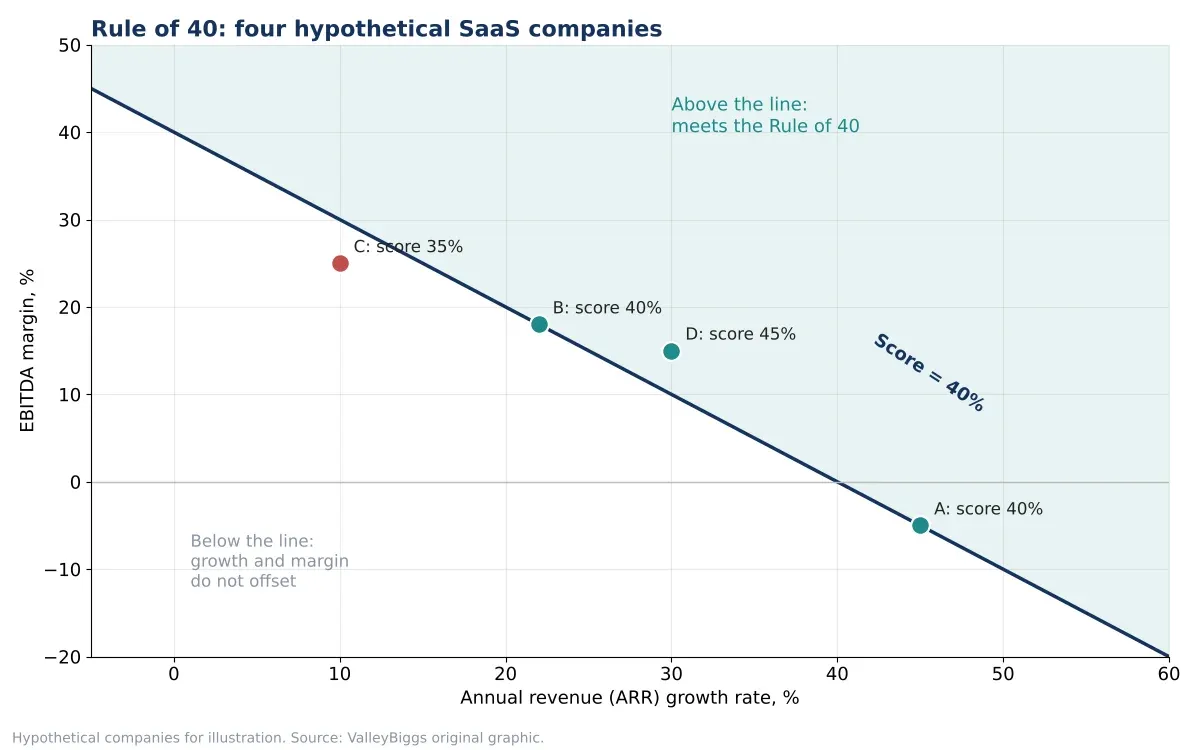
The table below shows how very different businesses can land on either side of the line. All four companies are hypothetical.
| Company (hypothetical) | ARR growth | EBITDA margin | Score | How a buyer may read it |
|---|---|---|---|---|
| A: venture-backed, high growth | 45% | -5% | 40% | Passes through growth; buyer will test whether growth holds without heavy spend |
| B: balanced | 22% | 18% | 40% | Passes; attractive to private equity because it already funds itself |
| C: mature, profitable | 10% | 25% | 35% | Falls short; often valued closer to an EBITDA multiple than a revenue multiple |
| D: efficient grower | 30% | 15% | 45% | Clears the line with room to spare; likely to draw competing bids |
Step-by-step rule of 40 calculation
Here is a worked rule of 40 example for a hypothetical company preparing for a sale:
- ARR a year ago: $6.0M. ARR today: $7.5M. Growth = ($7.5M − $6.0M) ÷ $6.0M = 25%.
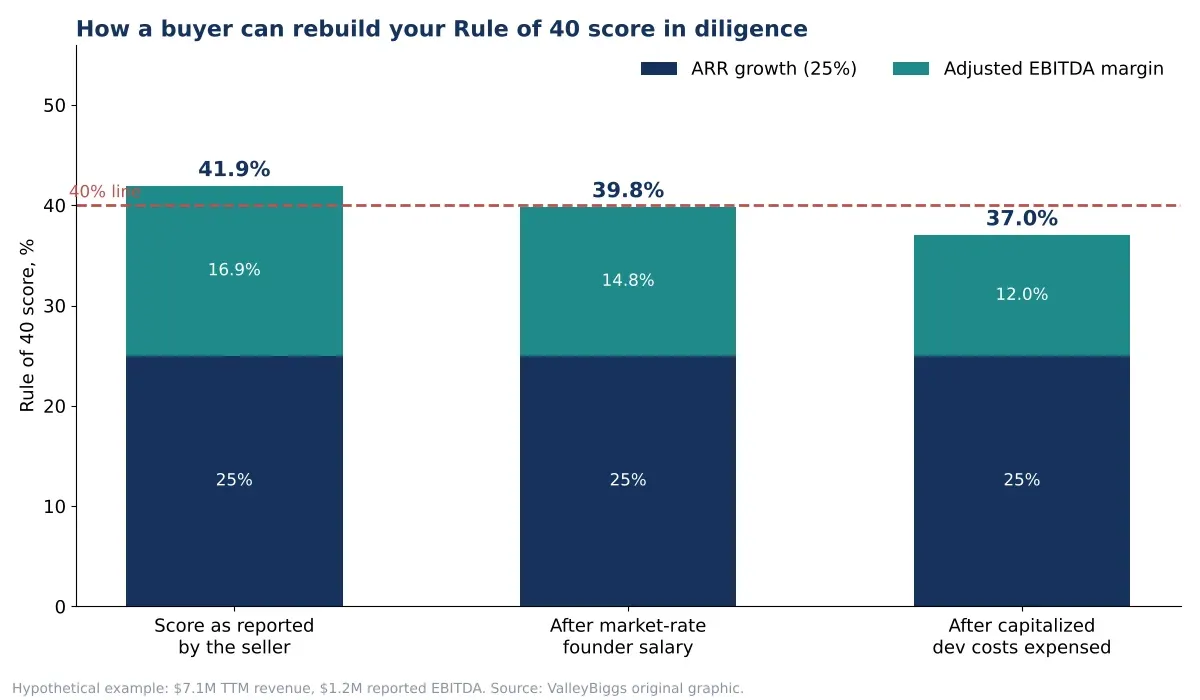
- TTM GAAP revenue: $7.1M. Reported adjusted EBITDA: $1.2M. Margin = $1.2M ÷ $7.1M = 16.9%.
- Rule of 40 score = 25% + 16.9% = 41.9%.
On paper the company passes. The next section shows why a buyer may reach a different answer. If you would rather not build the model yourself, a simple spreadsheet works as a rule of 40 calculator: one cell for prior ARR, one for current ARR, one for EBITDA, one for revenue, and a formula that adds growth to margin.
How SaaS Buyers Use the Rule of 40 in an Acquisition
Buyers use the score at three points in a deal, and each one matters to a seller:
- Screening: private equity funds and corporate development teams often see dozens of teasers a month. A clear score near or above 40 helps your company survive the first pass.
- Valuation framing: the score helps a buyer decide whether to price the company on a revenue multiple, where growth earns a premium, or on an EBITDA multiple, where current profit drives value.
- Diligence and deal terms: once the quality-of-earnings work starts, the buyer rebuilds the score from normalized numbers. A gap between your figure and theirs tends to show up as a lower price, a larger earnout or a bigger escrow.
Different buyer types weigh it differently. Growth equity investors care most about the growth half and its efficiency. Buyout funds that use debt want enough margin to service it. Strategic acquirers may accept a lower score if your product fills a gap they would otherwise build. Knowing which group you are selling to shapes how you present the number, which is part of how a software company sale is run well.
How buyers rebuild your score in diligence
A buyer’s analysts will normalize your financials before they rely on any ratio. The adjustments that most often move the score are:
- Founder compensation: if you pay yourself well below market, the buyer adds back the cost of a replacement executive, which lowers EBITDA.
- Capitalized development costs: software costs capitalized under accounting rules for internal-use software keep expenses off the income statement. Buyers often treat them as recurring cash costs.
- Deferred revenue and annual prepayments: cash collected upfront can make cash flow look stronger than revenue earned in the period.
- One-time items: legal settlements, migrations or relocation costs can be added back, but only with invoices and a clear explanation.
- Professional services revenue: low-margin implementation work can lift growth while diluting the recurring base the buyer is paying for.
In the worked example above, a $150,000 adjustment for a market-rate CEO salary drops the margin to 14.8% and the score to 39.8%. Expensing $200,000 of capitalized development work takes the margin to 12.0% and the score to 37.0%. Same company, same year, three different answers.
What Is a Good Rule of 40 Score?
A score of 40% or higher is the accepted benchmark, but published research shows that few companies hold it for long:
- Bain & Company studied publicly traded software companies and found that about 40% beat the Rule of 40 in 2017, while only 16% of the 86 companies it tracked did so in every year from 2013 to 2017. Bain also reported that outperformers traded at roughly double the enterprise-value-to-revenue multiples of companies below the line.
- McKinsey, using revenue growth plus free cash flow margin, reported in 2021 that barely one-third of the software companies it analyzed achieved it, and that top-quartile performers earned nearly three times the multiples of the bottom quartile.
- SaaS Capital’s 2025 survey of private SaaS companies, which uses growth plus EBITDA margin, found scores falling across nearly every size band. The median bootstrapped company was profitable, while the median equity-backed company was still unprofitable.
For a private company in 2027, a practical reading looks like this: 40 or above is a strong selling point; 25 to 40 is common and needs a clear story about the mix; below 20 usually means buyers will look for a specific fix, such as pricing, churn or sales efficiency, before paying a growth multiple. These bands are judgment calls rather than published thresholds, and sector, size and retention all shift them.
How the Rule of 40 Affects SaaS Valuation
The research above points the same way: companies that combine growth and margin efficiently tend to be valued at higher revenue multiples. For a seller, the mechanism is less about the headline number and more about which valuation method a buyer chooses. A company that clears 40 mainly through growth invites a revenue-based price. A company that scores in the 30s with high margins and modest growth is more often priced on EBITDA, which can produce a lower figure for the same revenue. Our guide to how business value is calculated explains both methods.
Growth usually carries more weight than margin at the same score, because a point of growth compounds into future revenue while margin can often be improved by a new owner. That is why two companies at 40 can receive very different offers. Retention, customer concentration, product risk and market size still decide where inside a range a bid lands, which is why many founders order an independent enterprise valuation before they go to market.
Deal structure also follows the score. A buyer comfortable with your growth may pay more cash at closing. A buyer who doubts it may shift value into an earnout tied to future ARR, which moves the risk back onto you.
Is the Rule of 40 Useful for Smaller SaaS Companies?
Feld framed the rule for companies with tens of millions in revenue, and most of the benchmark data comes from public or venture-backed businesses. Below about $10M in ARR, the score is noisier: one large customer win can add ten points of growth, and a single hire can swing the margin. Buyers of smaller SaaS companies still calculate it, but they read it alongside other numbers and give more weight to how revenue behaves over time.
Many small, founder-run SaaS businesses are also valued on seller’s discretionary earnings (SDE) rather than EBITDA. If that describes your company, present a score built on EBITDA after a market-rate salary for the role you fill, and keep the SDE view separate. Mixing the two is one of the quickest ways to lose credibility with a financial buyer. Founders at this size can find more on preparing for selling a SaaS business on our SaaS page.
Metrics Buyers Check Alongside the Rule of 40
No serious buyer prices a company on one ratio. These are the metrics most often reviewed next to the score, and what each tells the buyer.
| Metric | What it shows | Why it matters next to the score |
|---|---|---|
| Net revenue retention (NRR) | Revenue kept and expanded from existing customers over a year | Shows whether growth comes from a sticky base or must be bought with new sales spend |
| Gross revenue retention (GRR) | Revenue kept before upsells | Exposes churn that strong expansion can hide |
| Gross margin | Revenue left after hosting, support and other delivery costs | Sets the ceiling on how high EBITDA margin can go |
| CAC payback period | Months of gross profit needed to recover the cost of acquiring a customer | Tells a buyer whether growth spend is efficient or just large |
| Customer concentration | Share of revenue from the largest customers | A high score built on one or two accounts is fragile |
| Logo churn | Share of customers lost in a period | Signals product fit and support quality, especially in SMB SaaS |
How to Improve Your Rule of 40 Score Before a Sale
Changes made 12 to 24 months before a process tend to be credible; changes made in the last quarter tend to be discounted. A practical preparation checklist:
- Close the books monthly on an accrual basis and reconcile ARR to GAAP revenue, so the buyer can tie your score to audited or reviewed numbers.
- Document every EBITDA add-back with invoices and a one-line explanation, and remove any you cannot support.
- Pay yourself a market-rate salary, or show the adjustment openly, so the margin you present survives diligence.
- Work on retention first: reducing churn lifts growth without adding acquisition cost.
- Review sales and marketing spend by channel and cut programs with long or unknown payback periods.
- Revisit pricing and packaging, especially for legacy customers on discounted plans.
- Separate recurring revenue from services and one-off revenue in your reporting.
- Track the score monthly on a trailing-twelve-month basis so you can show a consistent trend, not a single point.
Avoid deep, short-term cuts such as freezing all hiring or pausing product work just before launch. Buyers compare spend trends across quarters, and a sudden drop in R&D or marketing often reads as a business being dressed for sale. The buyer’s team will also work through a full due diligence checklist, so consistency between your metrics and your documents matters as much as the score itself.
Red Flags Buyers Notice in the Score
- A score that only passes because of large or poorly documented add-backs.
- Growth driven by one-time services or hardware revenue rather than subscriptions.
- A sharp jump in margin in the final two quarters before the sale, with no operating explanation.
- ARR figures that do not reconcile to the general ledger or to billing data.
- High growth paired with falling net revenue retention, which suggests new sales are covering for churn.
- Different definitions of the score in the pitch deck, the CIM and the financial model.
Common Mistakes Founders Make With the Score
- Mixing periods: using a strong quarter’s annualized growth with a full-year margin, or the reverse.
- Using bookings instead of revenue: signed but unlaunched contracts inflate growth and are quickly removed in diligence.
- Choosing the flattering margin: switching between EBITDA, free cash flow and operating margin to get the best number undermines trust.
- Treating 40 as a price: the score opens the conversation; retention, market and risk still decide the multiple.
- Ignoring the story behind the mix: a buyer wants to know why you are investing for growth or harvesting margin, and what changes after the deal.
When to Talk to an M&A Advisor
It helps to bring in an advisor when you are 12 to 24 months from a possible sale, when an unsolicited offer arrives, or when your score sits close to 40 and the way it is presented could change which buyers engage. An experienced SaaS M&A advisory team can normalize your numbers before a buyer does, choose a definition of the score that holds up in diligence, and position the company to the buyer types that value its mix most. For broader technology companies, our tech company sale page explains how we approach those processes. Nothing in this article is tax, legal or investment advice; speak with your own advisors about your situation.
Conclusion
The rule is a simple sum, but in a sale it carries real weight: it decides whether buyers see a growth asset or a cash-flow asset, and it shapes how much of the price you receive at closing. Calculate your score the way a buyer will, fix the inputs you can defend, and present one consistent version across every document. If you want to know how your numbers would read to buyers today, start with a confidential conversation with our team.
FAQs
1. What is the rule of 40 in simple terms?
It is a quick health check for software companies: add your yearly revenue growth rate to your profit margin, and if the total is 40% or more, the business is balancing growth and profit well. A company growing 30% with a 10% margin passes; one growing 15% with a 5% margin does not.
2. Is the rule of 40 still valid?
Yes, as a screen. Private equity firms, lenders and public-market analysts still use it, but most now read it next to retention, gross margin and sales efficiency. Rising AI and hosting costs have pulled many scores down, so buyers increasingly ask why a score moved rather than only whether it clears 40.
3. Does the rule of 40 apply to businesses that are not SaaS?
It was built for recurring-revenue software, where high gross margins let a company trade growth for profit. Some investors apply it to other tech and ecommerce businesses, but benchmarks are thin and lower gross margins change the math. Outside SaaS, treat it as a rough comparison rather than a valuation test.
4. Should I use EBITDA or free cash flow in the rule of 40?
Use the measure your likely buyers use and keep it consistent. Most private equity and private SaaS buyers start with adjusted EBITDA margin, while some analysts prefer free cash flow margin because it captures capital spending and capitalized software. Showing both, clearly labelled, avoids surprises in diligence.
5. Can I sell my SaaS company if it scores below 40?
Yes. Many private SaaS companies sell below 40, especially those with strong retention, a niche product or clear strategic value to a buyer. A lower score mostly changes how the deal is priced and structured, for example more weight on an EBITDA multiple or an earnout. Our sell-side assistance team can show where you stand.
6. How often should a SaaS company calculate its rule of 40 score?
Monthly, on a trailing-twelve-month basis, once the company has steady recurring revenue. A monthly TTM view smooths out one-off wins and losses and gives buyers a clear trend line. Start tracking at least a year or two before a planned sale so the history is already part of your reporting package.