

A management buyout (MBO) is a sale in which the people who already run a company, usually its senior managers, buy a controlling stake or all of it from the current owner. The managers rarely pay from savings alone, so the price is typically funded with bank debt, a seller note and sometimes a private equity partner.
For an owner, an MBO can be a quiet, low-disruption exit to people who know the business. It can also leave money on the table if nobody tests the price against outside buyers. This guide explains how a management buyout works from the seller’s side, how deals are financed under current lending rules, a hypothetical worked example, and the terms worth negotiating before you sign.
Key Takeaways
- A management buyout transfers ownership to the existing leadership team; it is one form of internal exit, alongside employee buyouts, ESOPs and family succession.
- Most MBOs are leveraged: managers contribute a small slice of equity and borrow the rest, so the seller often finances part of the price through a seller note.
- Under the SBA’s updated 7(a) rules, lenders generally require a 10% equity injection, an independent valuation and a debt service coverage test for change-of-ownership loans.
- The main seller risk is accepting a below-market price or too much deferred payment. A valuation and a quiet market check protect you.
- Larger MBOs usually pair management with a private equity sponsor, which changes control, governance and how much the managers really own.
What Is a Management Buyout?
A management buyout is the acquisition of a business, or a division of a larger company, by its own management team. MBO stands for management buyout; you will also see it written as “management buy-out.” The buyers are insiders, so they already understand the customers, the systems and the risks, which shapes how the price and terms are negotiated.
Management buyouts happen in three common situations. A founder wants to retire and prefers to hand the company to the team that helped build it. A corporation wants to divest a non-core unit and the unit’s leaders bid for it. Or a public company’s executives take it private with an investor, as Michael Dell and the private equity firm Silver Lake did with Dell in 2013, a deal both parties valued at about $24.9 billion.
For owners of private companies in the roughly $1 million to $100 million value range, the first scenario is by far the most relevant. The rest of this article focuses on it.
MBO vs. MBI, EBO and ESOP
Several insider and semi-insider exits sound alike but work differently. The table compares the ones owners ask about most.
| Structure | Who buys | Typical financing | What it means for the seller |
|---|---|---|---|
| Management buyout (MBO) | Existing senior managers | Bank or SBA debt, seller note, sometimes private equity | Continuity for staff and customers; price must be tested |
| Management buy-in (MBI) | An outside management team | Usually backed by a private equity sponsor | Closer to a third-party sale; more diligence, less insider knowledge |
| Employee buyout (EBO) | A broader group of employees | Pooled employee capital, debt, cooperative structures | Wider ownership; decisions can be slower |
| Employee stock ownership plan (ESOP) | A trust that holds shares for employees | Company-sponsored debt repaid from company cash flow | Possible tax advantages for some C corporation owners; strict valuation rules |
| Third-party sale | Strategic acquirer or financial buyer | Buyer cash, acquisition debt, rollover equity | Competitive tension can lift price; more disruption risk |
How the Management Buyout Process Works
Every deal is different, but the management buyout process usually follows the same sequence. Lender and investor requirements, not the goodwill between seller and team, tend to set the pace.
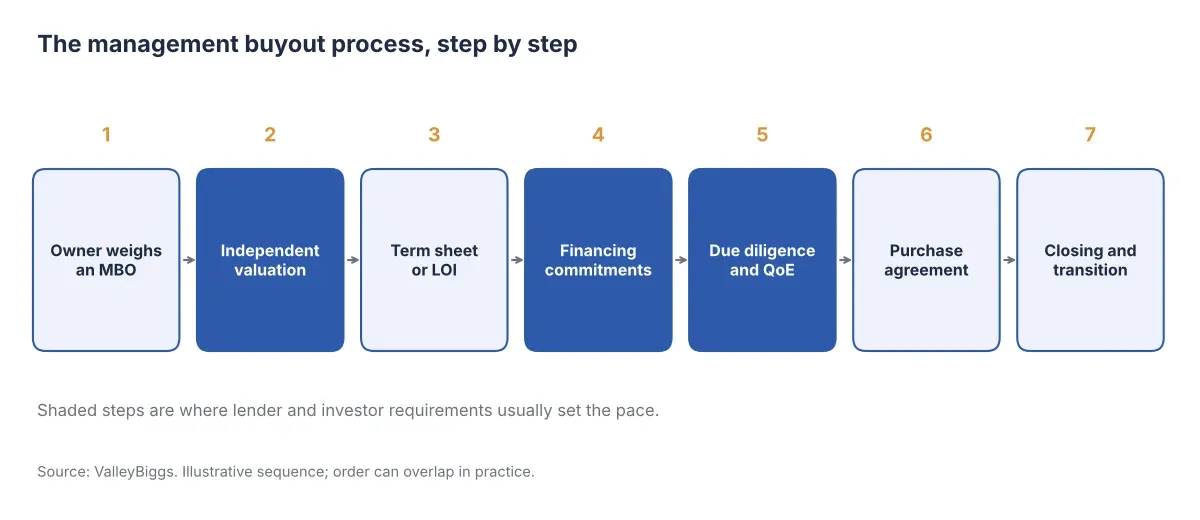
- Decide whether an internal sale fits your goals. Compare an MBO with a sale to an outside buyer before you open talks. Our guide to exit routes other than an IPO sets out the main alternatives.
- Establish value independently. Get an outside valuation before discussing price with your team. If the managers will use an SBA loan, the lender must also order its own independent valuation.
- Agree on a term sheet or letter of intent. Cover price, how much is paid at closing, seller note terms, any equity you keep, your transition role and exclusivity.
- Line up financing. Managers secure lender approval and, for larger deals, a private equity partner. This step often shows whether the agreed price is realistic.
- Complete due diligence. Lenders and investors verify earnings, often through a quality of earnings (QoE) report, even though the buyers already know the business.
- Sign the purchase agreement. Representations, warranties, indemnities and non-competes still apply in an insider deal.
- Close and hand over. Funds flow, ownership transfers, and your consulting or board role begins.
Insider deals skip the marketing phase of a typical sell-side M&A process, which saves time and keeps the sale confidential. The trade-off is that there is no auction to confirm the price, so the valuation step carries more weight than usual.
How Management Buyout Financing Works
Few management teams can write a check for the whole company. Management buyout financing therefore stacks several sources, each with a different cost and claim on cash flow.
- Senior debt. A bank term loan or an SBA 7(a) loan, secured by the business. The SBA caps a standard 7(a) loan at $5 million, which limits pure SBA-funded deals to smaller companies.
- Management equity. The managers’ own cash, sometimes raised with personal loans or home equity. Lenders want the team to have real money at risk.
- Seller note. You lend part of the price back to the buyers and are repaid over time, usually behind the senior lender.
- Private equity. In larger deals a sponsor supplies most of the equity, takes a controlling or significant stake, and gives managers a smaller ownership share plus incentive equity.
- Mezzanine or subordinated debt. Higher-cost capital that sits between senior debt and equity when the gap cannot be closed any other way.
What the SBA rules require
Many lower middle market MBOs use SBA 7(a) loans. The SBA’s lending rules were tightened in SOP 50 10 8 and again in SOP 50 10 8.1, effective October 1, 2026. Based on the SBA’s standard operating procedure as summarized by SBA lenders, the points that matter most to a selling owner are:
- An equity injection of at least 10% of total project costs on most change-of-ownership loans.
- A seller note can count toward up to half of that injection only if it is on full standby, meaning no principal or interest is paid for the life of the SBA loan.
- An independent business valuation ordered by the lender for every change-of-ownership loan. Total acquisition debt cannot exceed that valuation, so a price above it must be bridged with more equity.
- Historical cash flow that covers all post-closing debt payments by at least 1.25 times in most cases.
- Limits on how long the seller can stay involved after a complete change of ownership, and a long-standing ban on seller earnouts in SBA-financed deals.
These rules change, and some categories (such as partial buyouts where an existing owner stays on) follow different terms. Ask the buyers’ lender to confirm which category your deal falls under before you agree on structure.
Management Buyout Example: A Hypothetical $6 Million Sale
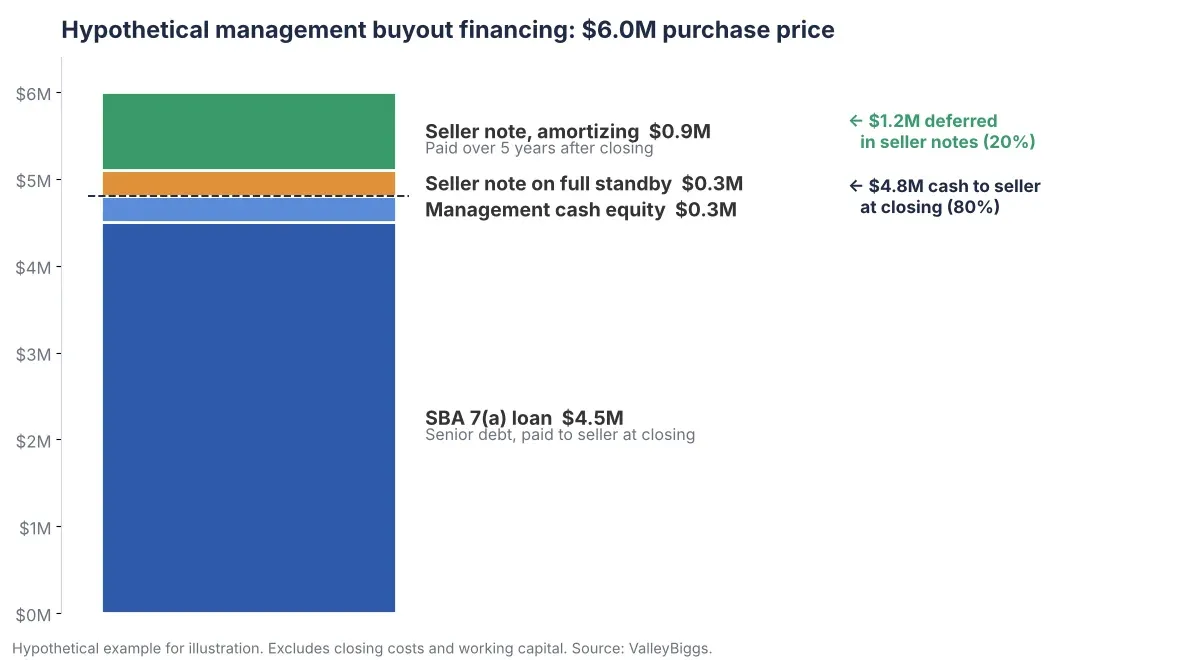
The following management buyout example is hypothetical and simplified to show how the pieces fit together. It is not a quote, a valuation of any real company, or a prediction of the multiple your business would receive.
Assume a founder owns an IT managed services company with $1.5 million of adjusted EBITDA. Three senior managers want to buy it, and both sides agree on a $6.0 million price, which is 4.0 times EBITDA. To see how that multiple compares with typical ranges for your size and sector, read our guide on how much a business is worth.
| Source of funds | Amount | Share of price | Paid to seller |
|---|---|---|---|
| SBA 7(a) loan | $4,500,000 | 75% | At closing |
| Management cash equity | $300,000 | 5% | At closing |
| Seller note on full standby | $300,000 | 5% | After the SBA loan is repaid |
| Seller note, amortizing over 5 years | $900,000 | 15% | Monthly after closing |
| Total | $6,000,000 | 100% | $4.8M at closing |
Now test whether the business can carry that debt. At an assumed 10% interest rate over 10 years, the SBA loan costs about $732,000 a year. The amortizing seller note at an assumed 7% over five years adds roughly $220,000. Total annual debt service of about $952,000 against $1.5 million of EBITDA gives coverage of about 1.58 times, above the 1.25 times lenders typically require. Real deals also have to cover taxes, capital spending and working capital, so lenders often look at a tighter cash-flow figure.
Two things stand out for the seller. First, 20% of the price depends on the company performing under new owners, and the standby portion may not be paid for a decade. Second, the price is capped by what the lender’s valuation supports, regardless of what the team is willing to pay.
When private equity joins the deal
Above the size an SBA loan can fund, the structure changes. A private equity sponsor might put up most of the equity, arrange a larger senior loan and ask management to invest alongside it. Managers then own a minority of the company but gain upside through incentive equity. For you as the seller, this often means more cash at closing and a buyer with real financial firepower, but also a sponsor that will run full diligence and negotiate like any outside acquirer. If your team is pursuing this route, it is worth comparing their offer with what other sponsors would pay through an M&A investment banking process.
Pros and Cons of a Management Buyout for the Seller
An MBO looks different depending on which side of the table you sit on. The comparison below summarizes the trade-offs owners most often weigh.
| Factor | Seller’s view | Management team’s view |
|---|---|---|
| Speed and confidentiality | No public marketing; fewer people learn the business is for sale | Insider knowledge shortens their learning curve |
| Price | Often lower than a competitive process would produce | Opportunity to buy at a fair, not inflated, price |
| Cash at closing | Smaller share up front; more deferred in notes | Less cash needed if the seller finances part |
| Continuity | Staff, customers and culture stay intact | They keep their roles and gain ownership |
| Risk after closing | Seller note depends on the new owners succeeding | Personal guarantees and heavy debt load |
| Relationships | Smoother handover; harder conversations if talks fail | Must negotiate with a boss they still report to |
The main benefits for the seller are continuity and discretion. The main drawbacks are price discovery and payment risk. Most of the work in a well-run MBO goes into reducing those two drawbacks.
Management Buyout vs. Leveraged Buyout
People often ask about management buyout vs leveraged buyout as if they were opposites. They are not. A leveraged buyout (LBO) is any acquisition funded mainly with borrowed money, repaid from the target’s cash flow. A management buyout describes who the buyer is. Most MBOs are therefore also LBOs, because the managers rely on debt.
The practical difference is control. In a sponsor-led LBO, the private equity firm picks the deal and decides strategy, and management may or may not stay. In an MBO, the managers start the deal and remain at its center, even when a sponsor supplies most of the money.
Key Terms to Negotiate in an MBO
Because the buyers are colleagues, owners sometimes accept loose terms they would never accept from a stranger. Treat the deal with the same discipline as an outside sale, and document it with the same care. Use a checklist for selling a business to keep track of what each side must deliver.
- Price and valuation basis. Agree on which earnings figure is used and which add-backs are allowed before any number is discussed.
- Cash at closing. Set a minimum share of the price you need in cash, and size any seller note around it.
- Seller note terms. Interest rate, amortization, standby periods, security, personal guarantees from the managers and what happens if a payment is missed.
- Retained or rollover equity. If you keep a stake, define your board rights, information rights and how you can sell it later.
- Transition role. Length, scope and pay for any consulting period, within any limits the lender imposes.
- Non-compete and non-solicit. These protect the buyers, and their scope and length are negotiable.
- Exclusivity and fallback. Limit exclusivity to a fixed period so you can approach outside buyers if financing fails.
Tax points for the seller
How the price is paid affects when you pay tax. According to the IRS, a sale where you receive at least one payment after the tax year of the sale can qualify for installment sale treatment, which spreads the gain over the years you are paid. Depreciation recapture is generally taxed in the year of sale even if you have not received the cash, and a seller note must charge adequate interest or the IRS may treat part of the principal as interest. Asset versus stock structure and purchase price allocation also change the outcome.
Owners of C corporations who are considering an ESOP instead may be able to defer gain under Section 1042 of the Internal Revenue Code if specific conditions are met. These rules are complex, and this section is general information, not legal or tax advice. Work with a CPA and transaction attorney before you agree on structure.
Common Mistakes Owners Make in a Management Buyout
- Negotiating price before getting a valuation. Once a number is said out loud to your team, it is hard to move.
- Skipping the market check. Even a confidential conversation with a few outside buyers shows whether the insider offer is fair.
- Carrying too much of the price. A large seller note turns you into the company’s lender without control over how it is run.
- Letting the business drift during talks. Managers negotiating to buy the company are also the people running it. Agree on how day-to-day performance is protected.
- Relaxing on documents. Insider knowledge does not replace representations, warranties and a full due diligence checklist.
- Ignoring team dynamics. If only some managers participate, those left out may leave, and key staff departures can hurt both the business and your note repayments.
Related Terms
- Leveraged buyout (LBO): an acquisition financed mostly with debt repaid from the target’s cash flow.
- Seller note: a loan from the seller to the buyer for part of the purchase price.
- Rollover equity: the share of the business a seller or manager keeps in the new ownership structure.
- Quality of earnings (QoE): an independent review that tests whether reported earnings are accurate and repeatable.
- Equity injection: the buyers’ own capital a lender requires before it will fund an acquisition loan.
- M&A advisory: professional help running a sale. Advisors manage valuation, buyer outreach, negotiation and closing on the seller’s behalf.
When to Talk to an M&A Advisor
An advisor is most useful at the start, before you and your team discuss numbers. Typical triggers include a manager raising the idea of buying the company, a valuation gap between what the team offers and what you expected, a deal large enough to need private equity, or a lender asking for a seller note you are not comfortable carrying. A good advisor can benchmark the insider offer against outside interest, keep the conversation professional, and help structure terms that protect your proceeds.
ValleyBiggs works with owners of technology, internet, ecommerce and other digital businesses. Our exit advisory team can help you decide whether a management buyout is the right path, and our enterprise valuation analysis gives you an independent view of value before you negotiate.
Conclusion
A management buyout can be one of the most satisfying ways to exit: the business stays in trusted hands, employees keep their jobs and customers see little change. It works best when the seller treats it as a real transaction, with an independent valuation, a realistic financing plan and clear terms on how and when the price is paid.
If your managers have raised the idea, or you want to compare an internal sale with what outside buyers would pay, request a confidential consultation with ValleyBiggs. If you are still weighing every option, start with our overview of how to sell your business.
FAQs
1. What does MBO stand for in business?
In mergers and acquisitions, MBO stands for management buyout: a deal in which a company’s existing managers buy a controlling stake or the whole business from its owner. In HR and management writing, the same letters can also mean management by objectives, a goal-setting method, so the context tells you which meaning applies.
2. How do business buyouts work?
A buyer agrees on a price with the owner, arranges financing, completes due diligence and signs a purchase agreement that transfers shares or assets at closing. In a buyout by insiders, the buyers usually combine their own cash with bank or SBA debt and a seller note, so part of the price is paid over several years after closing.
3. How long does a management buyout take?
There is no standard timeline. Smaller deals with one lender can move faster than buyouts that need a private equity partner, but most of the time goes into steps outside the seller’s control: the lender’s independent valuation, quality of earnings work, credit approval and legal documents. Getting your own valuation and records ready early shortens the process.
4. What are the risks of a management buyout for the seller?
The two biggest risks are price and payment. Without outside bidders, the agreed price may sit below market value, and a large seller note means part of your proceeds depends on the new owners running the company well. Talks can also strain working relationships, and performance can slip while managers focus on the deal instead of the business.
5. Can managers use an SBA loan to buy the company they work for?
Yes, an SBA 7(a) loan can fund a change of ownership to existing managers if the business and buyers meet the program’s rules. Lenders generally expect a 10% equity injection, an independent valuation and enough historical cash flow to cover the new debt. The standard 7(a) loan is capped at $5 million, so larger buyouts need other capital.
6. Should I get a valuation before my managers make an offer?
Yes. An independent valuation gives you a fact-based anchor before any number is discussed, shows which earnings figure and multiple are reasonable, and makes it easier to reject a low offer without damaging the relationship. It also helps you judge how much seller financing you can safely accept. ValleyBiggs offers an enterprise valuation analysis for this purpose.