

The best business brokers New York owners can hire are the ones whose closed deals look like yours: similar size, similar industry and the same kind of buyer. New York is a crowded market, so a short, well-checked list beats a long one. This 2027 guide compares ten firms that serve New York sellers, explains how brokers, M&A advisors and investment banks differ, and shows what a sale here typically involves, including the state bulk-sale notice that affects many asset deals. Use it to build an interview shortlist, then test each firm against the criteria below before you sign an engagement letter.
Key Takeaways
- Match the firm to your likely buyer. A neighborhood restaurant and a $20 million software company need very different processes and contacts.
- New York has about 2.4 million small businesses, so buyers compare many options. Clean financials and a clear growth story set your business apart.
- Ask every broker for comparable closed deals, the name of the person who will run your sale and a written fee illustration at several prices.
- In many asset sales, the buyer must notify the New York State Department of Taxation and Finance at least 10 days before paying or taking possession.
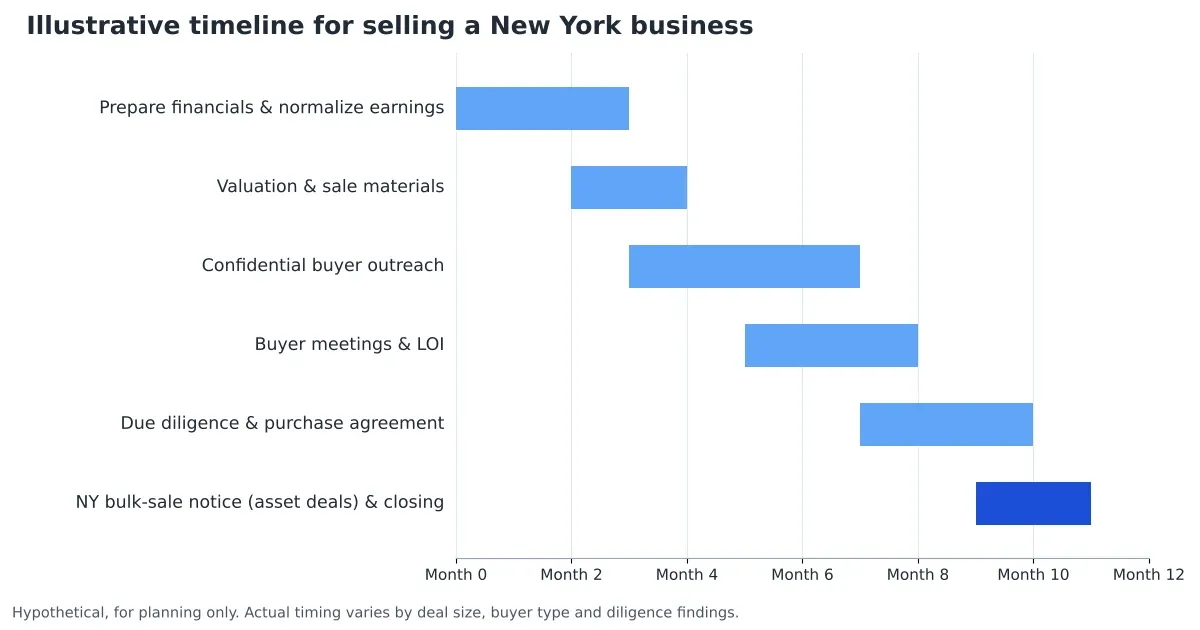
- Plan for roughly six to twelve months from preparation to closing, and longer for complex deals or heavy diligence.
New York Business Landscape in 2027
New York is one of the deepest business markets in the country. According to the SBA Office of Advocacy’s 2025 state profile, the state has about 2.4 million small businesses, which make up 99.8 percent of all firms and employ roughly 3.9 million people, or 46.6 percent of the state’s workforce. The wider New York-Newark-Jersey City metro area counts about 2.6 million small businesses on its own.
For a seller, that depth cuts both ways. There are many active buyers, from first-time owners to private equity groups with offices in Manhattan, but there are also many listings competing for their attention. Firms that arrive with normalized earnings, documented processes and a believable plan for the next owner tend to draw stronger offers.
Which industries dominate the deal flow?
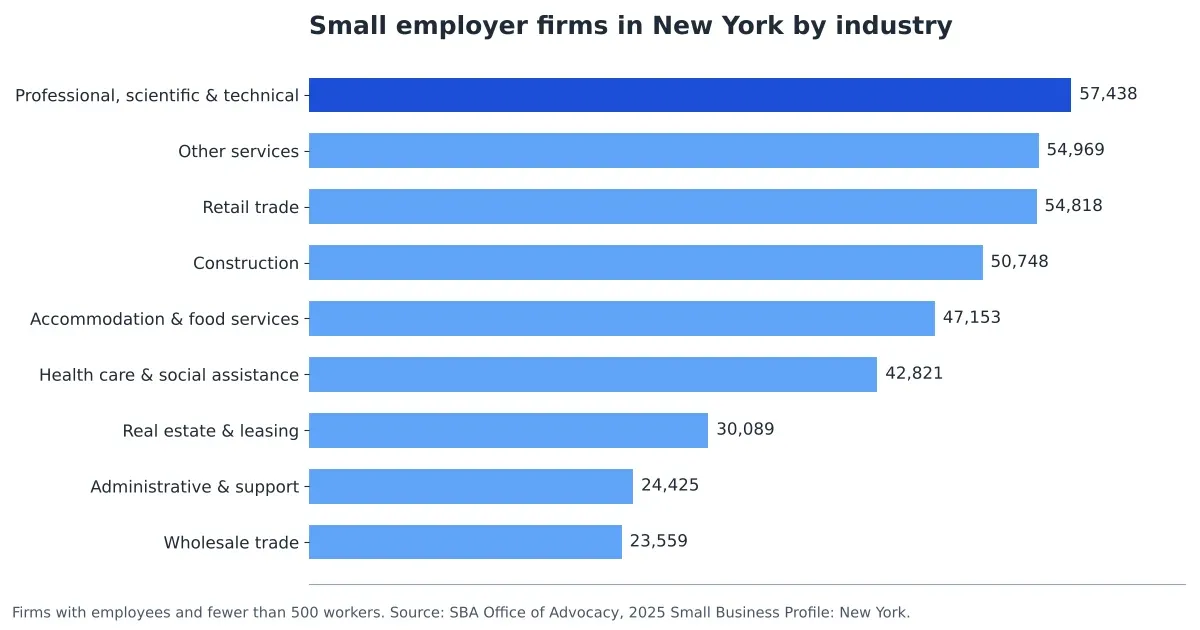
The SBA data shows professional, scientific and technical services as the largest group of small employer firms in the state, at roughly 57,400 firms, followed by other services, retail, construction, and accommodation and food services. Health care and social assistance employs the most people at small firms, at more than 600,000 workers. In practice, brokers who focus on New York listings see a steady mix of restaurants, retail, home and trade services, medical and professional practices, plus a sizable pool of tech, media and financial services companies in the city.
How do regional markets differ inside the state?
- New York City: the largest buyer pool, high rents and lease terms that often decide whether a retail or restaurant deal closes.
- Long Island: strong demand for service, trade and distribution businesses, with many buyers who live and work locally.
- Westchester and the Hudson Valley: a mix of professional practices, contractors and family companies preparing for succession.
- Upstate (Albany, Buffalo, Rochester, Syracuse): manufacturing, health care and service firms, where buyers may come from other states or from industry roll-ups.
What Does a Business Broker in New York Do?
Most New York business brokers manage the sale so you can keep running the company. The scope varies by firm and deal size, but a full engagement usually covers the following:
- Recasting your financial statements to show seller’s discretionary earnings (SDE) or adjusted EBITDA, then setting a defensible price range.
- Preparing a blind teaser and a confidential information memorandum that explains the business without revealing its name too early.
- Building a buyer list, screening prospects for funding and fit, and collecting signed NDAs before sharing details.
- Running management meetings, comparing offers and negotiating the letter of intent, including cash at close, seller notes and earnouts.
- Coordinating due diligence with your CPA and attorney, and keeping the timeline moving through to closing.
If you are still unsure what the business is worth, start with our guide on how much a business is worth before you interview brokers. It will help you judge whether a proposed asking price is realistic or just designed to win the listing.
Business Broker, M&A Advisor or Investment Bank?
Search results lump very different firms together under “business broker.” The label matters less than the model behind it. Use this comparison to decide which type of firm to interview first.
| Firm type | Typical client | How buyers are found | Questions to ask |
|---|---|---|---|
| Main Street business broker | Owner-operated firms, often under $2 million in value | Listing sites, local networks, individual buyers | How many listings does each broker carry at once? |
| Lower middle market M&A advisor | Companies with roughly $1 million or more in earnings | Targeted outreach to strategic buyers, private equity and family offices | Which buyers did you contact in your last three comparable deals? |
| Industry-focused advisor | Tech, SaaS, ecommerce or other specialist sectors | Sector buyer lists and repeat acquirers | Which metrics do buyers in my sector underwrite? |
| Investment bank | Larger or more complex transactions | Institutional processes, often a formal auction | What is the minimum deal size and retainer? |
How to Choose Business Brokers in New York: 7 Criteria
1. Comparable closed deals
Ask for three to five closed transactions that resemble yours by size, industry and buyer type. Listings that never sold do not count. If the examples are confidential, ask the firm to describe them without names.
2. Who actually runs your sale
Large brokerages and franchise networks can be excellent, but quality varies by office. Get the name of the lead advisor, how many active engagements that person handles and who answers buyer questions day to day.
3. A valuation you can follow
A good broker explains how the price range was built: which earnings figure, which add-backs, which multiple and why. Be careful with any firm that quotes a high number before seeing your tax returns.
4. Buyer reach beyond the five boroughs
Many New York companies sell to buyers in other states or to private equity groups. Ask how the firm reaches strategic and financial buyers nationally, not only local entrepreneurs.
5. Confidentiality controls
Ask when your company’s name is disclosed, how buyers are screened and how the firm keeps employees, landlords and competitors from learning about the sale too early.
6. Fee structure and contract terms
Compare retainers, success fees, minimum fees, the length of exclusivity and any tail period after the contract ends. Ask for a written example showing what you would pay at three different sale prices.
7. Communication rhythm
Agree on how often you will receive updates, what buyer activity reports include and how quickly the team responds once a letter of intent is signed.
Top 10 Business Brokers New York Owners Should Compare (2027)
The list below is based on each firm’s own description of its services and its presence in New York. It is a starting point for interviews, not an endorsement. Verify current experience, licensing and references directly with any firm you consider.
| Rank | Firm | New York presence | Best fit, based on the firm’s own description |
|---|---|---|---|
| 1 | Website Closers | Serves New York sellers nationally | Tech, SaaS, ecommerce and online businesses |
| 2 | Synergy Business Brokers | NYC, Long Island, Westchester, Hudson Valley, Upstate | Privately held companies across many industries |
| 3 | ValleyBiggs | Serves New York sellers nationally | Tech, internet, ecommerce and digital companies |
| 4 | Transworld Business Advisors of NY | Manhattan office | Main Street sales, franchise resales, M&A |
| 5 | SellerForce | Serves New York sellers nationally | Online and brick-and-mortar businesses |
| 6 | VNB Business Brokers | Manhattan and Garden City offices | Main Street and lower middle market firms in NYC and Long Island |
| 7 | MidCap Advisors | Midtown Manhattan | Lower middle market sell-side M&A in insurance, health care and services |
| 8 | DealPipe | Serves New York sellers nationally | Lower and middle market physical and digital businesses |
| 9 | East Coast Business Brokers | Long Island, NYC, Westchester | Confidential sales of local and service businesses |
| 10 | A. Neumann & Associates | Serves New York City boroughs regionally | Valuation and sale of privately held, mid-market firms |
1. Website Closers
Website Closers concentrates on technology and internet businesses, including SaaS, ecommerce brands, apps and online marketplaces. New York founders with recurring or digital revenue may find its buyer contacts a good match, especially when strategic acquirers or investor-backed buyers are the likely purchasers.
2. Synergy Business Brokers
Synergy says it serves owners across New York City, Long Island, Westchester, the Hudson Valley and Upstate New York, pairing local knowledge with national and international buyer reach. It works with privately held companies in many industries, so ask which team members have closed deals in your sector and size range.
3. ValleyBiggs
ValleyBiggs focuses on technology, internet, ecommerce and other digital companies, and says its team has owned and exited businesses in the same sector. Its services are performance-based, with no fees due until a transaction closes, and sellers work with a full team rather than a single broker. Owners of software, IT services or online businesses can review its technology business sale process and sell-side support to see how buyer outreach and negotiation are handled.
4. Transworld Business Advisors of NY
Transworld’s New York office is part of a large franchise network that the firm describes as the world’s largest business brokerage. It handles business sales, acquisitions, franchise resales and M&A work. As with any network, ask which individual advisor will lead your sale and what comparable deals that person has closed.
5. SellerForce
SellerForce sells both online companies and brick-and-mortar businesses and highlights its marketing reach. It can suit New York owners of small and mid-sized companies who want broad buyer exposure. Ask how it screens buyers before releasing your financials.
6. VNB Business Brokers
VNB lists offices in Manhattan and Garden City and serves New York City, Long Island and beyond. The firm says it works on Main Street and lower middle market deals, gives sellers a single point of contact and co-brokes with other firms to widen the buyer pool.
7. MidCap Advisors
MidCap Advisors is based in Midtown Manhattan and describes itself as a lower middle market investment bank. It offers sell-side M&A, diligence and consulting, with stated focus areas that include insurance, health care, retirement and wealth advisors, industrials and services, and education.
8. DealPipe
DealPipe works with lower and middle market companies, both physical and digital, and manages buyers through a structured pipeline. Owners who want a clear view of where each prospect stands may like that approach. Confirm the team’s experience in your industry before engaging.
9. East Coast Business Brokers
East Coast Business Brokers is a Long Island firm whose listings span Suffolk and Nassau counties, the Bronx and Manhattan. The firm says it relies on blind profiles, NDA-gated listings and vetted buyers so staff learn about a sale only after it closes. Its categories range from restaurants and retail to IT services, ecommerce and manufacturing.
10. A. Neumann & Associates
A. Neumann & Associates describes itself as an M&A advisory and business brokerage firm with more than 20 years of experience valuing and selling privately held, mid-market companies, and it markets its services to owners in New York City boroughs such as Brooklyn. Ask about recent closings in your region and sector.
When Should You Sell Your New York Business?
Timing rarely lines up perfectly, but some signals suggest the window is open. Consider starting the process when several of these apply:
- Revenue and earnings have grown for two or three years and the trend is easy to document.
- Your lease has enough remaining term, or a renewal option, to satisfy a buyer and a lender.
- Key employees would stay with a new owner, and customers are not concentrated in one or two accounts.
- You have personal reasons to exit within the next 12 to 24 months, such as retirement or a new venture.
- Buyers in your sector are active, for example when private equity groups are assembling roll-ups in your industry.
If the business is not ready yet, a year of preparation can change the outcome. Reducing owner dependence, cleaning up the books and fixing lease or contract issues usually raises both the price and the odds of closing.
Typical Sale Process in New York
- Prepare. Gather three years of tax returns and financial statements, recast earnings and list the add-backs you can support.
- Value. Set a price range based on comparable deals and the right earnings measure. Our enterprise valuation analysis is one way to test it.
- Market confidentially. Release a blind teaser, sign NDAs and share the information memorandum only with screened buyers.
- Negotiate. Compare offers on price, cash at close, seller financing, earnouts and the transition period, then sign a letter of intent.
- Diligence. Answer financial, legal, tax and operational questions. Our due diligence checklist for sellers lists the documents buyers request most often.
- Close. Finalize the purchase agreement, handle state notices and transfer the business.
The New York bulk-sale notice
New York has a rule that surprises many first-time sellers. When a business sells assets outside the ordinary course, the purchaser must file Form AU-196.10, Notification of Sale, Transfer, or Assignment in Bulk, with the Department of Taxation and Finance at least 10 days before paying for or taking possession of the assets, whichever comes first. The department then checks whether the seller owes sales tax. If nothing is owed, it issues a release; if taxes are due or an audit is pending, it sends the buyer a notice of claim, and the buyer should hold back payment until the issue is settled.
For sellers, the practical point is simple: make sure your sales tax filings are current before you go to market, and build the 10-day window into the closing schedule. This is general information, not legal or tax advice. Confirm the details for your deal with a New York CPA and attorney.
Compare Neighboring Markets
Many New York owners also talk to buyers and advisors in nearby states, especially when the company has customers or locations across the region. These ValleyBiggs guides cover the closest markets:
| Market | Why New York owners compare it | ValleyBiggs guide |
|---|---|---|
| New Jersey | Shared metro area and buyer pool with New York City | New Jersey broker list |
| Pennsylvania | Manufacturing, logistics and health care buyers with regional reach | Pennsylvania broker list |
| Massachusetts | Tech, life sciences and professional services acquirers in Greater Boston | Massachusetts broker list |
When to Talk to an Advisor
Speak with an advisor before you share numbers with any buyer, including a friendly competitor who asks over coffee. Early conversations shape the price range, the deal structure and who hears about the sale. It is also worth calling when you receive an unsolicited offer, when a partner wants to exit, or when the company’s value has grown beyond what a local listing is likely to attract.
- You have received an inbound offer and want to know whether it is fair.
- Your company has $1 million or more in earnings and could interest private equity or strategic buyers.
- You run a tech, SaaS or ecommerce business whose buyers will underwrite recurring revenue and growth metrics.
- You want to sell within two years and need a preparation plan.
Conclusion
The right broker for a New York sale is the one with proven deals like yours, a clear valuation method, real buyer reach and terms you understand. Interview at least three firms from this list, compare their answers side by side and check references before signing. If you own a technology, internet or digital company and want a confidential view of what it could sell for, request a confidential consultation with ValleyBiggs or start on the sell my business page to share a few details about your company.
FAQs
1. How do I find a good business broker in New York?
Start with firms that have closed deals similar to yours in size, industry and buyer type. Interview at least three, ask who will run your sale day to day, request references from recent sellers and compare written fee examples. A firm that explains its valuation method clearly is usually a safer choice than one that simply quotes the highest price.
2. How much does it cost to hire a business broker in New York?
Costs vary by firm and deal size. Most brokers earn a success fee paid at closing, and some add a retainer, monthly fees or a minimum fee. Ask each firm for a written illustration of the total cost at several sale prices. ValleyBiggs works on a performance basis, with no fees due until a transaction closes.
3. How long does it take to sell a business in New York?
Many sales take six to twelve months from preparation to closing, though small, well-documented businesses can move faster and larger or more complex deals often take longer. Lease assignments, lender approvals, diligence findings and the state bulk-sale notice can all add time, so plan your exit at least a year ahead when possible.
4. What is the difference between a business broker and an M&A advisor?
Business brokers usually sell smaller, owner-operated companies to individual buyers through listings and local networks. M&A advisors typically work with larger companies and approach strategic acquirers, private equity firms and family offices directly, with more structured negotiation and diligence support. Many firms do both, so judge them by their recent closed deals rather than their title.
5. Does New York State need to be notified when a business is sold?
In many asset sales, yes. The buyer must file Form AU-196.10 with the New York State Department of Taxation and Finance at least 10 days before paying for or taking possession of the assets. The state then checks for unpaid sales tax. This is general information, not legal or tax advice, so confirm the requirements with your CPA or attorney.
6. Should a New York tech company use a local broker or a national firm?
Buyers for software, SaaS and ecommerce companies are often based outside New York, so reach usually matters more than a local office. Look for a firm that knows how buyers value recurring revenue, retention and growth, and that can run a confidential national process. See how ValleyBiggs approaches a SaaS business sale.