

How much is a business worth with $1 million in sales? For most owner-run companies at that size, a realistic range is roughly $200,000 to $1.4 million, because buyers price the business on its seller’s discretionary earnings (SDE), not on the $1 million of revenue. Profit margin decides where you land in that range far more than sales volume does.
A $1 million company sits just above the typical small business that changes hands in the US, so it attracts a large pool of individual buyers, many of them financed by SBA loans. This guide shows the math those buyers use, sourced multiple ranges, two hypothetical examples, the lending rules that now shape price, and what to fix before you go to market in 2027.
Key Takeaways
- Revenue alone does not set the price. At $1 million in sales, value follows SDE, and SDE margins vary widely by industry and by how the owner runs the books.
- BizBuySell’s full-year 2025 data shows an average of about 2.6x cash flow and about 0.7x revenue on closed small-business sales, with a median sale price of $350,000.
- At a 2x to 3.5x SDE multiple, every $10,000 of verified, recurring profit adds roughly $20,000 to $35,000 to the price.
- Most buyers at this size use SBA 7(a) financing. Under SOP 50 10 8.1, effective October 1, 2026, the lender orders an independent valuation, and that figure caps the debt in the deal.
- Clean tax returns, documented add-backs and a business that runs without you are worth more than any pricing formula.
Where a $1 Million Business Sits in the Market
It helps to know what a “typical” sale looks like before you price your own company. According to BizBuySell’s 2025 year-in-review, closed small-business transactions had a median revenue of about $703,000, a median cash flow of about $158,950 and a median sale price of $350,000. Sellers received, on average, 94% of their asking price.
So a company with $1 million in annual sales is somewhat larger than the median business sold through that marketplace. That matters for three reasons:
- The buyer pool is deep. First-time owners, search-fund style buyers and local competitors all shop in this price band.
- Financing is standardized. Most of those buyers borrow through the SBA 7(a) program, so the lender’s underwriting rules quietly set a ceiling on price.
- The step up is visible. BizBuySell’s third-quarter 2026 report shows that businesses selling above $1 million had a median cash flow of $559,000 and a median price of $1.8 million, while those below that line had a median cash flow of $123,000 and a median price of $250,000. Moving from one bracket to the next is about profit, not sales.
If you want the full framework behind these numbers, our guide to how much a business is worth covers the general formula. This article stays focused on the $1 million revenue level and the decisions owners at that size face.
Why Buyers Price on SDE, Not on Sales
Two companies can each book $1 million a year and leave their owners with very different incomes. A landscaping firm with heavy labor costs might keep $120,000; a niche B2B software reseller with a lean team might keep $350,000. A buyer is purchasing that stream of cash, so the price follows it.
Seller’s discretionary earnings is the measure most used at this size. It starts with pre-tax profit and adds back the owner’s salary and payroll taxes, the owner’s benefits, interest, depreciation, amortization and one-time or personal expenses run through the company. The result shows what a single full-time owner-operator could take out of the business before debt service.
What usually counts as a legitimate add-back
- One owner’s salary, payroll taxes and health insurance
- Depreciation, amortization and interest on debt the buyer will not assume
- Documented one-time costs, such as a lawsuit settlement or a website rebuild
- Personal expenses paid by the company, if receipts make them easy to verify
- Above-market rent paid to an entity the owner controls, adjusted to market rate
What does not count: a second family member’s salary if that person does real work a buyer would have to replace, “lost” cash sales that never reached the tax return, and costs you call one-time but that show up every year. Buyers and lenders reconcile add-backs against tax returns, so anything you cannot document will be removed from the number.
SDE Multiples and Revenue Multiples for Small Businesses
BizBuySell’s closed-transaction data for 2025 put the average cash flow multiple at about 2.61x and the average revenue multiple at about 0.69x across all reported sales. Subsector averages mostly fell between roughly 2x and 3.5x SDE. A few examples from the same dataset:
| Segment (BizBuySell, full-year 2025) | Average SDE multiple | Average revenue multiple | Implied value at $1M sales on revenue alone |
|---|---|---|---|
| All reported small-business sales | About 2.6x | About 0.7x | About $690,000 |
| IT and software services | About 3.0x | About 1.1x | About $1.1 million |
| Other online and technology businesses | About 3.2x | About 1.3x | About $1.3 million |
| Car washes (asset-heavy example) | About 4.7x | Not shown | Depends on real estate and equipment |
Notice how the revenue column already bakes in an assumed margin. A 0.7x revenue multiple on a business earning 23% SDE produces about the same answer as a 3x SDE multiple. When your margin is well above or below the norm for your sector, the revenue shortcut breaks and the SDE method gives the honest answer.
Online calculators that multiply $1 million by 3x or 4x usually borrow multiples from public companies or venture-backed software firms. Those benchmarks describe businesses with very different scale and risk, and they rarely apply to an owner-operated company at this size.
How Much Is a Business Worth With $1 Million in Sales at Each Margin?
Because margin drives the answer, the most useful way to see the range is to hold sales at $1 million and change the SDE margin. The chart below applies a 2.0x to 3.5x SDE multiple, the band most BizBuySell subsectors averaged in 2025.
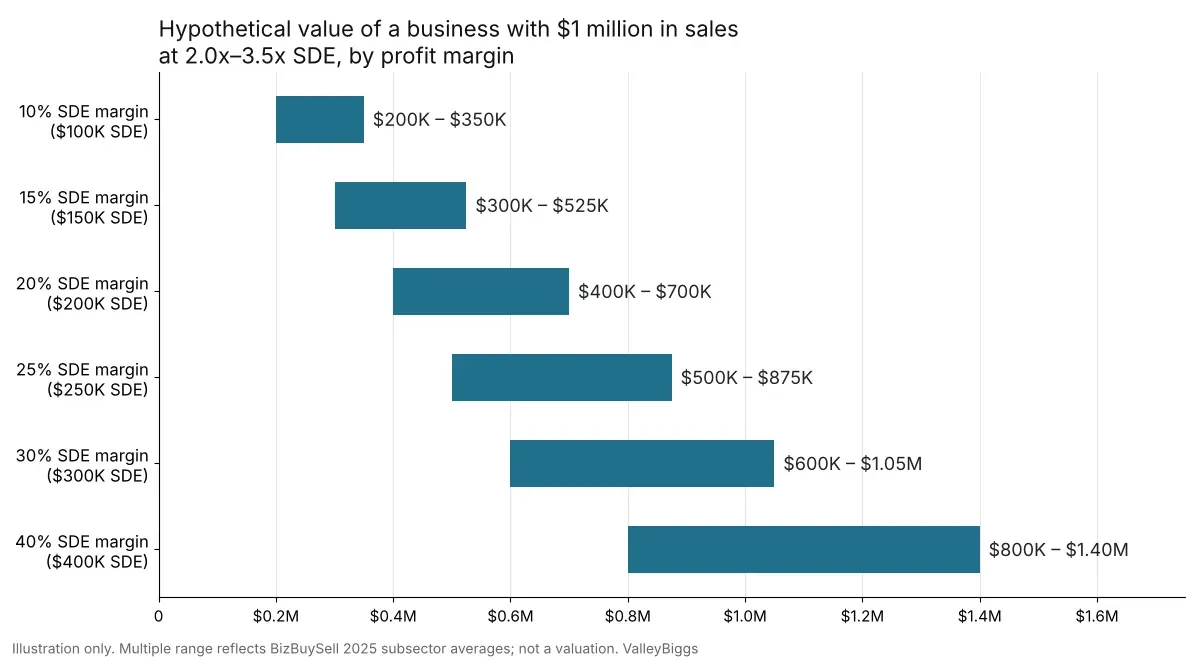
| SDE margin | SDE on $1M sales | Value at 2.0x | Value at 3.5x | Typical profile |
|---|---|---|---|---|
| 10% | $100,000 | $200,000 | $350,000 | Restaurants, labor-heavy trades, thin-margin retail |
| 20% | $200,000 | $400,000 | $700,000 | Many home services, distribution and local service firms |
| 30% | $300,000 | $600,000 | $1,050,000 | Agencies, consulting, specialty B2B services |
| 40% | $400,000 | $800,000 | $1,400,000 | Software, digital products, high-margin ecommerce niches |
The highest margins do not automatically earn the top multiple. A 40% margin that depends on the owner working 70 hours a week, or on one customer, will be discounted. A 20% margin with long-tenured staff and contracted revenue can sell at the top of its range.
Two Hypothetical Examples at $1 Million in Revenue
Example 1: a commercial cleaning company
This hypothetical company bills $1,000,000 a year to 40 office clients on monthly service agreements. The tax return shows $70,000 of net profit. The owner pays herself $85,000, with $9,000 of payroll tax and health insurance, and the business carries $16,000 of depreciation on vans and equipment. SDE is therefore about $180,000.
The owner still quotes every new account and handles client complaints, but a supervisor runs crews day to day and no client exceeds 8% of sales. A buyer might reasonably offer around 2.5x to 2.8x SDE, or about $450,000 to $505,000, plus the vans at fair value if they are not already included.
Example 2: a direct-to-consumer ecommerce brand
This hypothetical store also sells $1,000,000 a year, but it runs with two contractors and a third-party warehouse. Net profit is $230,000, and the owner adds back a $60,000 salary and $10,000 of one-time costs from a site migration. SDE is about $300,000.
Buyers will examine three years of channel data. If 70% of sales come from paid social ads, rising acquisition costs are a real risk, and the multiple may land near 2.5x, or about $750,000. If repeat customers and organic search drive most orders, the business could command 3x or more. Inventory is usually priced separately on top of the SDE-based number, which matters when a store carries $150,000 of stock. Our page on how to sell an ecommerce business covers the traffic and margin questions buyers raise.
Same revenue, very different prices. The cleaning company is worth roughly half of the ecommerce brand, and the gap comes entirely from profit and risk.
How SBA Lending Rules Shape the Price
At this size, the buyer’s bank is often the silent party that decides whether your asking price is realistic. SBA 7(a) loans go up to $5 million, which comfortably covers most businesses with $1 million in sales. The SBA’s updated lending rules, SOP 50 10 8.1, took effect on October 1, 2026, and they change how deals at this level get underwritten:
- Independent valuation on every change of ownership. The lender orders a third-party business valuation regardless of loan size, and total acquisition debt, including seller debt that is not on full standby, cannot exceed that valuation. If your price is higher, the buyer must cover the gap with more cash.
- Historical cash flow carries the loan. Change-of-ownership loans generally need at least 1.25x debt service coverage based on the most recent year or the average of the last two years. Projections do not count toward that minimum.
- At least 10% buyer equity. For a standard acquisition, the buyer injects at least 10% of total project costs. A seller note can supply no more than half of that injection, and only if it is on full standby for the life of the SBA loan.
- Limited seller transition. In a full acquisition, the seller generally must exit, though a consulting role of up to 24 months is allowed.
The practical effect: a price that your SDE cannot support at 1.25x coverage will not be financed, however keen the buyer is. Running a quick coverage test on your own numbers before listing saves months of failed negotiations. These are summaries of program rules, not legal or lending advice; buyers and sellers should confirm details with their lender.
What Raises or Lowers the Multiple at This Size
| Factor | Pushes value up | Pushes value down |
|---|---|---|
| Owner involvement | Manager or lead staff handle sales and operations | Owner is the main salesperson and technician |
| Customers | No client above about 10% of sales | One or two clients drive a large share of revenue |
| Revenue type | Contracts, subscriptions, repeat orders | One-off projects that must be resold each year |
| Trend | Three years of steady growth | One strong year after two weak ones |
| Records | Accrual books that match tax returns | Cash-basis books with unexplained adjustments |
| Lease and licenses | Assignable lease, transferable permits | Lease expiring soon, licenses tied to the owner |
The IRS lists similar considerations in Revenue Ruling 59-60, its long-standing guidance on valuing closely held businesses: the nature and history of the company, its earning capacity, its financial condition and the value of its goodwill. Buyers at every size work through the same questions.
How Deal Structure Changes What You Actually Receive
The headline price and your net proceeds are two different numbers. At $1 million in sales, the usual moving parts are:
- Cash at closing, funded by the buyer’s equity and the SBA loan. This is typically the largest share.
- A seller note, in which you lend part of the price back to the buyer. A note on full standby may receive nothing for years, so treat it as patient capital, not near-term cash.
- Inventory and working capital, which may be added to or included in the price. Agree on the method early.
- Asset sale versus stock sale. Most small deals are asset sales, and the allocation of price among equipment, goodwill and a non-compete affects the seller’s taxes. Ask your CPA to model it before you sign a letter of intent.
Earnouts are less common at this level than in larger transactions, but they appear when a buyer doubts a recent jump in sales. Our $10 million company valuation guide shows how structure and buyer types shift once a company is roughly ten times larger.
How to Estimate Your Own Number in Five Steps
- Pull three years of tax returns and profit-and-loss statements. Lenders and buyers will start from the returns.
- Calculate SDE for each year and list every add-back with a short explanation and supporting document.
- Weight the years. If earnings are rising steadily, buyers lean on the latest year; if they swing, expect an average.
- Apply a range, not a point. Start near the averages for your sector, then move up or down using the factor table above.
- Test financing. Check whether the buyer’s likely loan payment leaves at least 1.25x coverage from your SDE after a replacement salary for the new owner.
A professional enterprise valuation analysis replaces these estimates with market evidence and a defensible add-back schedule, which is useful before you set an asking price.
Preparing a $1 Million Business for Sale
Most of the value gap between similar businesses is created in the 12 to 24 months before a sale. The steps that pay off most at this size:
- Move to accrual accounting and reconcile books to tax returns every month.
- Stop running personal expenses through the company, so add-backs become a short list.
- Hand at least one major customer relationship and one operational role to an employee.
- Put informal client arrangements into written agreements that can transfer to a new owner.
- Review the lease term and any licenses or permits a buyer will need.
Our checklist for selling a business turns this into a timeline, and the due diligence checklist lists the documents buyers request once a letter of intent is signed.
When to Talk to an Advisor
An outside view is most useful when your business does not fit the averages: margins far above your sector, recurring software or subscription revenue, a company growing fast enough that buyers argue about which year to use, or several possible buyer types competing. It also helps when you are deciding whether to sell now or spend a year improving the numbers. A sell-side advisor can test your add-backs, prepare buyers’ financing questions in advance and run a confidential process so staff and customers are not unsettled. If your company is a subscription software business, review how buyers approach a SaaS business sale, since recurring revenue is often priced differently.
Conclusion
A business with $1 million in sales can be worth $200,000 or $1.4 million, and the difference is profit, transferability and how financeable the deal is under today’s SBA rules. Work out your real SDE, apply a sector-appropriate range and test it against lender coverage before you name a price. If you would like an informed second opinion, request a confidential consultation and we will walk through your numbers with you.
FAQs
1. How much is a business worth when you sell it?
Most small businesses sell for a multiple of their seller’s discretionary earnings, not their revenue. BizBuySell’s 2025 closed-sale data shows an average near 2.6x cash flow, with most subsectors between about 2x and 3.5x. Larger companies with management teams are priced on adjusted EBITDA, usually at higher multiples. Our business valuation guide explains both methods.
2. How much is a business with $2 million in sales worth?
Use the same logic as a $1 million business: find SDE or adjusted EBITDA, then apply a market multiple. At $2 million in sales with a 20% margin, $400,000 of SDE at 2.5x to 3.5x suggests roughly $1 million to $1.4 million. Higher profit and less owner dependence can move a company into EBITDA pricing and higher multiples.
3. Is a 1x revenue multiple realistic for a business with $1 million in sales?
It can be, but only when margins are above average or revenue is highly recurring. BizBuySell’s 2025 data shows small businesses averaging about 0.7x revenue overall, with IT and software services near 1.1x and other online businesses near 1.3x. A thin-margin retailer or restaurant will usually sell well below 1x revenue.
4. Does an SBA lender require a business valuation when someone buys my company?
Yes. Under SBA SOP 50 10 8.1, effective October 1, 2026, lenders must obtain an independent third-party business valuation for every 7(a) change-of-ownership loan, regardless of size. Total acquisition debt cannot exceed that value, so a price above the appraisal must be covered with additional buyer cash. Confirm current details with the lender.
5. How long does it take to sell a business with $1 million in revenue?
Plan for roughly six to twelve months from preparation to closing. BizBuySell’s 2025 market tables show median days on market of about five to seven months in many metro areas, and SBA financing, the lender’s valuation and due diligence add time after a buyer is found. Clean records shorten every stage.
6. Can I value my own business before talking to buyers?
You can build a reasonable estimate by calculating three years of SDE, documenting each add-back and applying a sector range. The weak points are usually add-backs buyers reject and multiples that ignore owner dependence. An independent valuation analysis tests those assumptions against market evidence before you set an asking price.