

An acquihire is a sale in which the buyer pays mainly for your team, not for your product, customers or revenue. The product is usually shut down after closing, and most of the money is paid to the people who join the buyer, through salaries, retention bonuses and new equity, rather than to shareholders. For a founder, that changes almost everything about the deal: how it is priced, who gets paid, what the board must check and how much negotiating power you have. This guide covers how an acquihire works, where the money goes, and how to protect your team and your cap table.
Key Takeaways
- In an acquihire, the buyer values people, not the business. The price is usually framed per engineer, and the product is often discontinued.
- A headline number can mislead. A large share of the value is typically paid as compensation to the hired team over several years, not as purchase price at closing.
- Investors and common shareholders often receive little, because the purchase price must first clear liquidation preferences, debt and deal costs.
- Structure matters: a stock purchase, an asset purchase and a license-and-hire arrangement leave very different liabilities with the founders.
- The best protection is timing. Teams that start talking to buyers while they still have runway and an intact team get better offers than teams negotiating in distress.
What Is an Acquihire?
The word blends “acquisition” and “hire,” and you will see it spelled acquihire, acqui-hire or acqui hiring. The acquihire meaning is simple: a company buys another company, or part of its assets, because it wants the employees. The buyer is usually a larger technology company that needs a working engineering, data or AI team faster than it can recruit one, and a group that has already shipped software together is worth more to it than the same number of separate hires.
What separates an acqui-hire from an ordinary sale is what the buyer underwrites. In a standard deal for a software or ecommerce company, the buyer models revenue, retention, margins and growth. In an acquihire, the buyer models how many of your people will accept offers, how long they will stay and what they will build once inside. That shift explains most of what follows in this guide.
Acquihire vs acquisition: the core differences
The table below compares an acquihire with a full acquisition of an operating business, which is the type of exit covered in our guide to startup exit strategies other than an IPO.
| Factor | Acquihire | Full acquisition |
|---|---|---|
| What the buyer wants | The team and its know-how | The business: revenue, customers, product, IP and team |
| How price is set | Usually per engineer or per key person | Multiple of revenue, ARR, EBITDA or SDE |
| Product after closing | Usually shut down or absorbed | Usually kept and grown |
| Where most value goes | Employment packages for people who join | Purchase price to shareholders |
| Typical seller profile | Early-stage, limited traction, short runway | Revenue-generating company with a track record |
| Main founder risk | Low payout to the cap table, unhired staff left behind | Price and terms moving during diligence |
Why Buyers Do Acquihires
Buyers turn to team acquisitions when hiring the normal way is too slow or too uncertain. The most common reasons are:
- Speed. Recruiting and onboarding a dozen senior engineers one at a time can take a year. Buying a team that already works together can take a few months.
- Proven collaboration. A team that has shipped a product under pressure has already shown it can work together, which lowers the buyer’s integration risk.
- Scarce skills. Machine learning, AI research, security and infrastructure specialists are hard to hire individually, so buyers pay a premium for groups of them.
- Defensive reasons. Some buyers want to keep a talented team away from a competitor, or to absorb a technology approach before it competes with theirs.
Since 2024, the largest examples have come from AI. Microsoft hired most of Inflection AI’s staff, including its co-founders, in March 2024 and was reported to have paid about $650 million, mostly framed as a license to Inflection’s technology. In August 2024, Google was reported to have paid roughly $2.7 billion in a licensing deal with Character.AI that brought its co-founders back to Google. These deals are far larger than the acquihires most founders will see, but they changed how buyers and regulators think about the structure.
How an Acquihire Works, Step by Step
Most of these deals follow a compressed version of a normal sale. The main stages are:
- First contact. Often the buyer approaches the founders directly, sometimes through an investor. Talks begin as a hiring conversation and turn into a deal discussion.
- Team selection. The buyer interviews key people and decides who will receive offers. This step decides most of the economics, so it deserves as much attention as the price.
- Letter of intent. The buyer sets out structure, total value, the split between purchase price and retention, and exclusivity. Terms agreed here rarely improve later. Our guide to the confidential information memorandum explains how sellers present a company before this stage when they run a wider process.
- Diligence. Usually lighter than in a full sale, but it still covers IP ownership, employee agreements, open liabilities and the cap table. The due diligence checklist for selling a business is a good starting list.
- Board and shareholder approval. Directors who will be hired by the buyer have a conflict and need a careful approval process.
- Closing and wind-down. Offers are signed, the purchase price is paid through the cap table, and the company either moves into the buyer or is wound down, with debts and contracts settled.
Common Acquihire Deal Structures
There are three main ways to structure the deal, and each one leaves different obligations with the founders and the old company. Law firms that advise on these deals, including Wilson Sonsini and Cooley in their founder resources, describe the same basic options.
| Structure | What the buyer gets | What stays behind | Founder watch-outs |
|---|---|---|---|
| Stock purchase or merger | The whole company, including contracts and liabilities | Little; liabilities move to the buyer | Usually the cleanest for founders, but buyers resist it when liabilities are unclear |
| Asset purchase | Selected assets, usually IP, plus offers to chosen staff | The legal entity, its debts, leases and contracts | Someone still has to wind down the company, pay creditors and deal with unhired staff |
| License and hire (reverse acquihire) | A license to the technology and most key people | The company, which may keep operating with a small team | Payout depends on how license fees reach shareholders; regulators now look closely at this model |
The third model is often called a reverse acquihire. The buyer does not acquire the company at all. It hires the founders and most of the team, pays the company a licensing fee, and the company stays alive with whoever remains. Investors are typically repaid from the license fee. Because no shares change hands, this structure was long thought to sit outside merger review. That is changing: the UK Competition and Markets Authority reviewed the Microsoft and Inflection arrangement as a merger in 2024 before clearing it, and US antitrust officials were reported to be examining the same deal.
Where the Money Goes in an Acquihire
The most important thing to understand about an acquihire is that the headline number is not the purchase price. A buyer may describe an offer as worth $12 million, but that figure usually combines three different streams of money, and only one of them passes through your cap table.
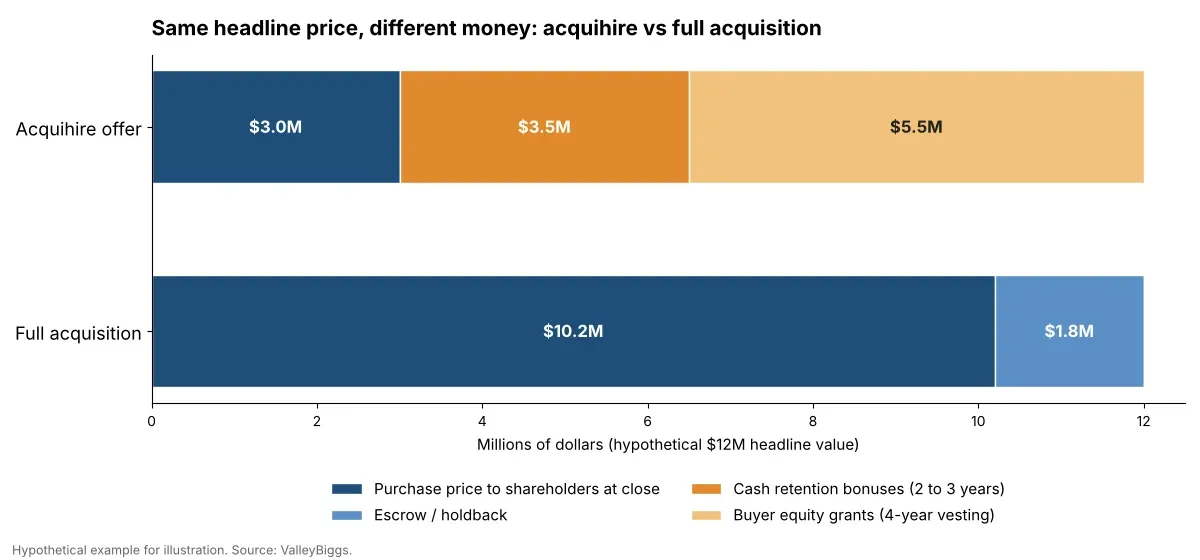
A hypothetical worked example
Consider a hypothetical seed-funded software company with 14 employees. It has raised $4 million of preferred stock with a 1x non-participating liquidation preference, and a buyer offers a $12 million package to hire 9 of the 14 people. The table shows how that offer might break down and who receives each part.
| Component | Amount | Paid when | Who receives it |
|---|---|---|---|
| Purchase price for the company | $3.0M | At closing | Shareholders, through the liquidation waterfall |
| Cash retention bonuses | $3.5M | Over 2 to 3 years, if still employed | Only the 9 people who join |
| Buyer equity grants | $5.5M | Vests over about 4 years | Only the 9 people who join |
| Headline value | $12.0M |
Now follow the $3.0 million purchase price through the waterfall. After deal costs and any debt, suppose $2.7 million remains. The preferred investors are owed $4 million under their preference, so they receive the entire $2.7 million and still lose money. Common shareholders, including founders and early employees who hold vested options, receive nothing. The 9 people hired by the buyer still do well through their packages; the 5 people who were not hired get nothing beyond any severance the company can afford.
This is why the same $12 million can be a good outcome for one group and a poor one for another. Before signing anything, founders should build a full flow-of-funds model that shows what each investor class, each option holder and each team member actually receives.
How acquihires are priced
Because the buyer is paying for people, offers are usually expressed per head. Cooley’s startup resource has described a going rate of a few hundred thousand dollars to about $2 million per engineer, though that guidance is several years old and prices vary widely by skill and competition. Specialists in AI research, security and infrastructure have commanded far more in recent deals. What moves the number most:
- How many credible buyers are interested at the same time
- How scarce the team’s skills are, and how senior the key people are
- Whether the team has shipped production software together, and what it built
- Whether any IP, data or customer contracts have value to the buyer on their own
- How much runway the company has left when talks begin
Acquihire Pros and Cons for Founders
| Pros | Cons |
|---|---|
| A clean exit for a company that cannot raise its next round | Investors and common shareholders often receive little or nothing |
| Team members keep working together, usually with better pay and stability | The product and its users are usually abandoned |
| Faster and simpler than a full sale process | Founders are tied to multi-year vesting and retention terms |
| Avoids a slower, more public wind-down | Staff who are not hired lose their jobs, and the founders still owe them a fair process |
| Can repay some investor capital and protect relationships | Directors face conflict-of-interest risk if they are among those being hired |
Legal and Tax Points Founders Should Raise Early
These are small deals with a large number of legal and tax issues. The points below are general information, not legal or tax advice; your own counsel and tax advisor should review your specific facts.
- Board conflicts. When directors will be hired by the buyer, they have a personal interest in the deal. Boards often use independent directors, a special committee or a fairness review to show that shareholders’ interests were considered.
- Purchase price versus compensation. Payments for stock are generally taxed differently from payments for services. Compensation such as retention bonuses is generally taxed as ordinary income, while gain on sale of stock may receive capital gains treatment. The split should reflect the economics, because the IRS can recharacterize payments that are really compensation.
- Golden parachute rules. Under Internal Revenue Code Section 280G, change-in-control payments to certain executives and owners that reach three times their base amount can trigger a 20% excise tax for the recipient and lose the company’s deduction. Private companies can often avoid this through a shareholder vote of more than 75% of disinterested shareholders.
- Creditors and contracts. Loan agreements, leases and customer contracts may require consent or notice before a sale or wind-down. Any debts left in the old company still need to be paid or settled.
- Unhired employees. Final pay, accrued vacation rules and, for larger companies, the federal WARN Act’s notice requirements can apply to the people who do not move to the buyer.
How to Get a Better Outcome From an Acquihire Offer
Founders who negotiate well in these deals tend to do the same things. Use this as a preparation checklist:
- Start before you are out of runway. Six or more months of cash lets you run a process and say no. Three weeks of cash makes you a price taker.
- Talk to more than one buyer. Competition is the single biggest driver of per-head value. A buyer that knows it is alone will set the price.
- Argue for the business, not just the team. If your product has revenue, customers or useful IP, present it so the buyer has to price it. Some team-only offers become full acquisitions once a buyer sees real ARR or retention data. Our guide to the Rule of 40 shows the metrics software buyers look at first.
- Negotiate the split, not only the total. Push for more of the value to be paid as purchase price at closing, which reaches investors and common holders, rather than as future compensation.
- Fix offers for the whole team in the letter of intent. Name who receives offers, at what pay and under what vesting, before exclusivity starts.
- Protect the people left behind. Ask the buyer to fund severance, or to extend offers to more of the team, as part of the deal.
- Model every payout first. Build the waterfall for every share class, convertible note and option holder before you agree to a number.
When an Acquihire Is the Right Exit
A team sale is not always a consolation prize. It tends to be the right path when the team’s market value is clearly higher than the value of the product, when the next funding round is unlikely, and when the founders believe the team would do its best work inside a larger company. It is usually the wrong path when the business has real revenue and customers that a different buyer would pay for, or when the founders still have conviction and runway to keep building.
If you have a profitable or growing company, other routes may return far more to shareholders. A full sale to a strategic or financial buyer is the most common, and a management buyout can work when a strong internal team wants to own the business. A business valuation before you take any meeting gives you a baseline to judge a team-only offer against.
When to Talk to an M&A Advisor
Founders often treat a team sale as a hiring conversation and bring in advisors only after the letter of intent is signed. By then, the split between purchase price and retention is usually fixed. It is worth speaking with an M&A advisor early if:
- A buyer has approached you and you want to know whether other buyers would compete
- Your company has revenue, customers or IP that could support a full acquisition rather than an acquihire
- Your cap table includes several preferred classes, convertible notes or a large option pool
- Some of your team will not receive offers and you need a fair plan for them
ValleyBiggs works only with technology, internet, ecommerce and digital companies. If you are weighing an offer for your team, our technology business sale team can help you test the market and present the full value of the company, and our startup sale advisory covers early-stage exits in particular. When a broader process makes sense, our sell-side M&A assistance runs it from preparation through closing.
Conclusion
An acquihire can be a sensible exit for a strong team whose product has stalled, but the headline number rarely tells you what shareholders will receive. Understand the structure, model every payout and create competition before you sign anything exclusive. If a buyer is already asking about your team, book a confidential consultation with ValleyBiggs to find out whether your company could command a full acquisition instead.
FAQs
1. What is a reverse acquihire?
A reverse acquihire is a deal in which a larger company hires a startup’s founders and most of its staff and pays the startup a fee to license its technology, instead of buying the company. The startup stays in existence with the remaining team, and investors are usually repaid from the license fee. Regulators in the UK and US have started to review these arrangements.
2. Do investors make money in an acquihire?
Often they do not. Investors are paid only from the purchase price that flows through the cap table, after debt, deal costs and liquidation preferences. Because much of the deal value is paid as salaries, bonuses and equity to the people who join, investors frequently recover less than they invested, and common shareholders may receive nothing.
3. How much do buyers pay per employee in an acquihire?
There is no fixed rate. Cooley’s startup resource has described a range of a few hundred thousand dollars to about $2 million per engineer, but that guidance is several years old. Scarce skills, senior people and competition between buyers push prices higher, while a short runway and a single interested buyer push them lower.
4. How long does an acquihire take?
Many close within one to four months of the first serious conversation, which is faster than most full company sales. The letter of intent can be agreed in a few weeks, but team interviews, diligence on IP and contracts, board approval and employee offers all take time. Starting early leaves room to bring in competing buyers.
5. What happens to employees who are not hired in an acquihire?
They usually lose their jobs when the company winds down. They receive final pay and any severance the company or buyer agrees to fund, and their vested options may be worth little if the purchase price does not clear investor preferences. Founders can negotiate for severance funding or more offers in the letter of intent.
6. Is an acquihire considered a successful exit?
It depends on the starting point. For a company that cannot raise its next round, an acquihire can be a good result that keeps the team together and avoids a slow shutdown. For a business with real revenue and customers, it may leave value on the table, so it is worth asking whether a buyer would acquire the whole technology business instead.