

A confidential information memorandum (CIM) is the detailed sales document a seller and its advisor share with qualified buyers after they sign a nondisclosure agreement. It explains what the company does, how it makes money, who runs it and what its numbers look like, so a buyer can decide whether to bid and at what price.
For an owner, the CIM is the first full story most buyers will read about the business, and every figure in it will be checked later in due diligence. This guide walks through what goes into a CIM section by section, how it fits the sale timeline, a hypothetical add-back example, the legal points worth knowing, and the mistakes that most often cost sellers money.
Key Takeaways
- A CIM is a marketing and disclosure document, not a contract and not a formal valuation; price is set later through bids and negotiation.
- Buyers see it only after signing an NDA, and usually after an anonymous teaser has confirmed their interest.
- The financial section, especially the adjusted EBITDA bridge, carries the most weight because most buyers price private companies off normalized earnings.
- For SaaS, tech and ecommerce companies, buyers expect operating metrics such as recurring revenue, retention, churn and customer concentration alongside the P&L.
- Every claim in the CIM becomes a diligence question, so a CIM that overstates the business tends to cost more at the LOI stage than it gains up front.
What Is a Confidential Information Memorandum?
Think of the CIM as the seller’s investment case written down. It is usually prepared by an M&A advisor, investment bank or business broker using information supplied by the owner and the finance team, and it is sent to buyers who have already shown interest and signed a confidentiality agreement.
You will also hear it called an offering memorandum, an information memorandum (IM) or simply “the book.” The names describe the same type of document. In investment banking and US middle-market M&A, “CIM” is the most common term, while “information memorandum” is used more often outside the US and in some capital raises.
Three things a CIM is not are worth stating clearly, because owners often confuse them:
- Not a binding offer or agreement. It carries a disclaimer, and the only promises that bind the seller are the representations in the signed purchase agreement.
- Not a pitch book. A pitch book is what an advisor uses to win your mandate; the CIM markets your company to buyers.
- Not a price tag. Most CIMs in a competitive process leave the price open so buyers anchor on their own view of value. Some smaller deals state an asking price, which is a strategic choice to discuss with your advisor.
Where the CIM Fits in the Sale Process
The CIM sits in the middle of the marketing phase of a sell-side M&A process. It follows the teaser and the NDA and comes before any buyer gets access to management or the full data room. That position is what makes it powerful: it is the only document every serious bidder reads in full before forming a price view.
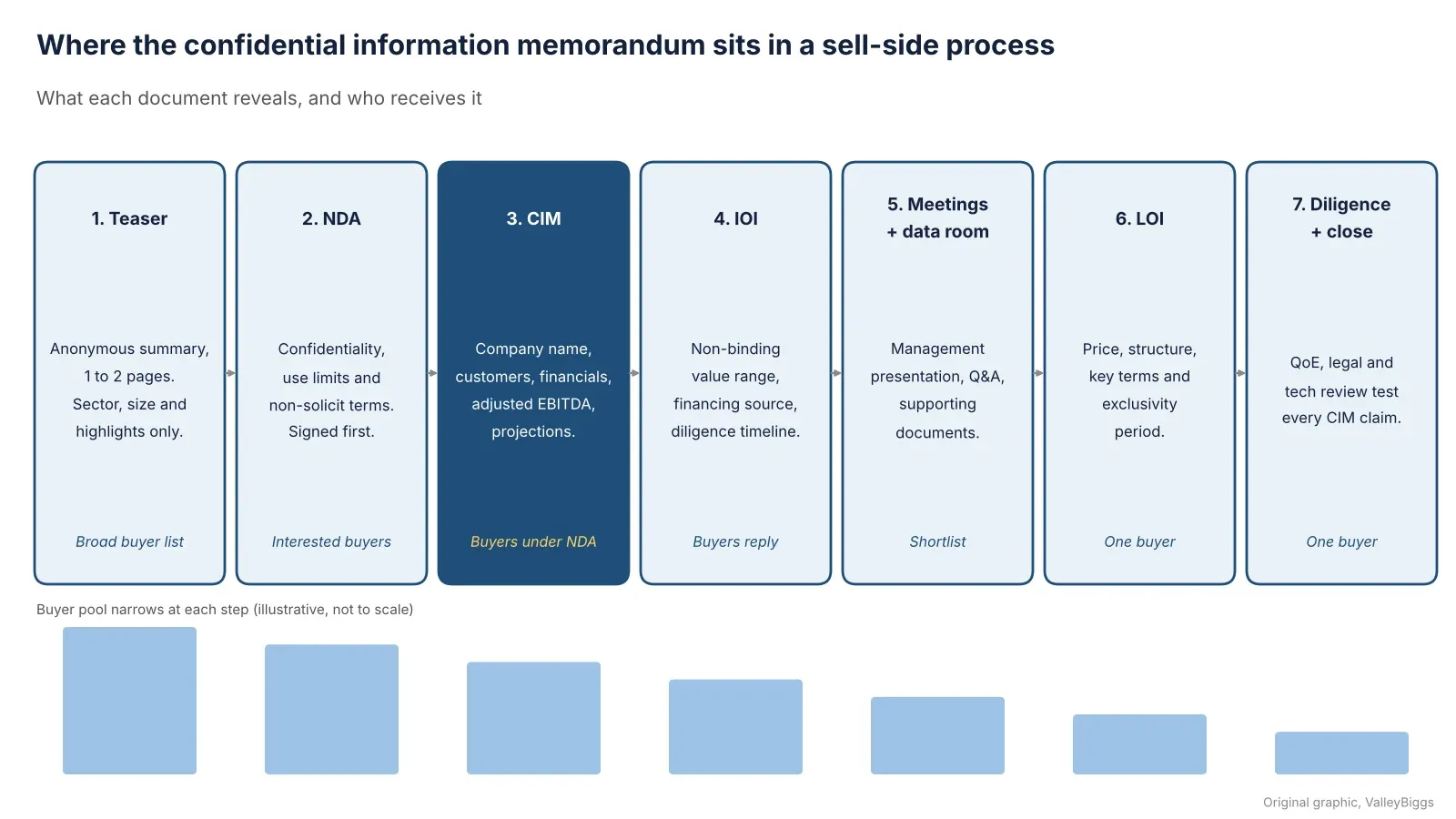
The sequence below is typical for a structured process run by an advisor. Smaller or more targeted sales compress some steps, but the order rarely changes.
- Teaser: a short, anonymous profile (often called an M&A teaser or blind profile) sent to a list of strategic and financial buyers to test interest without naming the company.
- NDA: buyers who want more sign a confidentiality agreement that limits how they can use the information and usually bars them from approaching employees or customers.
- CIM and process letter: the full memorandum goes out, together with instructions on how and when to submit a first-round bid.
- Indications of interest (IOIs): buyers return non-binding value ranges, proposed structure and financing sources.
- Management meetings and data room: a shortlist meets the leadership team and starts reviewing supporting documents.
- Letter of intent (LOI): the chosen buyer signs a mostly non-binding LOI with a price, key terms and an exclusivity period.
- Confirmatory diligence and closing: the buyer tests the CIM’s claims against the evidence, often using a due diligence checklist as the map, before signing the purchase agreement.
| Document | When buyers get it | Identifies the company? | What it is for |
|---|---|---|---|
| Teaser (blind profile) | Before any NDA | No | Generate interest from a wide list |
| CIM | After the NDA | Yes | Give enough detail for a first-round bid |
| Management presentation | After IOIs, shortlist only | Yes | Let buyers judge the team and test the story |
| Data room | Shortlist, then the LOI buyer | Yes | Provide the documents that prove the CIM’s claims |
| Purchase agreement disclosure schedules | Before signing | Yes | Turn the facts into binding representations and exceptions |
What Goes Into a CIM: Section by Section
The order and length vary by advisor, but most CIMs cover the same ground. Industry training sources commonly describe these documents as running from about 30 to 150 pages, with length driven mainly by the number of business lines and the depth of the financials. The table shows each section, what it usually contains and the first thing an experienced buyer looks for.
| Section | What it usually contains | What buyers check first |
|---|---|---|
| Executive summary | Business snapshot, headline financials, transaction type, reasons to buy | Whether the headline numbers match the financial section exactly |
| Investment highlights | Five to eight reasons the company is attractive | Which highlights are backed by data later in the book |
| Company overview | History, ownership, legal structure, locations, headcount | What exactly is for sale: stock, assets, which entities |
| Products and services | Offerings, pricing model, revenue mix, roadmap | How much revenue is recurring or contracted |
| Customers | Segments, top customers, tenure, contract terms, retention | Concentration and any change-of-control clauses |
| Market and competition | Market size and growth, positioning, named competitors | Whether market figures are sourced and realistic |
| Operations and technology | Facilities, suppliers, systems, tech stack, security | Key dependencies and any capital spending the plan needs |
| Management and employees | Bios, org chart, key staff, owner’s role | Who stays after closing and how much rests on the founder |
| Historical financials | Three or more years of P&L, balance sheet, cash flow, year to date | Whether figures tie to tax returns or reviewed statements |
| Adjusted EBITDA bridge | Reported EBITDA, each add-back, adjusted EBITDA | The support for every add-back |
| Projections | Management forecast and assumptions | How the first forecast year compares with the trailing 12 months |
| Transaction overview | Structure sought, process timeline, bid instructions | Deadlines, what the seller keeps, rollover expectations |
What tech, SaaS and ecommerce buyers expect to see
For a software or online business, the P&L alone does not tell a buyer enough. Buyers looking at these companies typically build their model on unit economics and recurring revenue quality, so the CIM should present them clearly and consistently. If your company sells subscriptions, also expect buyers to test growth against profitability with benchmarks such as the Rule of 40 for SaaS companies.
- Annual or monthly recurring revenue, with a clear definition of what counts as recurring.
- Gross and net revenue retention, logo churn and cohort tables over at least two years.
- Customer acquisition cost, payback period and lifetime value, with the method used to calculate them.
- Revenue by channel and by top customers; for ecommerce, marketplace dependence (for example, the share of sales through Amazon) and repeat purchase rates.
- Gross margin after hosting, payment processing and fulfillment costs.
- Ownership of code, domains and data, open-source usage and any security certifications, described only to the extent they actually cover the business.
Founders of subscription software companies can find more on how buyers weigh these metrics on our page about selling a SaaS business.
How Buyers Read the Financial Section
Most buyers of private companies price the business as a multiple of normalized earnings: seller’s discretionary earnings (SDE) for smaller owner-run firms and adjusted EBITDA for larger ones. That makes the EBITDA bridge, the schedule that starts from reported EBITDA and adds back costs the seller argues will not continue, the most scrutinized page in the CIM.
Each add-back is a claim that a cost is either personal, one-time or above market. Buyers and their accountants will test those claims in a quality of earnings (QoE) review after the LOI. Add-backs that recur every year, or that lack invoices and contracts, are the first to be removed.
Hypothetical example: an adjusted EBITDA bridge in a CIM
The figures below are hypothetical and simplified. Treat this as a confidential information memorandum example of one page, not a template: they show how a seller might present add-backs and how a buyer might respond.
| Line item (hypothetical) | Seller’s CIM | Buyer’s QoE view | Why |
|---|---|---|---|
| Reported EBITDA | $1,400,000 | $1,400,000 | Ties to reviewed financial statements |
| Owner salary above market rate | +$180,000 | +$150,000 | Buyer uses a higher replacement salary |
| One-time legal settlement | +$120,000 | +$120,000 | Documented, unlikely to recur |
| Platform migration project | +$90,000 | $0 | Similar projects appear in prior years |
| Personal vehicle and travel | +$25,000 | +$25,000 | Supported by expense records |
| Adjusted EBITDA | $1,815,000 | $1,695,000 | Difference of $120,000 |
If the buyer had priced the deal at a hypothetical 6x multiple, the $120,000 gap would reduce the headline price by $720,000, and that conversation would happen during exclusivity when the seller has the least leverage. The lesson is not to avoid add-backs but to include only the ones you can document, and to test them before the CIM goes out. An independent view of earnings and value, such as an enterprise valuation analysis, is the usual way to do that. For the bigger picture on pricing, see our guide to how much a business is worth.
Projections
Buyers rarely pay for a forecast they cannot trace. They compare the first projected year with the trailing 12 months and ask what has to happen for the forecast to come true. A forecast that steps up sharply needs evidence behind it: signed contracts, a priced pipeline, a completed price increase or a launched product with early results.
Pros and Cons of a CIM: Seller vs. Buyer View
| For the seller | For the buyer | |
|---|---|---|
| Main benefit | Controls the story and presents every bidder with the same facts | Gets a full picture quickly, before spending on diligence |
| Competitive effect | Supports parallel bids on a common timeline | Can compare the company with other targets on similar data |
| Main risk | Overstated claims are repriced later; sensitive data reaches competitors | The document is the seller’s best case and is not warranted |
| Cost | Owner and finance team time, advisor fees, sometimes a sell-side QoE | Time to analyze, plus diligence costs if the deal advances |
Legal and Confidentiality Points Sellers Should Know
This section is general information, not legal advice. Your deal counsel should review the NDA, the CIM disclaimer and the purchase agreement as one set.
- The NDA is the first protection. It should limit use of the information to evaluating the deal, restrict who can see it, cover employee and customer non-solicitation, and require return or destruction of materials if the buyer walks away.
- Competitor bidders need extra care. The Federal Trade Commission has warned that exchanging competitively sensitive information, such as current pricing, costs or strategic plans, between competitors before closing can raise antitrust concerns. Advisors often hold back customer names and pricing details from strategic buyers until later stages, or share them only with a separate clean team.
- Disclaimers have limits. CIMs state that the seller makes no representation about completeness or accuracy, and purchase agreements usually add a non-reliance clause. Courts, particularly in Delaware, have generally enforced such clauses for statements outside the contract, but they do not protect deliberate misstatements in the agreement itself.
- Stock sales can bring securities law into play. In Landreth Timber Co. v. Landreth (1985), the US Supreme Court held that stock sold when a whole business changes hands is a security. That means the anti-fraud rule in SEC Rule 10b-5, which prohibits material misstatements and misleading omissions in connection with a securities sale, can apply to what a seller says in a stock deal.
How to Prepare for Your CIM
The advisor writes the CIM, but the owner and finance team supply almost everything in it. Preparation done before the advisor starts drafting shortens the timeline and makes the book harder to pick apart.
- Close the books monthly and reconcile financial statements with tax returns for at least the last three years.
- List every proposed add-back with its amount, the reason it is non-recurring and the document that supports it.
- Build a customer file: revenue by customer for three years, contract terms, renewal dates and any change-of-control or assignment clauses.
- Prepare your KPI definitions and cohort data so the numbers in the CIM match what buyers will later see in the data room.
- Decide which information you will hold back from competitors and when you will release it.
- Identify key employees, decide how and when to tell them about the sale, and consider retention arrangements.
- Confirm ownership of intellectual property, domains, software licenses and key supplier contracts.
Common CIM Mistakes That Cost Sellers Value
- Aggressive add-backs. Items without support, or ones that repeat year after year, get removed in diligence and the price is cut by a multiple of each one.
- Numbers that do not tie. Revenue, customer counts or margins that differ between the CIM, the data room and the tax returns damage credibility for every other figure.
- Hidden concentration. A large customer that shows up only in the data room leads to a lower price, an earnout or a deal that stalls.
- A hockey-stick forecast. Projections with no bridge from current performance are discounted to trend and can make buyers doubt the rest of the book.
- Stale financials. A CIM built on last year’s numbers while the current year runs below plan invites a retrade once diligence adds the latest months.
- Overclaiming technology. Calling a platform proprietary or fully secure when code scans or audit reports show otherwise hands the buyer a finding to price.
- Saying too much to the wrong buyer. Sending full customer and pricing data to a direct competitor in the first round adds risk with little benefit.
Related Terms
- Teaser: the anonymous one- or two-page profile that comes before the NDA.
- Process letter: the instructions that go out with the CIM, covering bid deadlines and what a first-round bid must include.
- Indication of interest (IOI): a non-binding first-round bid, usually a value range with proposed terms.
- Letter of intent (LOI): the document that sets price and key terms and grants one buyer exclusivity.
- Quality of earnings (QoE): an accounting review that tests reported and adjusted earnings.
- Management buyout (MBO): a sale to the existing leadership team, which may use a lighter version of the CIM; see our guide to the management buyout process.
When to Talk to an M&A Advisor
If you expect buyers to compare your company with other opportunities, or you want more than one bidder at the table, a professionally prepared CIM is usually worth the effort. An advisor can tell you which information to include, what to hold back from strategic buyers, and how to present add-backs and projections so they survive diligence. The ValleyBiggs sell-side advisory team works with owners of tech, SaaS, ecommerce and other growth companies on exactly this stage of a sale.
It is worth starting that conversation before your financials for the latest year are final, because the cleanest CIMs are built on numbers that have already been reviewed.
Conclusion
A confidential information memorandum is where your company’s value story meets the evidence buyers will later check. A CIM that is complete, consistent and honest about weaknesses usually draws stronger first-round bids and fewer surprises after the LOI. If you are considering a sale in the next year or two, the practical next step is a confidential conversation about your numbers and timing: you can start the process of selling your business or book a confidential consultation with our team.
FAQs
1. What does CIM stand for in business?
In M&A, CIM stands for confidential information memorandum, the detailed document a seller’s advisor sends to qualified buyers after they sign an NDA. Outside deal work the acronym has other meanings, such as computer-integrated manufacturing, so context matters. In a company sale, the CIM is the main written case for why a buyer should bid.
2. What is the difference between a CIM and an information memorandum?
There is usually no practical difference. Information memorandum, or IM, is the more common name outside the US and in some capital raises, while US advisors tend to say CIM or offering memorandum. All three describe a confidential, detailed overview of a business that is given to prospective buyers or investors under an NDA.
3. Who writes a confidential information memorandum?
The seller’s M&A advisor, investment banker or business broker usually drafts it, working from information supplied by the owner, the CFO and the company’s accountants. Management reviews every page because the company is responsible for the facts. Deal counsel normally reviews the disclaimer and confidentiality language before the document goes out to buyers.
4. How long does it take to prepare a CIM?
Several weeks is common once the financial statements are final, though the timeline depends on how organized the records are, how many business lines the company has and how many review rounds the owner needs. Missing monthly closes, unreconciled tax returns and unsupported add-backs are the usual causes of delay.
5. Does a small business need a CIM?
Not always. Very small sales often rely on a shorter business summary or listing package. A full CIM becomes more valuable when you want several buyers bidding at the same time, when likely buyers are private equity firms or strategic acquirers, or when the business is complex enough that buyers need a structured explanation before making an offer.
6. Is a confidential information memorandum legally binding?
No. A CIM is an informational and marketing document with a disclaimer stating that only the signed purchase agreement creates binding obligations. Sellers should still keep it accurate, because misleading statements can create liability and the same facts return later as representations in the purchase agreement. This is general information, not legal advice.