

The best business brokers Colorado owners can hire are the firms whose buyer lists, deal size and industry experience match the company being sold. This guide compares ten of them, from a tech-focused national advisor to local brokerages in Denver, Aurora and Colorado Springs, and explains how to vet each one before you sign an engagement letter.
Colorado is a mid-sized market with an outsized share of professional, technical and aerospace work, so the right partner depends on what you own and who is likely to buy it. Below you will find the state’s small business picture, what a broker actually does, seven selection criteria, the ranked list, the Department of Revenue steps that come up at closing and a comparison with neighboring states.
Key Takeaways
- The SBA Office of Advocacy counts 730,887 small businesses in Colorado, yet only about 15,000 of them have 20 or more employees, so the pool of broker-ready companies is far smaller than the headline number.
- Professional, scientific and technical services is the largest small business sector in the state, which is why many Colorado sellers need a broker who can reach out-of-state strategic and private equity buyers.
- Judge a broker on comparable closed deals, the person who will run your sale and a valuation method you can follow, not on network size alone.
- Colorado sellers must pay all business taxes due at the time of sale, and buyers of retail businesses can hold back purchase money until the seller produces a Department of Revenue tax status letter.
- Colorado taxes personal income at a flat rate, so the state share of a gain is easier to estimate than in states with graduated brackets. Confirm the current rate and your structure with a CPA.
Colorado Business Landscape in 2027
Colorado gives sellers a broad and educated buyer market along the Front Range. The SBA Office of Advocacy’s 2025 small business profile reports 730,887 small businesses in the state, 99.5 percent of all Colorado firms. Those companies employ about 1.2 million people, or 48.6 percent of Colorado employees, so small firms are the backbone of the economy rather than a side story.
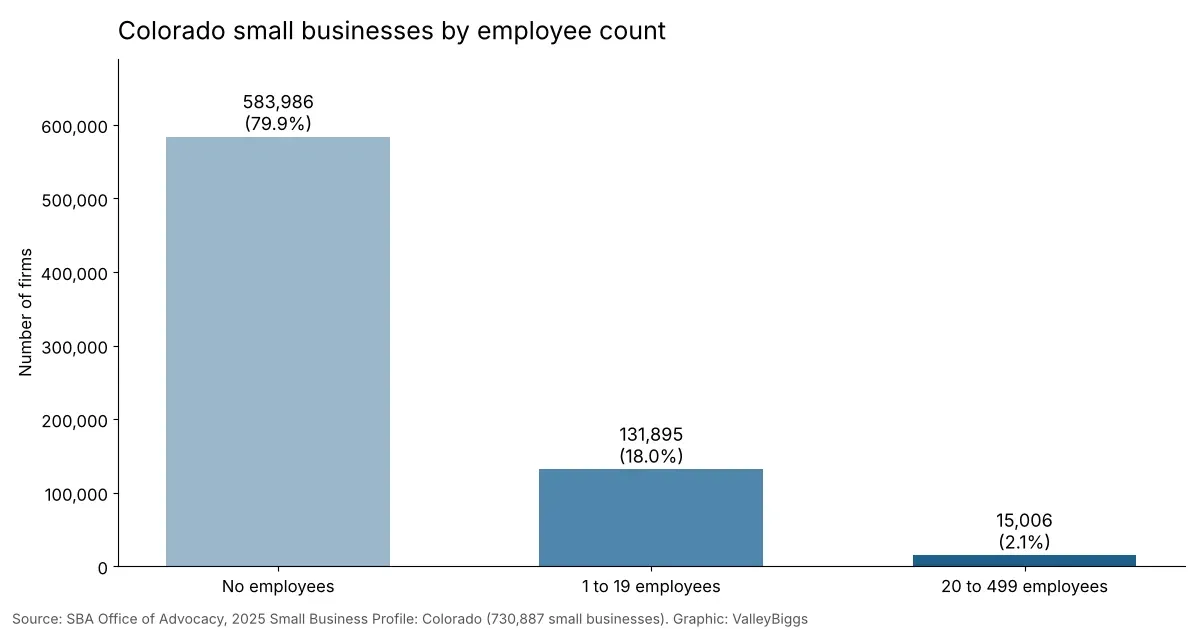
The same profile shows how uneven that population is. Close to 584,000 of those businesses have no employees at all, about 132,000 employ 1 to 19 people and roughly 15,000 employ 20 to 499. Brokers mostly work in the last two groups: companies with staff, repeatable revenue and earnings a buyer can finance.
Which industries produce the most Colorado deals?
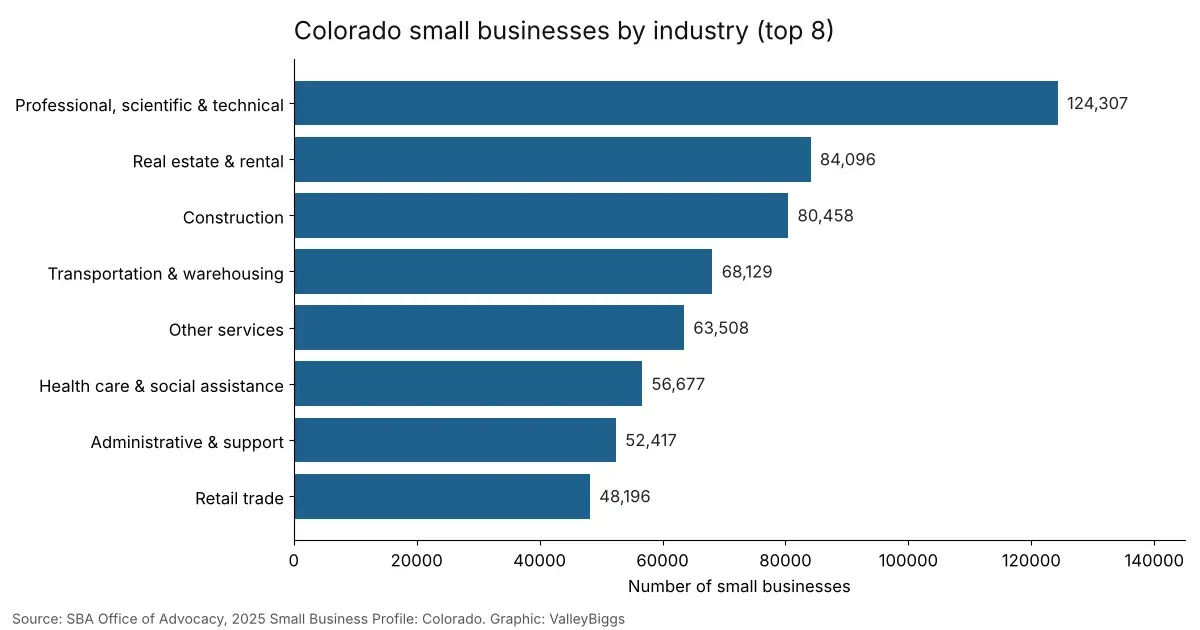
By firm count, professional, scientific and technical services leads with about 124,000 small businesses, followed by real estate and rental, construction, transportation and warehousing, other services and health care. By employment, accommodation and food services, health care and construction are the largest small business employers. In practice the categories that draw steady buyer interest include:
- Software, IT and engineering services: managed service providers, SaaS companies and engineering consultancies clustered around Denver, Boulder and the Denver Tech Center.
- Aerospace and defense suppliers: the state economic development office describes Colorado as the second-largest aerospace economy in the country, which supports a network of machine shops, contractors and specialty suppliers.
- Construction and home services: HVAC, plumbing, electrical, roofing and landscaping companies, a frequent target for private equity add-on acquisitions.
- Health care: dental, therapy, home care and medical practices, where ownership rules shape how a deal can be structured.
- Hospitality and outdoor recreation: restaurants, lodging, guide services and retailers in mountain towns, where seasonality and leases weigh heavily on value.
How do regional markets differ inside the state?
Colorado behaves like three or four markets. Metro Denver, including Aurora, Lakewood and the suburbs along I-25, has the deepest buyer pool and most of the state’s lower middle market activity. Boulder and Fort Collins lean toward technology, research and consumer brands. Colorado Springs has a large defense and aerospace footprint, and the Western Slope and mountain resort towns are smaller, relationship-driven markets where a local reputation still matters. Our local guides cover brokers serving Thornton and the north metro and selling a healthcare practice in Denver, and the ValleyBiggs locations directory lists other cities we cover.
What Does a Business Broker in Colorado Do?
A business broker represents the seller from the first valuation conversation through the closing table. The goal is not simply to advertise the company but to run a controlled process that produces a qualified buyer, a fair price and terms the owner can accept. A capable Colorado broker will typically:
- Recast three years of financial statements so buyers can see normalized earnings, with each owner add-back supported by records.
- Recommend a pricing range based on seller’s discretionary earnings or EBITDA, recent comparable sales and current lender appetite.
- Write an anonymous teaser and a confidential information memorandum, and release them only after a buyer signs a nondisclosure agreement.
- Qualify buyers for experience and financing, including SBA lender pre-approval where relevant.
- Keep several buyers engaged at once, compare offers on structure as well as price, and help negotiate the letter of intent.
- Manage due diligence requests with your CPA and attorney so the timeline does not drift.
The labels overlap. Main Street brokers usually handle smaller owner-operated companies, M&A advisors take on lower middle market businesses with professional buyers, and investment banks focus on larger transactions. Several firms below work across more than one band, so ask where a company of your size sits in their current client list.
How to Choose Business Brokers in Colorado: 7 Criteria
Interview at least three firms and ask each one the same questions. Writing down their answers makes the differences obvious.
1. Recent sales that resemble your company
Ask for anonymized examples of deals closed in the past few years in your industry and revenue range. A broker who has sold several Front Range contractors brings a different buyer list than one who mostly sells cafes in resort towns.
2. The person doing the work
Find out who will prepare the marketing documents, call buyers and sit in negotiations. With franchise networks and multi-broker offices especially, the quality of the individual advisor matters more than the brand.
3. A valuation you can trace
A credible opinion of value names the earnings measure, lists the adjustments and shows the comparable data behind the range. If one firm’s number is far above everyone else’s, ask how it will hold up when a buyer’s lender orders its own valuation.
4. Buyer reach that fits your exit
A Grand Junction service company may sell to a regional operator, while a Boulder software firm may sell to a strategic acquirer on either coast. Ask how the broker sources buyers, how many it expects to contact and how many of its recent buyers came from outside Colorado.
5. Confidentiality discipline
Look for blind listings, signed NDAs before any identifying detail, and staged release of customer and employee data. Ask how the firm handles inquiries from competitors.
6. Credentials and local standing
Industry designations show training and commitment. Common ones include the Certified Business Intermediary (CBI) from the International Business Brokers Association and the M&A Master Intermediary (M&AMI) from the M&A Source. In-state, many brokers belong to the Colorado Association of Business Intermediaries, which has connected buyers, sellers and brokers since 1990. If the sale includes real estate, ask who will handle that part of the transaction and how.
7. Contract terms
Read the engagement letter line by line: how the success fee is calculated, any upfront or monthly retainer, minimum fees, the length of exclusivity and the tail period after the agreement ends. Compare the total cost under realistic sale prices, not just the headline rate.
Top 10 Business Brokers Colorado Sellers Should Compare (2027)
The list mixes national firms with deep buyer reach and Colorado business brokers with strong local relationships. Each description reflects how the firm presents itself on its own website; confirm current services, offices and terms directly with any firm you consider.
| # | Firm | Colorado presence | Stated focus |
|---|---|---|---|
| 1 | Website Closers | Serves Colorado sellers nationally | Tech and internet businesses |
| 2 | Transworld Business Advisors of Colorado | Denver, Colorado Springs, Front Range and mountain communities | Business sales across many sizes and industries |
| 3 | ValleyBiggs | Serves Colorado sellers nationally | Technology, internet and ecommerce companies |
| 4 | Rocky Mountain Business Advisors | Denver; also Wyoming and New Mexico | Closely held companies with about $1M+ in revenue |
| 5 | SellerForce | Serves Colorado sellers nationally | Online and brick-and-mortar businesses |
| 6 | Company Broker Group | Denver | Companies with about $1M to $50M in revenue |
| 7 | Murphy Business (Denver) | Denver office of a national network | Business sales, valuation and M&A |
| 8 | DealPipe | Serves Colorado sellers nationally | Lower and middle market, physical and digital |
| 9 | Atlas Business Brokers | Aurora; statewide coverage | Main Street businesses and franchise resales |
| 10 | Crestone Business Group | Colorado Springs and Denver | Full-service brokerage along the Front Range |
1. Website Closers
Website Closers focuses on technology and internet companies, including SaaS platforms, ecommerce brands, apps and digital agencies. For a Colorado founder whose most likely buyer is a strategic acquirer or an investor-backed platform outside the state, a firm built around online businesses and national buyer outreach can be a sensible first call.
2. Transworld Business Advisors of Colorado
Transworld’s Colorado team says it works with owners in Denver, Colorado Springs, along the Front Range and in the mountains, across a large range of business sizes and industries. Its Colorado pages cover selling a business, valuations and buyer representation. As with any franchise network, results depend on the local advisor, so meet the broker who would actually handle your listing and ask about recent sales in your sector.
3. ValleyBiggs
ValleyBiggs specializes in technology, internet, ecommerce and other digital companies, and its team includes people who have built and exited businesses in the same space. Sellers work with a full deal team rather than a single broker, and fees are performance-based, with nothing due unless a transaction closes. Colorado owners of software, IT services or online brands can see how outreach and negotiation work on our sell-side assistance page and in our guide to selling a technology company.
4. Rocky Mountain Business Advisors
Rocky Mountain Business Advisors describes itself as a business broker and M&A advisor for Colorado, Wyoming and New Mexico, with a team serving Denver as well as Albuquerque and Santa Fe. The firm says it works with closely held companies with revenue from about $1 million into the tens of millions, in service, distribution, industrial, manufacturing and multigenerational family businesses. Its site lists CBI, M&AMI and certified exit planning credentials among its team.
5. SellerForce
SellerForce works with both online companies and traditional brick-and-mortar businesses and emphasizes marketing to a broad buyer audience. Colorado owners of small and mid-sized companies who want wide exposure may find it a good match. Ask how buyers are screened before any financial statements are released.
6. Company Broker Group
Company Broker Group is a Denver brokerage that says it concentrates on companies with annual revenue between roughly $1 million and $50 million. The firm describes a process built around a sales packet, video walk-throughs for qualified buyers and a controlled auction among a small group of bidders, and it also offers exit planning, management buyouts and family transfers. It suits established metro Denver owners who want a structured, competitive process.
7. Murphy Business (Denver)
Murphy Business’s Denver office is one of more than 140 offices in a national brokerage network. The office says its brokers have owned or managed businesses themselves and that each engagement starts with a valuation and a marketing plan. A network that size can widen buyer exposure beyond Colorado, while the local team handles the day-to-day process. Ask which deal sizes make up most of the office’s recent work.
8. DealPipe
DealPipe works with lower and middle market companies, including physical and digital businesses, and tracks every prospect through a structured buyer pipeline. Sellers who want clear visibility into where each buyer stands may value that approach. Confirm the team’s experience in your sector before you engage.
9. Atlas Business Brokers
Atlas Business Brokers is based in Aurora and says it serves the entire state, from Denver, Boulder and Colorado Springs to the Western Slope, Southern Colorado and the Eastern Plains. The firm lists business brokerage, franchise resales and commercial leasing among its services and works across industries such as construction, manufacturing, retail and hospitality. It is a practical option for owner-operated companies outside the core Denver market.
10. Crestone Business Group
Crestone Business Group is a licensed, full-service brokerage serving Colorado Springs, the Denver metro area and the mountain corridor. The firm says it manages the full sale, including valuation, marketing, buyer screening, negotiation, contracts and closing, and that its brokers are members of the Colorado Association of Business Intermediaries. It fits Southern Front Range owners who prefer a local team.
When Should You Sell Your Colorado Business?
There is no perfect month to sell a business in Colorado, but several conditions tend to line up when the timing is right. Start preparing when most of these are true:
- Revenue and earnings have grown for two or three years and your books show it clearly.
- No single customer, contract or referral source accounts for a large share of revenue.
- A manager or team could run daily operations for months without you.
- Your lease has enough remaining term, or a renewal option, to satisfy a buyer and an SBA lender. This matters most in mountain towns, where commercial space is scarce.
- Buyers are active in your sector, such as private equity groups building home services or health care platforms along the Front Range.
- You have a personal reason to exit in the next 12 to 24 months and want time to prepare.
If the business is not ready, use the next year to fix what buyers discount: owner dependence, informal bookkeeping, undocumented add-backs and expiring contracts. Our step-by-step guide on how to sell a business walks through that preparation in more detail.
Typical Sale Process in Colorado
Most Colorado sales follow the same broad sequence as anywhere else, with a handful of state tax steps near the end. Your broker coordinates the process, while your CPA and attorney handle tax and legal work.
- Prepare. Collect three years of tax returns and financial statements, recast earnings and organize leases, customer contracts, licenses and employee records.
- Value. Set a price range using the right earnings measure and comparable transactions. An independent enterprise valuation gives you a reference point before buyers see the company.
- Market confidentially. Release a blind teaser, sign NDAs and share the memorandum only with qualified buyers.
- Negotiate. Compare offers on cash at close, seller notes, earnouts, working capital targets and the length of your transition period.
- Diligence. Answer the buyer’s financial, legal, tax and operational requests on an agreed schedule.
- Close. Sign the purchase agreement, settle state and local taxes, transfer assets or ownership and begin the handover.
Colorado tax steps sellers should plan for
The Colorado Department of Revenue publishes specific guidance for business sales. Treat the summary below as general information, not legal or tax advice, and confirm how it applies to your deal with a Colorado CPA or attorney.
| Item | What it is | Why it matters |
|---|---|---|
| Final business taxes | All Colorado business taxes owed at the time of the sale | The Department of Revenue says a seller must pay all business taxes due when the business is sold |
| Tax status letter (Form DR 0096) | Department letter showing whether the business has unpaid taxes; the fee is $7 per tax type | A buyer of a retail business must withhold enough purchase money to cover the seller’s unpaid sales taxes until the seller provides this letter |
| Sales tax on business assets (retailers) | Sales tax on tangible personal property, other than resale inventory, transferred in the sale | If the seller does not collect it, the purchasing retailer becomes liable and reports it on Form DR 0155 by the 20th of the following month |
| Use tax (non-retail businesses) | Use tax on the price paid for tangible personal property | Buyers of non-retail businesses report it on Form DR 0252, plus Form DR 0251 inside a rural transportation authority |
| Local taxes | Sales and use taxes in home-rule cities that collect their own | Cities such as Denver administer their own taxes, so check city accounts as well as state ones |
Deal structure decides which of these apply. An asset sale and a stock or membership-interest sale carry different tax and liability results, and the allocation of the price among equipment, inventory and goodwill affects both the buyer’s sales or use tax and your federal tax bill. If you will dissolve the entity after an asset sale, plan for a statement of dissolution with the Colorado Secretary of State once final returns are filed.
Compare Neighboring Markets
Colorado borders six states and touches Arizona at the Four Corners. Buyers, especially private equity platforms and regional consolidators, often compare targets across these lines. The table gives a simple view; conditions in your own industry matter more than any state label.
| State | Personal income tax | Main metro markets | What it means for sellers |
|---|---|---|---|
| Colorado | Flat rate | Denver, Colorado Springs, Aurora, Fort Collins | Deep Front Range buyer pool with many technology and aerospace acquirers |
| Utah | Flat rate | Salt Lake City, Provo | Strong software market; see our Utah business broker list |
| Arizona | Flat rate | Phoenix, Tucson | Large retiree and services economy; compare with our Arizona broker rankings |
| Wyoming | None | Cheyenne, Casper | Small local market; many buyers come from the Front Range |
| New Mexico | Graduated | Albuquerque, Santa Fe | Thinner buyer pool; regional firms often cover both states |
| Kansas and Nebraska | Graduated | Wichita, Omaha, Lincoln | Agriculture, manufacturing and logistics deals with Midwest buyers |
| Oklahoma | Graduated | Oklahoma City, Tulsa | Energy and aerospace ties; smaller buyer pool than Denver |
Colorado’s individual income tax has been a flat 4.4 percent in recent tax years, with temporary reductions in some years. That makes the state portion of a gain easier to estimate, but federal capital gains tax, depreciation recapture and the net investment income tax may still apply. Model the after-tax result for your actual structure before you compare offers from buyers in different states.
When to Talk to an Advisor
Bring in an advisor early, ideally a year or more before you want to close, if any of these apply:
- You are not sure whether your company is a Main Street, lower middle market or middle market deal.
- Your earnings depend on add-backs you have not documented.
- The most likely buyer is outside Colorado, such as a strategic acquirer or a private equity platform.
- You have an unsolicited offer and do not know whether it is fair.
- Partners, investors or family members disagree about price, timing or terms.
A short conversation can clarify which type of firm fits, what preparation will raise value and how long a sale is likely to take for a company like yours.
Conclusion
Colorado offers sellers an educated workforce, a strong technology and aerospace base and a healthy choice of brokers, which makes fit the deciding factor. Shortlist two or three firms from this guide that match your industry, size and region, compare their closed deals and contract terms, and plan the Department of Revenue steps with your advisors before you sign a letter of intent. If you own a technology, SaaS or ecommerce company in Colorado, book a confidential consultation with ValleyBiggs to talk through valuation and timing.
FAQs
1. How much do business brokers charge in Colorado?
There is no single rate. Most Colorado brokers are paid mainly through a success fee at closing, calculated on the sale price, and some add an upfront or monthly retainer or a minimum fee. Terms vary with deal size and complexity, so compare the total cost of each engagement letter at a realistic price and read the exclusivity and tail clauses.
2. How long does it take to sell a business in Colorado?
Many sales take several months to a year or more from preparation to closing. Timing depends on the quality of your financial records, the size of the buyer pool in your industry, lender requirements and how quickly diligence moves. Preparing financials and key documents before going to market is the most reliable way to shorten the process.
3. What credentials should I look for in a Colorado business broker?
Look first for relevant closed deals, then for designations such as the Certified Business Intermediary (CBI) from the International Business Brokers Association or the M&A Master Intermediary (M&AMI) from the M&A Source. Membership in the Colorado Association of Business Intermediaries signals local involvement. Always meet the individual advisor who will run your sale.
4. Do I have to pay sales tax when I sell my Colorado business?
It depends on what is sold and the type of business. The Colorado Department of Revenue says retailers selling their business must collect and remit sales tax on business personal property other than resale inventory, while buyers of non-retail businesses owe use tax on tangible property they acquire. Confirm the treatment for your deal with a Colorado CPA.
5. What is a Colorado tax status letter?
It is a letter from the Colorado Department of Revenue, requested on Form DR 0096, that shows whether a business has unpaid or delinquent taxes. The fee is $7 per tax. Buyers of retail businesses may withhold part of the purchase price until the seller provides one, so many sellers request it well before closing.
6. Should I hire a local Colorado broker or a national firm?
Choose based on who is most likely to buy your company. Owner-operated service, retail and hospitality businesses often sell to regional buyers, where a local broker's relationships help. Technology, SaaS and ecommerce companies tend to attract buyers nationwide, so a firm with national buyer reach and sector experience may serve you better.