

Knowing how to sell a business comes down to eight steps: get the company ready, set a defensible value, pick your sale route and team, find the right buyers, market the company confidentially, negotiate a letter of intent, get through due diligence and close. Each step produces something the next one depends on, so a weak link early on usually shows up later as a lower price or a broken deal.
This guide walks owners through the full sequence in the order buyers will experience it. It covers who does what, how long each stage tends to take, which documents to gather, how deal terms change what you actually keep, and the mistakes that most often cost sellers money.
Key Takeaways
- Preparation is the step owners skip most and regret most: clean, reviewed financials and a business that runs without you do more for price than any negotiating tactic.
- Buyers price private companies on normalized earnings (SDE for smaller owner-run firms, adjusted EBITDA for larger ones), so know your number before the first buyer does.
- The right sale route depends on size and complexity: a direct sale, a business broker, an M&A advisor and an investment bank each fit a different kind of company.
- The highest headline price is not always the best offer. Cash at close, seller notes, earnouts, escrow and the working capital target decide what you take home.
- Plan for a process measured in months, not weeks, and keep running the business at full speed while it happens.
How to Sell a Business at a Glance
The table below is the short version. Each row links to a section further down with the detail.
| Step | What you do | What it produces |
|---|---|---|
| 1. Prepare | Clean up financials, contracts and owner dependence | A company that holds up under scrutiny |
| 2. Value | Normalize earnings and test them against market multiples | A realistic price range and asking strategy |
| 3. Choose a route and team | Decide between a direct sale, broker, M&A advisor or bank; hire legal and tax help | A sale plan and the people to run it |
| 4. Target buyers | Build a list of strategic, financial and individual buyers | A qualified buyer list |
| 5. Market confidentially | Teaser, NDA, confidential information memorandum, buyer calls | Indications of interest |
| 6. Negotiate the LOI | Compare offers on price and structure, grant exclusivity | A signed letter of intent |
| 7. Due diligence | Answer document requests and confirm the numbers | A confirmed (or renegotiated) deal |
| 8. Close and hand over | Sign the purchase agreement, transfer ownership, support the transition | Proceeds, released escrows and a clean exit |
Before You Start: Decide What a Good Exit Looks Like for You
Buyers will ask why you are selling, and they listen closely to the answer. An owner who is clear about goals runs a calmer process and makes better decisions when offers arrive. Before you take any of the steps to sell a business, settle these questions with your spouse, partners and financial planner:
- Your number. The after-tax amount you need to fund the next stage of life, not just the price that would feel fair.
- Your timing. Whether you need to be out within a year or can wait for a stronger set of results.
- Your role afterward. Whether you are willing to stay for a transition period, an employment agreement or an earnout.
- Your priorities beyond price. Keeping the team together, protecting the brand, or selling to employees or family.
- Full or partial exit. Selling 100% now, or selling a majority and rolling some equity into the buyer’s next chapter.
These answers shape everything else. An owner who wants a clean, fast exit will weigh an all-cash offer very differently from one who is happy to stay on and share in future growth.
Step 1: Prepare the Business 6 to 24 Months Ahead
Preparation is where most of the value in selling a business is won or lost. Buyers discount anything they cannot verify and anything that depends on you personally. The earlier you start, the more of those discounts you can remove.
Get the financials buyer-ready
Expect buyers to ask for at least three years of financial statements and tax returns plus year-to-date monthly results. Statements prepared on an accrual basis, reconciled to the tax returns and ideally reviewed by an outside CPA carry far more weight than cash-basis books kept for tax purposes. Separate personal and one-time expenses now, and document each one so the adjustments you claim later are easy to support. Larger companies often commission a sell-side quality of earnings report before going to market so that surprises surface on their own timetable, not the buyer’s.
Reduce owner dependence
If key customers, suppliers or employees deal only with you, a buyer sees risk. Hand off relationships, write down core processes and give your managers real authority. A company whose second tier can run day-to-day operations is easier to finance and attracts a wider buyer pool.
Fix the issues a buyer would find anyway
- Check that major customer and supplier contracts can be assigned or will survive a change of control.
- Confirm the company, not you personally, owns its domains, software code, trademarks and customer data.
- Bring employment paperwork, contractor classifications and benefit plans up to date.
- Resolve or document open disputes, tax notices and expired licenses or permits.
- Look at customer concentration; if one client is a large share of revenue, show the contract terms and relationship history.
Step 2: Value the Company Before Buyers Do
Most buyers of private companies start with normalized earnings and apply a multiple drawn from comparable deals. For smaller owner-operated firms the earnings figure is usually seller’s discretionary earnings (SDE), which adds the owner’s pay back to profit. For larger companies with a management team in place, buyers usually work from adjusted EBITDA. Our guide on what a business is worth and which earnings measure applies explains both in detail, with sourced multiple ranges.
Three points matter most when you set expectations:
- Enterprise value is not your check. The headline price is usually quoted on a cash-free, debt-free basis. Debt is repaid at closing, and the price is adjusted if working capital at closing is above or below an agreed target.
- Quality changes the multiple. Recurring revenue, growth, margins, low customer concentration and a strong team push multiples up. Owner dependence, declining results and messy records push them down.
- Buyers value different things. A strategic buyer may pay for synergies a financial buyer cannot capture, which is one reason to reach more than one buyer type.
An independent valuation before you go to market gives you a defensible anchor in negotiations and shows where value could be added first. ValleyBiggs offers an enterprise valuation analysis for owners who want that baseline.
Step 3: Choose Your Sale Route and Build Your Team
There is no single right answer to how to sell your business. The best route depends on the size of the company, how complex it is, and how much of your own time you can give to the sale while still running the business.
| Route | Usually fits | What you get | Main trade-off |
|---|---|---|---|
| Direct sale to a known buyer | A partner, employee, competitor or family member already at the table | Speed, privacy and no intermediary | One buyer means no competitive tension on price or terms |
| Business broker | Selling a small business on Main Street, often priced on SDE | Listing, buyer screening and deal coordination | Marketing is often broader and less tailored to specific acquirers |
| M&A advisor | Lower middle market companies, often priced on EBITDA | Targeted outreach to strategic and financial buyers and a managed, competitive process | A longer, more structured process that needs management time |
| Investment bank | Larger companies and complex transactions | Formal auctions and wide institutional buyer reach | Engagements are usually reserved for larger deal sizes |
Whichever route you choose, you will also need an M&A attorney (not your general business lawyer if they rarely handle acquisitions), a CPA or tax advisor who understands deal structuring, and often a wealth manager for life after the sale. For tech, SaaS and ecommerce companies, an advisor who knows how buyers underwrite recurring revenue and growth metrics is worth the search; the ValleyBiggs sell-side assistance team focuses on these kinds of growth companies.
Step 4: Identify and Qualify the Right Buyers
Price and terms improve when more than one qualified buyer is interested at the same time. That starts with a deliberate buyer list rather than waiting for inbound calls.
- Strategic buyers: competitors, suppliers, customers or companies in adjacent markets that gain capabilities, customers or technology from the deal.
- Private equity: funds buying a new platform company or an add-on for an existing portfolio company, usually with a plan to grow and sell again.
- Independent sponsors, search funds and family offices: investors who raise capital deal by deal or invest their own money, often with longer holding periods.
- Individual buyers: experienced operators buying a business to run, often financed with an SBA-backed loan.
- Insiders: your management team or employees; a management buyout can preserve culture but usually needs outside financing or seller financing.
Screen every serious buyer on three things: how they will fund the purchase, whether they have bought or run a comparable business, and what they plan to do with the company and its people. If you run a subscription software company, our page on how to sell a SaaS business covers the buyer types that dominate that market.
Step 5: Market the Business Confidentially
A leak that the company is for sale can unsettle employees, customers and lenders, and hand competitors a talking point. A professional process controls who learns what, and when.
- Teaser: a short, anonymous profile sent to the buyer list to test interest without naming the company.
- NDA: interested buyers sign a nondisclosure agreement before they learn the company’s identity or see financials.
- Confidential information memorandum: the detailed sales document that tells the company’s story and presents normalized financials; see our guide to what goes into a CIM.
- Management meetings and data room: shortlisted buyers meet the team and get access to supporting documents.
Larger companies often run a structured auction with set deadlines for first-round indications of interest and final bids. The sell-side M&A process article explains the auction formats and when each one makes sense, so this guide will not repeat them.
Step 6: Compare Offers and Negotiate the Letter of Intent
A letter of intent (LOI) sets out the price, structure and key terms of the deal. Most terms in it are non-binding, but the exclusivity clause usually is: once you sign, you stop talking to other buyers for an agreed period, often in the range of 60 to 90 days. Your leverage is highest before you sign, so negotiate the points that matter now.
What to compare across offers:
- Headline price and whether it is cash-free, debt-free
- Cash paid at closing versus deferred payments
- Seller notes: amount, interest rate, term and whether payments can be suspended
- Earnouts: the metric, the measurement period and who controls the decisions that affect it
- Escrow or holdback amounts and how long they last
- The working capital target and how it was calculated
- Rollover equity, your post-closing role and the scope of any non-compete
- Financing contingencies and the buyer’s proof of funds
Hypothetical example: two offers for the same company
The figures below are a hypothetical illustration, not market data. They show why a higher headline price can be worth the same or less than a lower one.
| Term | Offer A | Offer B |
|---|---|---|
| Headline price | $8.0 million | $9.0 million |
| Cash at closing | $7.2 million | $5.5 million |
| Escrow released after 18 months if no claims | $0.8 million | None |
| Seller note (paid over 5 years) | None | $1.5 million |
| Earnout (maximum, tied to revenue targets) | None | $2.0 million |
| Total received if the earnout pays half | $8.0 million | $8.0 million |
| Main risk to the seller | An indemnity claim against the escrow | Earnout shortfall and the buyer’s ability to pay the note |
On paper Offer B is $1 million higher. In practice, if the earnout pays out at half its maximum, both offers deliver $8 million, and Offer B delivers it later and with more risk. Seller financing deserves particular care when the buyer uses an SBA 7(a) loan. Under SBA lending rules (SOP 50 10 8 and its October 2026 update), a seller note counts toward the buyer’s required equity injection only if it is on full standby, with no principal or interest payments for the life of the SBA loan, and it can cover no more than half of that injection.
Step 7: Get Through Due Diligence
After the LOI, the buyer and its accountants, lawyers and lenders test everything you have said. Expect detailed requests on financial results, tax filings, contracts, employees, intellectual property, technology and compliance. Our due diligence checklist for sellers lists the documents by category.
A few habits keep this stage on schedule:
- Load the core documents into a virtual data room before the LOI is signed.
- Name one internal point of contact so requests do not scatter across the company.
- Disclose known problems early; issues found by the buyer late in diligence are what usually lead to price cuts.
- Track the business’s monthly results closely, because a soft quarter during diligence is a common reason buyers reopen terms.
Step 8: Close the Deal and Hand Over the Business
The definitive purchase agreement turns the LOI into a binding contract. The parts sellers negotiate hardest are the representations and warranties (the facts you promise are true), the indemnification provisions that say what happens if one proves wrong, and the size and duration of any escrow. In many mid-sized deals, buyers also use representations and warranties insurance, which can shift some of that post-closing risk to an insurer.
Asset sale or stock sale
How the deal is structured affects your tax bill as much as the price does. In an asset sale, the buyer acquires selected assets and liabilities, and the IRS treats the sale as the sale of each individual asset. Both buyer and seller generally report how the price is allocated among asset classes on IRS Form 8594, and that allocation decides how much of your gain is taxed as capital gain and how much as ordinary income, for example through depreciation recapture. In a stock sale, you sell your ownership interest and the company keeps its history, contracts and liabilities. Buyers often prefer asset deals; sellers of C corporations often prefer stock deals because an asset sale can trigger tax at the corporate level and again when proceeds are distributed. If part of the price is paid over time, such as through a seller note, you may be able to report some of the gain under the installment method.
This section is general information, not legal or tax advice. Talk to a qualified tax advisor and M&A attorney about your own situation before you agree on structure.
The handover
Closing day is when the purchase agreement and transfer documents are signed and funds move. Afterward, most sellers stay on for a transition period to introduce the buyer to customers, suppliers and staff. Agree the length, your responsibilities and any pay for this period in writing, and plan how and when employees and customers will hear the news.
How Long Does It Take to Sell a Business?
Timelines vary widely with company size, buyer type, financing and what diligence turns up. The ranges below are an illustrative planning guide for a prepared, owner-run company, not a promise; preparation can start years earlier, and complex or regulated deals take longer.
| Stage | Illustrative range | What usually drives it |
|---|---|---|
| Preparation | 6 to 24 months | State of the books, owner dependence, open legal issues |
| Valuation and sale materials | 1 to 3 months | Availability of clean financials and data |
| Buyer outreach and meetings | 2 to 4 months | Size of the buyer list, market conditions |
| Offers and LOI negotiation | 2 to 8 weeks | Number of bidders, complexity of terms |
| Due diligence | 60 to 90 days | Exclusivity period, buyer’s lenders, data room quality |
| Purchase agreement and closing | 2 to 6 weeks | Third-party consents, financing, regulatory filings |
| Transition support | 3 to 12 months | Owner’s role, earnout and employment terms |
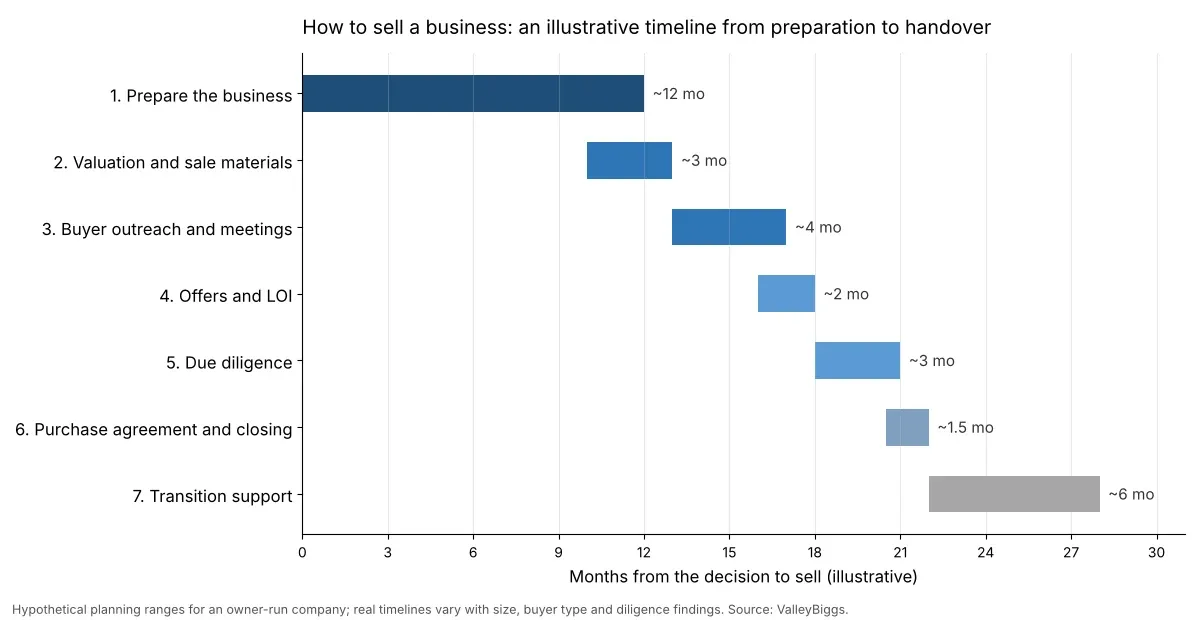
Larger transactions that cross the federal premerger notification threshold also need a Hart-Scott-Rodino filing with the FTC and Department of Justice and a waiting period before closing, which adds time on top of these ranges.
Documents Checklist for Selling a Business
These are the documents needed to sell a business in most deals. Gathering them early is one of the simplest ways to shorten the process. Not every item applies to every company.
- Three or more years of financial statements and business tax returns, plus monthly year-to-date results
- A schedule of add-backs and adjustments, with backup for each item
- Accounts receivable and payable agings, debt schedules and loan agreements
- Customer list with revenue by customer, key customer and supplier contracts
- Organizational chart, employee roster, employment and contractor agreements, benefit plans
- Formation documents, operating agreement or bylaws, cap table and any buy-sell agreements
- Leases, licenses, permits and insurance policies
- Intellectual property records: trademarks, domains, software ownership and licenses
- For tech and SaaS companies: recurring revenue, churn and retention reports, product roadmap, security policies
Common Mistakes Owners Make When Selling
- Starting too late. Selling because of burnout or a sudden life event leaves no time to fix what buyers will discount.
- Anchoring on an unsupported price. A number based on effort or a friend’s sale, rather than normalized earnings, stalls negotiations.
- Talking to only one buyer. Without competition, the buyer sets the terms.
- Signing a loose LOI. Vague language on working capital, earnouts or escrow becomes expensive during the purchase agreement.
- Letting performance slip. The business is still being judged until closing.
- Ignoring tax structure until the end. By then the allocation and structure are hard to change.
- Breaking confidentiality. Telling staff or customers too early can cost key people and contracts.
When to Talk to an M&A Advisor
It makes sense to bring in an advisor once a sale is a realistic possibility within the next one to two years, not when the first unsolicited offer arrives. At that point an advisor can tell you what buyers are likely to pay, which weaknesses to fix first, and whether a broad or targeted process suits your company. If a buyer has already approached you, a short conversation before you reply can keep you from giving away leverage in the first call.
Conclusion
Learning how to sell a business is mostly about sequence: prepare before you market, know your value before you negotiate, and judge offers on what you will actually keep rather than the headline number. Owners who follow that order tend to sell faster, with fewer surprises in diligence. If you are weighing a sale in the next year or two, the practical first step is a confidential conversation about your numbers and options. You can start the process of selling your business or book a confidential consultation with the ValleyBiggs team.
FAQs
1. What is the first step in selling a business?
The first step is deciding what you want from the exit: your after-tax number, your timing and your role after closing. Then get three years of financials cleaned up and reviewed, because every later step, from valuation to diligence, depends on numbers a buyer can verify.
2. How do you calculate what to sell a business for?
Start with normalized earnings, either seller’s discretionary earnings or adjusted EBITDA, and apply a multiple drawn from comparable private-company sales. Adjust for growth, recurring revenue, customer concentration and owner dependence. Remember that debt payoff and working capital adjustments come out of the headline figure. See how a company with $1 million in sales is valued for a worked example.
3. How much tax do you pay when you sell a business?
It depends on deal structure, how the price is allocated among assets, your entity type and your state. Gain on long-term capital assets is taxed at federal capital gains rates, while depreciation recapture and payments for consulting or non-competes can be ordinary income. This is general information, not tax advice; plan the structure with a tax advisor early.
4. Can I sell my business without a broker or advisor?
Yes. Owners with a known buyer, such as a partner, employee or competitor, often sell directly with only an M&A attorney and a CPA. The trade-off is that a single buyer faces no competition, and you carry the work of valuation, buyer screening, negotiation and diligence coordination yourself while still running the company.
5. When should I tell employees I am selling the business?
Most sellers tell only a small group of key managers before closing, under confidentiality agreements, because buyers want to meet them during diligence. Broader announcements usually come at or shortly after closing, together with the buyer. Retention bonuses for critical staff can help keep the team stable through the process.
6. Can you sell a business that is losing money?
Yes, but buyers will price it on something other than profit: its customers, technology, contracts, brand or assets, and what it would be worth inside their own company. Expect a lower price than a profitable peer and more of the value to be paid through earnouts or other deferred terms tied to a turnaround.
7. Is it better to sell to a competitor or a private equity firm?
It depends on your goals. A competitor may pay more for synergies but will see sensitive data, so disclosure should be staged carefully. A private equity buyer usually keeps the team, may offer rollover equity and a second payout later, but will expect strong reporting and growth plans. Running both through one process lets you compare them directly.