

Knowing how to sell an LLC starts with one choice: either the owners sell their membership interests, so the buyer takes over the company itself, or the LLC sells its assets and the owners keep the empty entity. Your operating agreement and your state’s LLC statute then decide who has to approve the deal, how a departing member is paid and what has to be filed after closing.
This guide covers both routes, plus partial sales and member buyouts. It explains how single-member and multi-member LLCs differ, the tax points to raise with your CPA, the documents buyers ask for and the mistakes that slow LLC deals down.
Key Takeaways
- An LLC can be sold two ways: a sale of the membership interests (the buyer gets the entity, including its history) or a sale of the company’s assets (the buyer picks what it takes).
- Read the operating agreement before you talk to any buyer. Consent rules, rights of first refusal and buy-sell clauses often decide whether a sale can happen at all.
- Under many state statutes, a buyer of an LLC interest gets only economic rights until the other members admit it as a member, so partial sales need member sign-off.
- For federal tax, a single-member LLC that is a disregarded entity sells assets even when the paperwork says it is selling the company. Multi-member LLCs follow partnership rules.
- Post-closing paperwork matters: an amended operating agreement, state filings where members or managers are listed, and IRS Form 8822-B within 60 days when the responsible party changes.
This article is general education about selling a limited liability company. It is not legal or tax advice. LLC law varies by state and every deal has its own facts, so confirm each point with your attorney and CPA.
What Are You Actually Selling When You Sell an LLC?
An LLC has no shares of stock. Ownership is held as membership interests, sometimes called units, and each interest carries two bundles of rights. The economic bundle is the right to profits, losses and distributions. The governance bundle is the right to vote, manage (in a member-managed LLC) and inspect records.
That split is what makes LLC sales different from corporate stock sales. In Delaware, for example, the LLC Act says that assigning an interest does not by itself let the assignee become a member or exercise a member’s rights; the assignee becomes a member as the LLC agreement provides or with the consent of the members. Many other states follow the Revised Uniform Limited Liability Company Act, which treats a transferee in a similar way: it receives distributions but no say in management unless it is admitted as a member.
In practice, a buyer paying full value for an interest will insist on being admitted as a member with full rights. So the real question in most LLC sales is not whether you can transfer LLC ownership, but who must agree to let the buyer in.
Four Ways to Sell an LLC
Owners usually exit an LLC through one of four structures. Which one fits depends on whether you are selling the whole company or only your stake, who the buyer is and how the LLC is taxed.
1. Sell 100% of the membership interests
All members sell their interests to one buyer under a membership interest purchase agreement (MIPA). The LLC keeps its name, EIN, bank accounts, contracts, permits and history, and the buyer steps into ownership. This is the closest LLC equivalent of a stock sale. Sellers often prefer it because contracts and licenses usually stay in place, while buyers weigh that convenience against inheriting past liabilities, which they manage with diligence, indemnities and escrows.
2. Sell part of your membership interest
When you sell an LLC membership interest without selling the whole company, you hand over a percentage of your stake, or your whole stake while the other members stay. A partial sale is how many owners bring in a growth investor or start a staged exit. It almost always needs the consent of the remaining members, and the price of a minority stake is often lower per percentage point than the price of control, because the buyer cannot direct the company or force a sale.
3. A buyout by the other members or the company
A buy-sell provision in the operating agreement, or a separate buy-sell agreement, may give the remaining members or the LLC itself the right or the duty to buy out a departing member. These clauses typically name trigger events (retirement, death, disability, divorce, a deadlock), a valuation method and a payment schedule. A sale to the people who already run the company is close in spirit to a management buyout, and it is often financed partly by the seller over time.
4. The LLC sells its assets
The company sells selected assets, such as customer contracts, intellectual property, equipment, inventory and goodwill, under an asset purchase agreement (APA). The buyer chooses which liabilities it assumes. Afterward the owners still hold the LLC, now holding cash, and pay off remaining debts before distributing proceeds and winding the entity down. Buyers often prefer this route for the liability protection and, for tax, a new basis in the assets.
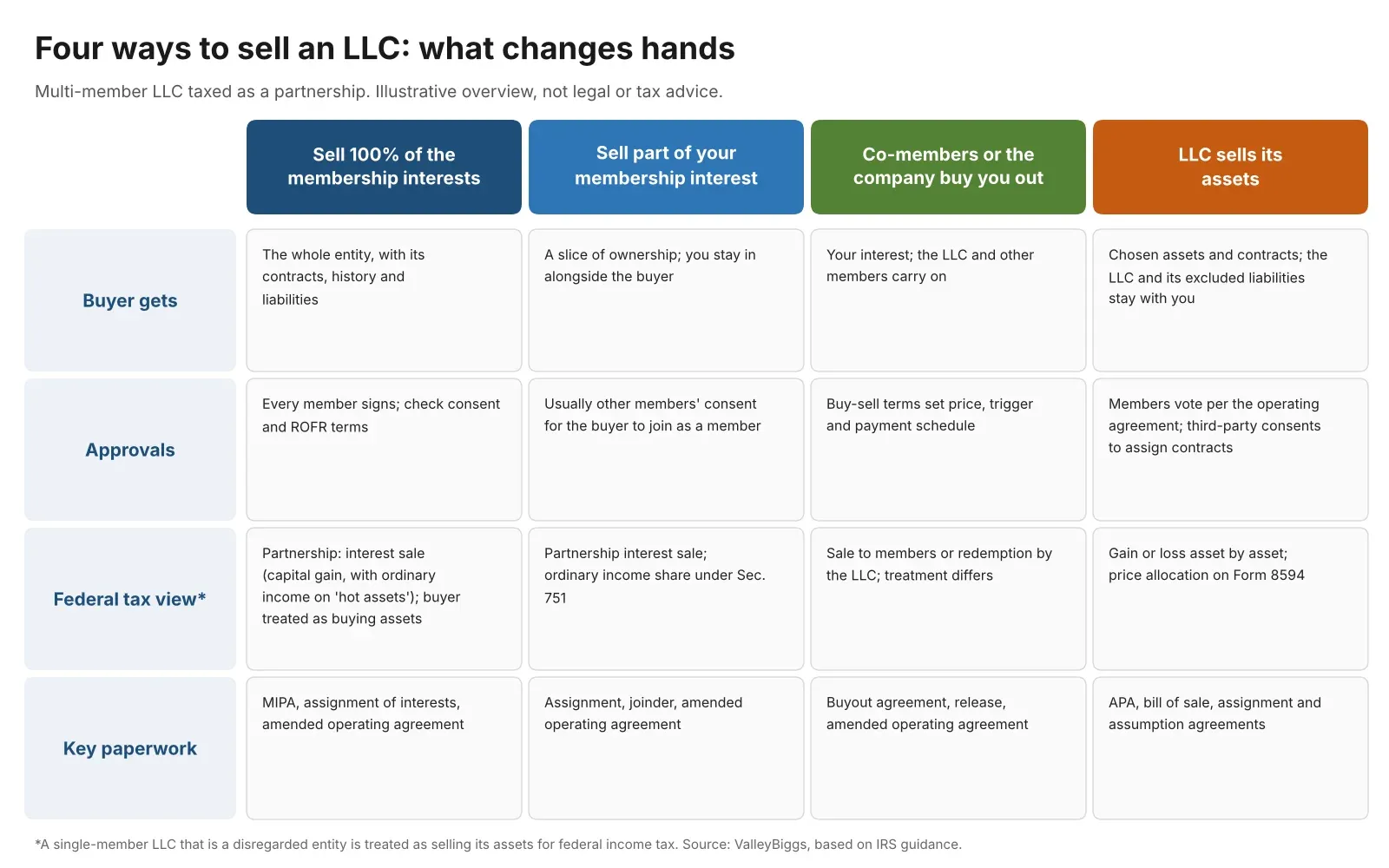
The table below compares the two main structures from each side of the table.
| Factor | Membership interest sale | Asset sale |
|---|---|---|
| What transfers | The entity, including contracts, permits, history and liabilities | Only the assets and liabilities listed in the APA |
| Contracts and licenses | Usually stay in place; watch for change-of-control clauses | Each one must be assigned; some need counterparty consent or reissue |
| Liability exposure for the buyer | Higher; handled with diligence, reps, indemnities and escrow | Lower; unassumed liabilities stay with the selling LLC |
| Paperwork | Lighter: MIPA, assignment of interests, amended operating agreement | Heavier: APA, bill of sale, assignment and assumption agreements, title transfers |
| Federal tax (multi-member LLC taxed as a partnership) | Generally capital gain for sellers, with ordinary income on any Section 751 items | Gain or loss computed asset by asset; character depends on the asset |
| Who usually prefers it | Sellers wanting a clean exit; buyers wanting continuity | Buyers wanting to limit inherited risk |
Single-Member vs Multi-Member LLC: What Changes
The number of owners changes both the legal mechanics and the tax result, so it is worth pinning down before you set a price.
Single-member LLC
A one-owner LLC that has not elected corporate tax treatment is a disregarded entity for federal income tax. When the owner sells 100% of the interest, the IRS treats it as a sale of the LLC’s assets, so the seller reports gain asset by asset, much as a sole proprietor would. On the legal side, Delaware lets an assignee become a member automatically when a sole member assigns all of its interests to a single assignee, unless the LLC agreement says otherwise. Check your own state’s rule.
Selling only part of a single-member LLC has its own consequence: the moment a second owner arrives, the LLC is generally treated as a partnership for tax, which brings a partnership return and K-1s.
Multi-member LLC taxed as a partnership
A sale of membership interests is generally treated as a sale of a partnership interest. The selling members usually report capital gain, except for the share of proceeds tied to unrealized receivables and inventory items under Section 751, which is ordinary income. When a single buyer acquires every member’s interest, the IRS (Revenue Ruling 99-6) treats the sellers as selling partnership interests and the buyer as acquiring the underlying assets.
Two older rules still circulate in online guides. The so-called technical termination, triggered when 50% or more of the interests changed hands within 12 months, was eliminated by the Tax Cuts and Jobs Act for tax years beginning after 2017. And a new EIN is not automatically required just because members change; the IRS lists the specific situations, such as terminating the LLC and forming a new corporation or partnership.
LLC taxed as an S corporation or C corporation
If the LLC elected corporate tax status, a sale of membership interests is taxed much like a stock sale, and buyers often push for an asset sale or a structure that gives them a stepped-up basis. This is where the after-tax gap between offers can be largest, so model each structure with your CPA before you sign a letter of intent.
How to Sell an LLC Step by Step
The sequence below fits most owner-run LLCs worth roughly $1 million and up. For the parts every business sale shares, such as preparing financials, marketing and negotiating, see our full step-by-step guide to selling a business. The steps here focus on what is specific to an LLC.
Step 1: Read the operating agreement before anything else
Pull the signed operating agreement and every amendment, and look for:
- Transfer restrictions: whether interests can be sold at all, and to whom.
- Consent thresholds: unanimous, majority or supermajority approval to sell interests, sell substantially all assets or admit a new member.
- Right of first refusal or first offer: whether the other members or the company must get the chance to match an outside offer.
- Drag-along and tag-along rights: whether a majority can force minority members to sell on the same terms, or whether minority members can join a sale.
- Buy-sell provisions: trigger events, the valuation formula and the payment terms for a departing member.
- Admission of new members: what a buyer must sign to become a member.
If there is no written operating agreement, your state’s default LLC rules fill the gap, and those defaults are often stricter about admitting new members than owners expect.
Step 2: Get the members aligned
In a multi-member LLC, agree internally on the goal (sell the whole company, sell one member’s stake or bring in a partner), the minimum acceptable terms and who speaks for the group with buyers. Disagreements that surface after a letter of intent are a common reason LLC deals stall.
Step 3: Value the company and, if needed, the interest
Buyers price the business on normalized earnings and market multiples, so start with how buyers price a private company. If you are selling a partial stake, expect discussion of discounts for lack of control and lack of marketability. An independent enterprise valuation gives the members one defensible number to work from, and it is often what a buy-sell clause requires anyway.
Step 4: Clean up the entity
- Confirm the LLC is in good standing with the state, with annual reports and franchise taxes current.
- Make sure intellectual property, domains and key contracts are owned by the LLC, not by a member personally.
- Paper any related-party arrangements, such as a member’s building leased to the company or loans from members.
- Reconcile capital accounts and distributions so every member’s economic share is clear.
- Gather federal and state tax returns, including partnership returns and K-1s for each year.
Step 5: Choose the structure with your advisors
Decide between an interest sale, an asset sale or a hybrid, and model each member’s after-tax proceeds. Members can come out very differently under the same headline price, especially when capital accounts or tax bases differ.
Step 6: Find buyers and market the company confidentially
Strategic acquirers, private equity firms, search funds and individual buyers each value an LLC differently. A sell-side advisory team builds the buyer list, runs NDAs and keeps the process competitive. You can also see how ValleyBiggs takes a business to market, from intake to valuation and buyer outreach.
Step 7: Negotiate the LOI, get through diligence and sign
The letter of intent sets price, structure, exclusivity and key terms such as escrow, earnouts or a seller note. In diligence, buyers of an LLC will ask for the formation documents and operating agreement on top of the usual financial and legal requests; our due diligence checklist lists what to prepare. The definitive agreement is a MIPA or an APA, plus the member consents that authorize it.
Step 8: Close and file
At closing, members sign the assignment of interests (or the bill of sale and assignment agreements in an asset deal), the buyer signs a joinder or new operating agreement, and funds flow. After closing, work through the filings:
- Amend the articles of organization or file a statement of change if your state lists members or managers on public filings.
- File IRS Form 8822-B within 60 days if the LLC’s responsible party changes.
- Check the IRS rules on whether the new structure needs a new EIN.
- In an asset sale, both buyer and seller generally file Form 8594 to report how the price was allocated among asset classes.
- If a partnership interest sale involves Section 751 property, the LLC may need to file Form 8308, and the selling member attaches a statement to their return.
- Update banks, lenders, insurers, licensing agencies and the registered agent.
Tax Points to Raise With Your CPA
Tax is where LLC sales differ most from one another. These are the questions worth putting on the agenda early, ideally before you go to market:
- How is the LLC classified for federal tax (disregarded entity, partnership, S corporation or C corporation), and what does that mean for an interest sale versus an asset sale?
- How much of the gain could be ordinary income, for example from receivables, inventory or depreciation recapture?
- Would the buyer ask for a Section 754 election so it gets a basis step-up in a partnership interest purchase, and should that affect price?
- How should the price be allocated among asset classes in an asset sale, and how does the allocation shift tax between the parties?
- If part of the price is paid over time, does installment sale treatment apply?
- What state income, transfer or sales tax filings apply, and does the state require any notice or tax clearance before assets change hands?
Documents Checklist for Selling an LLC
Buyers and their lawyers will expect the LLC-specific records below on top of the standard financial package:
- Articles of organization (certificate of formation) and every amendment
- Signed operating agreement and amendments, plus any separate buy-sell agreement
- Membership ledger or cap table showing each member’s interest and units
- Member and manager consents and minutes for major decisions
- Certificate of good standing and recent annual reports
- IRS EIN confirmation and any entity classification election
- Three to five years of tax returns, including K-1s, and financial statements
- Material contracts, with change-of-control and anti-assignment clauses flagged
- IP assignments from founders, employees and contractors
- Licenses, permits, leases and insurance policies
Hypothetical Example: Selling a Three-Member SaaS LLC
The figures below are hypothetical and simplified, used only to show how an LLC sale flows through to each member. Three founders own a software company organized as an LLC taxed as a partnership: Member A holds 50%, Member B 30% and Member C 20%. A buyer offers $8.0 million of enterprise value for 100% of the membership interests, on a cash-free, debt-free basis, with 10% of the price held in escrow for 12 months.
| Line item | Amount |
|---|---|
| Enterprise value (headline price) | $8,000,000 |
| Less: bank debt repaid at closing | ($600,000) |
| Plus: excess cash left in the company | $200,000 |
| Equity value to members | $7,600,000 |
| Held in escrow (10% of headline price) | ($800,000) |
| Cash to members at closing | $6,800,000 |
| Member A (50%) at closing | $3,400,000 |
| Member B (30%) at closing | $2,040,000 |
| Member C (20%) at closing | $1,360,000 |
Now suppose Member C wants out but A and B do not want to sell. The operating agreement’s buy-sell clause applies instead: an appraiser values the company, the clause applies its own discount for a minority interest if it has one, and the LLC redeems C’s stake over three years. Same company, very different outcome for C, which is why the operating agreement deserves attention long before an exit.
Common Mistakes When Selling an LLC
- Talking to buyers before reading the operating agreement. A missed right of first refusal can unwind a deal or start a dispute.
- Assuming a buyer of a partial stake automatically becomes a member. Without the required consents, it may receive only economic rights.
- Ignoring entity hygiene. A lapsed annual report or unpaid franchise tax can block the good-standing certificate a buyer needs at closing.
- Leaving IP or key contracts in a member’s personal name. Buyers want the assets inside the company they are buying.
- Comparing offers on headline price. Structure, escrow, earnouts and tax character can move each member’s net result by far more than the price gap.
- Skipping post-closing filings. An outdated state record or IRS responsible party can leave a former owner tied to the company.
LLC Exit Strategy Options Beyond a Full Sale
A sale to an outside buyer is not the only way out. Depending on your goals, your LLC exit strategy might be a buyout by co-members, a sale to your management team, a staged sale where an investor buys a stake now and the rest later, or an orderly wind-down where the LLC sells its assets, pays its creditors, distributes what is left and files for dissolution or cancellation with the state. If you are weighing these against each other, exit planning a year or more ahead gives you room to fix gaps and choose the timing.
When to Talk to an M&A Advisor
Owners selling a small LLC to a known buyer sometimes manage with an attorney and a CPA alone. Bring in an M&A advisor when the company is worth roughly $1 million or more, when you want competitive tension among several buyers, when the members disagree about price or timing, or when the buyer is a private equity firm or strategic acquirer with an experienced deal team on its side. An advisor also keeps the sale confidential and keeps the business running while members focus on customers and staff.
Conclusion
Selling an LLC follows the same arc as any business sale, with two extra layers: the operating agreement and state law decide who must agree, and the LLC’s tax classification shapes what each member keeps. Settle those early and the rest of the process gets easier. If you are thinking about how to sell your LLC business in the next year or two, book a confidential consultation with ValleyBiggs to talk through structure, value and timing.
FAQs
1. Is it hard to sell an LLC?
It is not harder than selling other private companies, but it has extra checkpoints. The operating agreement may require member consent or give co-members a right of first refusal, and state law may limit what a buyer of a partial interest receives. Sorting out those rules and the tax structure early removes most of the friction.
2. What happens to the LLC when it is sold?
In a membership interest sale, the LLC keeps operating under the new owner with the same name, contracts and history. In an asset sale, the buyer takes only the assets it purchased, and the original LLC remains with the sellers, who pay its remaining debts, distribute the proceeds and usually dissolve it.
3. Can I sell my share of an LLC without the other members' approval?
Often you can transfer the economic rights, but the buyer may not become a member with voting rights unless the operating agreement allows it or the other members consent. Many agreements also give co-members a right of first refusal. Read the transfer clauses first and confirm the result under your state’s LLC statute with an attorney.
4. Can you sell an LLC that has debt?
Yes. In most deals the debt is paid off from the sale proceeds at closing, so the buyer receives the company cash-free and debt-free. In an asset sale, the buyer assumes only the liabilities listed in the agreement. Personal guarantees signed by members are not released automatically, so arrange their release with the lender as part of closing.
5. Do I need a new EIN after selling an LLC?
Not always. If the buyer acquires the membership interests and the LLC continues, it often keeps its EIN, though the responsible party must be updated on Form 8822-B within 60 days. The IRS requires a new EIN in specific cases, such as terminating the LLC and forming a new corporation or partnership, so check its guidance with your CPA.
6. Can I sell an LLC without an operating agreement?
Yes, but your state’s default LLC rules will govern the sale, including who must approve it and whether a buyer can be admitted as a member. Those defaults may require consent from every member. Many sellers adopt a written agreement or a signed member consent before closing so buyers can see clear authority for the transaction.