

How much is a business worth with $5 million in sales? For a typical privately held company at that size, a realistic range is about $1 million to $7 million, and the profit margin, not the revenue figure, decides where you fall. Buyers multiply adjusted EBITDA (or, for owner-run firms, seller’s discretionary earnings) by a multiple that usually sits somewhere between 3.5x and 5.5x.
Five million dollars of revenue is an awkward size to price. The company is too big for many individual buyers and often too small for a private equity platform, so two very different buyer groups compete for it, and each uses its own math. This guide shows both methods, a hypothetical worked example, the financing rules that cap price, and the preparation that moves you up the range in 2027.
Key Takeaways
- Revenue sets the scale, but earnings set the price. At $5 million in sales, value usually follows adjusted EBITDA, with SDE still used when the owner runs daily operations.
- The IBBA and M&A Source Market Pulse survey for Q1 2026 reported median multiples of about 4.0x EBITDA for deals priced at $2 million to $5 million and 4.5x for $5 million to $50 million.
- Converting SDE to EBITDA means deducting a market-rate salary for the manager who will replace you. That single adjustment can cut the earnings base by $150,000 or more.
- Many deals at this size are financed with SBA 7(a) loans, which top out at $5 million. Since October 1, 2026, total acquisition debt in those deals cannot exceed an independent appraisal of the business.
- A management team, contracted revenue and clean monthly financials are what move a company from the low end of the range to the high end.
Why $5 Million in Sales Is a Pricing Crossroads
Most small businesses that change hands are much smaller. A company with $5 million of annual revenue usually carries a real payroll, at least one layer of management and an established customer base, which puts it at the bottom edge of what dealmakers call the lower middle market. That position creates a split buyer pool:
- Individual and search-fund buyers who will run the business themselves, typically with an SBA loan and a seller note. They think in terms of the cash the company puts in an owner’s pocket.
- Private equity add-on buyers and independent sponsors who already own a platform in your industry or plan to build one. They think in terms of EBITDA after a professional manager is paid.
- Strategic buyers, usually a competitor, supplier or customer, who may pay for cross-selling, territory or capacity they cannot easily build.
The same company can look like a $2.5 million business to one group and a $3.5 million business to another. Understanding which lens each buyer applies, and preparing for the one that pays more, is the main pricing decision at this size. Our general guide to what a business is worth covers the valuation basics; this article stays with the $5 million revenue tier.
SDE vs EBITDA: Which Earnings Number Buyers Use at $5 Million
Seller’s discretionary earnings (SDE) counts everything a single owner-operator takes home: pre-tax profit plus the owner’s salary and benefits, interest, depreciation, amortization and genuinely one-time or personal costs. It answers the question an individual buyer asks: if I step into the owner’s seat, what will I earn?
Adjusted EBITDA starts from the same profit and the same add-backs, but it keeps a fair salary for whoever will run the business after you leave. It answers the investor’s question: what does this company earn when every job, including the top one, is paid at market rates?
At $5 million in sales the choice between SDE vs EBITDA is not a formality. It changes the earnings base, and each base comes with its own multiple:
| SDE | Adjusted EBITDA | |
|---|---|---|
| Owner’s salary | Fully added back | Replaced with a market-rate manager salary |
| Typical buyer | Owner-operator, search fund, SBA borrower | Private equity add-on, strategic acquirer, independent sponsor |
| Multiple range seen in surveys | Roughly 2.5x to 3.5x for larger main street deals | Roughly 3.5x to 5.5x for the lower middle market |
| Best fit | Owner still runs sales or operations day to day | A general manager or leadership team already runs the business |
| What it rewards | High owner income | Transferable, management-led earnings |
A useful rule of thumb: if you could take a three-month sabbatical without revenue dropping, buyers will usually underwrite EBITDA. If customers, key suppliers or the sales pipeline depend on you personally, expect SDE pricing and a lower overall figure.
What Multiples Do Companies With $5 Million in Revenue Sell For?
The most useful public benchmark for this tier is the quarterly Market Pulse survey run by the International Business Brokers Association and M&A Source. It groups closed deals by purchase price and reports median multiples. In the Q1 2026 edition, the medians were about 3.0x SDE for deals priced at $1 million to $2 million, 4.0x EBITDA for $2 million to $5 million, and 4.5x EBITDA for $5 million to $50 million. Its Q2 2026 highlights noted that strong businesses above $2 million were still drawing real competition.
Private equity databases show higher figures for bigger companies. GF Data, which tracks sponsor-backed deals above $10 million of enterprise value, reported an average of about 6.3x adjusted EBITDA (median 6.0x) for its $10 million to $25 million tier over 2021 to 2025. Most companies with $5 million in sales are well below that deal size, so those multiples describe where a business can go as it grows rather than what it should expect today.
How Much Is a Business Worth With $5 Million in Sales at Different Margins?
Applied to a range of margins, the survey multiples produce the following hypothetical values:
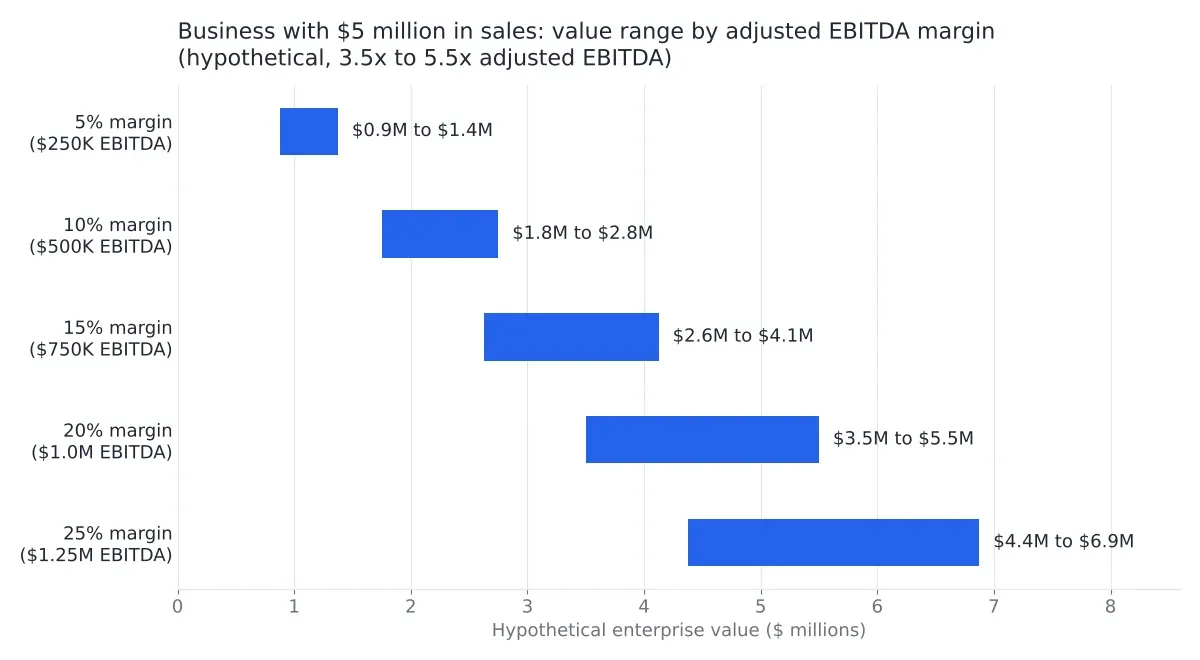
| Adjusted EBITDA margin | Adjusted EBITDA on $5M sales | Value at 3.5x | Value at 5.5x | Implied revenue multiple |
|---|---|---|---|---|
| 5% | $250,000 | $875,000 | $1,375,000 | 0.18x to 0.28x |
| 10% | $500,000 | $1,750,000 | $2,750,000 | 0.35x to 0.55x |
| 15% | $750,000 | $2,625,000 | $4,125,000 | 0.53x to 0.83x |
| 20% | $1,000,000 | $3,500,000 | $5,500,000 | 0.70x to 1.10x |
| 25% | $1,250,000 | $4,375,000 | $6,875,000 | 0.88x to 1.38x |
Two things stand out. First, the gap between a 10% and a 20% margin is worth roughly $2 million or more at this size, far more than the same margin gap at $1 million in revenue. Second, the revenue multiple is simply margin times the earnings multiple. Anyone quoting “one times sales” without asking about margin is guessing.
A Hypothetical Worked Example: From Tax Return to Asking Price
Consider a hypothetical B2B services company with $5.0 million in revenue. The owner works as CEO and draws a $220,000 salary. The tax return shows $520,000 of pre-tax profit, and the books carry $90,000 of depreciation, $40,000 of interest on an equipment loan, a one-time $30,000 legal bill and $15,000 of personal vehicle costs.
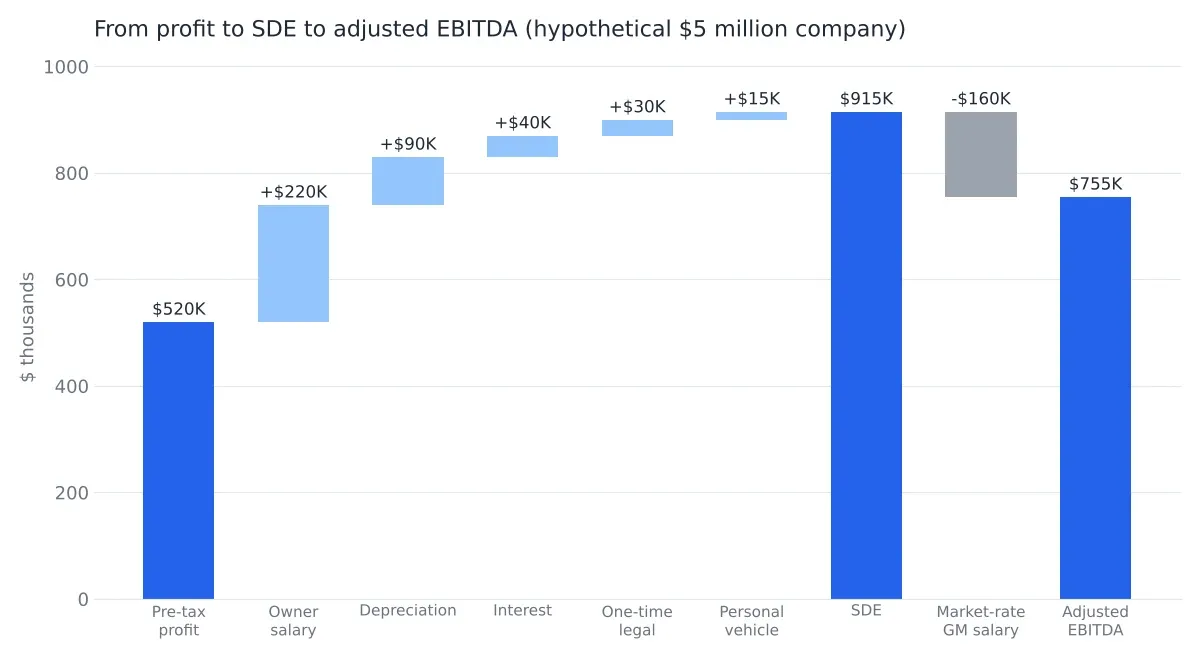
- Build SDE. $520,000 + $220,000 + $90,000 + $40,000 + $30,000 + $15,000 = $915,000.
- Replace the owner. A general manager for a business this size might cost about $160,000 including payroll taxes and benefits. Deducting that gives adjusted EBITDA of $755,000, a 15.1% margin.
- Apply each buyer’s lens. An owner-operator paying 3.0x SDE offers about $2.75 million. An add-on buyer paying 4.0x to 5.0x EBITDA lands at about $3.0 million to $3.8 million.
- Test the financing. At a $3.4 million price with 10% buyer equity, an SBA loan of about $3.06 million over 10 years at an illustrative 10.5% rate costs roughly $495,000 a year. Adjusted EBITDA of $755,000 covers that about 1.5 times.
- Pick a defensible asking price. Listing at $3.4 million to $3.6 million, with a clear explanation of each add-back, gives both buyer groups a reason to engage.
The example shows why management depth matters. If this owner had already promoted a general manager, the $160,000 deduction would be a real, proven cost rather than an estimate, and the EBITDA buyer would face less risk. Equally, if half of the add-backs could not be documented, every buyer would cut them and the value would fall by several hundred thousand dollars.
How SBA Financing Caps the Price
For the owner-operator buyer group, the bank sets the ceiling. The 7(a) program has a $5 million loan ceiling. That is enough for many companies in this tier, yet it gets tight once the price, working capital and closing costs approach that cap. Under the SBA’s SOP 50 10 8.1, which took effect on October 1, 2026, several rules shape what a buyer can pay:
- Every change-of-ownership loan needs an independent third-party valuation, whatever the loan size, and total acquisition debt cannot exceed that valuation.
- If the agreed price is higher than the appraisal, the buyer must cover the gap with additional equity.
- Initial acquisitions require buyer equity of at least 10% of total project costs. A seller note may fund up to 50% of the required equity, provided the seller agrees to receive no payments on it until the SBA loan is repaid.
- When a buyer acquires the whole company, the seller normally leaves, though a consulting arrangement lasting no more than 24 months is permitted.
In practice, an asking price that an independent appraiser would not support is unlikely to close with an SBA buyer. These are summaries of program rules, not lending or legal advice, and buyers should confirm the details with their lender.
What Moves the Multiple Up or Down at This Size
| Factor | Supports a higher multiple | Pushes the multiple lower |
|---|---|---|
| Leadership | General manager and department heads in place | Owner is the main salesperson and decision-maker |
| Customer mix | No customer above about 10% of revenue | A few accounts provide most of the revenue |
| Revenue quality | Contracts, subscriptions, repeat orders | Project work that must be resold every year |
| Growth | Three years of steady revenue and margin growth | Flat or declining trend, or one unusual year |
| Financial reporting | Monthly accrual statements that tie to tax returns | Cash-basis books and unexplained adjustments |
| Working capital | Predictable receivables and inventory levels | Large seasonal swings or slow-paying customers |
| Industry interest | Fragmented sector where consolidators are active | Shrinking or highly cyclical market |
Industry matters as well. A software or tech-enabled services company with $5 million of recurring revenue is often priced on revenue or annual recurring revenue rather than EBITDA, because buyers pay for growth and retention. If that describes your company, our pages on how to sell a SaaS business and on the Rule of 40 benchmark explain which metrics drive those offers.
How Deal Structure Changes What You Take Home
At $5 million in sales, the headline price is rarely paid entirely in cash on day one. Common components include:
- Cash at closing, paid from the buyer’s own equity plus bank debt. It is usually the largest piece.
- A seller note, which you repay to yourself over several years with interest. It bridges valuation gaps but leaves you exposed to the new owner’s performance.
- An earnout, which pays more if the business hits revenue or EBITDA targets after closing. Earnouts are more common when growth is part of the pitch.
- Rollover equity, where a private equity buyer asks you to keep a minority stake so you share in a second sale later.
- A working capital target, often called a peg, which requires you to deliver a normal level of receivables and inventory. Shortfalls reduce the price dollar for dollar.
Two offers at $3.5 million can be worth very different amounts once you account for timing, risk and taxes. Asset sales and stock sales also allocate price differently for tax purposes, so involve your CPA early. Treat this section as general information rather than legal or tax advice.
How to Prepare a $5 Million Business for Sale
Most of what lifts value at this size takes 12 to 24 months to show up in the numbers. A practical sequence:
- Move to monthly accrual financial statements and have a CPA review or audit at least the most recent year.
- Commission a sell-side quality of earnings review, so add-backs are tested before a buyer’s accountants test them.
- Promote or hire a general manager and document who owns sales, operations and finance.
- Put key customer relationships under contract where possible and spread revenue across more accounts.
- Clean up the data room: leases, licenses, contracts, payroll records and the items in our due diligence checklist for sellers.
- Prepare a clear confidential information memorandum that explains the business, the add-backs and the growth plan in one place.
If the company is closer to $1 million in revenue, the buyer pool and math are different; see our breakdown of what a business with $1 million in sales is worth. Companies that have grown into an eight-figure valuation face a third set of buyers, covered in our guide to how much a $10 million company is worth.
When to Bring In an M&A Advisor
Online calculators and survey medians are fine for a first estimate. They stop being enough when:
- Two buyer groups would price the company differently and you need to know which one to target.
- Your add-backs are large or unusual and need a documented defense.
- You have received an unsolicited offer and want to know whether it is fair.
- The likely price sits near the SBA loan limit, or a private equity buyer is asking for rollover equity or an earnout.
A professional enterprise valuation analysis turns those questions into a defensible range, and experienced sell-side advisors can then run a confidential process that invites both buyer groups to compete.
Conclusion
A business with $5 million in sales can be worth $1 million or $7 million. The difference comes from margin, management depth and the buyer you attract, not from the revenue line. Owners who know their adjusted EBITDA, document every add-back and build a team that runs without them give themselves the best chance of selling at the top of the range in 2027.
If a sale is on your horizon within one to three years, start with a confidential valuation conversation. Contact ValleyBiggs to discuss your numbers, or read how we help owners sell a business confidentially.
FAQs
1. Is a business with $5 million in sales priced on SDE or EBITDA?
It depends on who runs the company. If the owner still leads sales and operations, buyers often use seller’s discretionary earnings. If a general manager or leadership team runs daily operations, most buyers switch to adjusted EBITDA, which deducts a market-rate salary for that role. Many companies at this size are marketed on both figures so each buyer group can see its own number.
2. How many times revenue is a $5 million business worth?
Most companies at this size sell for well under 1.5 times revenue. The revenue multiple is simply the profit margin multiplied by the earnings multiple, so a 15% EBITDA margin at 4.0x equals about 0.6x revenue, and typical margins in this tier land around 0.35x to 0.8x. Recurring-revenue software companies are the main exception, because buyers pay for growth and retention.
3. Can a buyer use an SBA loan to buy a business with $5 million in sales?
Yes, and many do. SBA 7(a) loans go up to $5 million, which covers a large share of deals in this tier. Under SOP 50 10 8.1, the lender needs an independent business valuation, total acquisition debt cannot exceed it, and the buyer usually injects at least 10% equity. Prices well above the appraisal require extra cash from the buyer.
4. Who buys companies with around $5 million in revenue?
Three groups are most active: individual and search-fund buyers who plan to run the company, private equity firms adding a smaller company to an existing platform, and strategic buyers such as competitors or suppliers. Each group prices differently, which is why a structured sell-side process that brings several of them to the table often produces a better result.
5. What profit margin does a $5 million business need to sell well?
There is no single target, because normal margins differ widely by industry. Buyers compare your adjusted EBITDA margin with peers and look for stability over three years. Each five-point gain in margin on $5 million of sales adds about $250,000 of EBITDA, which at typical lower middle market multiples can add roughly $0.9 million to $1.4 million of value.
6. Should I get a professional valuation before selling a $5 million business?
Usually, yes. A professional valuation documents your add-backs, shows which earnings measure fits your company and tests whether your price can be financed. It also gives you a defensible anchor when offers arrive. An enterprise valuation analysis is a practical first step 12 to 24 months before going to market.