

The LTV:CAC ratio divides the gross profit a customer is expected to produce over its life by the fully loaded cost of winning that customer. Around 3x is the usual benchmark, but when you sell a software or subscription company, the number that matters is the one a buyer rebuilds from your data, not the one in your board deck. This guide covers the LTV CAC formula, what counts as a good ratio, how buyers recalculate it in diligence with a worked example, and how the result feeds into price and deal terms for founders preparing an exit in 2027.
Key Takeaways
- LTV:CAC compares customer lifetime value, measured on gross profit, with the cost of acquiring a customer. A ratio near 3x is the common rule of thumb for a healthy SaaS or subscription business.
- Buyers rarely accept a seller’s figure as presented. They rebuild it with gross margin, fully loaded sales and marketing cost, recent cohort churn and a capped customer lifetime, and the result is often far lower.
- The ratio and the CAC payback period are read together. A strong ratio with a three-year payback still ties up a lot of cash, which affects how buyers value growth.
- Better unit economics support a higher multiple. An a16z analysis of public consumer internet companies linked a move from 2x to 3x with a near tripling of value per dollar of gross profit.
- The most credible way to improve the number before a sale is to reduce churn and cut channels with weak payback, 12 to 24 months before you go to market.
What Is the LTV:CAC Ratio?
The LTV:CAC ratio measures how much gross profit an average customer generates over its relationship with your company for every dollar spent to acquire that customer. A ratio of 3.0x means each $1 of acquisition spend returns about $3 of lifetime gross profit before overhead, R&D and other operating costs.
LTV stands for customer lifetime value (sometimes written CLV or CLTV). CAC stands for customer acquisition cost. The ratio is written several ways, including LTV/CAC, LTV to CAC and the reversed CAC:LTV, but the most common form puts lifetime value on top.
Why buyers look at it before most other metrics
Revenue growth tells a buyer how fast the company is getting bigger. The LTV to CAC ratio tells the buyer whether that growth creates value or only consumes cash. A private equity fund that plans to add sales capacity after closing wants proof that each new rep or campaign dollar comes back with a return. A strategic acquirer wants to know whether your customers will still be profitable once they sit inside its own cost structure. The ratio answers both questions in one figure, which is why it appears in almost every SaaS diligence request list, alongside the Rule of 40 growth-and-profit test and retention metrics.
LTV CAC Formula: How to Calculate Each Part
The headline formula is simple: LTV:CAC = customer lifetime value ÷ customer acquisition cost. The judgment sits in how each part is built.
How to calculate LTV
The basic SaaS version uses three inputs: average revenue per account (ARPA), gross margin and churn. Use monthly or annual figures throughout, never a mix.
- Simple LTV = (ARPA × gross margin %) ÷ churn rate. A customer paying $1,500 a month at a 78% gross margin with 1.1% monthly churn has a simple LTV of $1,170 ÷ 0.011, or about $106,400.
- Capped LTV limits the lifetime to a fixed horizon, often five years, because the simple formula assumes customers keep paying indefinitely. The same customer capped at 60 months is worth about $51,600.
- Discounted LTV applies a discount rate so that profit earned in year five counts for less than profit earned this year. Buyers with a high cost of capital lean toward this version.
- Cohort LTV uses the actual revenue and gross profit of customers acquired in a given month or quarter, tracked over time. This is the version most sophisticated buyers prefer, because it shows real behavior instead of an average.
Gross margin matters because revenue is not value. If hosting, third-party software, onboarding and customer support consume 30% of each subscription dollar, a revenue-based LTV overstates what a customer is worth by more than 40%. Founders searching for how to calculate LTV often miss this step, and it is usually the first change a buyer makes.
How to calculate CAC
CAC = total sales and marketing cost in a period ÷ number of new customers acquired in that period. The arguments are about what goes into the numerator.
| Cost item | Often left out by sellers | How buyers usually treat it |
|---|---|---|
| Paid media and ad spend | Rarely | Included |
| Marketing team salaries and benefits | Sometimes | Included |
| Sales team salaries, commissions and bonuses | Often | Included in full, even where commissions are capitalized on the balance sheet |
| Sales and marketing software (CRM, automation, data tools) | Often | Included |
| Agencies, events, content and sponsorships | Sometimes | Included |
| Founder time spent selling | Almost always | Often estimated at a market salary, especially if the founder will leave after the sale |
| Customer success cost for renewals and upsells | Varies | Usually kept out of new-customer CAC and charged against gross margin or retention instead |
One accounting point trips up many founders. Under US GAAP (FASB ASC 340-40), incremental costs of obtaining a contract, such as sales commissions, are generally capitalized and amortized rather than expensed at once, unless the amortization period is one year or less. That treatment is correct for your financial statements, but buyers measuring CAC look at the cash spent to win customers in the period. If your CAC uses only the amortized commission expense, expect it to be restated.
You should also be clear whether you report blended CAC (all new customers, including organic and referral) or paid CAC (only customers from paid channels). Blended CAC looks better and is fine to show, as long as it is labelled and you can show the paid figure too.
CAC payback period: the companion metric
The CAC payback period is the number of months of gross profit needed to earn back the cost of acquiring a customer: CAC ÷ (ARPA × gross margin %). It answers a question the ratio cannot, which is how long your cash is tied up. David Skok, whose SaaS Metrics 2.0 framework is widely used by investors, observes that the best SaaS businesses recover CAC in roughly 5 to 7 months and that profitability is weak when payback runs beyond 12 months. Enterprise software with large contracts typically runs longer, so compare yourself with companies that sell the same way.
LTV CAC Ratio Example: How a Buyer Rebuilds Your Number
The example below is hypothetical, but the adjustments are the ones buyers and their quality of earnings providers make most often. Assume a B2B SaaS company with $1,500 of monthly revenue per customer, a 78% gross margin and 160 new customers in the last twelve months. The founder’s deck uses revenue-based LTV, blended monthly churn of 0.9% and only $2.0 million of marketing spend in CAC. Fully loaded sales and marketing cost, including the sales team, commissions and tools, was $2.9 million. Customers acquired in the last four quarters are churning faster, at 1.1% a month.
| Step | LTV | CAC | LTV:CAC |
|---|---|---|---|
| Founder’s version: revenue LTV, 0.9% churn, marketing-only CAC | $166,667 | $12,500 | 13.3x |
| Apply 78% gross margin | $130,000 | $12,500 | 10.4x |
| Use fully loaded sales and marketing cost | $130,000 | $18,125 | 7.2x |
| Use recent-cohort churn of 1.1% | $106,364 | $18,125 | 5.9x |
| Cap customer lifetime at five years | $51,590 | $18,125 | 2.85x |
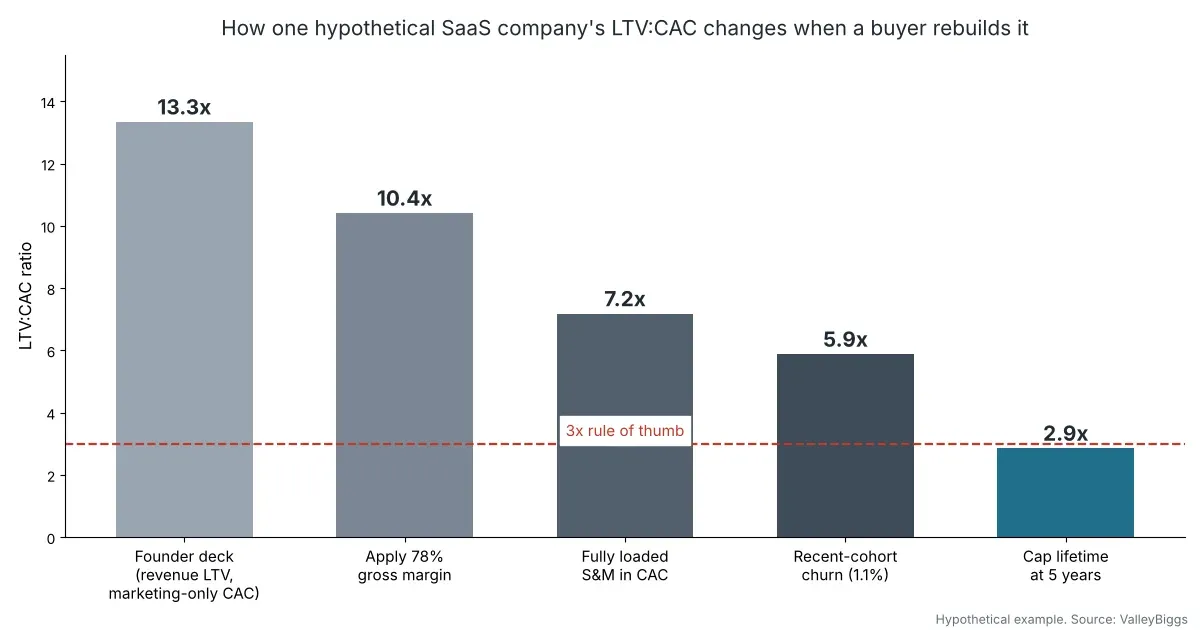
Nothing in the founder’s version was invented. Each input was real, but each choice favored the seller. The buyer’s version is still close to the 3x benchmark, so this is a reasonable business. The risk is the gap: a buyer who discovers a 13x claim that rebuilds to under 3x starts questioning every other number in the data room, and that loss of trust usually costs more than the metric itself. The CAC payback period in this example is about 15.5 months ($18,125 ÷ $1,170), which a buyer would compare with peers that sell at a similar contract size.
The practical lesson is to present the conservative version yourself, explain the assumptions in your confidential information memorandum, and show the upside separately. A number that survives diligence is worth more than a bigger one that does not.
What Is a Good LTV to CAC Ratio?
Most investors treat 3x as the starting benchmark. Harvard Business School material on entrepreneurial marketing describes three or higher as attractive, and Skok notes that the best SaaS businesses run above 3x, sometimes as high as 7x or 8x. How a buyer reads your result depends on the range:
| LTV:CAC range | What it usually signals | How a buyer tends to react |
|---|---|---|
| Below 1x | Each new customer destroys value | Questions product-market fit or pricing; growth spend is treated as a cost, not an investment |
| 1x to 2x | Customers barely cover acquisition cost and overhead | Values the existing base, gives little credit for future growth |
| About 3x | Healthy, repeatable acquisition | Treats growth spend as an asset and models more of it after closing |
| 3x to 5x | Strong unit economics | Supports a higher multiple, especially with fast payback and good retention |
| Above 5x | Very efficient, or underinvesting in growth | Asks whether the company could grow faster, or whether the figure is overstated |
A good ltv to cac ratio also depends on how you sell. Self-serve products with low prices need fast payback because churn tends to be higher. Enterprise products can carry a longer payback because contracts are larger and multi-year. A ratio above 5x is not automatically a positive: buyers may read it as a sign that you could have spent more to grow, and if the number comes from a short history, they will discount it.
How LTV:CAC Affects Your Valuation
Buyers rarely apply a multiple to the ratio itself. Instead, it shapes the assumptions behind the multiple they pay on revenue or EBITDA: how much growth they believe, how much it will cost, and how much cash it will consume.
Andreessen Horowitz illustrated the link in a 2023 analysis of more than 60 US public consumer internet companies. Treating LTV as gross profit, the firm estimated long-term operating margins of about 16% of gross profit for a business at 2x LTV:CAC, 33% at 3x and 46% at 5x. Companies at those margin levels traded at roughly 1.5x, 5.3x and 8.4x forward gross profit, which led the authors to conclude that moving from 2x to 3x could nearly triple value. Those are public-market figures for consumer companies, so they do not translate directly into private SaaS deal multiples, but the direction is the same in private transactions.
In practice, the ratio influences a sale in four ways:
- The growth case. A buyer who believes each sales and marketing dollar returns 3x will underwrite a bigger growth plan, and pay for part of it upfront.
- The multiple. Strong unit economics, combined with good retention and a healthy adjusted EBITDA margin, support a valuation toward the upper end of the range for your size and sector.
- The buyer universe. Growth equity and strategic buyers focus heavily on efficient acquisition. A weak ratio narrows the field to buyers who plan to cut sales spend and run the business for cash.
- Deal structure. When a buyer doubts the growth story, more of the price tends to move into an earnout tied to future revenue, and less is paid at closing.
If you want to see how your metrics translate into a value range before you speak with buyers, an independent enterprise valuation analysis tests the assumptions the way a buyer would.
LTV:CAC for eCommerce and Subscription Brands
The ratio was popularized by SaaS, but buyers apply it to any business with repeat customers, including direct-to-consumer brands, subscription boxes and marketplaces. The inputs change:
- Use contribution margin instead of software gross margin. Deduct product cost, shipping, fulfilment, payment fees and returns from each order.
- Replace churn with repeat purchase behavior. Track how many customers from each monthly cohort buy again in months 2 to 24 and how much they spend.
- Measure CAC on new customers only. Revenue from existing customers who return through a paid ad should not lower the cost of acquiring new ones.
- Watch channel concentration. If most new customers come from one ad platform, a buyer will ask what happens to CAC when that platform’s costs rise.
Founders selling an ecommerce business should expect buyers to ask for order-level data so they can build these cohorts themselves. A clean export from your store platform and ad accounts saves weeks in diligence.
What Buyers Ask For in Diligence
Buyers rarely ask for the ratio alone. They ask for the data behind it. Having the following ready shortens diligence and makes your figure easier to accept:
- Monthly sales and marketing spend for at least 24 months, split by channel and reconciled to your financial statements.
- New customer counts by month and by source, with a clear definition of when a customer counts as new.
- Customer-level revenue history, so the buyer can build cohorts and measure churn, contraction and expansion.
- Gross margin by month, with hosting, support and onboarding costs allocated consistently.
- Sales headcount, quota, commission plans and ramp time, to test whether the current CAC holds as the team grows.
- A written definitions sheet for every metric you present, including how LTV is capped or discounted.
Packaging this information well is part of a good sale process. Advisers who handle SaaS M&A transactions usually prepare a metrics pack before buyers are contacted, so the numbers in the first meeting match the numbers in the data room.
Red Flags Buyers Notice
- Revenue-based LTV. A lifetime value with no gross margin applied is the most common overstatement.
- Uncapped lifetimes. With churn under 1% a month, the simple formula implies customers stay for eight years or more, longer than most companies have existed.
- Blended CAC presented as paid CAC. Organic and referral customers flatter the figure, and buyers will separate them.
- Deteriorating cohorts. If customers acquired recently churn faster than older ones, a blended churn rate hides the trend.
- A sudden marketing cut before the sale. Lower spend can lift the ratio for a quarter, but buyers compare spend and new customer counts across periods and will spot it.
- Changing definitions. A different churn or CAC definition in the deck than in board reporting is a credibility problem, not a metric problem.
How to Improve Your LTV:CAC Before a Sale
Improvements made 12 to 24 months before a process tend to be credible. Changes made in the last quarter tend to be discounted. The levers, in rough order of impact:
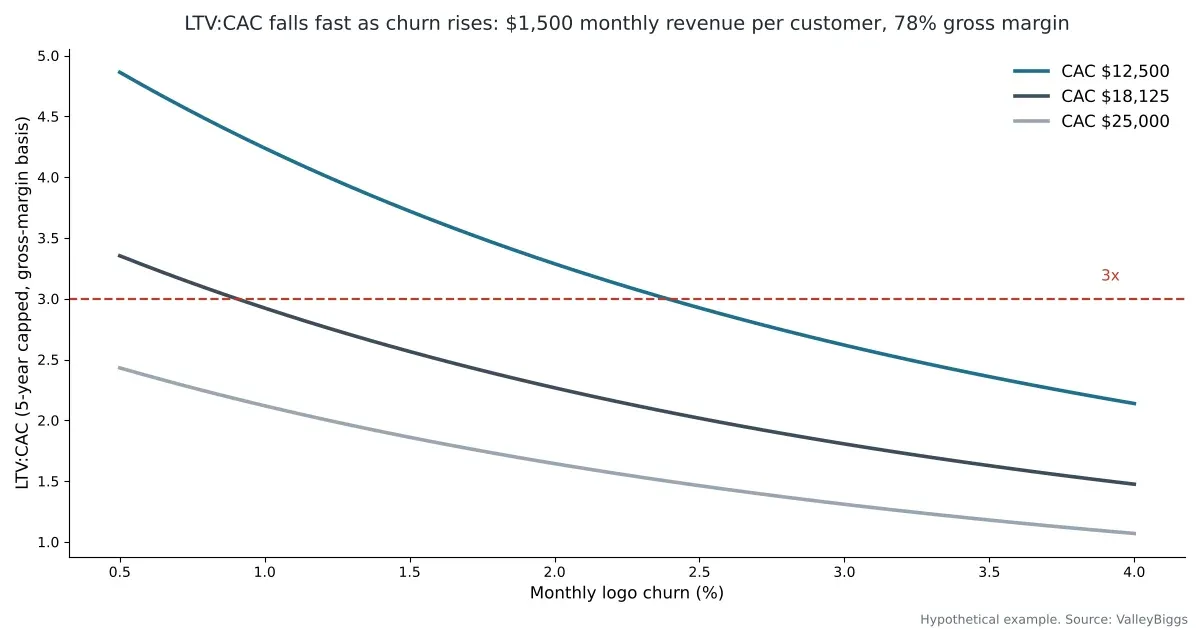
- Reduce churn first. As the chart above shows, churn has the largest effect on LTV. Better onboarding, annual contracts and customer success coverage for at-risk accounts all help.
- Raise revenue per account. Review pricing, retire legacy discounts and add paid tiers or usage-based expansion where customers get more value.
- Protect gross margin. Renegotiate hosting and third-party software contracts and automate support work that scales with customer count.
- Cut channels with weak payback. Measure CAC and payback by channel and move budget toward the ones that return cash fastest.
- Focus on the best-fit segment. Segment the ratio by customer size, industry and channel. Many companies find one segment produces most of the value.
- Fix the reporting. Build the metrics from your general ledger and CRM monthly, with written definitions, so the trend is visible and repeatable.
These steps also help other measures buyers check, such as retention and the Rule of 40, and they make the recurring revenue model easier for a buyer to underwrite.
When to Talk to an M&A Advisor
Talk to an advisor before you share metrics with any buyer, not after. Once a figure appears in a teaser or first-call deck, revising it downward costs credibility. An experienced advisor can rebuild your ltv cac ratio the way a buyer will, identify which adjustments are defensible, and decide how to present the conservative and upside cases. Earlier conversations also leave time to fix churn or channel problems before they show up in diligence.
Founders who are thinking about selling a SaaS business in the next one to three years often start with a metrics review and a valuation range, then decide on timing.
Conclusion
LTV:CAC is a short way of describing whether your growth makes money. Buyers will calculate it on gross margin, fully loaded acquisition cost, recent cohort behavior and a capped lifetime, so the most useful thing you can do is calculate it that way first. A ratio near or above 3x with a payback period that suits your sales model supports a stronger growth case, a wider buyer universe and more of the price paid at closing. If you would like a confidential review of your metrics and what they imply for value, contact ValleyBiggs to arrange a conversation with an advisor.
FAQs
1. What is a good LTV to CAC ratio?
Around 3x is the usual benchmark: each dollar spent to acquire a customer returns about three dollars of lifetime gross profit. Below 1x means customers cost more than they are worth, and 1x to 2x leaves little room for overhead. Above 5x can signal underinvestment in growth. Compare yourself with companies that sell at a similar price and contract length.
2. What does LTV CAC mean?
LTV CAC refers to customer lifetime value divided by customer acquisition cost. It shows whether the profit a typical customer produces over its relationship with you justifies the sales and marketing money spent to win that customer. Investors and acquirers use it as a quick test of unit economics for SaaS, subscription and repeat-purchase businesses.
3. How do you calculate CAC and LTV?
CAC is total sales and marketing cost for a period divided by new customers won in that period, including salaries, commissions, tools and ad spend. LTV is usually monthly revenue per account times gross margin, divided by monthly churn, often capped at five years. Keep both on the same time basis and the same definition of a customer.
4. Can an LTV:CAC ratio be too high?
Yes. A ratio well above 5x often means the company could grow faster by spending more on sales and marketing, so a buyer may see missed growth rather than strength. Very high figures also attract scrutiny, because they frequently come from revenue-based LTV, uncapped customer lifetimes or a short operating history that has not yet shown real churn.
5. Is CAC payback period more important than LTV:CAC?
Neither replaces the other. The ratio shows whether customers are profitable over their lifetime, while the CAC payback period shows how many months of gross profit it takes to recover acquisition spend. Buyers read them together: a strong ratio with a three-year payback still consumes a lot of cash, which limits how quickly growth can be funded.
6. Does LTV:CAC apply to ecommerce businesses?
Yes, with different inputs. For ecommerce and direct-to-consumer brands, buyers use contribution margin after product, shipping, fulfilment, payment fees and returns, and they replace churn with repeat purchase rates by monthly cohort. CAC should count only genuinely new customers. Clean order-level data lets a buyer build these cohorts quickly and trust the result.