

Adjusted EBITDA is a company’s earnings before interest, taxes, depreciation and amortization, corrected for items that a new owner would not inherit: one-time costs, owner perks, non-cash charges and pay that sits above or below market. In a private sale it is the earnings figure most buyers multiply to set a price, so each defensible adjustment moves your number.
This guide shows the adjusted EBITDA formula, the adjustments buyers usually accept and the ones they push back on, a hypothetical worked example, and how to prepare the figure before you go to market. If you want the bigger picture first, start with our guide to valuing a private company.
Key Takeaways
- Adjusted EBITDA starts from EBITDA and adds back, or subtracts, items that will not continue under a new owner. It is a non-GAAP measure with no official list of allowed adjustments.
- Adjustments run both ways. Below-market rent, an unpaid family role or a one-time gain should reduce the figure, and buyers will find them if you do not.
- Every accepted dollar is multiplied. At a hypothetical 5x multiple, a $100,000 adjustment is worth about $500,000 of enterprise value, and a rejected one costs the same.
- Buyers test the number through a quality of earnings review, lenders ask for written justification, and recurring costs labelled “one-time” are the most common dispute.
- Build the schedule 12 to 24 months before a sale, tie each adjustment to a document, and keep run-rate claims for the deal structure rather than the base figure.
What Is Adjusted EBITDA?
In simple terms, it is the profit a buyer can expect the business to produce each year once the noise is taken out. EBITDA strips financing, tax and accounting choices from net income. The adjusted version goes one step further and removes items that reflect how the current owner runs the company rather than how it performs.
Three points matter for sellers:
- It is not a GAAP figure. Accounting standards define net income, not EBITDA. Every adjustment is a judgment that you have to explain and support.
- It describes a future owner’s company. The question behind each line is whether that cost or income will exist after closing.
- It is negotiated. The seller’s figure in the marketing materials and the figure in the final purchase agreement are often different, and the gap is usually settled in due diligence.
Public companies that report the metric must follow SEC rules on non-GAAP measures: under Regulation G and Item 10(e) of Regulation S-K they have to reconcile it to the closest GAAP measure and present the GAAP figure with equal or greater prominence. Private sellers are not bound by those rules, but sophisticated buyers apply the same logic when they review your schedule.
Adjusted EBITDA vs EBITDA, SDE and Net Income
The four earnings measures answer different questions. The table shows which one buyers tend to use and why. For owner-run companies, the choice between SDE and EBITDA is explained in our guide to what a $5 million revenue business is worth.
| Measure | What it includes | Who relies on it | Main weakness |
|---|---|---|---|
| Net income | All revenue minus all expenses, interest, taxes, depreciation and amortization | Tax returns, lenders, audited statements | Shaped by the owner’s tax planning and capital structure |
| EBITDA | Net income plus interest, taxes, depreciation and amortization | Analysts comparing companies with different debt and tax profiles | Still includes owner perks and one-off items |
| Adjusted EBITDA | EBITDA plus or minus normalizing adjustments, with a market salary for the CEO | Private equity, strategic acquirers, M&A advisors for companies run by a management team | No standard definition, so it is open to optimism |
| Seller’s discretionary earnings (SDE) | Adjusted earnings plus one owner’s total compensation | Buyers of smaller owner-operated firms who will replace the owner themselves | Overstates earnings if the buyer must hire a manager |
Is adjusted EBITDA the same as profit?
No. It ignores interest, taxes and capital spending, and it excludes items that really did cost the company money last year. A business can show strong adjusted earnings and still have little cash left if it carries debt, pays heavy taxes or must reinvest in equipment or software every year. Buyers look at it alongside free cash flow, not instead of it.
The Adjusted EBITDA Formula
The adjusted EBITDA formula has two stages. First rebuild EBITDA from the income statement, then apply the normalizing adjustments:
EBITDA = net income + interest expense + income taxes + depreciation + amortization
Adjusted EBITDA = EBITDA + add-backs − deductions
To calculate adjusted EBITDA for a sale, work through these steps:
- Start from net income on reviewed or audited statements for the last two or three fiscal years and the trailing twelve months.
- Add back interest, income tax expense, depreciation and amortization to reach reported EBITDA.
- List every candidate adjustment with its amount, its account and the period it hit.
- Test each one: is it truly non-recurring, non-operating or owner-specific, and will a new owner avoid it?
- Include the negative adjustments, such as below-market costs and one-time gains, so the schedule is balanced.
- Attach evidence to each line: invoices, contracts, payroll records, settlement documents or a market salary benchmark.
- Reconcile the final figure back to the tax return and the bank statements so a reviewer can follow every number.
Common EBITDA Adjustments in a Business Sale
There is no official list, but most schedules fall into a few categories. Listed here are the ones we see most often, with the direction each usually moves the number.
- Owner compensation. If you pay yourself more than a hired CEO would earn, the excess is added back. If you pay yourself less, the shortfall is a deduction. For S corporations the IRS already expects shareholder-employees to receive reasonable compensation based partly on what comparable businesses pay, which gives you a useful benchmark.
- Non-recurring expenses. A lawsuit settlement, a relocation, a failed product launch written off, or costs of preparing the company for sale.
- Non-cash charges. Asset impairments and, in many tech companies, stock-based compensation.
- Personal or discretionary spending. Family vehicles, personal travel or club dues run through the business.
- Related-party arrangements. Rent paid to an entity you own, or services bought from a relative, adjusted to market terms in either direction.
- Non-operating income. Gains on selling equipment, insurance proceeds or one-off grants, which are removed rather than added.
Adjustments specific to SaaS, tech and ecommerce
Technology and online businesses raise their own questions, and buyers who specialize in them know where to look:
- Stock-based compensation. Under US GAAP (ASC 718) equity awards are recorded as compensation expense. Adding them back is common, but if employees would need cash pay to replace the equity, buyers often treat it as a real cost.
- Capitalized software development. Engineering costs moved to the balance sheet raise EBITDA because the amortization sits below the line. Buyers usually ask how much was capitalized and may treat part of it as an ongoing operating cost.
- Founders working below market. A CTO founder on a token salary means a new owner must hire at full cost, which is a deduction.
- Contractors who are effectively staff. Long-term contractors may need to become employees, with benefits and payroll taxes.
- Advertising spend. An ecommerce brand that cut ad spend late in the year to lift profit may see buyers normalize marketing back to its historical share of revenue.
- Inventory and platform changes. One-time inventory write-downs can be added back, but a permanent rise in marketplace or payment fees cannot.
For subscription businesses, buyers read the adjusted figure next to growth. Our explainer on the Rule of 40 and how SaaS buyers use it shows how margin and growth are weighed together.
Worked Example: From Net Income to Adjusted EBITDA
The example below is hypothetical. It describes a software company with about $9 million of revenue, a founder-CEO, and a few items typical of a business that has never been through a sale.
| Line item | Amount | Why |
|---|---|---|
| Net income | $640,000 | From the income statement |
| + Income taxes | $210,000 | Financing and tax items removed |
| + Interest | $95,000 | Financing and tax items removed |
| + Depreciation and amortization | $255,000 | Non-cash accounting charges |
| = EBITDA | $1,200,000 | |
| + Owner pay above market | $200,000 | Founder paid $450,000; a hired CEO benchmark is $250,000 |
| + Legal settlement | $85,000 | Single contract dispute, closed and documented |
| + Stock-based compensation | $60,000 | Non-cash, but likely to be challenged |
| + Sale-preparation costs | $45,000 | Accounting and legal work tied to the sale |
| + Personal expenses | $40,000 | Family vehicle and personal travel |
| − Rent to market | ($36,000) | Office leased from the founder’s entity at $60,000; market rent is $96,000 |
| − Gain on equipment sale | ($30,000) | One-time income that will not repeat |
| − Unpaid bookkeeping role | ($55,000) | Founder’s spouse works unpaid; a buyer must hire |
| = Adjusted EBITDA | $1,509,000 | About 16.8% of revenue |
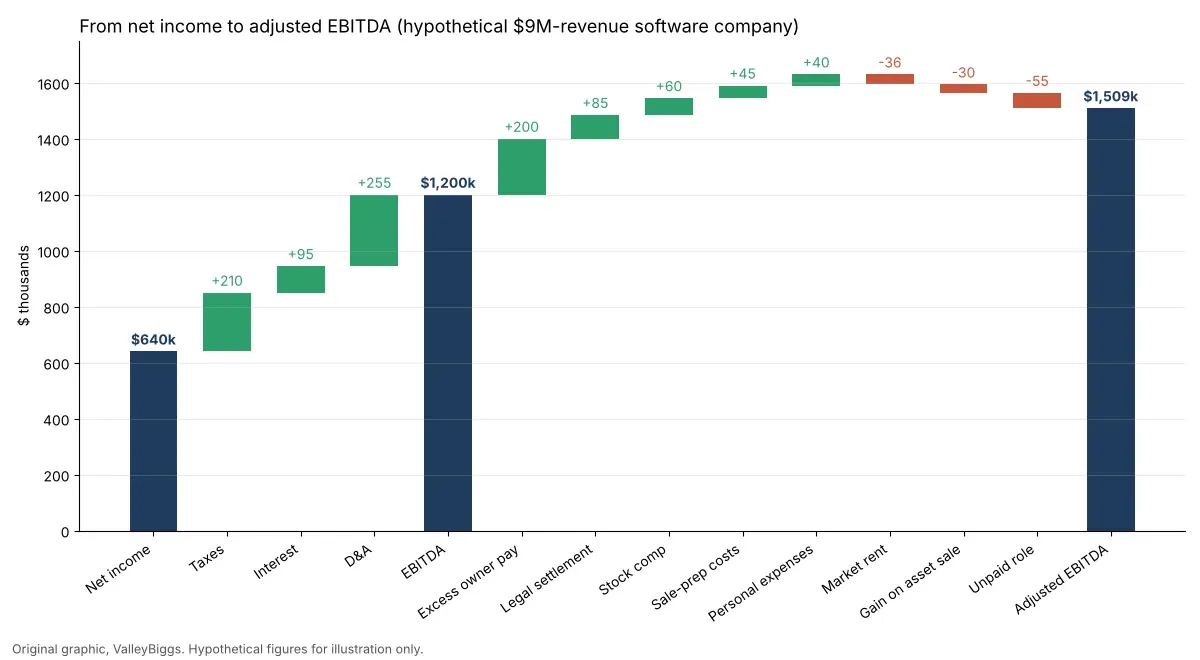
Notice that three of the eight adjustments reduce earnings. A schedule that only adds back looks one-sided, and buyers tend to answer it by reviewing every line more aggressively.
Why Every Dollar of Adjustment Matters at a Multiple
Buyers usually price lower middle market companies as a multiple of adjusted earnings, so the adjustment schedule has a direct effect on enterprise value. The IBBA and M&A Source Market Pulse survey for the first quarter of 2026 reported median multiples of about 4.0x EBITDA for deals priced at $2 million to $5 million and 4.5x for $5 million to $50 million, and multiples for larger or faster-growing companies can be higher, as our guide to what a $10 million company is worth explains. Using the worked example and a hypothetical 5x multiple:
| Scenario | Adjusted EBITDA | Value at 5x (hypothetical) |
|---|---|---|
| Seller’s schedule, all adjustments accepted | $1,509,000 | $7,545,000 |
| Buyer rejects the stock-based compensation add-back | $1,449,000 | $7,245,000 |
| Buyer also rejects the sale-preparation costs | $1,404,000 | $7,020,000 |
| Reported EBITDA with no adjustments | $1,200,000 | $6,000,000 |
A $60,000 disagreement becomes a $300,000 price difference. That is why buyers spend so much time on the schedule, and why a seller should know before the letter of intent which lines are strong and which are negotiable.
Which Adjustments Buyers Accept, Question or Reject
Acceptance depends on evidence and on whether the item could plausibly recur. In our experience the pattern looks like this:
| Adjustment | Typical buyer reaction | Evidence that helps |
|---|---|---|
| Owner pay above a market salary | Usually accepted if the benchmark is credible | Payroll records and a salary survey for the replacement role |
| Single legal settlement | Accepted if no similar claims exist | Settlement agreement and a litigation history |
| Personal expenses | Accepted when clearly personal and small | Card statements and the general ledger detail |
| Stock-based compensation | Often questioned | Grant history and a plan for retention without equity |
| “One-time” costs that appear every year | Usually rejected | Hard to support; better left in EBITDA |
| Projected savings or price increases | Usually rejected from the base figure | Signed contracts; otherwise handle through an earnout |
The SEC staff’s guidance for public companies captures the buyer’s instinct: its interpretation updated in December 2022 says excluding normal, recurring cash operating expenses needed to run the business can make a measure misleading, and it counts costs that occur at irregular intervals as recurring. A buyer reviewing your schedule will ask the same question about every line.
Run-Rate and Pro Forma Adjustments
Run-rate EBITDA annualizes a recent change, such as a price increase in the last quarter, a new contract or a cost cut that only took effect part-way through the year. Pro forma adjustments go further and add the expected effect of changes that have not happened yet.
Sellers can present both, but keep them separate from the historical figure. Buyers generally price on what the company has earned, and they treat forecasts with caution for good reason. In S&P Global Ratings’ 2024 study of EBITDA addbacks in large speculative-grade M&A and leveraged buyout deals, addbacks made up about 30% of management-adjusted EBITDA at deal inception on a median basis, and the agency found that more aggressive addbacks went with less reliable projections. Those deals are much larger than most private sales, but buyers of smaller companies have learned the same lesson. A forward-looking claim is often better handled through an earnout, which pays you if the improvement shows up.
How Buyers and Lenders Test the Number
Expect at least two independent reviews of your adjusted earnings before closing:
- Quality of earnings review. Most institutional buyers hire an accounting firm to rebuild your earnings from the ledger and bank records. It overlaps with the wider diligence process described in our due diligence checklist for selling a business.
- Lender review. If the buyer uses an SBA 7(a) loan, the lender has to analyze repayment ability, and SBA’s SOP 50 10 8.1, effective October 1, 2026, asks for justification of additions and subtractions to cash flow, including non-recurring items and owner’s draw.
- Buyer’s own model. Strategic buyers rebuild the figure around their own cost structure. They may accept more savings but will not pay you for synergies they create.
The figure you present first usually appears in the confidential information memorandum. Every later change against that number gives the buyer a reason to revisit price, so it pays to be conservative at the start.
What Is a Good Adjusted EBITDA Margin?
Adjusted EBITDA margin is the adjusted figure divided by revenue. There is no single good number because margins depend on the industry, the business model and the stage of growth. A distribution or services company and a mature software company can both be healthy at very different margins.
What buyers look for is a margin that is stable or rising, close to or above peers in the same niche, and explained by the business model rather than by adjustments. A margin that only looks good after many add-backs raises more questions than it answers. In software, buyers often accept a lower margin when growth is strong, which is the trade-off the Rule of 40 measures.
How to Prepare Your Adjusted EBITDA Before a Sale
Preparation is what turns a list of claims into adjustments that survive diligence. A practical sequence:
- 12 to 24 months out: stop running personal expenses through the company, move related-party arrangements to market terms and document any one-time event as it happens.
- 12 months out: get reviewed or audited statements, fix revenue recognition and separate capitalized development costs clearly.
- 6 to 9 months out: build the adjustment schedule with evidence for every line and consider a sell-side quality of earnings review.
- 3 to 6 months out: stress-test the schedule with an advisor, rank adjustments by strength and decide which run-rate claims belong in an earnout.
- At launch: present a conservative figure and a reconciliation from tax returns to adjusted earnings.
For an early read on where your company might land, our free business valuation calculator gives a quick range, and a full enterprise valuation analysis tests your adjustments line by line.
Common Mistakes Owners Make
- Adding back costs that recur, such as annual “one-time” consulting or yearly software migrations.
- Ignoring negative adjustments, which signals that the schedule was built to reach a target number.
- Adding back the full owner salary without replacing it with a market salary for the role.
- Mixing forecasts into historical earnings without labelling them.
- Presenting adjustments that cannot be traced to the ledger, the bank statements or the tax return.
- Changing the figure between the marketing materials and diligence, which invites a price renegotiation.
When to Talk to an Advisor
Talk to an advisor before you share any earnings figure with a buyer, and certainly before you sign a letter of intent. An experienced M&A team knows which adjustments buyers in your sector accept, how to document the borderline ones, and when to move a claim into deal structure instead of price. For software founders, our SaaS business sale team works with these questions every week. This article is general information, not accounting, legal or tax advice.
Conclusion
Adjusted EBITDA is where a valuation is won or lost: the multiple gets the headlines, but the earnings base it multiplies is what buyers fight over. Build the schedule early, include the adjustments that cut both ways, and back every line with documents. When you are ready to see what your earnings look like through a buyer’s eyes, request a confidential consultation with ValleyBiggs.
FAQs
1. What's the difference between EBITDA and adjusted EBITDA?
EBITDA is net income with interest, taxes, depreciation and amortization added back. Adjusted EBITDA starts there and then corrects for items a new owner would not carry, such as above-market owner pay, a one-off lawsuit or a gain on selling equipment. Buyers usually price a private company on the adjusted figure.
2. What is a good adjusted EBITDA percentage?
There is no universal benchmark, because margins vary widely by industry and growth stage. Buyers compare your adjusted EBITDA margin with peers in the same niche and care most that it is stable or improving. A margin that only looks healthy after many add-backs tends to get closer scrutiny, not a higher multiple.
3. Is adjusted EBITDA the same as profit?
No. Profit, or net income, is what remains after every expense, including interest, taxes and depreciation. Adjusted EBITDA excludes those items and some real costs that are not expected to recur, so it is usually higher than net income and is not the same as the cash the business generates.
4. Can adjusted EBITDA be lower than EBITDA?
Yes. If the owner takes a below-market salary, family members work unpaid, rent is paid to a related party at a discount or the year included a one-time gain, the honest adjustments reduce earnings. Including these deductions makes a seller’s schedule more credible during due diligence.
5. Do buyers accept stock-based compensation as an add-back?
Sometimes. Stock-based compensation is a non-cash expense under US GAAP, so sellers often add it back. Buyers accept it more readily when equity grants were occasional and less readily when the team expects ongoing equity or would need cash pay to replace it. Expect it to be negotiated.
6. Who calculates adjusted EBITDA when a business is sold?
The seller, usually with an accountant or M&A advisor, prepares the first schedule. The buyer then tests it, often through a quality of earnings review, and lenders run their own analysis. A professional valuation analysis before going to market helps you defend each line.