

Seller financing is when the owner of a business lets the buyer pay part of the purchase price over time, usually through a promissory note called a seller note. The buyer pays most of the price at closing, then repays the rest to the seller with interest over an agreed term.
For owners of growing companies, seller financing a business is less about generosity and more about closing at the right price. It can widen the buyer pool and support a higher valuation, but it also makes you a creditor of the company you just sold. This guide covers the terms, SBA and IRS rules, and how to protect yourself.
Key Takeaways
- Seller financing means you accept part of the price as a loan to the buyer, documented in a promissory note and usually secured by the business assets.
- In the IBBA and M&A Source Market Pulse survey for Q2 2026, sellers received 83% to 92% of the price in cash at close on average, so the financed piece is usually a minority of the deal.
- With an SBA 7(a) buyer, a seller note counts toward the down payment only if it is on full standby for the life of the SBA loan.
- The installment method can spread your capital gain over the years you collect, but interest is ordinary income and depreciation recapture is taxed in the year of sale.
- Your protection comes from the documents: security interest, personal guarantee, subordination terms, reporting covenants and clear default remedies.
What Is Seller Financing in a Business Sale?
In a business sale, seller financing is a loan from the seller to the buyer that covers part of the purchase price. The buyer signs a promissory note at closing, pays the seller principal and interest over an agreed term, and usually backs the note with a lien on the business assets and a personal guarantee.
Most of what ranks for this term online describes home sales, where the seller holds a mortgage or a land contract on a house. Business deals work differently. The collateral is an operating company, not a building. Its value depends on the new owner running it well. A bank lender usually sits ahead of you, and the note is one piece of a larger structure that may also include an earnout, an escrow and a working capital adjustment. That is why the terms of a business seller note deserve more attention than a simple payment schedule.
Other names you will hear for the same idea: owner financing, a seller carry back, a vendor note or vendor take-back. In a letter of intent it usually appears as a line such as “$X payable by a subordinated seller note.”
How Seller Financing Works, Step by Step
A seller note is negotiated alongside price, not after it. The typical sequence in a lower middle market sale looks like this:
- Offer and letter of intent. The buyer proposes a price and a split between cash at close, a seller note and any contingent payments. The headline terms of the note (amount, rate, term, security) belong in the LOI so they are not reopened later.
- Buyer diligence on you, seller diligence on them. The buyer reviews your financials and operations. You should review the buyer too: their capital sources, operating experience, personal financial statement and credit, because you are about to become their lender.
- Lender approval. If a bank or SBA lender is funding the senior loan, it sets limits on your note, such as subordination, payment restrictions or a full standby period.
- Documentation. The purchase agreement references the note. Separate documents usually include the promissory note, a security agreement, a UCC-1 financing statement, a personal guarantee and, where there is a senior lender, a subordination or intercreditor agreement.
- Closing and servicing. You receive cash at close, and payments on the note start on the agreed date. Many sellers ask for monthly financial statements and covenant reporting while the note is outstanding.
If you are earlier in the process, our step-by-step guide to selling a business shows where deal structure fits among valuation, marketing, negotiation and diligence.
Seller Note Terms You Will Negotiate
Every term below shifts risk between you and the buyer. The table shows what each one means and how the two sides typically push.
| Term | What it means | Seller usually wants | Buyer usually wants |
|---|---|---|---|
| Note amount | Share of the price paid over time | Smaller note, more cash at close | Larger note to reduce cash needed |
| Interest rate | Annual rate on the unpaid balance | Rate that reflects subordinated, unsecured-style risk | Rate close to bank debt |
| Term and amortization | How long repayment lasts and how principal is paid down | Short term, regular amortization | Longer term, interest-only period or a balloon |
| Security | Collateral backing the note | Lien on all business assets and equity | Unsecured note or a junior lien only |
| Personal guarantee | Buyer’s personal promise to repay | Full guarantee from the buyer and spouse where allowed | Limited or no guarantee |
| Subordination | Your rank behind the senior lender | Payments allowed while the bank is current | Strict standby until the bank is repaid |
| Covenants and reporting | Financial statements and limits on the buyer | Monthly reporting, limits on distributions and new debt | Annual reporting, few limits |
| Default and remedies | What counts as default and what you can do | Short cure periods, acceleration, cross-default | Long cure periods, limited remedies |
| Offset rights | Buyer’s right to reduce payments for indemnity claims | No offset, or offset only for finally resolved claims | Broad right to withhold payments |
How much of the price is usually financed?
There is no fixed rule, and recent data suggests the seller piece is usually modest. The IBBA and M&A Source Market Pulse survey reported that seller financing accounted for roughly 10% to 16% of most deals in Q1 2026, and only about 5% in the $5 million-plus segment. In Q2, sellers received 83% to 92% of the price in cash at close on average, and seller financing fell below 10% of most deals. Smaller, owner-operated businesses tend to carry larger notes than companies sold to private equity or strategic acquirers.
What is a fair seller financing interest rate?
The rate is negotiated, and it should reflect that a seller note normally ranks behind the bank. Because the senior lender is paid first and you hold the residual risk, a note priced at the bank rate undercompensates you for the risk you carry. There is also a legal floor. Under IRS rules, if the note does not carry adequate stated interest measured against the applicable federal rate (AFR), part of the principal is recharacterized as interest. Ask your tax advisor to confirm the current AFR test rate before you sign.
Seller Financing With an SBA 7(a) Buyer
Many buyers of businesses priced under roughly $5 million use SBA 7(a) loans, so the SBA’s rules often decide what your note can look like. SBA Standard Operating Procedure 50 10 8.1 applies to applications received on or after October 1, 2026. Based on the SOP and law firm summaries of it, the key points for sellers are:
- For a complete change of ownership, the buyer must inject equity of at least 10% of total project costs.
- A seller note counts toward that injection only if it is on full standby for the life of the SBA loan, meaning no principal or interest payments until the SBA loan is repaid.
- Standby seller debt, other standby debt and non-controlling minority investor equity, alone or combined, can provide no more than half of the required injection.
- A seller note that does not count as equity can still carry payments, subject to the lender’s subordination terms.
In practice, SBA deals often pair a small standby note with a larger cash payment at close funded by the loan. A standby note may not pay you anything for up to a decade, so treat it as deferred, at-risk consideration when you compare offers. SBA rules change, and lenders apply them differently, so confirm the current requirements with the buyer’s lender early.
For a sense of how SBA limits interact with price at different sizes, see how much a business with $5 million in sales is worth.
A Hypothetical Example: $4 Million Sale With a Seller Note
Assume a hypothetical software services company sells for $4.0 million to an independent sponsor. The buyer pays $3.2 million at closing and asks you to carry the remaining $800,000 as a five-year note at 8% interest, paid annually and fully amortizing. The rate is for illustration only.
| Year | Payment | Interest | Principal | Balance after payment |
|---|---|---|---|---|
| Close | $3,200,000 cash | – | – | $800,000 |
| 1 | $200,365 | $64,000 | $136,365 | $663,635 |
| 2 | $200,365 | $53,091 | $147,274 | $516,360 |
| 3 | $200,365 | $41,309 | $159,056 | $357,304 |
| 4 | $200,365 | $28,584 | $171,781 | $185,523 |
| 5 | $200,365 | $14,842 | $185,523 | $0 |
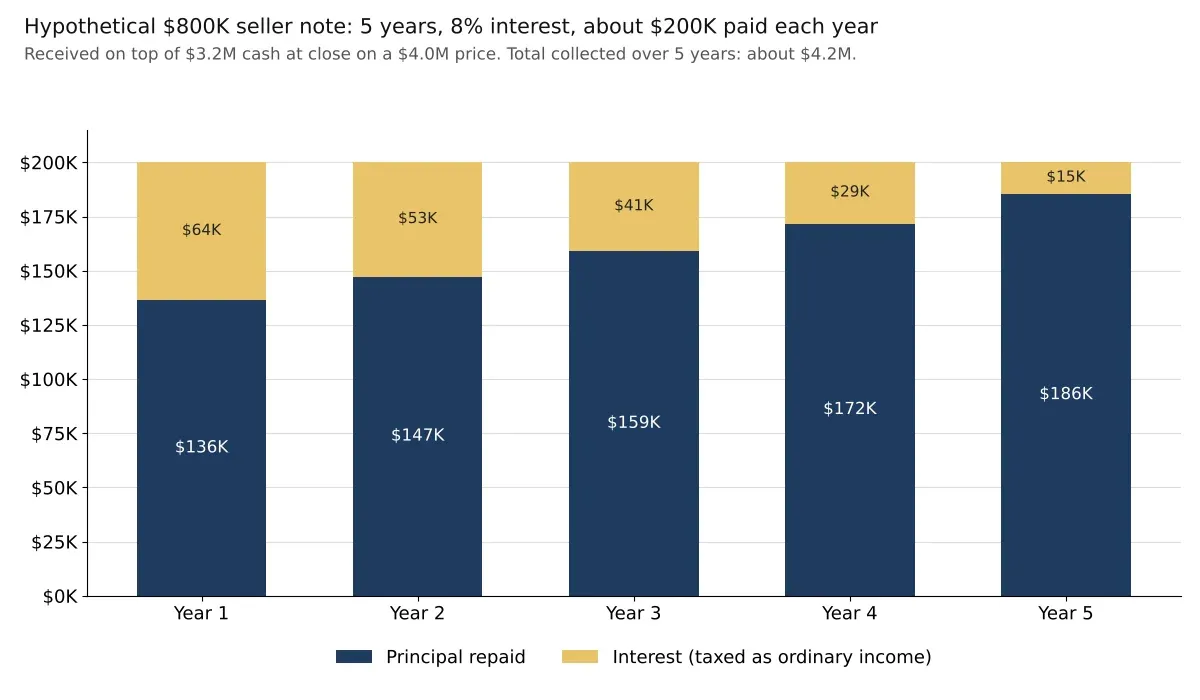
If every payment arrives, you collect about $4.2 million in total, including roughly $201,800 of interest. If the buyer defaults in year two, you have collected about $3.6 million and hold a claim on a business that is now under stress. The note makes the deal possible, and it also sets your real downside. Compare offers on cash at close first, then on the quality of the deferred piece.
Seller Financing Pros and Cons: Seller and Buyer View
| For the seller | For the buyer | |
|---|---|---|
| Advantages | Larger buyer pool; can support a higher price; interest income; possible tax deferral under the installment method | Less cash and bank debt needed; signals that the seller trusts the business; terms are negotiable |
| Disadvantages | Default risk; subordinated to the bank; money tied up for years; may need to stay involved if the business struggles | Personal guarantee exposure; rate may exceed bank debt; seller may expect reporting rights and covenants |
| Biggest risk | The buyer underperforms and stops paying after the bank takes priority | Cash flow cannot cover both senior debt service and the seller note |
The pattern behind most disputes is simple: the buyer borrowed too much against the business, and the seller note is the first payment to stop. A note sized to what the business can service after the bank is paid is worth more than a larger note with a weak borrower.
How Seller Financing Is Taxed
The IRS treats a sale with at least one payment received after the year of sale as an installment sale. The points below come from IRS Publication 537; they are general information, not tax advice, and your CPA should model your own deal.
- Under the installment method, you generally report the gain on qualifying assets as you receive principal, not all in the year of sale. Sales are reported on Form 6252.
- Interest you receive on the note is ordinary income.
- Depreciation recapture is reported in full in the year of sale, even if you receive no payment that year.
- Gain on inventory, and on stock or securities traded on an established market, cannot use the installment method.
- In an asset sale, the price is allocated across asset classes using the residual method, which determines how much of the gain can be deferred.
- If total installment obligations from sales over $150,000 exceed $5 million at year-end, an interest charge on the deferred tax can apply.
- You can elect out of the installment method and report the full gain in the year of sale.
Asset versus stock structure, state taxes and the allocation schedule can change the after-tax result more than the interest rate. Settle them with your advisors before you sign the LOI.
Seller Note vs Earnout vs Rollover Equity
Buyers bridge a valuation gap in three common ways. They differ in how certain your payment is and what it depends on.
| Feature | Seller note | Earnout | Rollover equity |
|---|---|---|---|
| What you receive | Fixed principal plus interest | Contingent payments if targets are met | Shares in the buyer or new holding company |
| Depends on | Buyer’s ability to pay | Post-close performance against agreed metrics | Value at the buyer’s next exit |
| Certainty | Fixed obligation, subject to credit risk | Uncertain by design | Uncertain; can exceed or fall below the value rolled |
| Typical buyer | Individual buyers, independent sponsors, some private equity | Strategic and private equity buyers with valuation disagreements | Private equity platforms and add-ons |
| Key protection | Security, guarantee, covenants | Clear metric definitions, accounting rules and control limits | Governance rights, tag-along and drag-along terms |
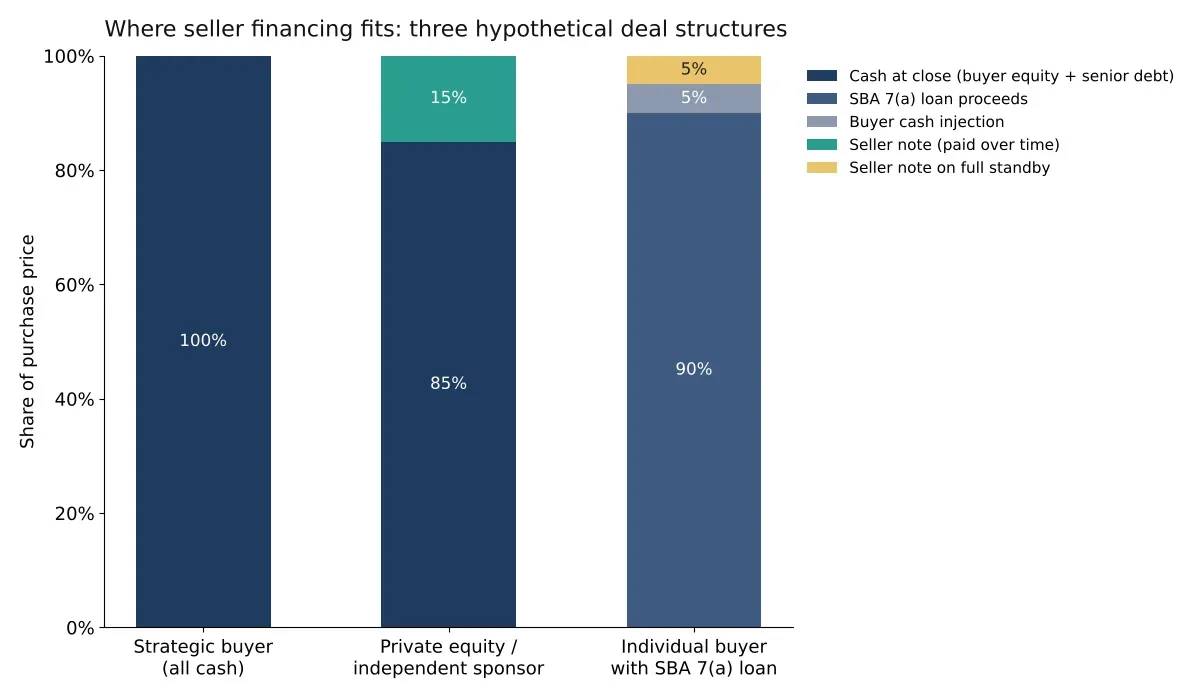
In a management buyout, all three can appear together, since an internal team rarely has enough capital to pay the full price at closing.
How to Protect Yourself When You Carry a Note
The best protection is choosing the right buyer. The documents then give you leverage if things go wrong. A practical checklist:
- Review the buyer’s personal financial statement, credit report, sources of equity and operating track record before you accept the structure.
- Take a security interest in the business assets and file a UCC-1 so your lien is recorded.
- Ask for a personal guarantee, and for a pledge of the equity in the company you sold where the senior lender allows it.
- Negotiate the subordination agreement directly: what payments are allowed, when blockages apply and how long a standstill on your remedies lasts.
- Require monthly or quarterly financial statements and notice of any default under the senior loan.
- Limit distributions, owner compensation increases and new debt while your note is outstanding.
- Include acceleration and cross-default clauses, and limit offset rights to claims that are finally resolved.
- Consider life and key person insurance on the buyer, with the proceeds assigned to repay the note.
Diligence runs both ways. Our due diligence checklist for selling a business covers what buyers will ask of you, and the same discipline applies to what you ask of them.
Common Mistakes Sellers Make
- Agreeing to a note amount in principle and leaving security, guarantees and subordination for the lawyers to settle later.
- Comparing offers on headline price instead of cash at close plus the realistic value of the deferred piece.
- Accepting broad offset rights that let the buyer stop paying over any indemnity dispute.
- Not reading the senior lender’s subordination terms, then discovering that payments can be blocked for long periods.
- Ignoring the tax timing: recapture in year one can create a tax bill larger than the cash you keep after closing costs.
- Underpricing the rate because the buyer is likable, even though the note ranks behind every other lender.
Related Deal Terms
Seller financing is usually agreed in the letter of intent and described in the offering materials. If you are preparing to go to market, read how a confidential information memorandum presents your business to buyers, and how the sell-side M&A process builds competition so that you, not the buyer, set the structure.
When to Talk to an Advisor
Bring in an M&A advisor, a transaction attorney and a CPA before you respond to an offer that includes a seller note. It matters most when the note exceeds what you could afford to lose, when an SBA or bank lender is involved, when the buyer is a first-time owner, or when the offer mixes a note with an earnout or rollover. A clear view of value from an independent enterprise valuation also helps you judge whether a larger note for a higher price is worth it.
Our sell-side advisory team negotiates deal structure, not just price, and works with your legal and tax advisors on the documents.
Conclusion
Seller financing can be the difference between a deal that closes and one that stalls, but the note is only as good as the buyer behind it and the documents around it. Keep the financed share to an amount you can afford to wait for, price it for its risk, secure it properly and model the taxes before you agree.
If you are weighing an offer that includes a seller note, or planning a sale in 2027, contact ValleyBiggs for a confidential conversation about your options, or learn more about selling your business confidentially.
FAQs
1. Is seller financing a good idea when selling a business?
It can be, if the note is a modest share of the price and the buyer is creditworthy. Seller financing widens the buyer pool and can support a higher price, but you take on default risk behind the bank. Many sellers accept a note only when they could live with losing that amount if the business struggles under new ownership.
2. How long does a typical seller note last?
Terms are negotiated deal by deal, but business seller notes usually run for a few years rather than decades, with monthly or quarterly payments and sometimes a balloon at the end. A note placed on full standby for an SBA loan cannot be paid until that loan is repaid, which can mean waiting ten years or longer.
3. What happens if the buyer defaults on a seller note?
Your remedies depend on the documents. With a security agreement, a filed UCC-1 and a personal guarantee, you can accelerate the balance and pursue the collateral and the guarantor. If a bank holds the senior loan, the subordination agreement may require you to wait before acting, and the bank is repaid from the assets first.
4. Can a seller note be combined with an SBA loan?
Yes. Under SBA SOP 50 10 8.1, a seller note counts toward the buyer’s required equity injection only if it is on full standby for the life of the SBA loan, and standby sources together can cover no more than half of that injection. A note outside the injection can carry payments if the lender’s subordination terms allow it.
5. Do I have to offer seller financing to sell my business?
No. Many sales close with all cash at closing, especially to strategic acquirers and well-capitalized private equity firms. A competitive sale process gives you more say over structure. A modest note can still make sense when most likely buyers depend on bank or SBA debt, or when it helps you reach a higher price.
6. Is interest on a seller note taxed differently from the sale gain?
Yes. Under IRS rules, interest you receive on a seller note is ordinary income, while the principal portion can carry capital gain reported under the installment method as you collect it. If the stated rate is too low compared with the applicable federal rate, part of the principal can be treated as interest. This is general information, not tax advice.