

Choosing among business brokers Georgia owners can rely on starts with fit: the right firm already sells companies of your size, in your industry, to the kind of buyer most likely to pay for yours. This guide ranks ten firms active in the state, from national specialists in tech and online companies to Atlanta brokerages with decades of local deals, and explains what to verify before you sign anything.
Metro Atlanta produces most Georgia transactions, yet established companies also change hands in Savannah, Augusta, Columbus, Macon and Athens every year. The sections below cover the state’s small business numbers, how broker licensing works here, eight questions for your first meetings, the ranked list, the sales tax clearance that can delay closing, and a comparison of Georgia with neighboring states.
Key Takeaways
- SBA Office of Advocacy data puts Georgia at roughly 1.37 million small businesses, but just 22,049 have between 20 and 499 employees. That smaller group, along with larger firms in the 1 to 19 employee band, is where brokered sales concentrate.
- The biggest pools of established small employers are in restaurants and hospitality, health care, professional services, construction, manufacturing and wholesale.
- There is no Georgia-specific business broker license. Real estate licensing rules apply once property is part of the sale, so ask each firm how it is licensed for your transaction.
- O.C.G.A. 48-8-46 makes a buyer hold back enough of the price to cover any unpaid sales and use tax until the seller shows a paid receipt or a no-tax-due certificate from the Department of Revenue.
- Judge firms by comparable closed deals, the actual person handling your file, the method behind their valuation and the fine print in the engagement letter.
Georgia Business Landscape in 2027
Georgia’s economy rests on small firms. The 2025 Georgia profile from the SBA’s Office of Advocacy counts about 1.4 million small businesses, 99.7 percent of all companies in the state, employing around 1.8 million people, or 42.5 percent of the private workforce.
Only a slice of that total is sellable through a broker. Roughly 1.18 million Georgia small businesses have no payroll, 177,382 have 1 to 19 workers and 22,049 have 20 to 499. Buyers and lenders focus on the employer groups, because that is where they find a staff that stays after closing, recurring revenue and cash flow strong enough to service acquisition debt. The base keeps expanding, too: from March 2023 to March 2024 the state recorded 41,761 establishment openings and 37,392 closings, for a net increase of 4,369.
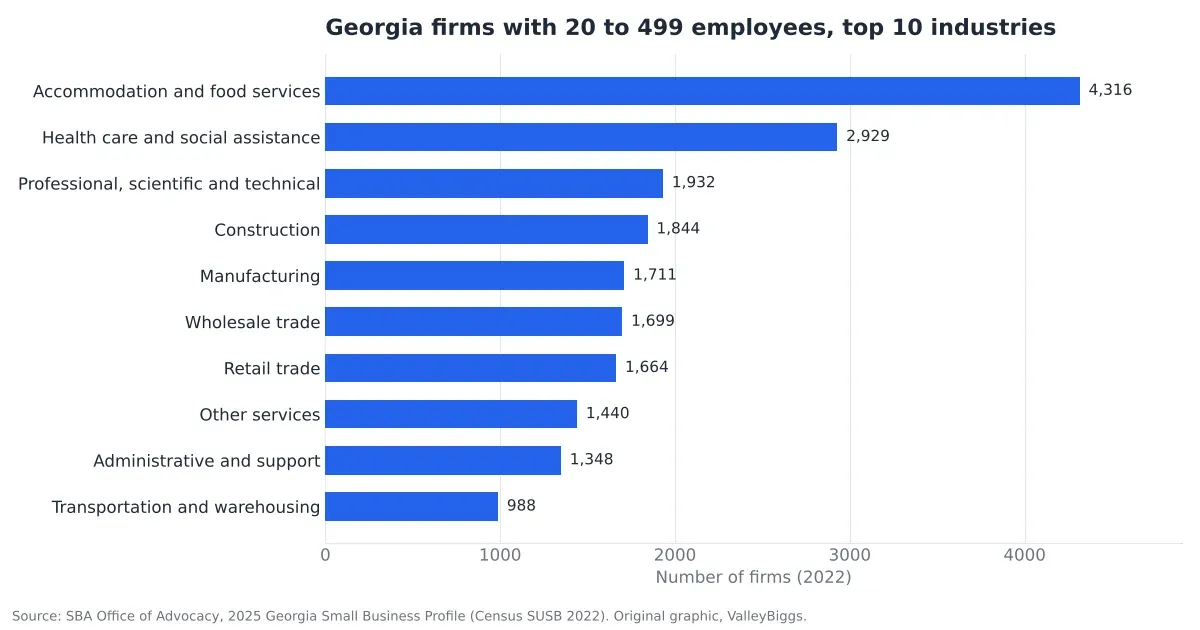
Which industries generate the most Georgia deals?
In the 20 to 499 employee range, accommodation and food services is the largest category at 4,316 firms. Next come health care and social assistance at 2,929, professional, scientific and technical services at 1,932, construction at 1,844, manufacturing at 1,711 and wholesale trade at 1,699. Retail, other services and administrative support each contribute between about 1,300 and 1,700 more.
Some of these sectors attract particularly active acquirers in Georgia:
- Logistics and distribution: the Port of Savannah, air cargo at Hartsfield-Jackson and the interstate web around Atlanta sustain freight brokers, 3PLs, warehouse operators and wholesalers with sticky accounts.
- Construction and the trades: HVAC, plumbing, electrical, roofing and utility contractors remain steady add-on targets for private equity platforms and regional consolidators.
- Professional and technical services: engineering, managed IT, accounting, staffing and marketing firms, typically priced on client retention and the depth of the team.
- Health care services: dental groups, therapy clinics, home health agencies and medical billing companies, where licenses and payer agreements drive how a deal is papered.
- Software and online companies: SaaS, fintech and ecommerce businesses clustered in Atlanta, Alpharetta and the north suburbs, many of which end up with out-of-state acquirers.
How do Georgia’s regions differ for sellers?
The Atlanta metro area, with Fulton, DeKalb, Cobb and Gwinnett counties and the growth corridor running north through Alpharetta, Cumming and Woodstock, has the largest concentration of acquirers, banks and deal advisors. Coastal Georgia around Savannah is shaped by port logistics, manufacturing and tourism. Augusta brings health systems, energy and defense contractors; Columbus adds financial services and military-linked companies; Macon and Athens contribute manufacturing, universities and medical employers. Brokers rooted in one of these regions tend to know which lenders and nearby competitors are worth calling first.
What Does a Business Broker in Georgia Do?
Think of a broker as the project manager of your sale, from setting price expectations to signing day. Core tasks usually include:
- Recasting several years of financials so a buyer sees true earnings after owner compensation and one-off costs are adjusted.
- Producing a blind profile for first contact and a detailed offering memorandum for qualified prospects.
- Building a buyer list, getting NDAs signed and checking proof of funds or lender support before sharing sensitive data.
- Collecting and comparing offers, negotiating the LOI and keeping diligence on track with your lawyer and accountant.
- Clearing the closing checklist: loan approvals, landlord consents, permit and license transfers and state tax clearances.
In larger transactions the work resembles a banker-led auction, with multiple bidders, private equity and strategic outreach and heavy negotiation over earnouts, seller financing and the net working capital peg. Our walkthrough of the full business sale process points out the stages where outside help pays off most, and our explainer on how sell-side and buy-side advisors differ clarifies whose interests each one represents.
Do business brokers need a license in Georgia?
Georgia does not issue a separate business broker license, and it has no business broker registration law like the ones found in a few other states. The Georgia Real Estate License Law in Title 43, Chapter 40 of the Official Code of Georgia is built around real estate, so it comes into play when a sale includes real property, and many practitioners also treat a lease assignment as a reason to hold a license. That is why several Atlanta brokerages say their brokers carry real estate licenses.
If your deal includes owned property or a significant lease, confirm the broker’s license through the Georgia Real Estate Commission’s online lookup. For a stock sale or a deal paid partly in securities, ask the firm how it is registered for that kind of transaction. This is general background, not legal advice.
How to Choose Business Brokers Georgia Owners Can Trust: 8 Questions
1. Can you show me sales similar to mine?
Request a handful of recent closings in your sector and size band, including the rough deal value, who bought and how many months it took. A shop that mostly lists gas stations and franchise restaurants calls a different set of buyers than one that just sold a $12 million logistics company.
2. Who actually handles my engagement?
Ask who drafts the memorandum, qualifies inquiries and sits at the table during negotiations, and how many open files that person is juggling. Senior partners often win the listing and then hand the daily work to someone else.
3. What is behind your price estimate?
You should see which earnings figure was used (SDE for owner-run companies, EBITDA for larger ones), every adjustment that was made and the market data supporting the multiple. Getting an independent enterprise valuation analysis first lets you check each broker’s number against a neutral benchmark.
4. Where will my buyers come from?
Some firms work mostly with Georgia buyers found through listing platforms and local bankers; others canvass private equity funds, independent sponsors, family offices, searchers and corporate acquirers nationwide. Get a clear answer on who will be contacted and how prospects are screened before they see your memorandum.
5. How do you keep the sale quiet?
An early leak can unsettle staff, customers and suppliers. Find out at what stage your name is revealed, whether an NDA is signed before any numbers go out and how tours and management calls are arranged to avoid attention.
6. What licenses and designations does your team hold?
Verify any real estate license your deal calls for. Beyond that, credentials such as the Certified Business Intermediary designation from the IBBA, Georgia Association of Business Brokers or M&A Source membership and formal valuation training signal a team that does this full time.
7. What am I signing up for?
Check the length and exclusivity of the agreement, any retainer or marketing charge, the success fee formula and the tail clause that lets the firm collect after the agreement ends if a buyer it introduced closes later. Run the math at a conservative price, not just the hoped-for one.
8. How do you manage Georgia’s closing requirements?
A broker who works here regularly will bring up the final sales tax return and the clearance letter well before closing. Ask what the firm has done when a clearance came back late, such as a holdback or an escrow at closing.
Top 10 Business Brokers in Georgia for 2027
The ranking blends national advisors with wide buyer networks and Georgia offices with long local track records. Every profile is based on what the firm publishes about itself. Details such as offices and services shift over time, so check them with the firm before you sign.
| # | Firm | Georgia presence | Stated focus | |
|---|---|---|---|---|
| 1 | Website Closers | Nationwide | serves Georgia sellers | Tech and internet companies |
| 2 | Sunbelt Atlanta | Atlanta-based office since 1998 | Businesses from about $100K to $75M | |
| 3 | ValleyBiggs | Nationwide | serves Georgia sellers | Software, SaaS, ecommerce and other growth businesses |
| 4 | Georgia Business Brokers, Inc. | Metro Atlanta, founded in 1979 | M& | A, brokerage and valuation services |
| 5 | First Choice Business Brokers Atlanta Metro | Lawrenceville, serving metro Atlanta and North Georgia | All industries, about $50K to $50M | |
| 6 | SellerForce | Nationwide | serves Georgia sellers | Digital and traditional businesses |
| 7 | Peterson Acquisitions | Woodstock office serving Greater Atlanta and Northwest Georgia | Trades, services, practices and internet businesses | |
| 8 | Transworld Business Advisors of Atlanta Peachtree | Peachtree Corners area | Business sales, M& | A and franchising |
| 9 | DealPipe | Nationwide | serves Georgia sellers | Lower middle market online and operating companies |
| 10 | Murphy Business Sales Atlanta | Marietta, serving East Cobb and metro Atlanta | Business sales, purchases and valuations |
1. Website Closers
Website Closers specializes in internet and technology businesses, from software and subscription products to online stores, mobile apps, agencies and media properties, and pitches them to a national roster of acquirers. Georgia founders in Midtown, Alpharetta or Peachtree Corners who expect their best offer to come from an out-of-state strategic or a PE-backed platform should talk to a firm with that kind of reach early.
2. Sunbelt Atlanta
Sunbelt Atlanta says it has helped owners sell companies confidentially since 1998, reports more than 1,250 businesses sold and states that most of its sales close within about seven months. The office works on deals from roughly $100,000 to $75 million, charges no upfront fee and lists manufacturing and distribution, technology, health care, hospitality, utility construction and home services among its industries. It is part of the global Sunbelt Network and says its brokers hold real estate licenses.
3. ValleyBiggs
ValleyBiggs represents owners of SaaS, internet, online retail and other digital businesses. Several members of our team are former founders who went through a sale themselves. Each seller gets a full deal team, and our compensation depends on a completed sale: if the deal does not close, there is no fee. Georgia owners of SaaS, fintech, IT services and direct-to-consumer brands can review our sell-side advisory process and our playbook for selling a tech company to see how outreach and negotiations are run.
4. Georgia Business Brokers, Inc.
Georgia Business Brokers, Inc. traces its start to 1979, when it opened to work with Atlanta-area companies, and says it has offered brokerage and M&A support for over four decades. Its services cover business sales, buyer searches, mergers, pricing studies and valuations, including help getting a company ready for market. The firm lists IBBA, Georgia Association of Business Brokers and M&A Source among its affiliations, which suits owners who want a long-established local firm.
5. First Choice Business Brokers Atlanta Metro
First Choice Business Brokers Atlanta Metro describes itself as a local office of a national network, serving metro Atlanta and North Georgia from Lawrenceville. It handles deals across industries from about $50,000 to $50 million, offers free valuations and says it charges no upfront fees. The parent network claims more than $15 billion in business sales managed and lists IBBA and International Franchise Association memberships.
6. SellerForce
SellerForce markets internet businesses alongside service and storefront companies and leans on broad promotion to bring in a large volume of buyer leads. That approach can suit Georgia owners who want their listing seen as widely as possible. Ask early how leads are qualified and at what point a prospect receives your financials.
7. Peterson Acquisitions
Peterson Acquisitions runs an Atlanta-area office in Woodstock and says it serves Greater Atlanta, Northwest Georgia, the North Georgia mountains and parts of the East Alabama border. The firm describes a three-step process of a confidential conversation, a valuation grounded in real transactions and a managed sale. It lists industries including roofing, HVAC, plumbing, trucking, manufacturing, medical, dental and veterinary practices, CPA firms and internet businesses.
8. Transworld Business Advisors of Atlanta Peachtree
The Atlanta Peachtree office of Transworld Business Advisors offers business sales, buyer representation, mergers and acquisitions and franchise consulting. It draws on a franchise network that reports more than 15,000 businesses sold and over 250 offices worldwide. Owners who want a local office with access to a large national listing network may find it a practical option.
9. DealPipe
DealPipe serves lower and middle market owners, covering both digital businesses and companies with staff, facilities and inventory, and it reports buyer activity to sellers in a structured, trackable way. Owners who like steady visibility into each prospect’s status may appreciate that. Confirm the team’s track record in your industry first.
10. Murphy Business Sales Atlanta
Murphy Business Sales says its Atlanta office, based in Marietta, serves East Cobb County with connections across metro Atlanta. The office handles business sales, purchases and valuations, and the firm says its brokers bring prior experience owning or running companies. Murphy offers valuation work ranging from a broker’s opinion of value to certified reports prepared under USPAP standards.
When Should You Sell Your Georgia Business?
Timing is rarely perfect, but a Georgia company usually draws its strongest offers when most of these are true:
- Sales and margins have trended up for at least two full years, and the statements have been reviewed or audited.
- Your largest customer is a modest share of revenue, and no single supplier or contract can sink the business.
- Day-to-day decisions run through a manager or leadership team, not only through you.
- Trucks, equipment, software and facilities are current, so the new owner is not facing a large reinvestment bill.
- Your own plans, whether retirement, a new venture or family priorities, give you room to wait for the right buyer.
Seasonal operators, such as landscapers, pool companies and coastal tourism businesses, generally go to market after a strong peak season has been booked and reported.
Typical Sale Process in Georgia
Most brokered sales move through the same broad phases, though deal size, lender requirements and the state of your books will stretch or compress each one.
| Phase | Main work | Georgia checkpoint |
|---|---|---|
| Get ready | Recast earnings, organize contracts, leases and permits | Bring sales and use tax, payroll withholding and unemployment filings up to date |
| Value and engage | Settle on a price range and sign with an advisor | Verify any real estate license the transaction requires with the Georgia Real Estate Commission |
| Go to market | Blind profile, memorandum, outreach and NDAs | Decide how and when staff and key accounts hear the news |
| Negotiate the LOI | Weigh offers on price, terms and the working capital peg | Write the sales tax holdback or escrow mechanics into the LOI |
| Diligence | Buyer tests financials, contracts, taxes and operations | Ask the Georgia Department of Revenue for a sales and use tax clearance early |
| Close | Sign the purchase agreement, fund and transfer | Submit the final sales tax return within 15 days after the sale |
For local coverage, browse the ValleyBiggs locations hub for our state and city pages, including our guide to business brokers serving Sandy Springs, a major business hub just north of Atlanta.
Georgia tax steps sellers should plan for
Georgia protects its sales tax claims through the buyer. Under O.C.G.A. 48-8-46, a dealer who sells the business or its stock of goods or equipment must file a final return and pay within 15 days of the sale. The purchaser has to retain part of the price large enough to cover unpaid sales and use tax, interest and penalties until the former owner hands over a receipt from the Revenue Commissioner or a certificate showing nothing is owed. A buyer who skips that step becomes personally liable for the unpaid amounts, up to the total purchase price, and the transferred property stays subject to the state’s tax lien. Georgia courts have applied the rule to asset purchases that included inventory, equipment and goodwill.
On income tax, the Georgia Department of Revenue lists a flat 4.99 percent individual rate that took effect January 1, 2026, and the same rate applies to corporate taxable income. The legislature has cut the rate repeatedly, so confirm the figure in force for your closing year when you estimate net proceeds. The choice between an asset sale and a stock sale turns on your entity structure and what the buyer needs, which is a conversation to have with your CPA early. None of this is legal or tax advice.
Compare Neighboring Markets
Plenty of Georgia deals involve buyers from bordering states, and some Southeast brokerages cover several of them. The 2025 SBA state profiles put Georgia alongside its five neighbors as follows.
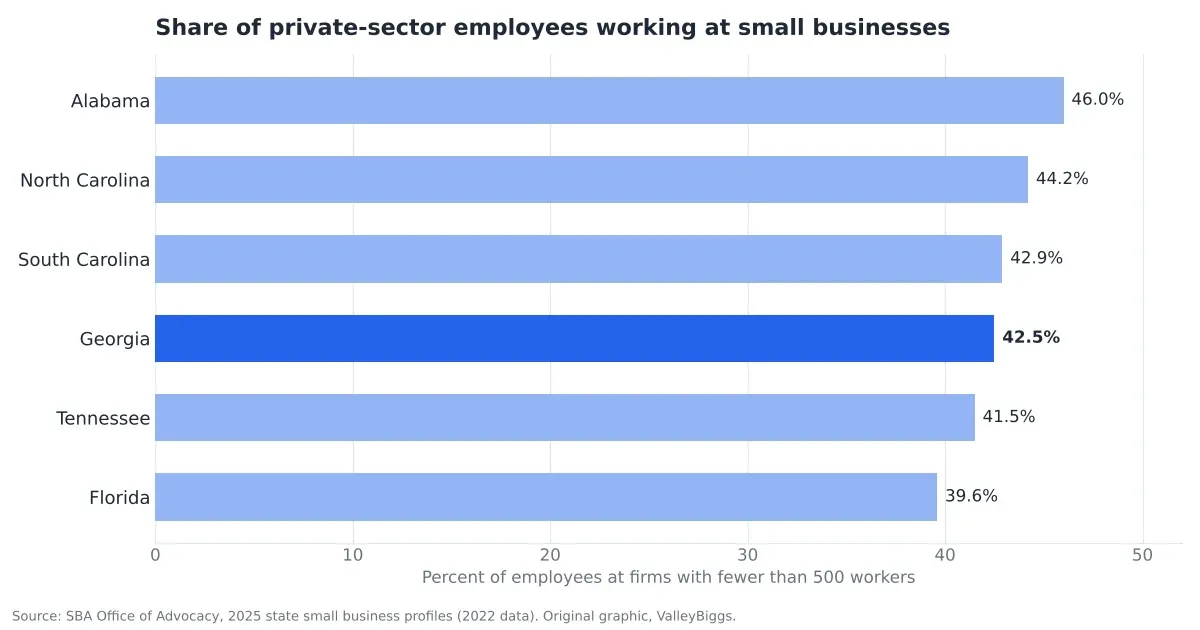
| State | Small businesses | Small business share of employment | Why it matters to Georgia sellers | |
|---|---|---|---|---|
| Georgia | 1.37 million | 42.5% | Second-largest base in the group, with Atlanta’s concentration of PE funds and lenders | |
| Florida | 3.5 million | 39.6% | Largest small business market in the region | Florida acquirers often expand into South Georgia |
| Alabama | 465,610 | 46.0% | Highest small business employment share of the group | West Georgia trades closely with East Alabama |
| Tennessee | 741,196 | 41.5% | Chattanooga’s metro area reaches into Northwest Georgia | |
| South Carolina | 530,402 | 42.9% | The Augusta metro spans both sides of the Savannah River | |
| North Carolina | 1.1 million | 44.2% | Charlotte-based private equity and strategic buyers regularly hunt for add-ons to the south |
When the most likely acquirer is across the border, our ranking of Florida business brokers and our list of Tennessee business brokers profile firms in two markets that do steady business with Georgia companies.
When to Talk to an Advisor
Owners often wait too long to get outside advice. An early call is worth it in situations like these:
- A competitor or investor has made an approach and you have no benchmark for the number or the structure.
- The business could be worth $5 million or more, where earnouts, rollover equity and working capital terms can swing the outcome.
- Your natural buyer is a PE platform, a national strategic or an acquirer based outside the Southeast.
- A retirement date, a co-owner exit or an estate plan sets the clock for the sale.
Have recent financial statements, a short list of top customers and key agreements, and your own goals for life after the sale ready for that first meeting.
Conclusion
Georgia offers sellers a deep bench of local brokerages and access to national advisors, and the best choice depends on your industry, your size and where your strongest buyer is likely to be. Narrow the field to two or three firms from this list, put the eight questions to each one, check licensing where real estate is involved and lay their proposals next to each other before you commit. If you run a software, SaaS or ecommerce business and want an honest read on value, buyer demand and timing, schedule a confidential consultation with ValleyBiggs.
FAQs
1. Do business brokers need a license in Georgia?
Georgia has no dedicated business broker license. The state real estate license law applies when real property is part of the sale, and many brokers hold a real estate license for deals that include a building or a lease. Ask each firm how it is licensed for your specific transaction and confirm it through the Georgia Real Estate Commission lookup.
2. How much does a business broker charge in Georgia?
Most Georgia brokers earn a success fee paid at closing and based on the final sale price, and several Atlanta firms say they charge nothing upfront. Larger M&A engagements may add a retainer. Fee structures vary with deal size, so get written proposals from two or three firms and compare the total cost at a realistic price.
3. How long does it take to sell a business in Georgia?
A well-prepared company usually takes six to twelve months from engagement to closing, and complex or larger deals can run longer. Buyer financing, the quality of your records and diligence findings drive the timeline. Requesting the Georgia sales and use tax clearance early keeps the final weeks from slipping.
4. What is the difference between a business broker and an M&A advisor?
Business brokers usually sell smaller owner-operated companies, often to individual buyers found through listing sites and local networks. M&A advisors run structured processes for larger companies and target private equity groups and strategic acquirers. Many Georgia firms offer both, so focus on the deals each one has closed in your size range.
5. What taxes apply when I sell my business in Georgia?
Gains are generally subject to federal tax and Georgia income tax, which the Department of Revenue lists at a flat 4.99 percent for individuals and corporations. Sellers must also file a final sales and use tax return within 15 days of the sale. Asset and stock sales are taxed differently, so plan the structure with a CPA. This is not tax advice.
6. What should I prepare before meeting a Georgia business broker?
Gather three years of tax returns and financial statements, a current year-to-date profit and loss, a list of owner add-backs, major customer and supplier contracts, your lease and an equipment list. Those documents let a broker give you a grounded value range quickly, and an independent business valuation can sharpen the discussion.