

The best business brokers in Illinois are the ones whose buyer network, typical deal size and industry experience match the company you want to sell, and who are properly registered with the state. Below we compare ten firms that business brokers Illinois owners shortlist most often, from national specialists in technology and online companies to Chicago and suburban brokerages, and we explain what to check before you sign anything.
Illinois is one of the largest small business markets in the country, anchored by Chicago but with real deal flow in the collar counties, Rockford, Peoria, Springfield and the Metro East. This guide covers the state’s small business data, how the Business Brokers Act works, eight screening questions, our ranking, the two state clearance steps that can hold up a closing and how Illinois compares with its neighbors.
Key Takeaways
- Illinois has about 1.4 million small businesses, according to the SBA Office of Advocacy, but only 28,812 of them employ 20 to 499 people. Those established employers, plus the larger firms with 1 to 19 staff, produce most broker-led sales.
- Restaurants and hospitality, health care, manufacturing, professional services and wholesale distribution account for the most established small employers in the state.
- Under the Illinois Business Brokers Act of 1995, a business broker based in Illinois generally must register with the Secretary of State’s Securities Department and give clients a disclosure document, unless an exemption applies.
- In an asset sale, the buyer is expected to file Form CBS-1 with the Illinois Department of Revenue at least 10 business days before closing, and unpaid unemployment insurance contributions can follow the business to the buyer.
- Compare brokers on closed deals that resemble yours, the person who will run your file, the logic behind their valuation and the terms of the engagement letter.
Illinois Business Landscape in 2027
Small companies make up nearly the whole Illinois business base. The SBA Office of Advocacy’s 2025 Illinois profile counts 1,353,957 small businesses, or 99.6 percent of all firms in the state. They employ about 2.4 million people, which is 43.7 percent of Illinois private-sector employees.
The headline number hides how few of those firms are realistic acquisition targets. About 1.1 million have no employees at all. Roughly 224,500 employ 1 to 19 people, and 28,812 employ 20 to 499. Brokers spend most of their time in the last two groups, because that is where a buyer finds a team, repeat customers and earnings that a lender is willing to finance.
Which industries produce the most Illinois deals?
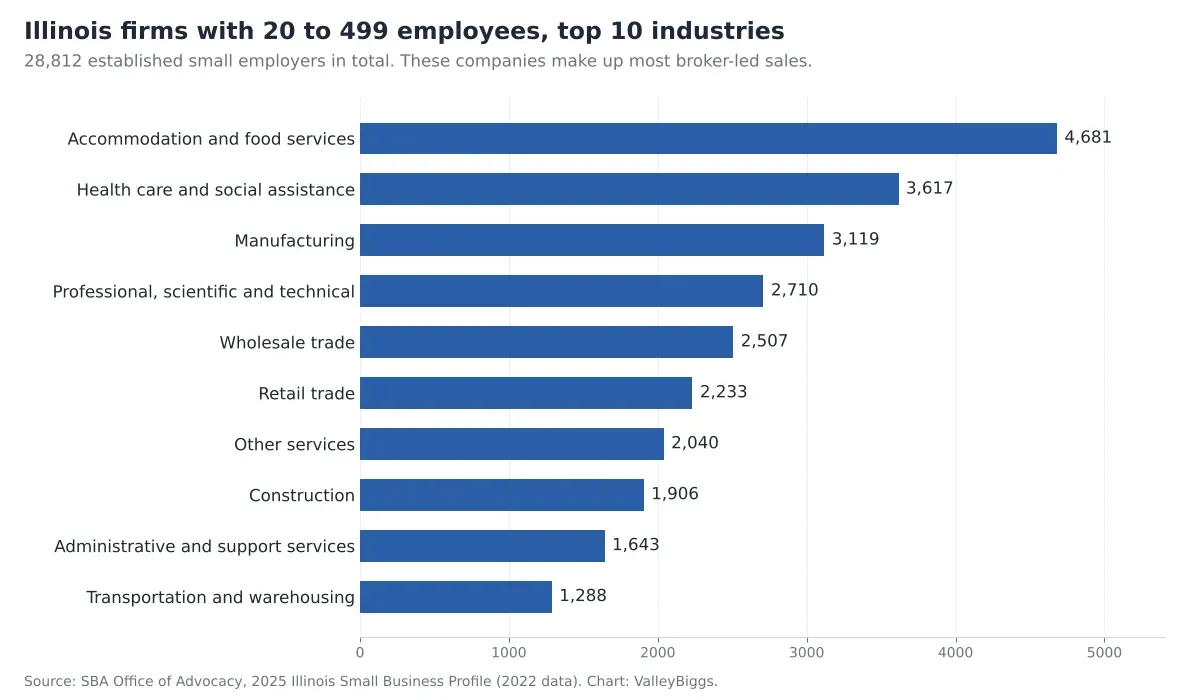
Among firms with 20 to 499 employees, accommodation and food services is the largest group with 4,681 companies. Health care and social assistance follows with 3,617, then manufacturing with 3,119, professional, scientific and technical services with 2,710 and wholesale trade with 2,507. Retail, other services and construction each have roughly 1,900 to 2,200 established employers.
Several of these categories regularly draw well-funded buyers in Illinois:
- Manufacturing and industrial services: machine shops, packaging and plastics producers, food processors and contract manufacturers, which attract strategic acquirers and private equity platforms that buy up smaller rivals.
- Distribution and logistics: Chicago’s rail, interstate and air cargo links support a large group of wholesalers, freight brokers and warehousing firms with long customer relationships.
- Professional and technical services: engineering, accounting, staffing, IT managed services and marketing firms, often bought for their recurring client base and skilled staff.
- Health care: dental, therapy, home health and senior care operators, where licensing and payer contracts shape the structure of the deal.
- Technology and online businesses: software, SaaS and ecommerce companies in Chicago and the suburbs, which frequently sell to buyers outside the state.
How do Illinois regions differ for sellers?
The Chicago metro area, including Cook County and the collar counties of DuPage, Lake, Kane, McHenry and Will, holds the largest concentration of companies, buyers, lenders and advisors. Northern Illinois around Rockford has a strong manufacturing base, while Peoria, Bloomington and the Quad Cities lean on heavy equipment, agriculture-related industries and insurance. Springfield and Champaign-Urbana add government, education and health care, and the Metro East is tied closely to the St. Louis economy. A broker who knows your region usually knows the local banks and the competitors most likely to buy.
What Does a Business Broker in Illinois Do?
A business broker represents the owner from the first conversation about value through the closing. On a typical engagement the broker will:
- Build a value range from your tax returns and financial statements, adjusted for owner compensation and one-time expenses.
- Prepare an anonymous teaser and a confidential information memorandum that describes the company in detail.
- Identify likely buyers, collect signed nondisclosure agreements and confirm each buyer can fund the deal.
- Run the offer process, negotiate the letter of intent and coordinate due diligence with your attorney and accountant.
- Keep financing, lease assignments, license transfers and state tax clearances on schedule until closing.
For larger companies the work looks closer to investment banking: a structured process with several bidders, outreach to private equity groups and strategic acquirers, and careful negotiation of earnouts, seller notes and the working capital target. Our guide to each stage of selling a business explains where an advisor adds the most value along the way.
Do business brokers need to register in Illinois?
Yes, in most cases. The Illinois Business Brokers Act of 1995 requires anyone domiciled in Illinois who is paid to help buy or sell a business, negotiate offers or find prospects for a business sale, or who advertises as a business broker, to register with the Securities Department of the Illinois Secretary of State unless the law exempts them. Registration must be renewed every year, and the broker must give clients a disclosure document described in the Act, unless the client qualifies for an exemption.
The Act exempts some groups, including attorneys licensed in Illinois and real estate licensees who are primarily engaged in real estate work and only act as a business broker on an incidental basis. Ask every Illinois-based firm for its registration status and search it on the Secretary of State’s registration lookup. National M&A advisors that structure transactions as securities deals may rely on other registrations; ask them to explain how they are covered.
How to Choose Business Brokers in Illinois: 8 Questions to Ask
1. Which completed sales are closest to my company?
Ask for several closed deals in your industry and size band, with a rough value, the type of buyer and how long each one took. A firm that mostly sells restaurants and gas stations works with a very different buyer pool than one that sells a $15 million distribution company.
2. Who handles my sale day to day?
Find out who writes the marketing materials, who screens buyers, who sits in on negotiations and how many active engagements that person is carrying right now. The partner who pitches you is not always the person who answers buyer calls.
3. How did you reach your value estimate?
A credible estimate names the earnings measure, either seller’s discretionary earnings or EBITDA, lists every add-back and shows the comparable sales or multiples used. If you want to understand how buyers price larger companies, our explainer on how EBITDA multiples are set is a useful primer, and an independent enterprise valuation analysis gives you a baseline to test each broker’s number against.
4. Which buyers will you contact?
Local brokers often rely on regional buyers, listing marketplaces and bank relationships. National firms reach private equity groups, family offices, search funds and strategic acquirers across the country. Ask which pools the firm will approach and how it decides who receives your memorandum.
5. How will you keep the sale confidential?
Employees, customers and competitors should not hear about a sale early. Ask when buyers learn your company’s name, whether NDAs are signed before any financials go out and how management meetings and site visits are arranged.
6. Are you registered, and what credentials does your team hold?
Confirm the Illinois registration or the exemption the firm relies on. Then look at professional credentials such as the IBBA’s Certified Business Intermediary designation, M&A Source membership, valuation credentials or finance licenses held by the deal team.
7. What does the engagement letter commit me to?
Read the term, exclusivity, any upfront or monthly charges, how the success fee is calculated and the tail period during which the broker can still claim a fee after the agreement ends. Run the numbers at a realistic sale price, not only at the price the broker hopes to reach.
8. How will you handle the Illinois closing requirements?
An experienced Illinois broker should raise the bulk sales notice and unemployment insurance clearance early, rather than at the closing table. Ask how the firm has handled stop orders or escrow holdbacks on past deals.
Top 10 Business Brokers Illinois Sellers Should Compare (2027)
Our list mixes national firms with wide buyer reach and Illinois brokerages with long local relationships. Each profile is based on how the firm describes itself on its own website. Services, offices and terms change, so confirm the details directly before you engage anyone.
| # | Firm | Illinois presence | Stated focus |
|---|---|---|---|
| 1 | Website Closers | National coverage, works with Illinois owners | Tech and internet companies |
| 2 | Sun Acquisitions | Headquartered in Chicago | Privately held companies valued at about $2M to $75M |
| 3 | ValleyBiggs | National coverage, works with Illinois owners | Tech, SaaS, ecommerce and growth companies |
| 4 | Calder Capital | Chicago Metro office in Deer Park | Manufacturing, distribution and service companies valued at $1M to $250M |
| 5 | Playbook Advisory | Chicago | Companies of about $1M to $15M |
| 6 | SellerForce | National coverage, works with Illinois owners | Digital and traditional businesses |
| 7 | The Grasemann Group | Greater Chicagoland | Small and mid-size closely held businesses |
| 8 | First Choice Business Brokers Naperville | Naperville, serving Chicago and the western suburbs | Main Street and middle market businesses |
| 9 | DealPipe | National coverage, works with Illinois owners | Lower middle market, digital and physical |
| 10 | Transworld Business Advisors Chicago North Side | Chicago North Side | Larger transactions, including companies with earnings above $1M |
1. Website Closers
Website Closers concentrates on selling internet and technology businesses, such as SaaS products, ecommerce stores, apps, agencies and content properties, and markets them to acquirers across the country. For a Chicago founder whose most likely buyer is a strategic company or private equity platform in another state, a specialist with that kind of national buyer list is worth an early conversation.
2. Sun Acquisitions
Sun Acquisitions describes itself as a sell-side M&A advisory firm headquartered in Chicago that works with privately held companies valued at about $2 million to $75 million. The firm says it serves Illinois, Wisconsin, Michigan, Indiana and nearby states and has completed more than 500 deals since 2005. Its services include business sales, buy-side work, business value analysis, seller and buyer readiness assessments and due diligence advisory, and it says its advisors are certified in M&A.
3. ValleyBiggs
ValleyBiggs works with owners of tech, internet, ecommerce and digital companies, and several of our advisors are former founders who have sold businesses of their own. Sellers get a full deal team rather than a single broker, and we are paid on results, with no fee if the transaction does not close. Illinois founders of software, IT services and online brands can see how buyer outreach, negotiation and closing support work through our sell-side advisory service and on our guide for owners selling a technology company.
4. Calder Capital
Calder Capital runs a Chicago Metro office in Deer Park, and the firm says its advisors there serve buyers and sellers across Lake, Cook, Kane, McHenry, DuPage, Winnebago and Boone counties and the rest of Northern Illinois. It describes its focus as manufacturing, distribution and service businesses valued at roughly $1 million to $250 million, with M&A advisory, exit planning and business valuation among its services. That combination suits owners of established industrial and B2B companies in the northern half of the state.
5. Playbook Advisory
Playbook Advisory is a Chicago firm founded in 2016 that says it confidentially sells small and mid-sized companies, typically in the $1 million to $15 million range. It lists manufacturing, distribution, services, technology and retail among its industries, and states that founder Jim Peddle runs every deal personally with a Chicago-based team. The firm reports more than $100 million in businesses listed and sold since its founding, and its process covers valuation, marketing, due diligence and support on legal points such as holdbacks and representations.
6. SellerForce
SellerForce lists online businesses alongside brick-and-mortar and service companies, and its model depends on broad marketing to bring in a high volume of inquiries. Illinois owners of small and mid-sized companies who want maximum exposure may find that appealing. Before signing, ask how prospects are screened and at what stage they see your financial statements.
7. The Grasemann Group
The Grasemann Group describes itself as a Greater Chicagoland M&A firm that has helped owners since 1999 with the confidential sale of small and medium-sized closely held businesses. Its services include sell-side advisory, buy-side advisory and business valuations, and it offers a complimentary first consultation. Owners who want a long-established Chicago-area firm for a confidential, owner-to-buyer process may want to include it on a shortlist.
8. First Choice Business Brokers Naperville
First Choice Business Brokers Naperville is a local office of a national brokerage network founded in 1994. The office says it helps owners across Chicago and the western suburbs confidentially buy and sell profitable companies, covering Main Street and middle market businesses, and its site lists free business evaluations, confidential listing services and buyer representation. The network reports more than $15 billion in businesses listed and managed and shows IBBA and International Franchise Association affiliations.
9. DealPipe
DealPipe works with lower and middle market sellers, from online companies to operating businesses with staff and locations, and it tracks each buyer’s progress in a way the owner can follow. Sellers who want regular, concrete updates on where every prospect stands may value that approach. Ask about the team’s experience in your sector before committing.
10. Transworld Business Advisors Chicago North Side
The Chicago North Side office of Transworld Business Advisors says its M&A team focuses on larger transactions, such as companies with earnings above $1 million, businesses too large for an individual buyer to finance conventionally and companies in consolidating industries. The office describes a process that runs from goals and valuation through a prioritized buyer list, letters of intent, negotiation, due diligence and closing, including real estate sales or lease transfers. It is a practical option for owners who want a local office backed by a national franchise network.
When Should You Sell Your Illinois Business?
There is no perfect month to sell, but Illinois sales tend to go best when several of these conditions line up:
- Revenue and profit have grown over the last two to three years, supported by reviewed or audited statements.
- No single customer, contract or distributor accounts for an outsized share of sales.
- A manager or small leadership team can run the business for several months without you.
- Equipment, facilities and systems are in good order, so a buyer does not face immediate capital spending.
- You have a personal reason to move on, such as retirement or a new venture, and enough time to plan rather than sell under pressure.
Seasonal businesses, such as landscaping companies or hospitality operators, usually present best after a strong season’s results are on the books.
Typical Sale Process in Illinois
Most broker-led sales follow a similar sequence. The table below is a general guide; the real timeline depends on deal size, financing and how organized your records are.
| Stage | What happens | Illinois-specific check |
|---|---|---|
| Preparation | Clean up financials, normalize earnings, gather contracts and leases | Confirm sales, withholding and unemployment insurance filings are current |
| Valuation and engagement | Agree on a value range and sign the engagement letter | Check the broker’s Secretary of State registration and collect its disclosure document |
| Marketing | Teaser, confidential memorandum, buyer outreach and NDAs | Plan how and when employees and key customers will be told |
| Offers and LOI | Compare offers, negotiate price, structure and the working capital target | Agree early on how any state tax or unemployment holdback will work |
| Due diligence | Buyer reviews books, contracts, taxes and operations | Buyer files Form CBS-1 at least 10 business days before closing |
| Closing | Sign the purchase agreement, fund the deal, transfer ownership | Seller settles unemployment insurance contributions and provides clearance |
Working capital often becomes the last real negotiation before signing, so read our explainer on working capital pegs and post-closing adjustments before you accept a letter of intent. The ValleyBiggs locations hub gathers our state and city guides, including local pages on business brokers in Springfield, brokers serving Joliet owners and business brokers in Waukegan.
Illinois tax and clearance steps sellers should plan for
Illinois protects its tax claims through the buyer. When a business sells or transfers the major part of its stock of goods, furniture, fixtures, machinery, equipment or real property outside the normal course of business, the Illinois Department of Revenue says the purchaser must file Form CBS-1, Notice of Sale, Purchase, or Transfer of Business Assets, at least 10 business days before the sale. The seller may file it on the buyer’s behalf. If the notice is late, the buyer becomes personally liable for the seller’s unpaid state taxes up to the reasonable value of the property acquired, and the department can respond to a notice with a stop order telling the buyer to hold back part of the price.
Unemployment insurance works in a similar way. Under the Illinois Unemployment Insurance Act, an employer that sells substantially all of its business or certain classes of its assets must, within 10 days after the sale, file the required reports and pay contributions owed up to the sale date. The buyer is expected to withhold enough of the purchase money to cover any unpaid amounts until the seller produces a receipt or certificate from the Illinois Department of Employment Security; a buyer who does not can become liable for them. The department’s Form UI-2600 is used to request a letter of clearance.
For income tax, Illinois charges individuals a flat 4.95 percent of net income. C corporations pay a 7 percent income tax plus a 2.5 percent personal property replacement tax, while partnerships and S corporations pay a 1.5 percent replacement tax. Whether an asset sale or a stock sale suits you better depends on your entity type and the buyer’s goals, so work through the options with a CPA. This section is general background and is not legal or tax advice.
Compare Neighboring Markets
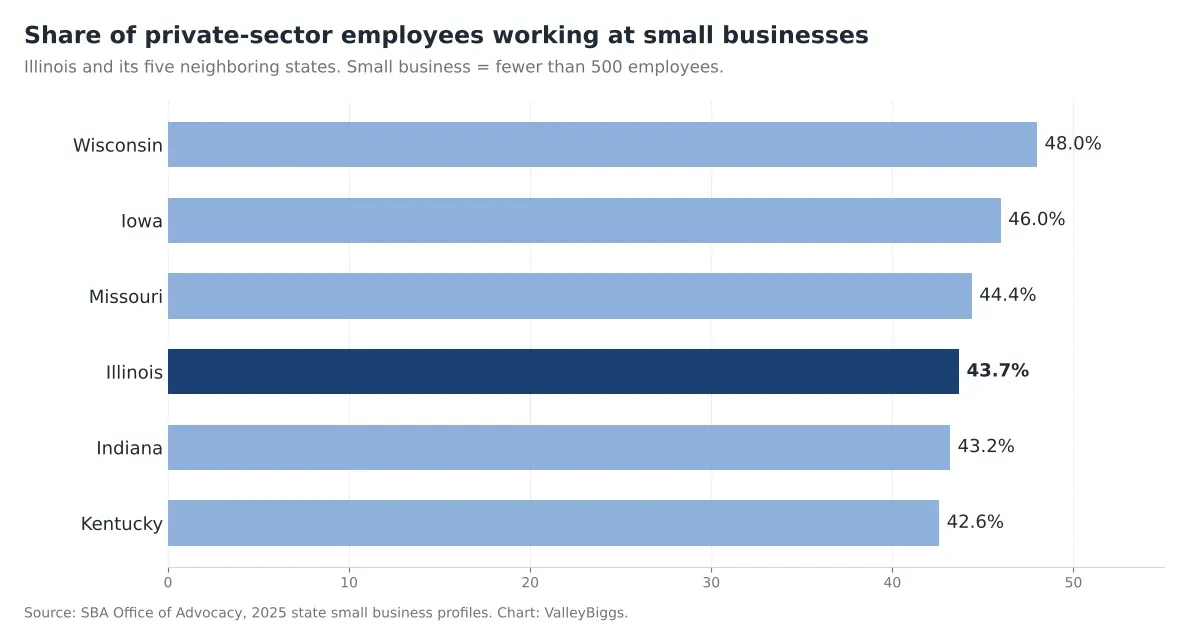
Illinois sellers often find buyers in nearby states, and several Midwest firms cover more than one state. The SBA’s 2025 state profiles show how Illinois compares with its five neighbors.
| State | Small businesses | Share of employees at small businesses | What it means for sellers |
|---|---|---|---|
| Illinois | 1.35 million | 43.7% | Largest market in the region, with deep private equity and lender coverage in Chicago |
| Indiana | 591,671 | 43.2% | Smaller market; northwest Indiana is part of the Chicago metro area |
| Wisconsin | 497,370 | 48.0% | Highest small business share among neighbors; strong manufacturing base |
| Missouri | 590,131 | 44.4% | The St. Louis metro area includes Illinois’ Metro East counties |
| Iowa | 289,962 | 46.0% | Smaller market; the Quad Cities straddle the Iowa and Illinois border |
| Kentucky | 393,860 | 42.6% | Lowest small business employment share in the group |
If your likely buyer sits across a state line, our pages on business brokers in the St. Louis area and our ranking of Michigan business brokers cover nearby markets that frequently trade with Illinois companies.
When to Talk to an Advisor
A short conversation with an experienced advisor pays off well before you list. It makes sense when:
- An unsolicited offer has arrived and you cannot tell whether the price or terms are fair.
- You expect the company to be worth several million dollars or more, where structure can matter as much as headline price.
- Your best buyer is likely to be a private equity group, a strategic acquirer or a company outside Illinois.
- You need to time a sale around retirement, a partner buyout or estate planning.
Bring two to three years of financial statements, a summary of key customers and contracts and a clear sense of what you want after closing, whether that is a clean exit, a transition period or retained equity.
Conclusion
The right broker for an Illinois sale depends on what you are selling and who is most likely to buy it. Local firms bring regional buyers and bank relationships, while national advisors reach acquirers across the country. Shortlist two or three firms from this list, ask the eight questions above, check each firm’s registration and compare written proposals side by side. If you own a technology, SaaS or ecommerce company and want a clear view of value, likely buyers and timing, book a confidential call with ValleyBiggs before you choose a path.
FAQs
1. How much does a business broker charge in Illinois?
Most Illinois business brokers are paid mainly through a success fee that is due only when the sale closes and is calculated on the final price. Some firms also charge an upfront or monthly retainer, especially for larger companies. Rates vary with deal size and complexity, so compare written proposals and model the total cost at a realistic sale price.
2. Do I need a business broker to sell my business in Illinois?
No, Illinois does not require a broker, and some owners sell directly to an employee, family member or competitor. A broker earns their fee by valuing the company, finding and screening buyers, keeping the process confidential and managing negotiations and closing. The larger and more complex the company, the more that support tends to matter.
3. How long does it take to sell a business in Illinois?
An established company often takes six to twelve months from preparation to closing, and larger or more complex deals can take longer. Timing depends on how clean your records are, how quickly buyers secure financing and how diligence goes. Filing state notices early, such as the CBS-1 bulk sale notice, helps avoid delays in the final weeks.
4. What is the difference between a business broker and an M&A advisor?
Business brokers usually handle smaller, owner-operated companies and often sell to individual buyers using listing sites and local networks. M&A advisors focus on larger companies and run structured processes aimed at private equity firms and strategic acquirers. Many Illinois firms do both, so judge them on deals they have actually closed in your size range.
5. How can I check whether an Illinois business broker is registered?
Use the registration search on the Illinois Secretary of State Securities Department website, which lists registered business brokers and their representatives. Ask the broker for the disclosure document the Business Brokers Act requires as well. If the firm says it is exempt, ask which exemption applies and how it is licensed or registered instead.
6. What documents should I prepare before meeting a business broker?
Bring three years of tax returns and financial statements, a current year-to-date profit and loss statement, a list of add-backs, key customer and supplier contracts, your lease and an equipment list. These let a broker give a realistic value range quickly. An independent valuation of your company can also sharpen that first discussion.