

Vertical SaaS is subscription software built for one industry, such as dental practices, HVAC contractors, law firms or independent restaurants. For founders, the business model matters most at exit: buyers usually value a vertical SaaS company on a multiple of recurring revenue, then move that multiple up or down based on retention, payments revenue, margins and how deeply the product runs the customer’s daily operations.
This guide covers how buyers price these companies, the metrics they check first, a worked hypothetical example, and the exit paths open to owners who plan to sell in the next one to three years.
Key Takeaways
- Vertical SaaS serves a single industry and often becomes the customer’s system of record, which tends to lower churn and raise switching costs.
- Most buyers start with an ARR multiple, then test it against gross retention, net revenue retention, growth and profitability.
- Embedded payments can lift revenue per customer, but buyers usually value net payments revenue below subscription revenue.
- The buyer universe includes strategic acquirers, private equity platforms, and long-term holders of vertical market software.
- Clean revenue data, cohort reporting and documented integrations matter more than a pitch about market size.
What is vertical SaaS?
A vertical SaaS product is shaped around the workflows, compliance rules and vocabulary of one industry. A veterinary practice platform handles appointments, medical records, prescriptions and client billing in one place. A construction platform manages bids, change orders, subcontractor payments and job costing. The older term, vertical market software, describes the same idea before cloud delivery became standard.
Horizontal SaaS takes the opposite approach. A CRM, an email marketing tool or a project management app serves almost any company, regardless of industry. The vertical vs horizontal SaaS comparison below shows why buyers underwrite the two models differently.
| Factor | Vertical SaaS | Horizontal SaaS |
|---|---|---|
| Target market | One industry, often a defined niche inside it | Many industries with a shared function |
| Product depth | Industry workflows, compliance, specialized integrations | Broad features configured by each customer |
| Total addressable market | Smaller, so market share and expansion revenue matter | Larger, but more crowded |
| Go-to-market | Trade shows, associations, referrals, industry content | Paid acquisition, product-led growth, broad outbound |
| Typical expansion levers | Payments, payroll, add-on modules, data products | Seats, usage tiers, enterprise plans |
| Main buyer concern at exit | Ceiling on growth once the niche is penetrated | Competition and customer acquisition cost |
Why buyers pay attention to vertical software companies
Acquirers like products that customers cannot easily rip out. When a dental group runs scheduling, charting, insurance claims and patient payments through one platform, replacing it means retraining staff and migrating years of records. That friction shows up in the numbers buyers care about: steadier gross retention and more predictable cash flow.
There is also a dedicated buyer group for this category. Constellation Software, for example, describes itself as a buy-and-hold acquirer that supports vertical market software companies for the long term. Large private equity firms are active too. Bain Capital took PowerSchool, a K-12 cloud software provider, private at an enterprise value of about $5.6 billion, and Thoma Bravo agreed in 2025 to buy restaurant platform Olo in an all-cash deal valued at roughly $2.0 billion in equity value, according to the companies’ announcements. Most founder-owned deals are far smaller, but the same logic about switching costs and recurring revenue applies.
How is a vertical SaaS company valued?
The starting point depends on size and profitability. Smaller, owner-run software businesses are often priced on seller’s discretionary earnings or EBITDA, much like other lower middle market companies. Once a company has several million dollars of ARR and reliable growth, buyers usually switch to an ARR or revenue multiple and use EBITDA as a cross-check. Our guide to how EBITDA multiples work explains the earnings side of that comparison.
Published SaaS valuation multiples give a rough frame, not a price. SaaS Capital’s model, built from its survey of private B2B SaaS companies, predicted private multiples of about 4.8x ARR for bootstrapped companies and 5.3x for equity-backed companies when its public index stood at 7.0x in early 2025. Meritech’s Software Pulse put the median public software company at around 4.4x implied ARR in October 2026, with the ten most valued names near 21.7x. Private deals for niche software can land well below or above these figures.
| Company profile | Primary valuation measure | What usually drives the range |
|---|---|---|
| Under about $2M ARR, owner-operated | SDE or EBITDA multiple | Owner dependence, customer concentration, code quality |
| About $2M to $10M ARR, profitable or near breakeven | ARR multiple with EBITDA cross-check | Gross retention, growth rate, Rule of 40 score |
| $10M+ ARR with strong growth | ARR or forward revenue multiple | Net revenue retention, market share, expansion products |
| Mature, slower growth, high margins | EBITDA multiple | Cash conversion, churn stability, pricing power |
What moves the multiple up or down
- Gross revenue retention: the clearest sign of product stickiness. Buyers look at logo churn and dollar churn separately.
- Net revenue retention: shows whether existing customers buy more modules, locations or payment volume over time.
- Market share in the niche: a leading position in a defined segment can justify a premium, while a ceiling on new logos can cap it.
- Gross margin: heavy onboarding services or hosting costs pull the blended margin down.
- Growth efficiency: many buyers apply the Rule of 40 to balance growth against profit.
- Revenue mix: subscription, payments, services and hardware are valued differently.
Metrics buyers underwrite in a vertical SaaS deal
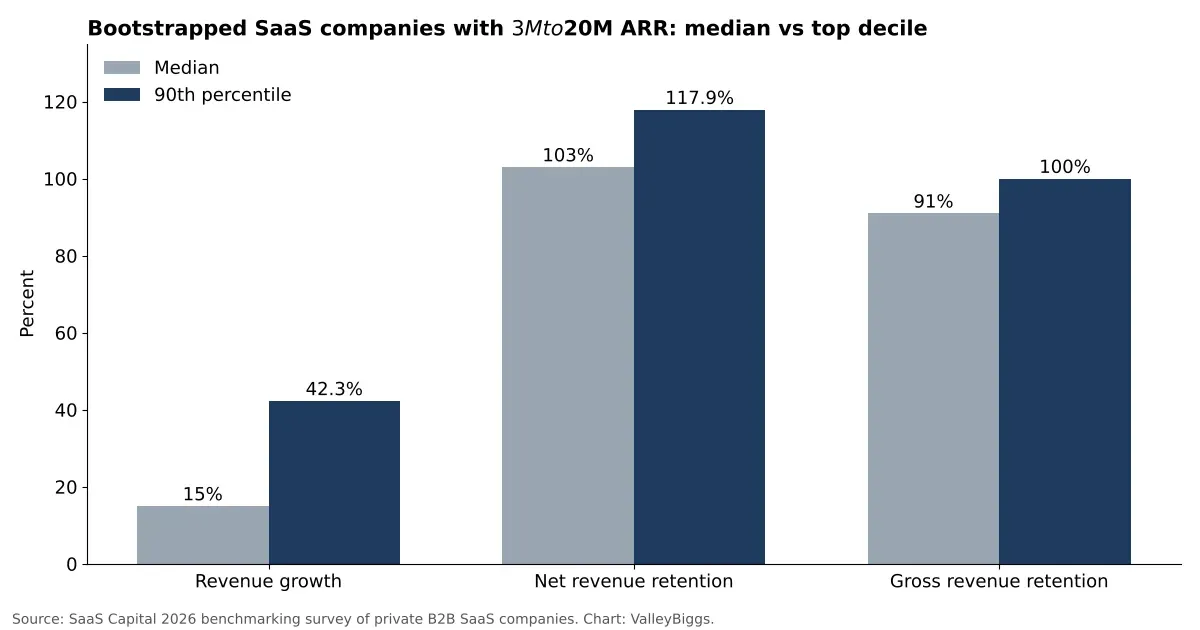
Diligence teams rebuild your metrics from raw billing and CRM data, so the numbers in your pitch deck need to match what they find. SaaS Capital’s 2026 benchmarking survey of bootstrapped companies with $3M to $20M in ARR reported median revenue growth of 15%, net revenue retention of 103% and gross revenue retention of 91%. Top-decile companies reported about 42% growth, 118% net retention and 100% gross retention. Those gaps explain much of the spread in private multiples.
| Metric | What buyers check | Vertical SaaS nuance |
|---|---|---|
| ARR and MRR | Contracted recurring revenue, reconciled to bank deposits | Separate per-location fees from one-time setup and hardware |
| Gross revenue retention | Dollar churn and downgrades by cohort | Churn from customer closures differs from churn to a competitor |
| Net revenue retention | Expansion from add-ons, locations and price increases | Payments volume growth should be shown apart from subscription expansion; see our net revenue retention guide |
| Customer acquisition cost and payback | Sales and marketing spend per new customer | Association partnerships and referrals often lower acquisition cost |
| Gross margin | Hosting, support, onboarding and payment processing costs | Report subscription margin and payments margin separately |
| Customer concentration | Share of ARR from the top 10 customers | Multi-location groups and franchise systems can create hidden concentration |
| Market penetration | Customers as a share of the reachable segment | Buyers test how much room is left before growth slows |
How do embedded payments affect valuation?
Many vertical platforms process their customers’ card and ACH payments, take a share of the processing economics, and add payroll, lending or insurance on top. Andreessen Horowitz argued in its widely cited “Fintech Scales Vertical SaaS” essay that adding financial services can raise revenue per customer by 2x to 5x compared with a software subscription alone. That upside is real, but it changes how buyers read your income statement.
- Gross vs net: buyers look at payments revenue net of interchange and processor costs, not gross processing volume.
- Different multiple: net payments revenue is tied to customer transaction volume, so it is usually valued below contracted subscription revenue.
- Contract terms: the payments processor agreement, its change-of-control language and who owns the merchant relationship all get reviewed.
- Risk and compliance: chargeback history, underwriting responsibility and any money transmission questions come up in diligence.
- Attach rate: the share of customers using payments shows how much expansion is left.
Hypothetical example: valuing a $6M ARR vertical SaaS company
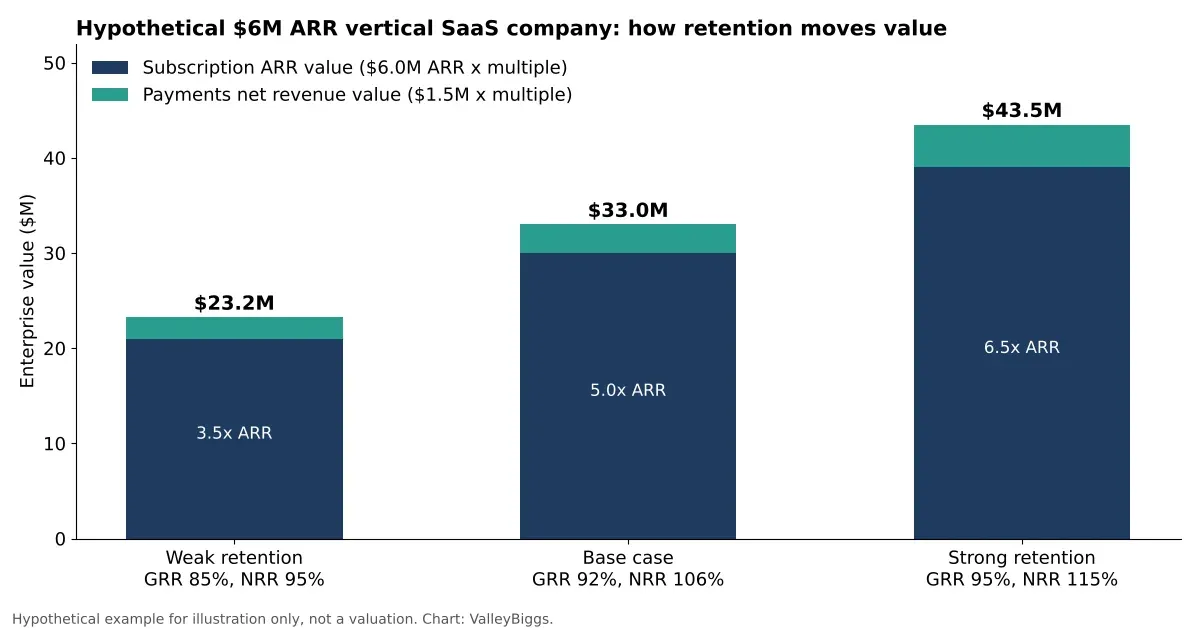
Consider a hypothetical platform for HVAC and plumbing contractors. It has $6.0M of subscription ARR, $1.5M of annual payments revenue net of processing costs, 80% subscription gross margin, about $1.8M of adjusted EBITDA and 20% growth. A buyer might value subscription ARR and net payments revenue separately, then adjust the subscription multiple for retention quality.
| Scenario (hypothetical) | Retention | Subscription value | Payments value | Indicative enterprise value |
|---|---|---|---|---|
| Weak retention | GRR 85%, NRR 95% | $6.0M x 3.5 = $21.0M | $1.5M x 1.5 = $2.25M | $23.25M |
| Base case | GRR 92%, NRR 106% | $6.0M x 5.0 = $30.0M | $1.5M x 2.0 = $3.0M | $33.0M |
| Strong retention | GRR 95%, NRR 115% | $6.0M x 6.5 = $39.0M | $1.5M x 3.0 = $4.5M | $43.5M |
The same revenue produces values about $20M apart, and the difference comes almost entirely from retention. In the base case, $33.0M is roughly 18x adjusted EBITDA, which is why profitable but slower-growing companies sometimes get better offers from buyers who price on earnings. A formal enterprise valuation analysis tests which approach fits your numbers.
Exit paths for a vertical SaaS company
Industry focus narrows the list of logical buyers but often makes them easier to identify. Each buyer type looks for something different, and the right fit affects price, structure and what happens to your team.
| Exit path | Who the buyer is | What they value | Typical structure points |
|---|---|---|---|
| Strategic acquirer | A larger software or services company in the same industry | Cross-sell into its base, product gaps filled, competitive position | More cash at close; integration and retention packages for key staff |
| Long-term software holder | Buy-and-hold acquirers of vertical market software | Stable recurring revenue, profitability, mission-critical use | Disciplined pricing on earnings; business often keeps operating independently |
| Private equity platform | A fund buying its first company in a vertical | Management team, growth runway, add-on potential | Rollover equity is common; debt financing may be used, as in a leveraged buyout |
| Private equity add-on | An existing portfolio company in your vertical | Customers, modules or geography that fit the platform | Faster process; earnouts or holdbacks to bridge valuation gaps |
| Growth equity or recapitalization | A minority or majority investor | Growth capital use, partial liquidity for founders | Founder keeps a stake and often stays in control |
| Management buyout | The existing leadership team | Continuity and culture | Usually needs seller financing or outside capital |
For a broader look at selling a software business, including how a sell-side process runs, see our guide on how to sell a software company.
Does vertical AI change the valuation story?
Buyers now ask every software seller about AI. In vertical markets, the useful question is whether AI features automate work that customers currently pay people to do, such as insurance claim coding, dispatch or document review, and whether your product holds proprietary industry data that a new entrant cannot easily copy. A chatbot added to the interface rarely moves the multiple. Measurable time saved, usage data and pricing for AI modules give buyers something to underwrite.
Red flags that reduce a vertical SaaS valuation
- ARR that cannot be reconciled to invoices and bank deposits.
- Payments revenue reported gross, or blended into subscription revenue.
- Heavy reliance on the founder for product decisions, key accounts or industry relationships.
- Large customers on month-to-month terms or with unusual termination rights.
- A processor or integration partner contract that can be terminated on a change of control.
- Unresolved data privacy or industry compliance gaps, such as health or financial records handling.
- Technical debt or undocumented code that a buyer must rewrite.
Preparation checklist before you go to market
Twelve to 24 months of preparation usually pays for itself. The list below mirrors what diligence teams request, and our due diligence checklist for sellers goes deeper on documents.
- Build a monthly ARR bridge: new, expansion, contraction and churn, reconciled to billing.
- Produce cohort tables for logo and dollar retention by signup year and customer size.
- Split revenue and gross margin by subscription, payments, services and hardware.
- Document market penetration: customers served against the reachable segment.
- Review customer contracts, processor agreements and partner terms for assignment and change-of-control clauses.
- Prepare quality of earnings support for adjusted EBITDA and one-time costs.
- Document architecture, security practices, integrations and open-source use.
- Put a second layer of management in place so the business runs without you.
Deal structure: what you actually take home
Headline value and cash at close are rarely the same. Buyers deduct debt, adjust for working capital, and often hold back part of the price. In software deals, deferred revenue and the working capital target deserve close attention, as our article on net working capital pegs explains. Common components include:
- Cash at close: the portion paid when the deal funds, after debt and adjustments.
- Rollover equity: a stake you keep in the buyer’s company, common with private equity.
- Earnout: payments tied to future ARR, payments volume or retention targets.
- Escrow or holdback: funds set aside to cover indemnification claims.
- Seller note: part of the price paid over time, more common in smaller deals.
These terms are set in the letter of intent, so negotiate them early. This article is general information, not legal or tax advice. Asset versus stock structure and purchase price allocation have tax consequences that a CPA or tax attorney should review.
When to talk to an M&A advisor
Bring in an advisor when an unsolicited offer arrives, when you are 12 to 24 months from a planned sale, or when a strategic buyer asks for data before you have a process in place. An advisor can benchmark your metrics, identify the buyers most likely to pay for your niche, and run competition between them. ValleyBiggs works with owners who want to sell a SaaS business, and our SaaS M&A services cover valuation, buyer outreach and negotiation through closing.
If you run a vertical SaaS company and want to know how buyers would price it today, start with a confidential conversation. Contact ValleyBiggs to request a valuation review and a clear view of your exit options.
FAQs
1. What is vertical market software?
Vertical market software is built for the specific needs of one industry, such as veterinary clinics, trucking fleets or property managers. It bundles that industry’s workflows, rules and integrations into one product. When it is delivered as a cloud subscription, it is usually called vertical SaaS.
2. What is the difference between vertical and horizontal SaaS?
Vertical SaaS serves one industry in depth, while horizontal SaaS serves one business function, such as sales or accounting, across many industries. Vertical products usually have a smaller addressable market but deeper customer reliance, which buyers often see in steadier retention and more options to add payments or other modules.
3. How much is a vertical SaaS company worth?
There is no single multiple. Private SaaS companies have often been valued at roughly 4x to 6x ARR in published surveys, and strong retention, growth and margins can push a company well above that range. Smaller owner-run businesses are frequently priced on EBITDA or seller’s discretionary earnings instead.
4. Do embedded payments increase a SaaS company's valuation?
They can, because payments raise revenue per customer and make the platform harder to replace. Buyers usually value payments revenue net of processing costs and apply a lower multiple than subscription revenue, since it depends on customer transaction volume. Clear reporting of the two streams helps avoid a discount.
5. Who buys vertical SaaS companies?
Typical buyers include larger software companies in the same industry, private equity platforms and their add-on companies, and long-term holders that specialize in vertical market software. The best fit depends on size, profitability and growth. Our step-by-step guide to selling a business explains how a sale process reaches them.
6. Is vertical AI replacing vertical SaaS?
Not in most markets. AI is being added to vertical platforms to automate tasks such as coding, scheduling and document review. Buyers tend to reward companies that combine AI features with proprietary industry data and established workflows, rather than standalone AI tools without a customer base or system-of-record role.