

The best business brokers in Michigan are the firms whose buyer contacts, usual transaction size and sector track record fit the company you plan to sell. Below we rank ten firms active with Michigan owners, from national advisors that specialize in technology and online companies to brokerages based in Grand Rapids, Kalamazoo and Oakland County, and we show what to verify before any engagement letter is signed.
Michigan is a large, diverse market: a manufacturing economy, a deep bench of service companies and a growing technology scene. Below you will find the state’s small business numbers, what a broker does, the licensing rule for Michigan brokers, seven screening questions, our ranking, the Treasury tax clearance rule buyers raise before closing and how nearby states compare.
Key Takeaways
- Michigan has 983,079 small businesses, according to the SBA Office of Advocacy, but only 21,966 of them employ between 20 and 499 people. Most broker-led sales come from that group and from larger firms with 1 to 19 staff.
- Manufacturing, health care and restaurants account for the most established small employers, so many Michigan buyers are industry consolidators and private equity add-on platforms.
- Michigan law treats anyone who negotiates the sale of a business for others as a real estate broker, so ask any Michigan-based broker which license the firm holds.
- Before closing, a buyer is expected to escrow enough money to cover the seller’s unpaid state taxes until the seller produces a Treasury tax clearance certificate. Only the seller can request it, using Form 5156.
- Compare brokers on closed sales similar to yours, the person who will run your file, a valuation whose math you can trace and the terms of the engagement letter.
Michigan Business Landscape in 2027
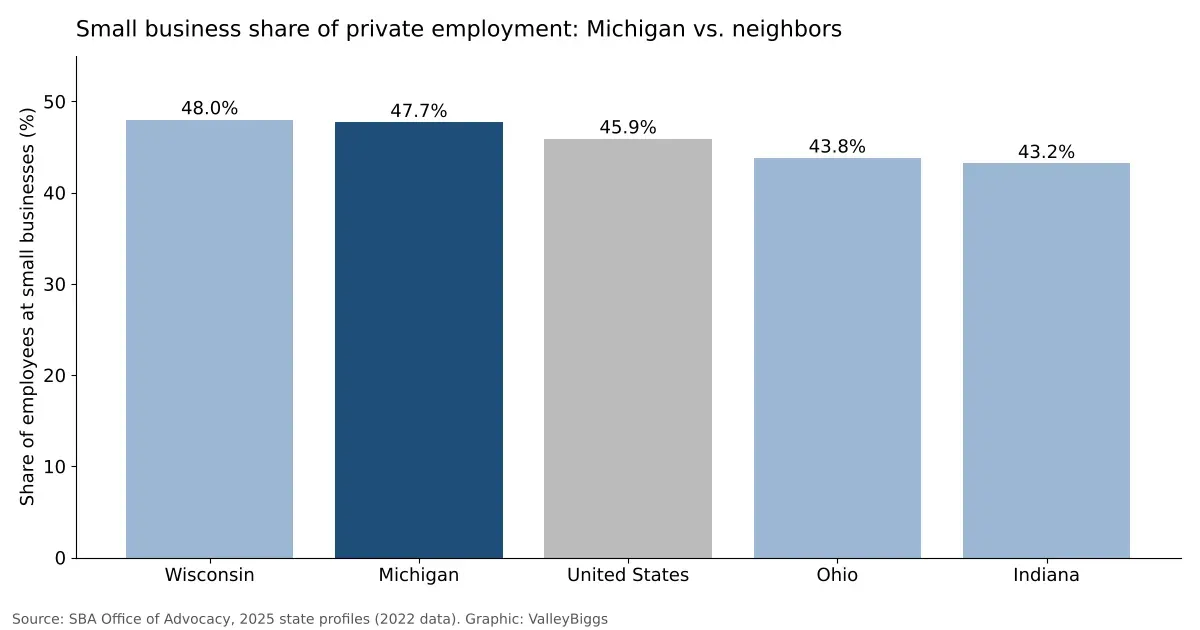
Small companies make up almost the entire Michigan business base. According to the 2025 Michigan profile from the SBA Office of Advocacy, the state has 983,079 small businesses, or 99.6 percent of all firms. They employ about 1.9 million people, which is 47.7 percent of the state’s private workforce and above the national small business share of 45.9 percent.
The base is still growing, if slowly. Between March 2023 and March 2024, 25,756 Michigan establishments opened and 24,412 closed, a net gain of 1,344, and small businesses added a net 27,947 jobs over the same period. For an owner thinking about a sale, that steady churn means a regular flow of first-time buyers, search fund operators and competitors looking to expand.
Only a fraction of these companies is a realistic broker listing. About 809,400 have no employees at all, roughly 151,700 employ 1 to 19 people and 21,966 employ 20 to 499. Broker-led deals cluster in those two employer groups, because a buyer gets staff, recurring customers and profits a bank will finance.
Which industries produce the most Michigan deals?
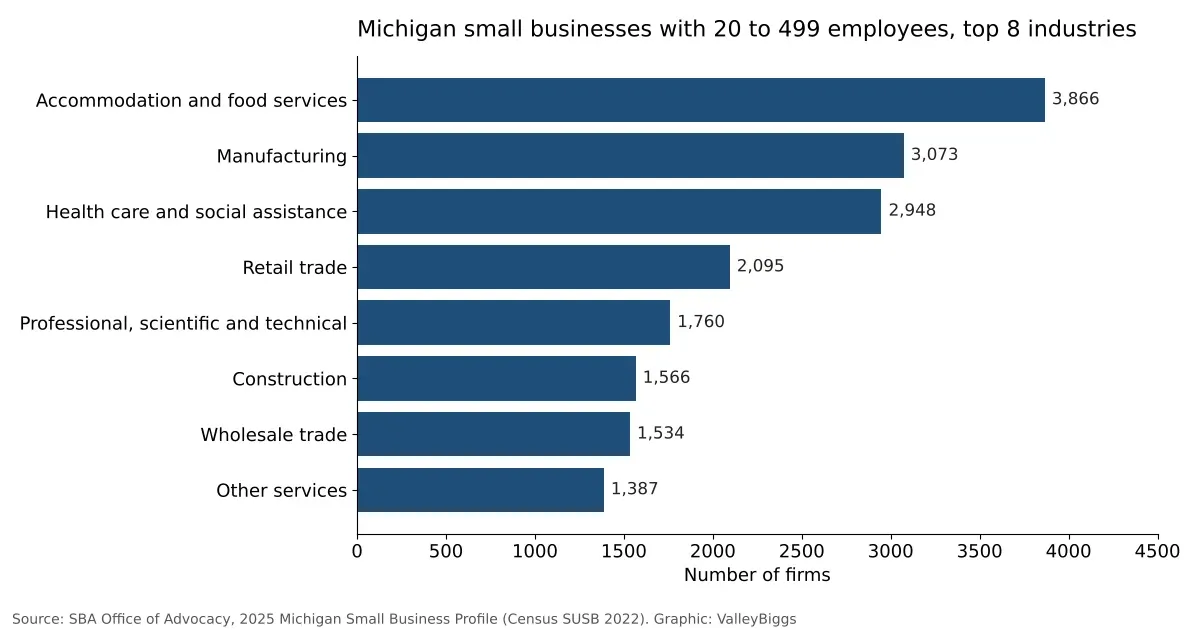
Looking only at firms with 20 to 499 employees, accommodation and food services leads with 3,866 firms, followed by manufacturing at 3,073 and health care and social assistance at 2,948. Retail, professional and technical services, construction and wholesale trade follow. Manufacturing stands out: Michigan small manufacturers employ about 256,000 people, more than in any other industry in the state profile.
In practice, Michigan business categories that tend to attract steady buyer interest include:
- Manufacturing and machining: contract manufacturers, tool and die shops, metal fabricators and suppliers to the auto industry, often bought by larger manufacturers or private equity platforms building scale.
- Trades and home services: heating and cooling, plumbing, electrical contractors, roofers and lawn care firms with service agreements that renew every year.
- Health care: dental and therapy practices, home care and senior care operators, where licensing rules shape the deal structure.
- Distribution and logistics: wholesale distributors and trucking firms that benefit from the state’s position on cross-border trade routes with Canada.
- Technology and online businesses: software, IT services, engineering firms and ecommerce brands around Detroit, Ann Arbor and Grand Rapids, which often draw out-of-state buyers.
How do Michigan’s regions differ for sellers?
Southeast Michigan, including Detroit and Oakland County suburbs such as Farmington Hills, Novi and Troy, holds the largest concentration of companies and buyers, with a strong automotive and professional services base. West Michigan, centered on Grand Rapids, Holland and Kalamazoo, has a dense mix of family-owned manufacturers, furniture and food companies. Mid-Michigan around Lansing and Flint leans on government, education and health care, while Northern Michigan and the Upper Peninsula see many hospitality, recreation and seasonal business sales. A broker with relationships in your region usually knows the local lenders and the likely buyers.
What Does a Business Broker in Michigan Do?
A business broker represents the owner through the sale, from the first valuation to the closing table. The work usually covers:
- Estimating a realistic value range from your financial statements, add-backs and recent comparable sales.
- Writing an anonymous one-page summary and a detailed confidential memorandum so buyers can judge the company before learning its name.
- Finding and screening buyers, collecting signed nondisclosure agreements and checking proof of funds.
- Managing offers, negotiating the letter of intent and coordinating due diligence with attorneys, accountants and lenders.
- Keeping the deal moving through financing, lease assignments, license transfers and closing.
For larger companies, the work looks more like investment banking: a structured auction, outreach to private equity groups and strategic acquirers and closer negotiation of deal terms such as earnouts and seller notes. Our overview of the full business sale process, step by step shows where a broker adds the most value at each stage.
Do business brokers need a license in Michigan?
Under the Occupational Code, MCL 339.2501, Michigan’s definition of a real estate broker covers a person paid to buy, sell or negotiate the sale of a business or its goodwill on behalf of someone else. In practice, that means a Michigan-based business broker generally needs a real estate broker license or must work under a licensed broker. Ask any firm you interview which license covers its Michigan work, and check the record with the state’s licensing agency. National M&A advisors that structure deals as securities transactions may hold other registrations; ask them to explain how they are covered.
How to Choose Business Brokers in Michigan: 7 Questions to Ask
1. Which closed sales look most like my company?
Ask for three to five completed transactions in your industry and size range, with the approximate value, buyer type and time from listing to closing. A broker who mainly sells restaurants may struggle with a precision machining shop, and the reverse is also true.
2. Who will run my sale every day?
The person who wins your listing is not always the person who answers buyer calls. Find out who writes the marketing package, who screens buyers and who joins the negotiation, and how many other active files that person carries.
3. How did you arrive at your valuation?
A credible estimate shows the earnings measure used, seller’s discretionary earnings or EBITDA, every add-back and the comparable sales or multiples behind the range. Be wary of a number that is far above what other advisors tell you; it can win the listing and then sit on the market. If you want an independent view first, a formal enterprise valuation analysis gives you a baseline to test each broker against.
4. Where will my buyer come from?
Local brokers often rely on regional buyers, listing sites and lender relationships. National firms reach private equity groups, family offices and strategic acquirers across the country. Ask which buyer pools the firm will contact and how many qualified buyers it expects to bring to the table for a company like yours.
5. How will you protect confidentiality?
Employees, customers and competitors should not learn about a sale too early. Ask how buyers are screened before they receive your name, whether nondisclosure agreements are signed before any financial data goes out and how site visits are handled.
6. Which license and credentials does the team hold?
Given the Michigan licensing rule, confirm the license first. Then look at professional credentials such as the IBBA’s Certified Business Intermediary designation, M&A Source membership or valuation credentials, and at membership in the Michigan Business Brokers Association, a nonprofit group focused on ethics and cooperation among Michigan brokers.
7. What does the engagement letter actually commit me to?
Check how long the agreement runs, whether it is exclusive, whether any retainer or monthly charge applies, how the success fee is worked out and how long the broker can still claim a fee once the contract expires. Model what you would pay at a realistic price, not just the quoted rate.
Top 10 Business Brokers Michigan Owners Should Compare (2027)
The ranking combines national firms with wide buyer reach and Michigan brokerages with long local relationships. We drew every profile from the firm’s own published description. Services, offices and terms change, so confirm the details directly before you engage anyone.
| # | Firm | Michigan presence | Stated focus |
|---|---|---|---|
| 1 | Website Closers | National coverage, works with Michigan owners | Tech and internet companies |
| 2 | Praxis Business Brokers | Statewide Michigan brokerage | Main Street and mid-sized companies across many industries |
| 3 | ValleyBiggs | National coverage, works with Michigan owners | Tech, internet and ecommerce firms |
| 4 | Equity Group of Michigan | Grand Rapids, Ann Arbor, Muskegon, Cadillac area | Privately owned businesses in Michigan and Indiana |
| 5 | SellerForce | National coverage, works with Michigan owners | Digital and traditional businesses |
| 6 | Capital Business Brokerage | Farmington Hills | Businesses from about $500K to $50M |
| 7 | Advanced Business Brokers | Kalamazoo | Michigan, Indiana, Ohio and California companies |
| 8 | DealPipe | National coverage, works with Michigan owners | Lower middle market, digital and physical |
| 9 | Small Business Deal Advisors | West Michigan | Small businesses and franchise resales |
| 10 | Michigan Business Broker | Farmington Hills, statewide | Confidential sales and valuations |
1. Website Closers
Website Closers focuses on selling internet and technology companies, including SaaS platforms, ecommerce brands, apps, digital agencies and content sites, and it markets those deals to a national pool of acquirers. Michigan founders whose best-fit acquirer sits out of state, such as a strategic company or a private equity platform, may want this kind of digital specialist early in their search.
2. Praxis Business Brokers
Praxis Business Brokers says it has helped owners buy, sell and value businesses across Michigan for more than 20 years. The firm reports more than 350 Michigan businesses sold and over $1 billion in transaction value for its clients, and its services include business sales and acquisitions, valuations and exit planning. Its listings span restaurants, retail, construction, automotive service, wholesale food and steel fabrication, which makes it a fit for owners of established Main Street and mid-sized companies.
3. ValleyBiggs
ValleyBiggs advises owners of tech, internet, ecommerce and digital businesses, and a number of our advisors are former founders who sold their own companies. Sellers work with a complete deal team instead of a single broker, and we are paid on results: there is no fee if the transaction does not close. Michigan founders of software, IT services and online brands can see how buyer outreach, negotiation and closing support work through our sell-side advisory service and on our page for tech company sellers.
4. Equity Group of Michigan
Equity Group of Michigan describes itself as an independent M&A advisory firm headquartered in Grand Rapids, with further locations listed in Ann Arbor, Muskegon and near Cadillac, serving privately owned companies in Michigan and Indiana. The firm says it has handled deals from about $250,000 to more than $30 million and that it and its affiliates completed more than 115 transactions in the last four years. It lists manufacturing, contracting, gas stations and convenience stores, retail and restaurants among its sectors, along with SBA financing experience and liquor license transfer support.
5. SellerForce
SellerForce takes on digital businesses as well as storefront and service companies, and its approach leans on wide marketing reach to generate buyer volume. That can suit Michigan sellers of smaller and mid-market firms who value exposure. Before signing, ask what screening a prospect must pass before seeing your financials.
6. Capital Business Brokerage
Capital Business Brokerage is based in Farmington Hills and says it confidentially sells and helps buyers acquire businesses from about $500,000 to $50 million. The firm groups its work into Main Street businesses, stable and growing companies with $1 million to $10 million in revenue and larger, more complex companies, and it cites experience in manufacturing, construction, food and beverage, health care, automotive, distribution and technology. Its site shows IBBA affiliation.
7. Advanced Business Brokers
Advanced Business Brokers, based in Kalamazoo, says it brokers privately owned businesses in Michigan, Indiana, Ohio and California. Its main brokerage channel works with companies of roughly $1 million to $10 million or more in revenue, and the firm says partner platforms let it handle smaller Main Street businesses as well as companies up to $100 million. Services include business sales, valuations and exit and succession planning.
8. DealPipe
DealPipe represents owners in the lower and middle market, from online companies to operating businesses with locations and staff, and it organizes outreach so each prospective buyer’s status is visible to the seller. That visibility suits sellers who want frequent, specific updates. Confirm the team’s experience in your industry before you commit.
9. Small Business Deal Advisors
Small Business Deal Advisors describes itself as a discount-commission brokerage that markets small businesses and franchises for sale in Michigan and across the United States and Canada. The firm says its service includes professional sale materials, an in-depth valuation, marketing, NDA processing and buyer introductions, and its published closed deals show many West Michigan service, food and franchise businesses. It suits owners of smaller companies and franchise units who want a structured process at a lower cost.
10. Michigan Business Broker
Michigan Business Broker is a Farmington Hills brokerage led by founder and senior broker Nadir Jiddou, who the firm says has more than 18 years of experience buying and selling businesses across Michigan. It offers confidential valuations and buyer introductions statewide and stresses that nothing about a seller is shared without the owner’s approval. It is a practical option for owners who want direct contact with the senior broker throughout the sale.
When Should You Sell Your Michigan Business?
No month is perfect for a sale, but Michigan deals tend to go best when several of these conditions are true at once:
- Sales and profit have risen over the last two to three years, backed by reviewed or audited statements.
- Revenue does not depend heavily on one customer, one automaker program or one contract.
- A manager or small leadership team can run daily operations without you for several months.
- Equipment, facilities and software are in good shape, so a buyer does not have to budget for immediate capital spending.
- You have personal reasons to move on, such as retirement or a new venture, and time to plan instead of selling under pressure.
Seasonal companies, such as tourism businesses up north or landscaping firms, usually do better going to market after a strong season’s results are on the books.
Typical Sale Process in Michigan
Most broker-led sales follow the same sequence. The timeline below is a general guide; the actual length depends on deal size, financing and how ready your records are.
| Stage | What happens | Michigan-specific check |
|---|---|---|
| Preparation | Clean up financials, normalize earnings, gather contracts and leases | Confirm sales, use and withholding tax filings are current with Treasury |
| Valuation and engagement | Agree on a value range and sign the engagement letter | Confirm the broker’s Michigan license status |
| Marketing | Teaser, confidential memorandum, buyer outreach and NDAs | Plan how employees and key customers will be told |
| Offers and LOI | Compare offers, negotiate price, structure and terms | Discuss the tax clearance escrow with the buyer early |
| Due diligence | Buyer tests the books, contracts, taxes and operations | Request a tax clearance through Form 5156; check liquor or other license transfers |
| Closing | Sign the purchase agreement, fund the deal, transfer ownership | Escrow is held until the tax clearance certificate is issued |
The ValleyBiggs locations hub collects our state and city guides if you want to compare local processes, including our page on business brokers in Rochester Hills for Oakland County owners.
Michigan tax steps sellers should plan for
Michigan puts the burden for unpaid state taxes on the buyer unless the buyer protects itself. Under MCL 205.27a, a purchaser of a business or its stock of goods should hold enough money in escrow to cover the seller’s unpaid state taxes, interest and penalties until the seller produces a tax clearance certificate or a receipt showing the taxes are paid. A buyer who skips the escrow can become personally liable for those amounts.
Only the seller can ask the Michigan Department of Treasury for a clearance, using Form 5156, Request for Tax Clearance. Treasury says it will release the seller’s known or estimated liability, or a certificate showing none, within 60 days of a complete request. Because the escrow holds back part of your proceeds, file the request early, ideally during due diligence. Unemployment insurance debts can also follow a business to its buyer, so settle those accounts before closing as well.
On the income tax side, Michigan taxes individuals at a flat rate, which the Treasury set at 4.25 percent for the 2026 tax year. Confirm the rate for the year of your sale, any city income tax where you live or operate, and whether an asset or stock sale suits you better with a CPA. Treat this section as background only; it is not legal or tax advice.
Compare Neighboring Markets
Michigan sellers often find buyers in nearby states, and many Midwestern brokers cover more than one state. The SBA’s 2025 profiles show how Michigan compares with its neighbors.
| State | Small businesses | Share of employees at small businesses | Broker landscape |
|---|---|---|---|
| Michigan | 983,079 | 47.7% | Strong manufacturing and service deal flow; brokers hold real estate broker licenses |
| Ohio | 1.1 million | 43.8% | Larger market with many Cleveland, Columbus and Cincinnati brokers |
| Indiana | 591,671 | 43.2% | Smaller market; several Michigan firms also cover northern Indiana |
| Wisconsin | 497,370 | 48.0% | Similar small business share; strong manufacturing base |
If your buyer is more likely to come from across the border, our pages on business brokers serving Cleveland and business brokers in Fort Wayne cover nearby markets, and our ranking of Minnesota business brokers covers the Upper Midwest across Lake Superior.
When to Talk to an Advisor
A short conversation with an experienced advisor makes sense well before you list. Consider one when:
- An unsolicited offer has arrived and you do not know whether the price is fair.
- You expect the company to be worth several million dollars or more, where deal structure can matter as much as price.
- Your most likely buyer is a private equity group, a strategic acquirer or a company outside Michigan.
- You need to plan the timing of a sale around retirement, a partner buyout or estate planning.
Bring two or three years of financial statements, a summary of key customers and contracts and a clear idea of what you want after closing, whether that is a full exit, a transition period or retained equity.
Conclusion
The right broker for a Michigan sale depends on what you are selling and who is likely to buy it. Local firms bring regional buyers and lender relationships, while national advisors reach acquirers across the country. Shortlist two or three firms from this list, ask the seven questions above, confirm the license and compare written proposals. If you run a technology, internet or ecommerce company and want to know what it could be worth, schedule a confidential call with ValleyBiggs and we will walk through value, likely buyers and timing before you choose a path.
FAQs
1. What is a typical fee for a business broker in Michigan?
Most Michigan brokers are paid mainly through a success fee at closing, calculated on the sale price and often subject to a minimum. Some also charge a retainer or a valuation fee up front. Terms vary widely with deal size, so compare written proposals and model the total cost at a realistic price before you sign.
2. What do business brokers actually do?
A business broker values the company, prepares confidential marketing materials, finds and screens buyers, and negotiates price and terms for the owner. The broker then coordinates due diligence, financing and closing with attorneys, accountants and lenders, so the owner can keep running the business while the sale moves forward.
3. How do I find a good business broker in Michigan?
Start with firms that have closed sales similar to yours in size and industry, then interview two or three. Check the firm’s Michigan license, ask who will handle your file and test each valuation. Our guide to what a business is worth helps you judge their numbers.
4. How long does it take to sell a business in Michigan?
A broker-led sale often takes several months to a year or more from preparation to closing. Clean financials, realistic pricing and a ready buyer shorten it, while SBA financing, license transfers and the Treasury tax clearance can add weeks. Much of the time is spent after the letter of intent is signed.
5. Do I need a tax clearance certificate to sell my Michigan business?
It is strongly advisable. Michigan law lets a buyer hold back sale proceeds in escrow until the seller produces a Treasury tax clearance certificate, and buyers who skip that step can inherit unpaid state taxes. Only the seller can request one, using Form 5156, so file it early in due diligence.
6. Should I use a local Michigan broker or a national firm?
It depends on who will buy your company. Local brokers know regional buyers, lenders and landlords, which suits many Main Street and trade businesses. National firms reach private equity groups and out-of-state strategic acquirers, which matters most for technology, ecommerce and larger companies. Some owners interview one of each.