

The best Idaho business brokers are the ones whose buyer network, deal size and industry experience fit the company you want to sell. This guide ranks ten firms that work with Idaho owners, from national advisors focused on technology and online businesses to Boise, Meridian and Coeur d’Alene brokerages, and shows you how to check each one before you sign an engagement letter.
Idaho is a fast-growing but compact market, so finding the right buyer often means looking beyond the state line. Below you will find the Idaho small business picture, what a broker does day to day, seven questions to ask, the ranked list, the State Tax Commission steps that come up near closing and a comparison with the six neighboring states.
Key Takeaways
- The SBA Office of Advocacy counts 207,670 small businesses in Idaho, but only 4,903 of them have 20 to 499 employees. That small group produces many of the deals brokers handle.
- Construction and professional, scientific and technical services are the two largest small business sectors by firm count, and both attract regional consolidators and private equity add-on buyers.
- Choose a broker on comparable closed sales, the advisor who will actually run your process and a valuation you can follow line by line.
- Before closing, the seller cancels Idaho tax permits in its own name, and buyers can ask the State Tax Commission for a Successors’ Liability clearance letter on unpaid sales and use taxes.
- Idaho taxes individual income at a flat 5.3 percent, which makes the state share of a gain easier to model. Confirm the current rate and your deal structure with a CPA.
Idaho Business Landscape in 2027
Small companies carry the Idaho economy. The SBA Office of Advocacy’s 2025 state profile reports 207,670 small businesses, or 99.2 percent of all firms in Idaho. They employ 386,078 people, which is 56.0 percent of the private workforce, a higher share than in many larger states.
The same profile shows a growing base. Between March 2023 and March 2024, 10,867 Idaho establishments opened and 9,928 closed, a net gain of 939, and small business employment rose 54.4 percent between 1998 and 2022, faster than the national small business rate. For sellers, that growth brings first-time buyers, relocating owners and out-of-state acquirers.
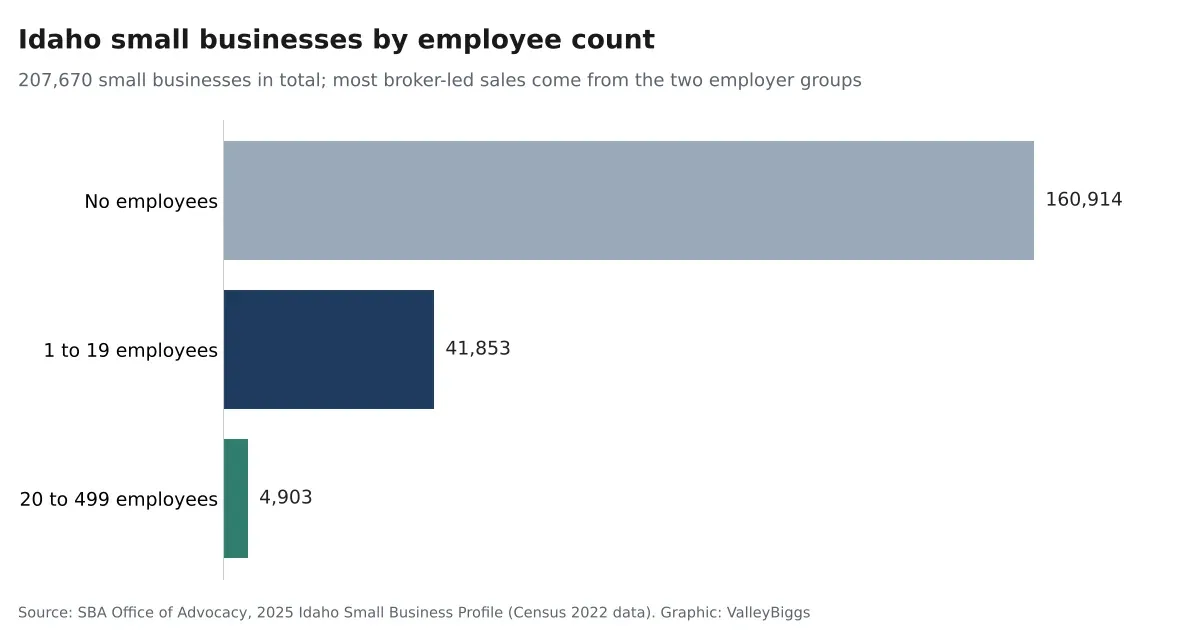
Most of those firms are too small for a broker-led sale. About 160,900 have no employees, roughly 41,900 employ 1 to 19 people and 4,903 employ 20 to 499. Brokers spend most of their time in the last two groups, where there is a team, a customer base and earnings a lender will finance.
Which industries produce the most Idaho deals?
By firm count, construction leads with about 27,800 small businesses, followed closely by professional, scientific and technical services at about 27,200, then real estate, other services and retail. Among established employers with 20 to 499 staff, the picture shifts toward restaurants and lodging, health care, construction and retail.
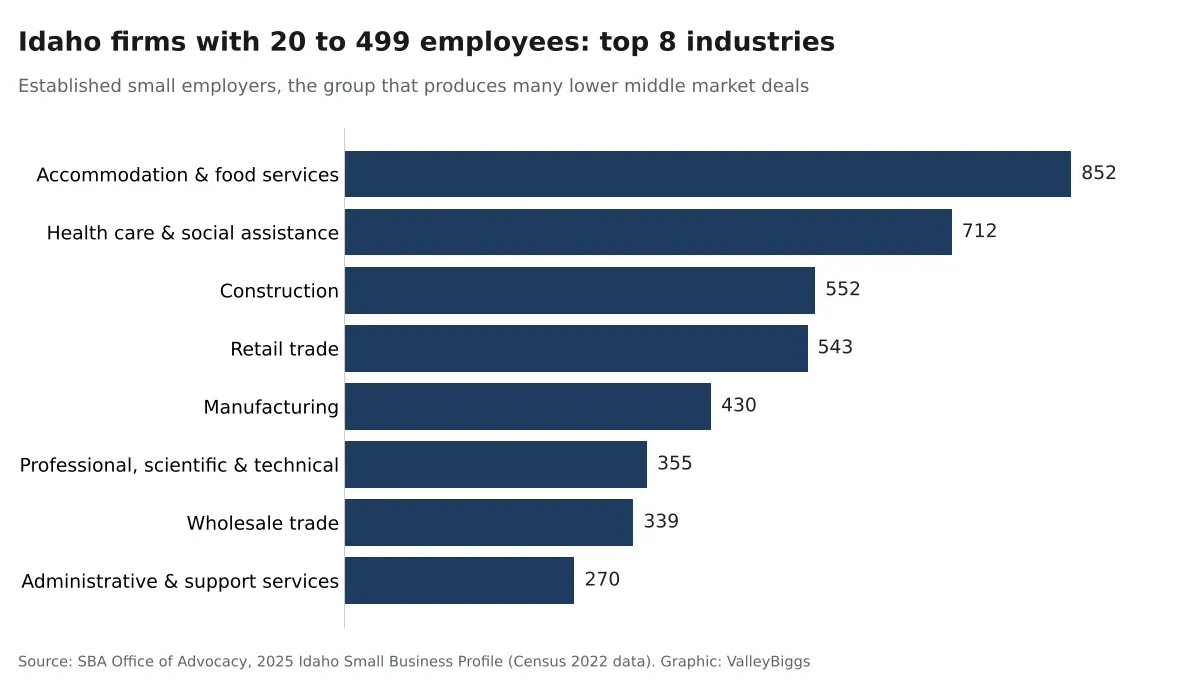
In practice, the categories that tend to draw steady buyer interest in Idaho include:
- Construction and the skilled trades: HVAC, plumbing, electrical, roofing and specialty contractors, many of them in the Treasure Valley, where population growth has kept order books full.
- Health care and home care: dental, therapy, home health and senior care operators, where licensing and ownership rules shape how a deal is structured.
- Technology and engineering services: IT providers, software companies and engineering firms around Boise, which is home to Micron Technology, and around Idaho Falls, near the Idaho National Laboratory.
- Food production, agriculture and distribution: processors, ag service companies and wholesalers in the Magic Valley and eastern Idaho, often bought by strategic acquirers from outside the state.
- Hospitality and outdoor recreation: restaurants, lodging, guides and retailers in Coeur d’Alene, Sandpoint, McCall and the Wood River Valley, where seasonality and leases weigh on value.
How do regional markets differ inside the state?
Idaho behaves like four or five separate markets. The Treasure Valley, including Boise, Meridian, Nampa, Caldwell and Eagle, holds the deepest pool of local buyers and most of the Boise business brokers profiled below. North Idaho, centered on Coeur d’Alene, trades closely with Spokane and draws many buyers from Washington. Eastern Idaho, from Idaho Falls to Pocatello, has a strong engineering and research base, while the Magic Valley around Twin Falls is shaped by food processing and agriculture. Resort areas such as Sun Valley and Ketchum are small, relationship-driven markets. ValleyBiggs does not yet have city pages for Idaho, but the ValleyBiggs locations directory lists the regional markets we already cover.
What Does a Business Broker in Idaho Do?
A business broker acts for the seller from the first pricing discussion to the day the funds clear. The job is not only to advertise a listing but to run a private, controlled process that produces a qualified buyer, a defensible price and terms you can live with after closing. Capable business brokers in Idaho will typically:
- Recast three years of financial statements so buyers see normalized earnings, with every owner add-back tied to a receipt or ledger entry.
- Recommend a price range based on seller’s discretionary earnings or EBITDA, recent comparable sales and what SBA and conventional lenders will currently fund.
- Prepare a blind teaser and a confidential memorandum, and share the memorandum only after a buyer signs a nondisclosure agreement.
- Screen buyers for industry experience, liquidity and financing, including lender pre-qualification on SBA-backed deals.
- Keep several buyers moving at the same time, compare offers on structure as well as headline price and help negotiate the letter of intent.
- Coordinate diligence with your CPA and attorney so requests are answered on schedule and the closing date holds.
Titles overlap. Main Street brokers usually sell owner-operated companies, M&A advisors handle lower middle market businesses with professional buyers, and investment banks take on larger transactions. Several firms below span more than one band, so ask where a company like yours sits in their client list.
How to Choose Idaho Business Brokers: 7 Questions to Ask
Interview at least three firms and ask each one the same questions.
1. Which recent sales look like mine?
Ask for anonymized examples closed in the past few years in your industry and revenue band. A broker who has sold several Treasure Valley contractors brings a different buyer list from one who mostly sells resort-town restaurants or rural ag businesses.
2. Who will run my sale day to day?
Find out who writes the marketing materials, calls buyers and sits in negotiations. In franchise networks and multi-office firms, the individual advisor matters more than the logo on the door.
3. How did you reach your valuation?
A credible opinion of value names the earnings measure, lists each adjustment and shows the comparable data behind the range. If one number is far above the others, ask how it will hold up when a buyer’s lender orders its own appraisal.
4. Where will the buyer come from?
A Twin Falls distributor may sell to a regional competitor, while a Boise software company may sell to a strategic acquirer in Seattle, Salt Lake City or the Bay Area. Ask how the firm sources buyers, how many it expects to contact and how many of its recent buyers came from outside Idaho.
5. How do you protect confidentiality?
Look for blind listings, signed NDAs before any identifying detail and a staged release of customer, pricing and employee data. In smaller Idaho towns, where many owners know each other, ask specifically how the firm handles inquiries from competitors and employees.
6. What credentials and memberships does the team hold?
Designations show training and commitment. Common ones include the Certified Business Intermediary (CBI) from the International Business Brokers Association and the M&A Master Intermediary (M&AMI) from the M&A Source, and some advisors also hold valuation credentials. If real estate is part of the sale, ask who will handle that piece and whether a licensed real estate professional will be involved.
7. What exactly does the engagement letter say?
Read the contract line by line: how the success fee is calculated, any upfront or monthly retainer, minimum fees, the length of exclusivity and the tail period after the agreement ends. Compare total cost at a realistic sale price, not just the headline rate.
Top 10 Idaho Business Brokers Compared (2027)
The ranking mixes national firms with wide buyer reach and Idaho brokerages with deep local relationships. Each profile reflects how the firm describes itself on its own website; confirm current services, offices and terms directly before you engage anyone.
| # | Firm | Idaho presence | Stated focus |
|---|---|---|---|
| 1 | Website Closers | Serves Idaho sellers nationally | Technology and internet businesses |
| 2 | Arthur Berry & Company | Boise; brokering in Idaho since 1983 | Business sales, commercial real estate, valuations |
| 3 | ValleyBiggs | Serves Idaho sellers nationally | Technology, internet and ecommerce companies |
| 4 | First Choice Business Brokers Idaho | Meridian office of a national network | Preparation-first sale process |
| 5 | SellerForce | Serves Idaho sellers nationally | Online and brick-and-mortar businesses |
| 6 | Murphy Business (Idaho) | Boise, Coeur d’Alene and Ketchum | Companies with about $500K to $100M in revenue |
| 7 | Morgan & Westfield (Boise) | Downtown Boise office | Companies with about $1M to $100M in revenue |
| 8 | DealPipe | Serves Idaho sellers nationally | Lower and middle market, physical and digital |
| 9 | Bristol Group | Headquartered in Boise | Main Street and lower middle market |
| 10 | Treasure Valley Business Brokers | Boise; all of Idaho and parts of eastern Oregon | Service-based businesses |
1. Website Closers
Website Closers is built around the sale of internet and technology companies, including SaaS products, ecommerce stores, mobile apps, content properties and digital agencies, and it markets those businesses to buyers across the country. For an Idaho founder whose most likely acquirer is a strategic buyer or investor-backed platform in another state, a specialist in online businesses with national outreach is a logical first conversation.
2. Arthur Berry & Company
Arthur Berry & Company is a Boise firm that says it has worked with Idaho owners since 1983. It combines business brokerage and M&A with commercial real estate sales and leasing and business valuation services, and its site describes a professional staff of nine. The firm says it lists businesses on national services such as BizBuySell, BizQuest and LoopNet and is affiliated with the IBBA and NACVA. It suits owners who want one local firm to handle both the company and the property it sits on.
3. ValleyBiggs
ValleyBiggs focuses on technology, internet, ecommerce and other digital companies, and several people on the team have built and sold businesses themselves. Owners are supported by a full deal team rather than a single broker, and compensation is performance-based, so no fee is owed unless a transaction closes. Idaho founders of software, IT services or online brands can see how buyer outreach and negotiation work on our sell-side assistance service page and in our guide to selling a technology business.
4. First Choice Business Brokers Idaho
First Choice Business Brokers Idaho operates from Meridian as part of a national network the company says has more than 100 independently owned offices and dates back to 1994. The Idaho office emphasizes preparation before marketing: it describes a five-phase process that can spend several months improving readiness and value before a business is listed, plus a free valuation calculator for owners. It fits sellers who want help getting the company ready, not just a fast listing.
5. SellerForce
SellerForce represents both online companies and traditional brick-and-mortar businesses and leans on wide marketing to reach a large pool of buyers. Idaho owners of small and mid-sized companies who want broad exposure may find it a good fit. Ask how buyers are screened before any financial information is released.
6. Murphy Business (Idaho)
Murphy Business lists Idaho offices in Boise, Coeur d’Alene and Ketchum, covering the Treasure Valley, North Idaho and the Blaine County area. The Idaho team says it works in every industry with company revenue from roughly $500,000 to $100 million, and its services include business sales, M&A, franchise resales, valuations, machinery and equipment appraisals and commercial real estate.
7. Morgan & Westfield (Boise)
Morgan & Westfield, a national M&A firm, runs an office in downtown Boise that serves southwestern Idaho communities including Meridian, Nampa, Eagle, Kuna and Caldwell. The firm says it works with companies from about $1 million to $100 million in annual revenue and describes a process that covers valuation, buyer outreach, negotiation and deal structuring.
8. DealPipe
DealPipe serves lower and middle market sellers, physical and digital, and organizes outreach as a tracked buyer pipeline so owners can see where each prospect stands. That transparency appeals to sellers who want regular, concrete updates. Confirm the team’s experience in your sector before you sign.
9. Bristol Group
Bristol Group describes itself as an M&A advisory and business brokerage firm headquartered in Boise with offices across the United States. It says it works with Main Street and lower middle market owners, including mid-market companies with $1 million or more in EBITDA, on business sales, mergers and acquisitions and valuations, and it cites more than 20 years of experience. It suits Idaho owners who want a Boise-based team with reach outside the state.
10. Treasure Valley Business Brokers
Treasure Valley Business Brokers is a two-person Boise brokerage that says it serves all of Idaho and parts of eastern Oregon. The firm lists work with contractors, HVAC companies, electricians, commercial cleaners, medical spas, home care and property management businesses, and it says it coordinates with Idaho lenders on SBA financing for buyers. It is a practical choice for service-business owners who want the same two people handling every step.
When Should You Sell Your Idaho Business?
There is no ideal month to sell a business in Idaho, but the strongest Idaho sales usually start when several of these conditions line up:
- Revenue and earnings have risen for two or three years in a row, and clean books show it.
- No single customer, contractor relationship or referral source makes up a large share of revenue.
- A manager or small leadership team could run operations for several months without you.
- Your lease has enough remaining term, or a renewal option, to satisfy a buyer and an SBA lender. This matters in resort towns and fast-growing suburbs where space is tight.
- Buyers are active in your niche, for example private equity groups assembling home services, dental or veterinary platforms across the Mountain West.
- You have a personal reason to exit within 12 to 24 months and time to prepare properly.
If the company is not ready, use the next year to fix what buyers discount: owner dependence, informal bookkeeping, undocumented add-backs and contracts about to expire. Our step-by-step guide on how to sell a business covers that preparation in detail.
Typical Sale Process in Idaho
A sale in Idaho follows the same broad steps as anywhere else, with a short list of State Tax Commission items near the end. Your broker coordinates the timeline, while your CPA and attorney handle tax and legal work. An independent enterprise valuation analysis before marketing gives you a reference point when offers arrive.
| Stage | What happens | Typical length |
|---|---|---|
| Preparation | Collect three years of returns and statements, recast earnings, organize leases, contracts and licenses | 1 to 3 months |
| Valuation and positioning | Set a price range, write the teaser and memorandum, build the buyer list | 2 to 6 weeks |
| Marketing and buyer meetings | Release the teaser, sign NDAs, share the memorandum, hold management meetings | 2 to 4 months |
| Offers and letter of intent | Compare price and terms, negotiate and sign a letter of intent | 2 to 6 weeks |
| Due diligence and financing | Buyer reviews financial, legal, tax and operational records; lender underwrites | 1 to 3 months |
| Closing and transition | Sign the purchase agreement, settle taxes and permits, hand over operations | 1 day to close, then weeks to months of transition |
Idaho tax steps sellers should plan for
The Idaho State Tax Commission publishes guidance for owners who sell or close a business. Treat the summary below as general information, not legal or tax advice, and confirm how it applies to your transaction with an Idaho CPA or attorney.
| Item | What it is | Why it matters |
|---|---|---|
| Cancel the seller’s permits | The prior owner cancels the business’s tax permits in its own name, using the Tax Commission’s Business Taxpayer Self-Service form | The Tax Commission points sellers to its Sales and Use Tax Rule 70.04 for this step |
| Final returns | Last sales tax, withholding and other returns for the period you owned the business | Unfiled returns can delay closing and leave you exposed after the sale |
| Successors’ Liability clearance letter | A letter a buyer can request to see whether the business owes sales and use taxes | The Tax Commission warns that buying without checking raises the risk of a surprise tax bill, so expect buyers to ask for it |
| Buyer’s new permits | The new owner applies for its own sales, withholding and other permits | Permits do not transfer automatically with the business |
| Sales or use tax on assets | Idaho’s sales and use tax rate is 6 percent; whether it applies to equipment and fixtures depends on the facts, including the occasional-sale rules | The price allocation in your purchase agreement affects this, so review it early |
| State income tax on the gain | Idaho’s individual income tax is a flat 5.3 percent | Pass-through owners usually report their share of the gain on Idaho returns |
Deal structure decides which of these apply. An asset sale and a stock or membership-interest sale have different tax and liability results, and the allocation of price among equipment, inventory and goodwill affects both the buyer’s sales or use tax and your federal tax bill. If you plan to dissolve the entity after an asset sale, file the appropriate dissolution with the Idaho Secretary of State once final returns are in.
Compare Neighboring Markets
Idaho borders six states and Canada, and buyers, especially private equity platforms and regional consolidators, often compare targets across those lines. The table below gives a simple view; conditions in your own industry matter more than any state label.
| State | Personal income tax | Main metro markets | What it means for sellers |
|---|---|---|---|
| Idaho | Flat rate | Boise, Meridian, Nampa, Idaho Falls | Fast-growing local buyer pool, with many acquirers arriving from neighboring states |
| Washington | No general income tax; separate tax on some capital gains | Seattle, Spokane | Spokane buyers are active in North Idaho; see our Washington business broker rankings |
| Oregon | Graduated | Portland, Bend | Large Pacific Northwest buyer base; compare our list of Oregon brokers |
| Utah | Flat rate | Salt Lake City, Provo, Ogden | Strong software and services market close to eastern Idaho; see the Utah broker guide |
| Montana | Graduated | Billings, Missoula | Smaller market with similar outdoor and ag businesses |
| Nevada | None | Las Vegas, Reno | Reno buyers sometimes look north for manufacturing and logistics targets |
| Wyoming | None | Cheyenne, Casper | Thin local market; many buyers come from Colorado and Utah |
For a wider Mountain West comparison, our ranking of Colorado business brokers covers the Front Range market, where many private equity platforms that buy Idaho companies are based. Federal capital gains tax, depreciation recapture and the net investment income tax can still apply wherever you live, so model the after-tax result for your actual structure before you compare offers.
When to Talk to an Advisor
Bring in an advisor early, ideally a year or more before you want to close, if any of these apply:
- You are unsure whether your company is a Main Street, lower middle market or middle market deal.
- Your earnings rely on add-backs you have not documented.
- The most likely buyer is outside Idaho, such as a strategic acquirer or a private equity platform.
- You have received an unsolicited offer and do not know whether it is fair.
- Partners, investors or family members disagree about price, timing or terms.
A short conversation can clarify which type of firm fits and what preparation would raise value.
Conclusion
Idaho gives sellers a growing economy, a steady stream of new buyers and a solid choice of brokers, which makes fit the deciding factor. Shortlist two or three firms from this guide that match your industry, size and region, compare their closed deals and contract terms, and plan the State Tax Commission steps with your advisors before you sign a letter of intent. If you own a technology, SaaS or ecommerce company in Idaho, schedule a confidential consultation with ValleyBiggs to talk through valuation and timing.
FAQs
1. How much do business brokers charge in Idaho?
Most Idaho brokers are paid a success fee calculated on the final sale price, and some also charge an upfront or monthly retainer or set a minimum fee. Structures vary by firm and deal size, so ask each broker for a written fee schedule and compare the total cost at a realistic sale price before you sign an engagement letter.
2. How long does it take to sell a business in Idaho?
Many broker-led sales take roughly six to twelve months from preparation to closing. Small, well-prepared companies can move faster, while larger deals with detailed diligence or SBA financing often take longer. The biggest variables are the quality of your financial records, how realistic the asking price is and how quickly the buyer’s lender underwrites the loan.
3. What is a Successors' Liability clearance letter in Idaho?
It is a letter from the Idaho State Tax Commission that shows whether a business owes sales and use taxes a buyer could become responsible for. Buyers often request one before closing, so sellers should file final returns and settle any balance early. Ask your CPA or attorney how the letter fits into your purchase agreement and closing checklist.
4. Do I pay Idaho income tax when I sell my business?
Usually, if you are an Idaho resident or the business has Idaho-source income. Idaho taxes individual income at a flat 5.3 percent, and owners of pass-through entities generally report their share of the gain on Idaho returns. Federal capital gains tax and depreciation recapture may also apply. This is general information, not tax advice, so confirm the details with a CPA.
5. Should I hire a local Idaho broker or a national firm?
It depends on who is most likely to buy. Local brokers know Treasure Valley, North Idaho and eastern Idaho buyers, lenders and landlords. National firms can reach strategic acquirers and private equity groups in other states, which often matters for technology, SaaS and ecommerce companies. Many owners interview one of each before deciding.
6. Can I offer seller financing when selling an Idaho business?
Yes. Many Idaho sales include a seller note for part of the price, often alongside SBA or bank financing, and offering one can widen the buyer pool. Interest rate, term, subordination and security all need careful drafting. Our guide to seller financing in a business sale explains how seller notes work and what to negotiate.