

A leveraged buyout (LBO) is the purchase of a company paid for mostly with borrowed money, where the debt is repaid from the acquired company’s own cash flow. The buyer, usually a private equity firm, puts in a smaller slice of equity, and the business you sell becomes the borrower.
If you own a profitable company worth $10 million or more, the buyer across the table is quite often running an LBO. That changes how the price is set, how much you receive at closing and what you are asked to leave in the deal. This guide explains how a leveraged buyout works from the seller’s chair, with a worked example, the terms to expect and the mistakes that cost owners money.
Key Takeaways
- In a leveraged buyout, lenders fund most of the price and the acquired company carries the debt after closing.
- An LBO buyer’s price is capped by how much debt your cash flow can support and the return its fund needs, not only by what comparable companies sold for.
- Sellers in LBOs are often asked to roll over part of their equity and sometimes to carry a seller note, so headline price and cash at closing can differ by millions.
- Lenders run their own diligence, so clean financials and a credible quality of earnings report protect both the price and the timeline.
- Rollover equity can add upside, but it sits behind the new debt and can lose value if the plan misses.
- Financing conditions, solvency and the debt terms deserve as much attention in the LOI as the headline multiple.
What Is a Leveraged Buyout?
The leveraged buyout definition is simple: an acquisition in which debt, not the buyer’s own cash, provides most of the purchase price. The loans are raised by a new holding company that buys your shares or assets, and after closing that debt is pushed down to, or guaranteed by, the company itself. Its assets usually serve as collateral and its operating cash flow pays the interest and principal.
The buyer’s logic is leverage in the plain sense of the word. If a fund pays $56 million for a company using $20 million of its own money and the company later sells for more after paying down debt, the gain lands on a much smaller equity base, which multiplies the percentage return. The same arithmetic works in reverse when results disappoint, which is why lenders and sponsors care so much about stable, predictable earnings.
When people search for the LBO meaning in finance, they usually picture mega deals. Reuters reported in September 2025 that the agreed $55 billion take-private of Electronic Arts, funded in part with about $20 billion of debt, would be the largest leveraged buyout on record. Most LBOs are far smaller. Private equity firms, independent sponsors and family offices use the same structure every week to buy founder-owned companies with a few million dollars of EBITDA.
Common types of leveraged buyouts
| Type | Who buys | When sellers see it |
|---|---|---|
| Sponsor-led LBO | A private equity fund with lender financing | The most common path for profitable companies above roughly $2M to $3M of EBITDA |
| Management buyout (MBO) | The existing management team, often with a sponsor | Founder retirement or a corporate carve-out to the unit’s leaders |
| Management buy-in (MBI) | An outside executive team backed by investors | No internal successor, but a strong business to run |
| Secondary buyout | One sponsor buying from another sponsor | A PE-backed company changing owners |
| Add-on acquisition | A PE-backed platform company using its credit facility | Your company fits a buy-and-build strategy in your sector |
| Search fund or SBA-financed buyout | An individual buyer with an SBA 7(a) loan and investors | Smaller companies, generally under the SBA’s $5 million loan cap |
If your successor is likely to be your own team, our guide to the management buyout process covers that version in more detail.
How Does a Leveraged Buyout Work in a Real Sale?
From the outside an LBO looks like any other acquisition. Behind the scenes, the buyer is solving two problems at once: winning your company and lining up lenders who agree with its view of your cash flow. A typical sequence looks like this.
- Screening. The sponsor reviews your teaser and confidential information memorandum and asks one early question: can this business carry debt? Recurring revenue, steady margins and low capital spending score well.
- Indication of interest. The buyer builds a quick model of debt capacity and target returns, then sends a price range.
- Letter of intent. The letter of intent for the buyout sets the price, the mix of cash, rollover and seller paper, the exclusivity period and whether the deal depends on financing.
- Diligence, twice. The sponsor’s accountants test your earnings, and then the lenders review the same numbers, often through a quality of earnings report, before they issue final commitments.
- Financing and documents. Credit agreements are negotiated alongside the purchase agreement. The lenders’ conditions can affect your closing date.
- Closing and the hold period. Debt funds at closing, you receive cash, and the sponsor runs the plan, usually aiming to pay down debt and grow earnings before its own exit several years later.
Each of these steps rests on earnings that a lender will believe. Buyers and banks lend against adjusted EBITDA that survives scrutiny, so add-backs that look generous in a pitch book tend to be trimmed in diligence, and the loan size and price shrink with them.
How an LBO Is Financed: The Capital Stack
Every leveraged buyout is funded by a capital stack, a ranked list of who puts money in and who gets paid back first. Senior lenders sit at the top and equity sits at the bottom. As a seller, you can end up in two places on that stack at once: as a creditor if you carry a note, and as an owner if you roll equity.
| Layer | Typical provider | Repayment priority | What it means for the seller |
|---|---|---|---|
| Revolver and senior term loan | Banks or private credit lenders | First, secured by company assets | Sets most of the cash available at closing |
| Second-lien, unitranche or mezzanine debt | Private credit funds, mezzanine investors | After senior debt, at a higher interest rate | Lets a buyer stretch the price, but adds risk to the company you may still own part of |
| Seller note | You, the seller | Usually subordinated to all bank debt | Deferred price that depends on the company staying healthy |
| Rollover equity | You, the seller | Last, alongside the sponsor’s equity | Upside if the plan works; first to lose value if it does not |
| Sponsor equity | The private equity fund | Last | The buyer’s own capital at risk |
How much debt is typical? It depends on size, sector and the credit cycle. Raymond James’s Debt Market Insight, citing 2025 market data, put the average leverage on LBO loans at about 5.0 times EBITDA, with interest coverage near 2.9 times. Smaller and less predictable companies generally support less debt than those figures, and lenders tighten quickly when rates rise or a sector weakens.
Seller financing plays a bigger role at the lower end of the market. A note can close a valuation gap or satisfy a lender, and our article on how seller financing works explains the terms to negotiate, including subordination, interest and default rights.
Leveraged Buyout Example: A $56 Million Sale
The numbers below are hypothetical and simplified, but the structure mirrors many lower middle-market LBOs. A founder owns a software-enabled services company with $8 million of adjusted EBITDA and no debt. A private equity firm offers 7.0 times EBITDA, a $56 million enterprise value, on a cash-free, debt-free basis.
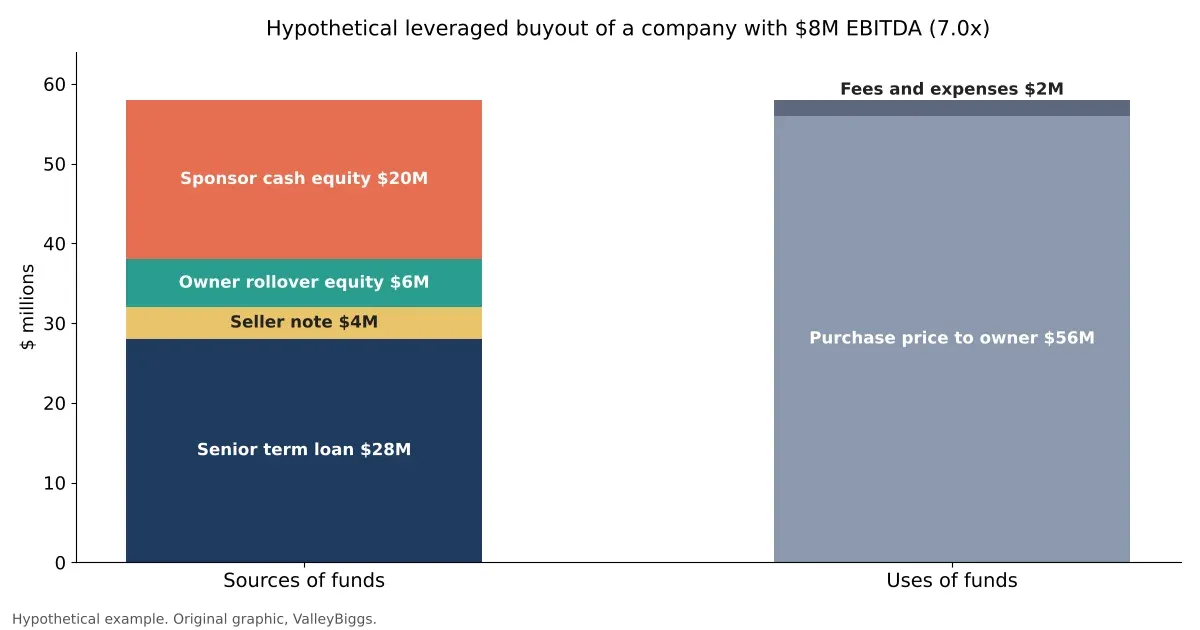
| Sources of funds | $M | Uses of funds | $M |
|---|---|---|---|
| Senior term loan (3.5x EBITDA) | 28.0 | Purchase price paid to the owner | 56.0 |
| Seller note | 4.0 | Fees and expenses | 2.0 |
| Owner rollover equity (23% of new equity) | 6.0 | ||
| Sponsor cash equity | 20.0 | ||
| Total | 58.0 | Total | 58.0 |
The founder’s offer is $56 million, but only $46 million arrives at closing, before taxes, working capital adjustments and transaction costs. The other $10 million stays in the deal as a $4 million note and a $6 million rollover stake. At a 9% hypothetical rate, interest on the term loan is about $2.5 million a year, so the company starts with total debt of 4.0 times EBITDA and covers its interest roughly 3.2 times.
Now look five years ahead under two hypothetical outcomes.
| Year-5 outcome | Base case | Downside case |
|---|---|---|
| EBITDA at exit | $11.0M | $6.0M |
| Exit multiple | 7.0x | 6.0x |
| Enterprise value | $77.0M | $36.0M |
| Debt remaining | $14.0M | $22.0M |
| Equity value | $63.0M | $14.0M |
| Founder’s 23% stake | $14.5M | $3.2M |
| Sponsor’s return on $20M | About 2.4x (roughly 19% a year) | About 0.5x, a loss |
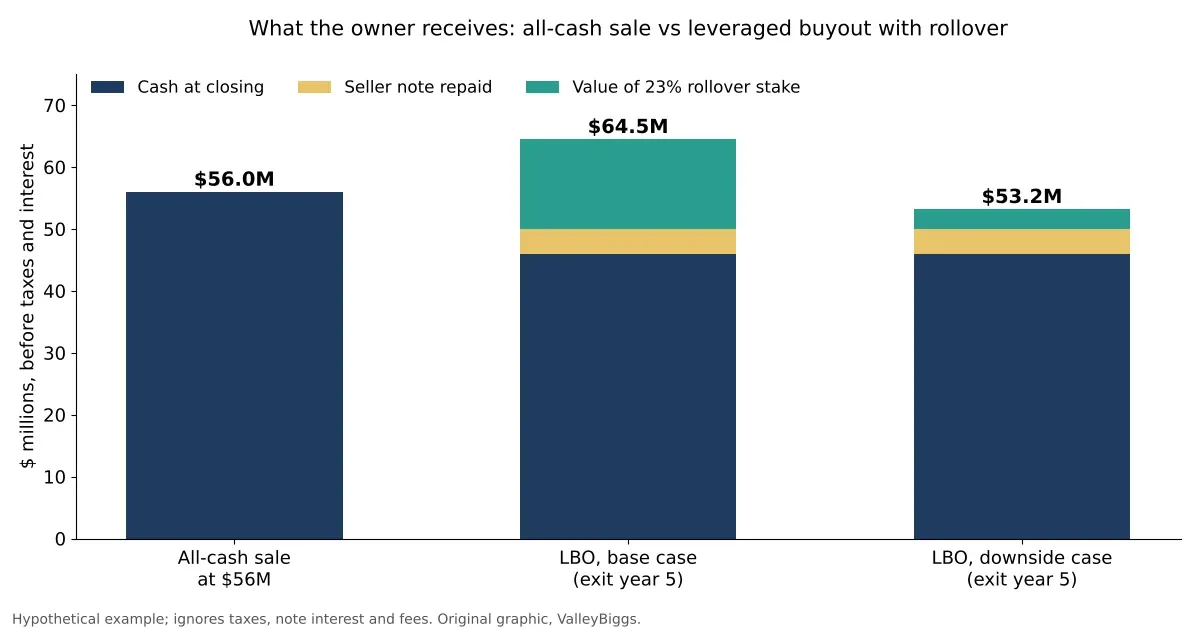
Three lessons come out of this simple model. The base case pays the founder about $64.5 million in total, more than an all-cash sale at the same price, because the second bite of the rollover grows on a leveraged base. The downside case pays about $53.2 million, below the all-cash offer, and that assumes the note is repaid in full. And in both cases the $46 million at closing is the only number the founder controls on signing day.
What an LBO Buyer Can Pay for Your Company
A strategic acquirer can justify price with synergies. A financial sponsor running an LBO model works backward from its target return. It estimates how much debt your earnings can carry, how much equity it must invest to close the gap, and whether the expected exit value pays back that equity at the rate its investors expect. If the answer is no, it lowers the price or asks the seller to carry more of the structure.
Owners can influence each input of that model before going to market:
- Earnings quality. Documented, recurring EBITDA supports more debt than earnings that rely on one-time projects or large add-backs.
- Predictability. Contracted or subscription revenue, low customer concentration and steady gross margins raise the leverage lenders will offer.
- Capital needs. Low capital spending and modest working capital swings leave more free cash flow for debt service.
- Management depth. A team that can run the company without the founder reduces risk for lenders and the sponsor alike.
- Growth path. A credible plan for add-on acquisitions or new markets supports a higher exit value in the sponsor’s model.
- Competition. Several sponsors and at least one strategic buyer in the process push bidders toward the top of their models.
If you want to see how those inputs translate into a number before buyers run their own model, an enterprise valuation analysis gives you a defensible range and shows which levers matter most. For a sense of how this plays out by company size, see our breakdown of what a $20 million company is worth.
Pros and Cons of a Leveraged Buyout for Sellers
| Seller view | Advantages | Drawbacks |
|---|---|---|
| Price | Leverage lets sponsors pay prices they could not fund with equity alone | The price is capped by debt capacity, and lenders can force a re-trade if diligence finds issues |
| Liquidity | A large share of value is usually paid in cash at closing | Rollover and seller notes defer part of the price and put it at risk |
| Upside | Rollover equity offers a second payday at the sponsor’s exit | Rollover sits behind all the new debt and has limited control rights |
| Your company and team | Sponsors often fund growth, add-ons and new systems | Debt service reduces room for investment if results dip; cost cuts may follow |
| Certainty | Experienced sponsors close deals routinely | Financing conditions and lender approvals add a source of delay or failure |
Key Terms to Negotiate in an LBO Offer
Most of the risk in a leveraged buyout is allocated in the LOI and the purchase agreement. These are the terms owners most often focus on too late:
- Financing certainty. Ask whether the buyer has committed debt, who the lenders are and whether there is a financing contingency. A sponsor with committed financing or a reverse termination fee carries less risk for you.
- Cash at closing. Compare offers on the cash you receive at closing, not only on the headline multiple.
- Rollover terms. Clarify whether you roll at the same price per unit as the sponsor, what class of equity you receive, how distributions work and what happens to your stake if you leave the company.
- Seller note terms. Interest rate, maturity, subordination to senior debt and what happens when a lender blocks payments.
- Working capital peg and debt-like items. These adjustments move dollars from your proceeds to the buyer after closing, so agree on definitions early.
- Solvency. Ask the buyer for comfort that the company will remain solvent after the debt is added, and consider a solvency opinion on larger deals.
That last point matters more than many owners realize. Under federal bankruptcy law (11 U.S.C. § 548), a trustee can challenge transfers made within two years before a bankruptcy filing if the company received less than reasonably equivalent value while insolvent or left with unreasonably small capital, and state laws such as the Uniform Voidable Transactions Act generally reach back about four years. Courts have used these rules to pursue payments to selling shareholders in failed LBOs. This is not legal advice; speak with your M&A attorney about how the structure and the buyer’s solvency support protect you.
Tax and Regulatory Points Sellers Should Know
The buyer’s tax position affects how much debt it will use. Under Section 163(j) of the Internal Revenue Code, business interest deductions are generally limited to 30% of adjusted taxable income. According to the IRS, for tax years beginning after December 31, 2024, depreciation and amortization are again added back when computing that figure, which makes the limit closer to an EBITDA test and supports interest deductions on acquisition debt.
On the seller’s side, the structure drives your own tax bill. An asset sale, a stock sale and a rollover that may be structured to defer tax on the rolled portion produce different outcomes, and the purchase price allocation is reported to the IRS on Form 8594 in asset deals. Very large deals may also require a pre-merger filing with the Federal Trade Commission and Department of Justice under the Hart-Scott-Rodino Act once the size-of-transaction threshold, adjusted every year, is met. Tax and filing requirements depend on your facts, so treat this section as general information rather than tax advice.
Common Mistakes Sellers Make in Leveraged Buyouts
- Choosing the highest headline price without comparing cash at closing, rollover and note terms across offers.
- Accepting a long exclusivity period while the buyer’s financing is still uncommitted.
- Going to market with add-backs that will not survive the lenders’ quality of earnings review.
- Treating rollover equity as guaranteed upside instead of a leveraged, illiquid minority investment.
- Carrying a large seller note fully subordinated to bank debt without default protections.
- Ignoring the company’s debt load after closing when part of your wealth, your team and your earnout remain tied to it.
Related Deal Terms
- Management buyout (MBO): an LBO in which the existing managers lead the purchase.
- Seller note: part of the price paid over time to the seller, usually subordinated to bank debt.
- Adjusted EBITDA: the earnings figure lenders and sponsors use to size debt and price.
- Rollover equity: the share of the seller’s proceeds reinvested in the buyer’s new holding company.
- Secondary buyout: one private equity firm buying a portfolio company from another.
- Dividend recapitalization: new debt raised after the buyout to pay a distribution to owners.
Leveraged buyouts are one route among several. If you are still weighing whether a sale, a recapitalization or a transfer to family fits your goals, start with our overview of exit strategy options for owners.
When to Talk to an Advisor About an LBO Offer
Bring in an M&A advisor before you sign an LOI with a private equity buyer, not after. That is especially true when an offer includes rollover equity or a seller note, when more than one sponsor is interested, or when your earnings rely on adjustments that a lender will test. An advisor can model the offers side by side on cash at closing and risk, run a competitive process and push for committed financing.
ValleyBiggs provides sell-side support for business owners and, for larger and more complex transactions, M&A investment banking that brings both financial sponsors and strategic buyers to the table, so an LBO offer is measured against real alternatives.
Conclusion
A leveraged buyout lets a private equity buyer pay a full price with a modest amount of its own money, but the debt, the rollover and the seller paper decide how much of that price you actually keep. Understand the buyer’s model, prepare earnings that lenders will accept and negotiate the structure as hard as the multiple. If a sponsor has approached you or you are planning a sale, request a confidential consultation to see what your company could command and how to structure the deal.
FAQs
1. Why are leveraged buyouts still legal?
Leveraged buyouts are legal because borrowing to buy a company is an ordinary financing choice, much like a mortgage on a house. The risks are policed in other ways: lenders set credit limits, directors owe duties to the company, and federal and state fraudulent transfer laws let creditors challenge deals that leave a business insolvent or with too little capital.
2. What is the biggest LBO in history?
Reuters reported in September 2025 that the agreed $55 billion take-private of Electronic Arts by Saudi Arabia’s Public Investment Fund, Silver Lake and Affinity Partners, with about $20 billion of debt, would be the largest leveraged buyout on record. The previous record was the roughly $45 billion buyout of TXU in 2007, whose successor later filed for bankruptcy.
3. What is leverage in simple terms?
Leverage means using borrowed money to control an asset worth more than the cash you put in. If you buy a $1 million company with $300,000 of your own money and $700,000 of loans, every change in the company’s value has a larger effect on your $300,000. Gains are magnified, and so are losses.
4. Is a leveraged buyout good for the seller?
It can be. A private equity buyer using leverage often pays a competitive price and a large share in cash at closing. The trade-off is that part of the price may be deferred through rollover equity or a seller note, both of which depend on the company handling its new debt. Compare offers on cash at closing and risk, not the headline number.
5. Can a small business be sold through a leveraged buyout?
Yes. Many small companies are bought by individuals using an SBA 7(a) loan, which is capped at $5 million. Under the SBA’s current rules the buyer generally needs an equity injection of at least 10% of project costs, and a seller note can count toward up to half of it only if it stays on full standby for the life of the loan.
6. What is rollover equity in an LBO?
Rollover equity is the part of your sale proceeds that you reinvest in the buyer’s new holding company instead of taking cash. Sponsors often ask for it to keep the seller aligned with the business. It gives you a second payday if the company is sold again at a higher value, but it ranks behind all the acquisition debt and is usually illiquid.
7. What is the difference between an LBO and an MBO?
A leveraged buyout describes how a deal is financed: mostly with debt repaid from the company’s cash flow. A management buyout describes who the buyer is: the existing management team. Most MBOs are financed as LBOs. Our guide to the management buyout process explains how manager-led deals are structured.