

An exit strategy is an owner’s plan for how and when they will leave a business and turn their ownership into cash or other value, whether through a sale, a transfer to managers or family, a public offering or an orderly wind-down. The strongest plans are written years before the exit, because the route you pick shapes how you run the company today. This guide gives a plain-English exit strategy definition, walks through the main types with examples, and shows how owners of tech, SaaS, ecommerce and other growth companies can match a route to their goals for price, timing, control and legacy.
Key Takeaways
- An exit strategy answers three questions: who will own the business after you, what you will receive, and when the handover happens.
- The main routes are a sale to a strategic or financial buyer, a management buyout, an ESOP, family succession, a sale to a co-owner, an IPO and liquidation.
- Each route trades off price, speed, the control you keep and what happens to employees and customers.
- Owners who plan three to five years ahead usually have more options, because they have time to fix the issues buyers discount.
- Some tax outcomes, such as an ESOP rollover or an installment sale, depend on structuring decisions made before the deal is signed.
What Is an Exit Strategy in Business?
In business, the term describes the route an owner, founder or investor intends to use to step away from a company and realize the value they have built. For a founder, that usually means selling some or all of the equity. For a private equity fund, it means selling a portfolio company at the end of the hold period. Traders use the phrase too, for a rule about when to close a position, but this guide is about owners of operating businesses.
It helps to separate the strategy from the plan. The strategy is the choice: which buyer type, roughly when, and on what terms you would accept. The exit plan is the work that makes the choice possible: the timeline, the deal team, the clean-up of financials, the tax structure and the transition of your duties. Many owners have a vague strategy (“sell in a few years”) and no plan at all, which is why so many exits end up being decided by circumstances rather than by the owner.
A working definition you can use
A practical way to write your own version is a single sentence: “By 2026, I want [buyer type] to own [all or part] of the company, with me receiving [cash at close, rollover equity, a seller note] and staying on for [time period] in [role].” If you cannot fill in those blanks yet, that is the first planning task.
Why an Exit Plan Matters Even If You Are Not Selling Soon
The best time to think about leaving is when nothing is forcing you to. A written route changes everyday decisions: which customers you sign, how you document code and processes, whether you hire a second-in-command, and how you keep the books. Here is why owners who are years away from a sale still benefit:
- Value is built for a specific buyer. A strategic acquirer pays for fit and synergies, a private equity firm pays for predictable cash flow, and a management team pays for what it can finance. Knowing your likely buyer tells you which metrics to improve.
- Unplanned exits happen. Death, disability, divorce, a falling-out between partners or a sudden downturn can force a transition. A plan, a buy-sell agreement and insurance keep those events from becoming a fire sale.
- Tax options need lead time. Several outcomes covered below depend on how the company and the deal are structured well before closing.
- Options create leverage. An owner who can credibly choose between two or three routes negotiates from a stronger position than one who must sell to the first serious bidder.
- Personal readiness takes time. Many owners underestimate how hard it is to hand over the company they built. Deciding what comes next is part of the work.
Types of Exit Strategies for Business Owners
There is no single best route. The table compares the common options on the factors owners tend to care about most. Treat it as a starting point: deal terms vary widely by size, sector and market conditions.
| Exit route | Typical buyer | Control after close | Typical pace | How proceeds tend to be paid | Often fits when |
|---|---|---|---|---|---|
| Strategic sale | Competitor, supplier, larger company in an adjacent market | Usually none | Months of process, plus integration | Mostly cash, sometimes stock or an earnout | The business fills a gap for an acquirer |
| Private equity sale or recap | PE fund, family office, search fund | Partial if you roll over equity | Months, with detailed diligence | Cash plus rollover equity, sometimes a seller note | Steady earnings and a team that can grow without you |
| Management buyout | Your own leadership team | None, though you may advise | Varies with financing | Bank debt, seller financing, management equity | Strong managers who want to own the company |
| ESOP | A trust for employees | Can be gradual | Often several months to set up | Lender and seller financing through the trust | Profitable company, owner wants to reward staff |
| Family succession | Children or relatives | Gradual handover | Often years | Gifts, installment sales, trusts | A capable, willing next generation |
| Sale to a co-owner | Existing partner or shareholder | None | Can be quick if a buy-sell agreement exists | Cash, notes or insurance proceeds | Partners with a clear agreement and funding |
| IPO | Public market investors | Shared with a board and shareholders | Long and heavily regulated | Shares that can be sold over time | Large, fast-growing companies |
| Liquidation | Buyers of individual assets | None, the company closes | Fast or gradual | Asset proceeds after creditors are paid | No buyer for the business as a going concern |
1. Sale to a strategic buyer
A strategic buyer is an operating company that wants your customers, technology, team or market position. Because it can often cut overlapping costs or sell more through its own channels, a strategic acquirer is sometimes willing to pay more than a buyer who values the business on its standalone cash flow. The trade-off is that your brand, systems and team may be folded into the acquirer, and you rarely keep a say in how the company is run. For tech and SaaS founders, this is often the most common outcome, which is why buyer research and a competitive process matter so much.
2. Sale to private equity or a recapitalization
Financial buyers, such as private equity funds and family offices, buy companies they expect to grow and sell again later. They often ask the owner to “roll over” part of the proceeds into equity in the new company, so you take cash now and keep a stake that can pay out at the fund’s own exit. A majority recapitalization works the same way and suits owners who want liquidity but are not ready to walk away. Expect detailed financial diligence and an emphasis on recurring revenue, margins and a management team that can run without the founder.
3. Management buyout
In a management buyout, your existing leaders buy the company, usually with a mix of bank debt, their own money and financing from you. It keeps culture and customer relationships intact, but the price is limited by what the team can borrow, and you may carry part of the risk through a note. Our guide to how a management buyout works covers the financing and negotiation points in detail.
4. Employee stock ownership plan (ESOP)
An ESOP is a qualified retirement plan that buys company stock on behalf of employees. The IRS describes it as a defined contribution plan designed to invest primarily in employer securities. For owners of C corporations, Section 1042 of the Internal Revenue Code can let the seller defer capital gains tax if the ESOP owns at least 30% of the company after the sale and the seller reinvests in qualified replacement property within a window that runs from three months before to twelve months after the sale. ESOPs require an independent valuation, a trustee and ongoing compliance, so they suit profitable companies with a stable workforce. This is general information, not tax advice.
5. Family succession
Passing the company to children or relatives can preserve a legacy and keep the business local, but it works only if the successor is both able and willing to lead. Transfers are often staged over years through gifts, trusts or installment sales, and they raise fairness questions when some family members work in the business and others do not. Estate and gift tax rules shape the structure, so an estate attorney and a CPA belong on the team early.
6. Sale to a partner or co-owner
When a company has more than one owner, the simplest exit for one of them is often a sale to the others. A buy-sell agreement sets in advance how the price will be calculated and how the purchase will be funded, which avoids disputes at a stressful moment. If your business is an LLC, the operating agreement usually governs these buyouts, and a buyout of membership interests follows the terms set there.
7. Initial public offering
Listing shares on a stock exchange gives early owners a market for their stock and gives the company access to public capital. It also brings SEC registration, audited financials, quarterly reporting and lock-up periods before insiders can sell. IPOs are realistic for a small number of large, fast-growing companies. Venture-backed founders weighing other paths can compare them in our article on startup exits other than an IPO.
8. Liquidation or an orderly wind-down
If no one will buy the business as a going concern, the owner can sell its assets, pay creditors and close the entity. A planned wind-down lets you collect receivables and sell equipment, inventory or intellectual property for a fair price, while a rushed one usually means discounts. Companies that cannot pay their debts may end up in bankruptcy, either Chapter 7 liquidation or Chapter 11 reorganization under the federal Bankruptcy Code. Liquidation usually returns far less than selling a working company, which is why it tends to be the fallback rather than the goal.
Exit Strategy Examples: Three Hypothetical Owners
The same company can suit different routes depending on the owner’s goals. These hypothetical cases show how the choice plays out.
- The SaaS founder who wants a clean break. A founder of a vertical SaaS company wants to step away within 18 months. Revenue is mostly annual contracts and two larger software companies already integrate with the product. A competitive sale to strategic buyers, with a short transition agreement, matches the goal. The planning work focuses on churn data, a documented codebase and making sure the product roadmap does not live only in the founder’s head.
- The ecommerce owner who wants a second payday. An owner of a profitable direct-to-consumer brand wants liquidity now but believes the brand can double. A private equity recapitalization lets the owner sell a majority stake, roll over a minority interest and stay as president for a few years. The planning work focuses on inventory controls, channel concentration and a finance lead who can handle a lender’s reporting.
- The IT services owner who values the team. An owner of a managed IT services firm cares most about keeping the staff together. A management buyout, financed partly with a bank loan and partly with a seller note, keeps leadership in place. The owner accepts a lower headline price and some payment risk, and negotiates protections in the note. Our guide to seller financing in a business sale explains those protections.
How to Choose the Right Exit Route
Work through these questions in order. Your answers will usually narrow the field to one or two realistic routes.
- What do you need to net? Start from the amount you need after taxes, debt payoff and transaction costs, not from the headline price. A good first step is understanding how much your business is worth today.
- When do you want to be out? A one-year horizon rules out routes that take years to arrange, such as a staged family transfer.
- What role do you want after closing? Some owners want to stay as CEO, some want an advisory role, and some want to leave on day one.
- Who do you want to own the company? Legacy, employees and community ties can matter as much as price.
- Is the business ready? Owner dependence, customer concentration, unaudited books and month-to-month revenue all reduce what buyers will pay.
- Who is buying in your sector? Buyer appetite varies by industry and size. A business with a large, active pool of acquirers has more options than one with few natural buyers.
Deal structure matters as much as the route. Two offers with the same headline price can leave you with very different results once cash at close, earnouts, escrows and rollover equity are taken into account. If you sell to a financial buyer, ask how and when the rollover stake is expected to pay out. If you accept a seller note, ask what security and covenants protect it.
When Should You Start Planning Your Exit?
Three to five years ahead is a sensible target for most privately held companies. That window leaves time to set a baseline valuation, fix the issues a buyer would discount, and test whether the business runs well without you. The timeline below shows the stages most owners move through.
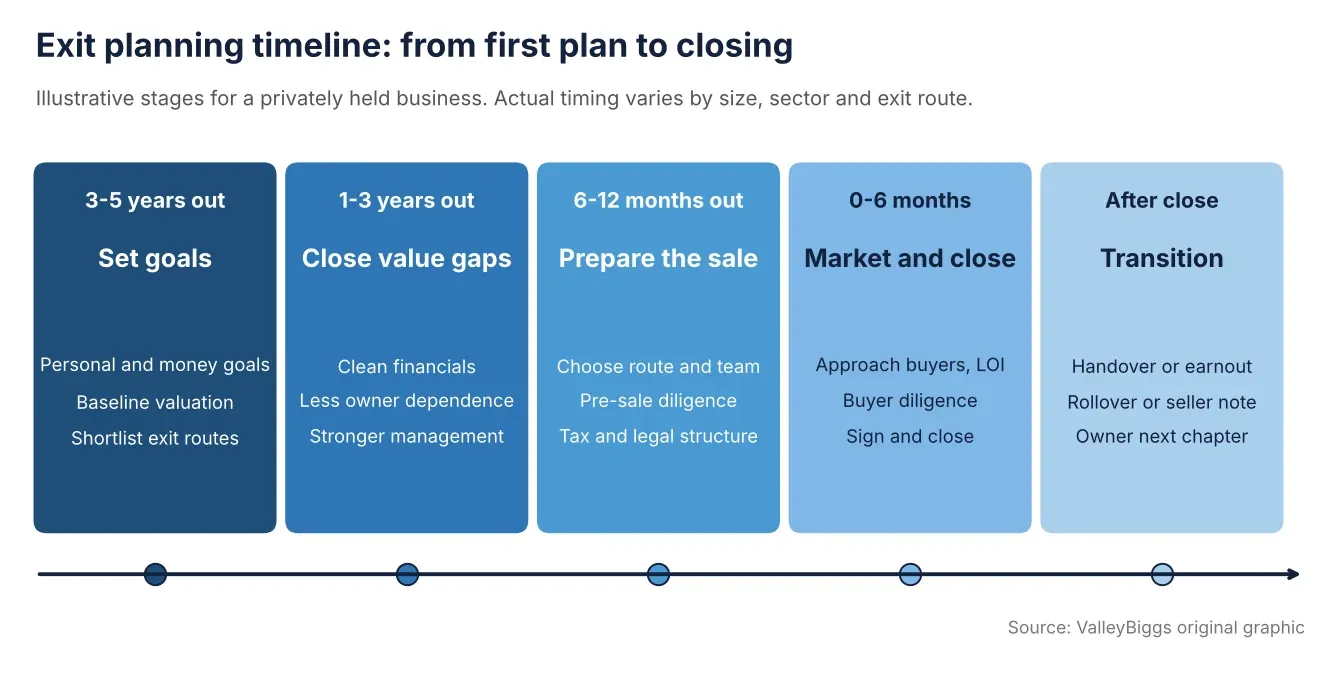
A professional valuation early in the process turns a vague number into a target and shows which drivers move it. ValleyBiggs offers an enterprise valuation analysis that is updated as the business changes, so owners can track progress toward the number they need. In the final year, the work shifts to buyer outreach, the letter of intent, diligence and the purchase agreement, steps our step-by-step guide to selling a business walks through.
Common Exit Strategy Mistakes to Avoid
- Waiting for a buyer to call. An unsolicited offer sets the terms on the buyer’s timeline and rarely produces competition.
- Planning around the headline price. Taxes, debt, working capital adjustments and deferred payments can change what you actually take home.
- Staying indispensable. If customers, suppliers and staff all depend on you personally, buyers will either discount the price or tie more of it to an earnout.
- Ignoring the tax structure until the LOI. Asset versus stock treatment, entity type and the timing of payments are easier to shape before a deal is on the table.
- Having no partner agreement. Co-owners without a funded buy-sell agreement can find that an unexpected event decides the exit for them.
- Keeping the plan secret from key people. You do not need to announce a sale, but your spouse, co-owners and a few trusted advisors should know the goal.
When to Talk to an Advisor
Bring in outside help when you can name a target year, when an unsolicited offer arrives, when partners disagree about the future, or when you suspect the business is worth less than you need. A sell-side M&A team can test the market quietly, and a CPA and attorney can model the tax and legal side of each route. ValleyBiggs works with owners of technology, internet, ecommerce and digital companies through its exit advisory services, and owners who are earlier in the process can start with business exit planning support to prepare the company before any buyer conversations. The firm says its services are performance-based, with no fees paid until a transaction closes.
This article is for general information only and is not legal, tax or investment advice. Talk to qualified professionals about your situation.
Conclusion: Choose the Route Before It Chooses You
A clear exit strategy turns a distant, emotional decision into a set of practical steps: know what you need, pick the buyer type that can pay it, and spend the years before the sale removing the reasons a buyer would pay less. Owners who start early tend to keep more options and more negotiating power. If you are ready to see where your company stands, explore how ValleyBiggs approaches a business sale or book a confidential consultation to discuss your timeline and goals.
FAQs
1. What is a 5 year exit strategy?
A 5 year exit strategy is a plan that targets a sale or handover about five years out and uses that runway to raise value. Typical steps are a baseline valuation, cleaner financials, a stronger management team, less customer concentration and a chosen buyer type. Five years also leaves time to set up tax-sensitive structures that cannot be rushed.
2. What are the 5 D's of exit planning?
Exit planners use the 5 D’s to describe events that can force an unplanned exit: death, disability, divorce, disagreement between owners and distress, such as a financial crisis. Some lists swap in departure or disaster. Each one is a reason to have a buy-sell agreement, insurance and a documented succession plan in place well before you intend to sell.
3. Is an ESOP a good exit strategy?
An ESOP can be a good fit for a profitable company with stable cash flow and an owner who wants employees to benefit. C corporation sellers may defer capital gains under Section 1042 if the rules are met. The trade-offs are setup cost, ongoing compliance and a price limited to fair market value set by an independent appraiser.
4. What is the most common exit strategy for a small business?
For most privately held businesses, the most common exit is a sale to an outside buyer, either an operating company or a financial buyer such as a private equity fund or an individual acquirer. Internal routes like management buyouts and family transfers are less common because the buyers often lack financing. Our guide to selling a business covers the process.
5. How do you create an exit plan for a business?
Start by writing down your goals for timing, proceeds and your role after the sale. Then get a valuation, compare the exit routes that can meet those goals, and list the gaps a buyer would discount. Assemble a team of an M&A advisor, CPA and attorney, set a timeline, and review the plan every year as the business changes.
6. Can you change your exit strategy later?
Yes. An exit strategy should be reviewed at least once a year and whenever something important changes, such as a new partner, a large customer win or loss, a health event or a shift in buyer demand. Owners who keep financials clean and the business less dependent on them can usually switch routes, for example from a family transfer to an outside sale, without losing much value.