

A $20 million company is usually worth somewhere between about $4 million and $45 million, and the gap comes down to one number: adjusted EBITDA. When owners ask how much is a $20 million company worth, they usually mean $20 million in annual revenue, and buyers at this size price the business as a multiple of its earnings, not its sales.
This guide shows the math a buyer will run on your company: which earnings figure counts, what multiples lower middle market deals have closed at, a value table by margin, a hypothetical worked example from headline price to cash at closing, and what moves the number before you go to market.
Key Takeaways
- At $20 million in revenue, buyers value the company on adjusted EBITDA times a multiple. Revenue sets the scale; margin sets the price.
- Survey medians for deals of $5 million to $50 million sat near 5.8x EBITDA in the second quarter of 2026, with private equity deals of $10 million to $25 million averaging roughly 6.2x to 6.7x in 2025.
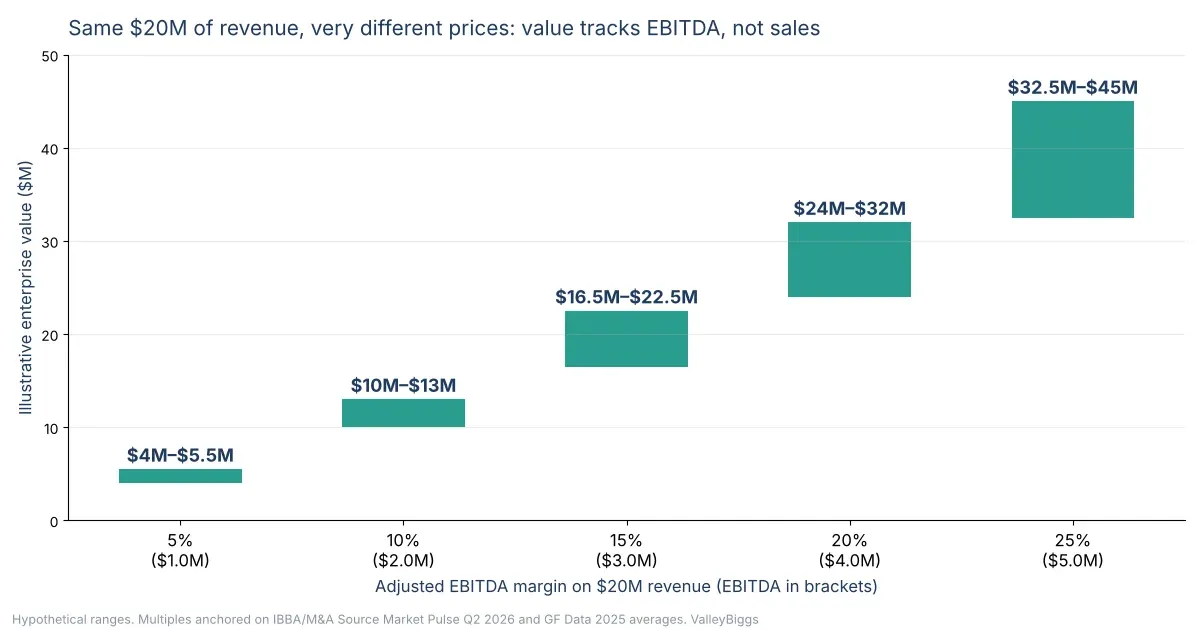
- A 10% margin business with $20 million in sales might be worth roughly $10 million to $13 million; the same revenue at a 20% margin could be worth $24 million to $32 million.
- The headline price is not what you bank. Debt payoff, the working capital peg, rollover equity, escrow and earnouts can cut cash at closing by a third or more.
- At this size you are selling to institutions, so a quality of earnings review, clean monthly financials and a management team that runs without you carry real weight in the multiple.
How Much Is a $20 Million Company Worth? Start With What Buyers Mean
Owners use the phrase two ways. Most mean a company with $20 million in annual sales. Some mean a company that is already valued at $20 million. This article covers both, but the order matters: you find value by working from revenue down to earnings, and then from earnings up to price.
Revenue of $20 million places a company firmly in the lower middle market. That is a different market from the one described in our guides to businesses with $1 million in sales and companies with $5 million in sales, where the owner is often the operator and buyers lean on seller’s discretionary earnings. At $20 million, most companies have a second layer of management, a controller or CFO, and customers who are not personal relationships of the founder. Buyers therefore look at EBITDA after paying a market salary for every role the owner fills today.
If you are starting from scratch, our overview of how much a business is worth explains the main valuation methods. The rest of this guide assumes you want the specific math for a company at this scale.
Which Earnings Number Do Buyers Use at $20 Million in Revenue?
Buyers at this size use adjusted EBITDA: earnings before interest, taxes, depreciation and amortization, normalized for owner pay, one-time costs and non-operating items. The adjustments are where the negotiation starts. Our article on how adjusted EBITDA is calculated and defended walks through a full add-back schedule; the points below are the ones that matter most at $20 million.
- Owner and family compensation. If you pay yourself well above or below what a hired CEO would cost, the difference is adjusted. Buyers will benchmark the replacement salary, not accept your estimate.
- Related-party rent. If the company leases property from you, the rent is reset to market. That can raise or lower EBITDA.
- Truly non-recurring items. A lawsuit settlement or a one-off system migration can be added back. A “one-time” expense that shows up every year will not survive diligence.
- Run-rate changes. Price increases, new contracts or cost cuts made late in the year may be credited, but buyers often discount them until they show up in monthly results.
- Accounting basis. Cash-basis books are common below $5 million. At $20 million, buyers expect accrual accounting, and converting late can move EBITDA in either direction.
Most institutional buyers will commission a quality of earnings report to test these adjustments. Some sellers order their own sell-side review before going to market, so the number in the marketing materials is one they can defend line by line.
What Multiples Do Companies With $20 Million in Revenue Sell For?
Private company multiples are not published the way public stock prices are, so the best evidence comes from industry surveys and transaction databases. Three data points frame the lower middle market:
- The IBBA and M&A Source Market Pulse survey reported a median of 5.8x EBITDA for deals priced between $5 million and $50 million in the second quarter of 2026, up from 5.5x a year earlier and the highest reading for that segment since early 2022. The same survey found that 87% of deals over $5 million drew at least three offers.
- GF Data, which tracks private equity sponsored transactions, reported that deals with an enterprise value of $10 million to $25 million averaged roughly 6.2x to 6.7x trailing EBITDA in the first half of 2025, while deals of $5 million to $10 million averaged about 5.6x.
- Across its broader $10 million to $500 million universe, GF Data reported an average of 7.5x trailing adjusted EBITDA in the third quarter of 2025, which reflects how multiples keep rising with size.
Read these as reference points, not a price list. Surveys blend industries, and a single strong or weak characteristic in your business can move the multiple by a full turn or more. The size effect is the consistent pattern: companies with more EBITDA attract more buyers, more lenders and more competition, and they tend to trade at higher multiples.
How Much Is a Business Worth With $20 Million in Sales at Different Margins?
Because value follows earnings, two companies with identical sales can be worth wildly different amounts. The table applies hedged multiple ranges, anchored on the survey data above, to five margin levels. The ranges widen and move up as EBITDA grows, reflecting the size premium.
| Adjusted EBITDA margin | Adjusted EBITDA | Illustrative multiple range | Illustrative enterprise value |
|---|---|---|---|
| 5% | $1.0M | 4.0x to 5.5x | $4.0M to $5.5M |
| 10% | $2.0M | 5.0x to 6.5x | $10.0M to $13.0M |
| 15% | $3.0M | 5.5x to 7.5x | $16.5M to $22.5M |
| 20% | $4.0M | 6.0x to 8.0x | $24.0M to $32.0M |
| 25% (often software or asset-light services) | $5.0M | 6.5x to 9.0x | $32.5M to $45.0M |
The ranges are hypothetical and illustrate the arithmetic only. Low-margin distribution or contracting businesses often sit at the bottom of a band, while recurring-revenue, asset-light companies with steady growth can clear the top of it.
What Earnings Does It Take to Reach a $20 Million Valuation?
If you are asking the question the other way round, the math is simple division: target value divided by the multiple. Our guide to what a $10 million company is worth does the same exercise one size down.
| EBITDA multiple | Adjusted EBITDA needed for $20M enterprise value | Revenue needed at a 15% margin |
|---|---|---|
| 5.0x | $4.0M | About $26.7M |
| 6.0x | $3.3M | About $22.2M |
| 7.0x | $2.9M | About $19.0M |
| 8.0x | $2.5M | About $16.7M |
Most companies that reach a $20 million enterprise value do so with $2.5 million to $4 million of EBITDA. Getting there on lower earnings usually requires a strategic buyer who can capture synergies, or a recurring-revenue model that buyers price on forward growth.
Can a $20 Million Company Be Valued on a Revenue Multiple?
Sometimes. Recurring-revenue software and some technology-enabled services companies are priced on annual recurring revenue, especially when they are growing fast and reinvesting profit. In those deals the revenue multiple is a shortcut for future earnings, and it moves with growth, gross margin, churn and net revenue retention.
For most other businesses, a revenue multiple is a check, not a method. A rule of thumb such as “one times sales” ignores margin entirely: at a 5% margin, one times $20 million of revenue implies 20 times EBITDA, which few buyers would pay. If your company is a SaaS or ecommerce business, start from the earnings and retention metrics buyers underwrite, then compare the result to revenue multiples for context.
Who Buys Companies With $20 Million in Revenue?
The buyer universe changes sharply between $5 million and $20 million in revenue. SBA loans, which cap at $5 million under the 7(a) program, stop being the main source of financing, and individual buyers largely drop out. In their place:
| Buyer type | What they look for | Typical structure |
|---|---|---|
| Private equity platform | A management team, a defensible niche, room to grow by acquisition | Majority purchase, rollover equity of the seller, bank debt |
| Private equity add-on | A fit with a company the fund already owns, cost or cross-selling synergies | Often more cash at close; integration into the platform |
| Strategic acquirer | Customers, products, territory or capabilities it cannot build quickly | Full purchase, sometimes with an earnout or retention packages |
| Family office | Durable cash flow and a long holding period | Majority or full purchase, often with less leverage |
| Independent sponsor | A specific deal it can fund with outside equity | Deal-by-deal capital; may include seller financing or earnouts |
A competitive process across several of these groups is what pushes a company toward the top of its range. Strategic buyers can sometimes pay more because they price in synergies, while private equity buyers tend to offer more structure and the chance to share in a second sale.
A Hypothetical Worked Example: From Headline Price to Cash at Closing
Consider a hypothetical industrial services company with $20 million in revenue, a founder-CEO and a stable base of commercial customers. The company reports $2.10 million of EBITDA. The steps below show how the price is built and then reduced to what the owner receives at closing.
| Step | Amount | Comment |
|---|---|---|
| Reported EBITDA | $2.10M | From the year-end financial statements |
| Owner pay above a market CEO salary | +$0.28M | Founder takes $550K; a hired CEO would cost about $270K |
| One-time litigation settlement | +$0.12M | Documented, unlikely to recur |
| Related-party rent reset to market | −$0.09M | Owner charged the company below-market rent |
| Personal expenses run through the business | +$0.04M | Vehicles and travel with receipts |
| Seller’s adjusted EBITDA | $2.45M | Figure presented in the marketing materials |
| Quality of earnings adjustment | −$0.10M | A recurring recruiting cost the seller treated as one-time |
| Diligenced adjusted EBITDA | $2.35M | Figure the buyer accepts |
| Enterprise value at 6.0x | $14.10M | Headline price in the letter of intent |
The buyer’s letter of intent sets the headline at $14.1 million on a cash-free, debt-free basis. From there, the owner’s proceeds are reduced by $1.8 million of bank and equipment debt, a $0.25 million working capital shortfall against the agreed peg, and the deal structure: $2.0 million rolled into equity in the buyer’s new holding company, a $0.5 million escrow released after about 18 months, and a $1.0 million earnout tied to next year’s EBITDA.
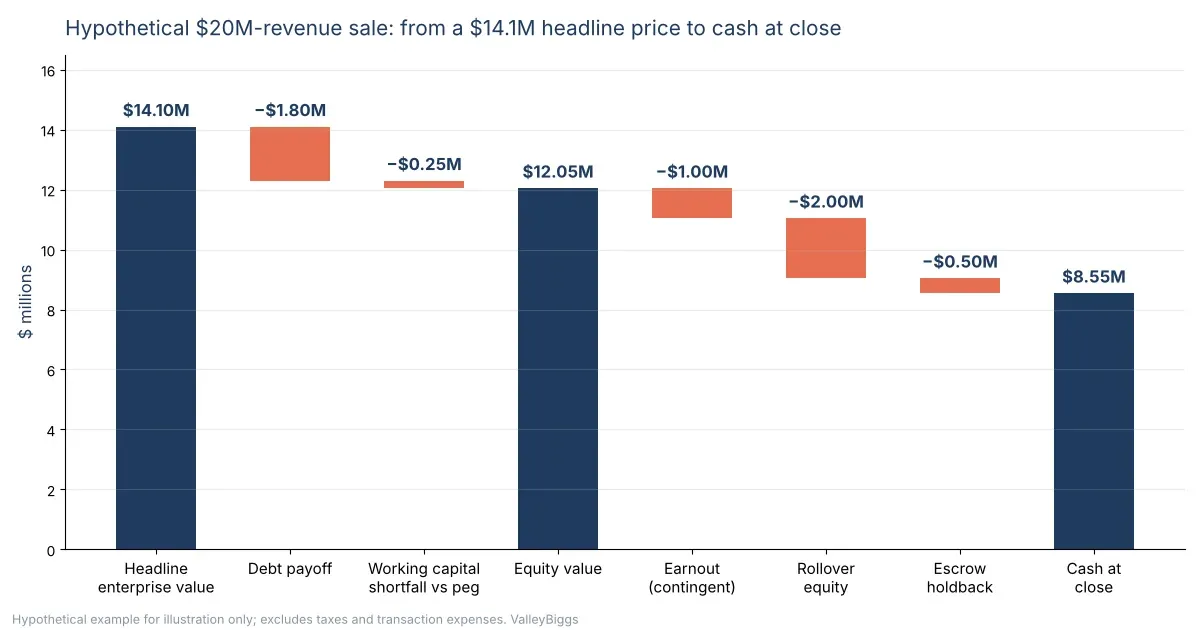
The owner banks $8.55 million at closing, before taxes and deal costs, or about 61% of the headline price. The rest is deferred or at risk. That is why sellers should compare offers on cash at close, the terms of the deferred pieces and the tax treatment, not on enterprise value alone.
How Deal Structure Changes What You Take Home
At $20 million in revenue, almost every offer carries some structure. Each piece has a reason and a cost to the seller:
- Rollover equity. Private equity buyers often ask the seller to reinvest part of the proceeds. If the fund grows the company and sells it again, the rolled stake can be worth more than the cash it replaced, but it is illiquid and carries risk.
- Earnouts. These bridge a gap between what the seller believes the company will earn and what the buyer will pay for today. The definitions of revenue or EBITDA, the measurement period and who controls the business afterward decide whether the earnout pays.
- Escrow and holdbacks. A slice of the price is held to cover breaches of the seller’s representations. Where buyers use representations and warranties insurance, the escrow is often smaller, because the policy absorbs most post-closing claims.
- Seller notes. Less common than in smaller deals, but still used to close valuation gaps or reduce bank debt. They are subordinated to senior lenders, so repayment depends on the business performing.
- Working capital peg. The buyer expects a normal level of receivables, inventory and payables at closing. Delivering less reduces the price dollar for dollar.
What Moves the Multiple Up or Down at This Size?
Inside any survey range, a handful of characteristics decide where a specific company lands. The comparison below reflects what institutional buyers test in diligence.
| Factor | Pushes the multiple up | Pushes the multiple down |
|---|---|---|
| Management depth | A CEO, CFO and operations lead who stay after the sale | Founder holds key customer, supplier and technical relationships |
| Revenue quality | Contracted or recurring revenue, high retention | Project-based or one-off sales with no backlog |
| Customer concentration | No customer above roughly 10% of revenue | One or two customers drive a large share of profit |
| Growth | Consistent growth over three or more years | Flat or declining sales, or a single strong year |
| Financial reporting | Accrual, monthly closes, reviewed or audited statements | Cash-basis books, frequent restatements |
| Market position | Niche leadership, pricing power, roll-up interest in the sector | Commoditized offering, heavy competition on price |
How to Prepare a $20 Million Company for Sale
Preparation pays off more at this size than at any smaller one, because buyers bring larger diligence teams and price every gap they find. A practical sequence over the 12 to 24 months before a sale:
- Move to accrual accounting with monthly closes and, if possible, a financial statement review or audit.
- Commission a sell-side quality of earnings review so your adjusted EBITDA is tested before a buyer tests it.
- Document every add-back with invoices, contracts and payroll records.
- Build the management team so the business does not depend on you for sales, operations or key relationships.
- Reduce customer concentration or lock key customers into longer contracts.
- Clean up legal housekeeping: corporate records, contracts that require consent on a change of control, IP ownership and employment agreements.
- Organize a virtual data room before marketing begins, so diligence does not stall the deal.
A typical sale at this size follows a predictable rhythm, although every deal runs on its own timeline:
| Phase | What happens | Common duration |
|---|---|---|
| Preparation | Financial clean-up, quality of earnings, valuation, data room | 1 to 3 months |
| Marketing | Teaser, NDAs, confidential information memorandum, buyer outreach | 1 to 2 months |
| Indications of interest | Buyers submit non-binding price ranges; management meetings | 3 to 6 weeks |
| Letter of intent | Seller selects a buyer and grants exclusivity | 2 to 4 weeks |
| Due diligence and documents | Financial, legal, tax and operational diligence; purchase agreement | 2 to 4 months |
| Closing | Funds flow, escrow set up, transition begins | 1 to 2 weeks |
Most sales at this scale fall below the Hart-Scott-Rodino premerger filing threshold, which was $133.9 million in 2026 and is adjusted every year, so antitrust filings rarely set the timetable. Financing, diligence findings and negotiation of the purchase agreement usually do. This is general information, not legal or tax advice.
When to Bring In an M&A Advisor
Owners of $20 million companies are selling to professional buyers who negotiate deals for a living. An advisor earns their keep by building competition, defending the earnings number and negotiating the structure, not only the price. It is worth starting the conversation when:
- you have received an unsolicited offer and want to know whether it is a fair price;
- you are 12 to 36 months from a possible sale and want to know which improvements will move the multiple;
- you are weighing private equity against a strategic buyer, or a partial sale against a full exit;
- offers include rollover equity, an earnout or a seller note and you need to compare them on a like-for-like basis.
ValleyBiggs provides enterprise valuation analysis for owners who want a defensible number before talking to buyers, and sell-side M&A assistance for owners ready to run a process. For larger or more complex transactions, our M&A investment banking team works with institutional buyers and investors.
Conclusion
A $20 million company is worth what its adjusted EBITDA, multiplied by a market multiple, says it is worth, and then less whatever the structure defers or puts at risk. Margins drive the first number, the quality of your business and the competition you create drive the second, and the terms decide how much reaches you at closing. If you want to see where your company sits on that range, request a confidential valuation consultation with ValleyBiggs.
FAQs
1. How much is a business worth with $20 million in sales?
Most businesses with $20 million in sales are worth between roughly $4 million and $45 million, depending on adjusted EBITDA. A company earning a 10% margin, or $2 million, might sell for about 5x to 6.5x that figure. Higher margins, recurring revenue and a strong management team push the value toward the top of the range.
2. What EBITDA multiple does a $20 million revenue company sell for?
Lower middle market surveys put median multiples near 5.8x EBITDA for deals of $5 million to $50 million in mid-2026, and private equity deals of $10 million to $25 million averaged about 6.2x to 6.7x in 2025. Individual companies land above or below those averages based on growth, margins, customer concentration and how competitive the sale process is.
3. Are SaaS companies with $20 million in revenue valued differently?
Yes. Recurring-revenue software companies are often priced on annual recurring revenue rather than EBITDA, because many reinvest profit into growth. Buyers adjust that revenue multiple for growth rate, gross margin, churn and net revenue retention. Founders considering a sale can see how ValleyBiggs approaches these deals on its SaaS business sale page.
4. Who buys companies with $20 million in revenue?
The main buyers are private equity funds, either buying a new platform or an add-on for a company they already own, along with strategic acquirers, family offices and independent sponsors. Individual buyers using SBA loans rarely compete at this size, because the 7(a) program caps loans at $5 million, well below typical purchase prices.
5. How long does it take to sell a $20 million company?
A sale at this size commonly takes six to twelve months from preparation to closing. Preparing financials and a confidential information memorandum takes one to three months, marketing and offers another two to three, and due diligence after the letter of intent usually runs two to four months. Complex diligence findings or financing can extend that timeline.
6. Do I need a quality of earnings report before selling?
It is not required, but it is increasingly expected. Institutional buyers almost always commission their own review, and a sell-side quality of earnings report lets you find and fix problems first. It gives your adjusted EBITDA more credibility in negotiations and reduces the risk of a price cut late in the process, when you have the least leverage.
7. How much of the purchase price is paid in cash at closing?
It varies by buyer and deal. In the hypothetical example in this guide, the owner receives about 61% of the headline price in cash at closing, with the rest in rollover equity, escrow and an earnout. Strategic buyers often pay more cash upfront, while some offers add seller financing to bridge a valuation gap.