

To sell a domain name, set a realistic price from comparable sales, list it where qualified buyers look (a marketplace, a domain broker or direct outreach), agree terms in writing and close through escrow so the money is secured before you transfer control. The details that decide the outcome are pricing, the sale channel and a clean transfer.
This guide explains how to sell a domain name the way a business owner should: what drives domain name value, which channel fits which name, how escrow and registrar transfers work, the tax and trademark checks to run first, and what changes when the domain belongs to a company you may sell one day.
Key Takeaways
- Price from comparable sales and the buyer’s use for the name, not from a single automated appraisal.
- End users usually pay far more than domain investors, but they take longer to find and close.
- Use escrow for any meaningful amount, and never transfer the domain before funds are confirmed.
- Check registrar locks, the registrant contact and any trademark conflict before you list.
- If the domain runs an operating website, the business is usually worth more than the name alone, so decide which asset you are selling.
How to Sell a Domain Name in 8 Steps
The process is similar whether the name is worth a few hundred dollars or six figures. What changes with value is how much time you spend on pricing, buyer outreach and paperwork.
- Confirm you control it. Log in to the registrar, check that you (or your company) are the registrant, and note the expiry date and any transfer lock.
- Decide what you are selling. The bare name, a website with content and traffic, or an operating business that happens to own the domain.
- Research value. Look up comparable sales for similar length, extension and keyword, and think about who would use the name and what it is worth to them.
- Set a pricing strategy. A fixed buy-now price, a minimum offer, or make-offer only.
- Choose the channel. Marketplace listing, auction, a domain broker, or your own outreach to likely end users.
- Negotiate and agree terms in writing. Price, who pays escrow fees, transfer method and timing.
- Close through escrow. The buyer funds escrow, you transfer the domain, the buyer confirms control and the funds are released.
- Clean up afterwards. Update your records for tax reporting, remove the name from other listings and cancel any auto-renewals tied to it.
Domain, Website or Business: What Are You Actually Selling?
Many owners searching for this topic are not domain investors. They own a name that a company or product uses, or they are winding down a site and wonder what the address is worth. The answer depends on what comes with it.
| What changes hands | What the buyer pays for | Typical buyers | Where it is usually sold |
|---|---|---|---|
| Bare domain (no site or a parked page) | The name itself: brandability, keyword, extension, length | End users building a brand, domain investors | Marketplaces, auctions, domain brokers, direct outreach |
| Website with content and traffic | The name plus traffic, rankings, content and any revenue | Content operators, niche buyers, small acquirers | Website marketplaces or a broker for larger sites |
| Operating business that owns the domain | Cash flow, customers, team, systems; the domain is one asset among many | Strategic acquirers, private equity, search funds | A confidential sale process run by an M&A advisor |
If your domain carries an operating SaaS, ecommerce or service business, selling the name on its own can strip value from everything built on it. In that case the domain should be treated as part of a full technology business sale, where it is valued inside the company rather than as a standalone asset.
What Is My Domain Name Worth?
A domain is worth what a specific buyer will pay for the use they have in mind. That is why two names that look similar can sell for very different prices, and why the same name can draw a low offer from an investor and a high one from a company that needs it.
The factors that move domain name value
- Extension. In the US market, .com usually commands the highest prices; other extensions can sell well when they fit an industry or a country.
- Length and clarity. Short names that are easy to spell, say and remember are scarcer and easier to sell.
- Commercial meaning. Words tied to products or services that companies spend money advertising tend to attract more interest.
- Brandability. An invented or two-word name can be valuable if it sounds like a company someone would build.
- Type-in traffic and backlinks. Existing visitors or links pointing at the name add value for some buyers, especially if a site has operated on it.
- Legal cleanliness. A name that overlaps with someone else’s trademark can be close to unsellable and may invite a dispute.
How to use a domain appraisal
Automated domain appraisal tools estimate value from patterns in past sales. They are a useful first screen, but they cannot see who wants the name, so treat their figure as a reference point rather than a price. A better test is a short list of comparable sales of names with the same extension, similar length and similar meaning, combined with a list of companies that would plausibly use yours.
Keep the gap between wholesale and retail in mind. Investors buy names to resell, so their offers are a fraction of what an end user may pay. If a fast sale matters more than the top price, a wholesale offer can be rational; if not, patience and targeted outreach usually pay.
Where to Sell Domain Names: Channels Compared
There is no single best marketplace. The right channel depends on how valuable the name is, how quickly you need cash and how much work you want to do yourself.
| Channel | How it works | Best fit | Cost pattern | Watch for |
|---|---|---|---|---|
| Marketplace listing | You list the name with a buy-now price or minimum offer; the platform handles checkout and transfer | Most names, from low four figures upward | Commission on the sale price, no fee if it does not sell | Commission level, listing exclusivity, how offers reach you |
| Registrar distribution network | Your listing is shown at many registrars when someone searches for the name | Names likely to be found by people searching for them | Commission, sometimes higher for wider distribution | Fast-transfer requirements and nameserver settings |
| Auction | Bidders compete over a set period, often with a reserve price | Liquid names that investors already value | Commission, sometimes a membership or listing fee | Low results if the reserve is not set |
| Domain broker | A specialist prices the name, finds end users and negotiates | Premium names with a clear set of likely buyers | Success fee on the sale | Exclusivity period and how buyers are contacted |
| Direct outreach | You identify likely users and contact them, or receive inbound offers through a for-sale page | Owners who know their industry and have time | Your time plus escrow fees | Unsolicited offers that are scams, and pressure to transfer early |
Published marketplace commissions vary widely by platform and listing type, from single digits to roughly a quarter of the price, and they change. Check each platform’s current fee page and compare what you would keep, not the headline price.
Hypothetical Example: One Domain, Three Sale Routes
Imagine a hypothetical two-word .com that a small software company stopped using after a rebrand. The owner gets three realistic options. The figures below are illustrations, and the commission rates are assumptions rather than any platform’s actual fees.
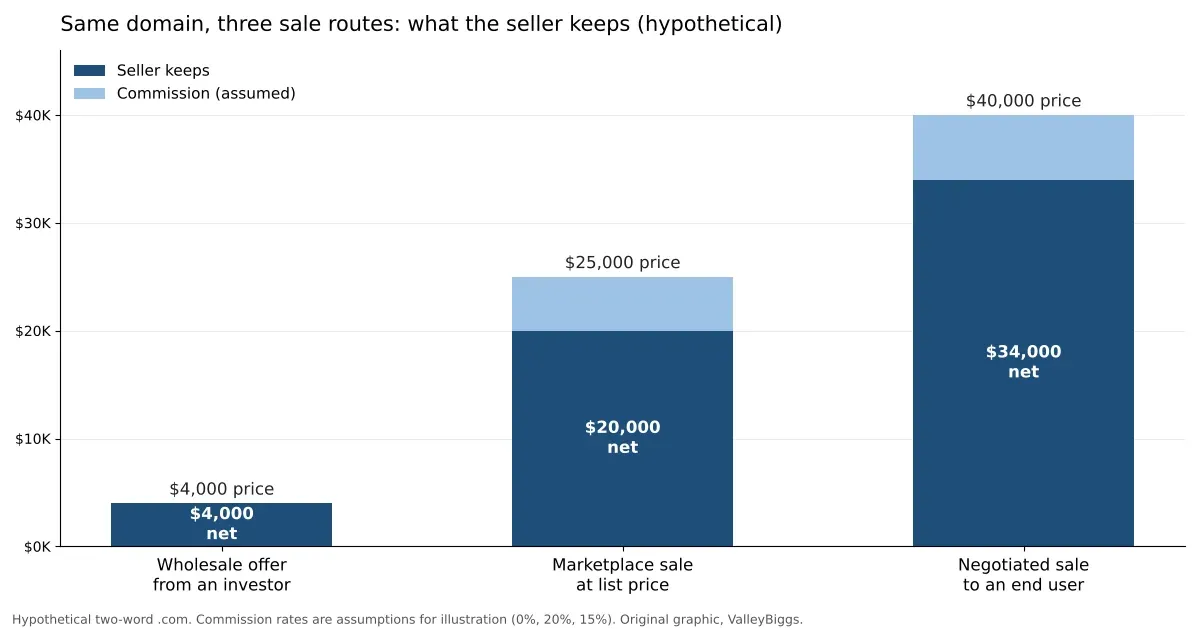
| Route | Price | Assumed commission | Seller keeps | Typical time to close |
|---|---|---|---|---|
| Wholesale offer from a domain investor | $4,000 | None (direct sale) | $4,000 | Days |
| Marketplace sale at the buy-now price | $25,000 | 20% ($5,000) | $20,000 | Weeks to many months, if it sells at all |
| Negotiated sale to an end user through a broker | $40,000 | 15% ($6,000) | $34,000 | Weeks to months of outreach and negotiation |
The point is not the exact numbers. It is that the channel decides both your net proceeds and your timeline, and that an end-user sale only happens if someone actually needs the name. A seller who is not in a hurry can list at a retail price while running targeted outreach, and keep the wholesale offer as a fallback.
How to Handle Offers and Negotiate
Most domain sales start with an inquiry rather than a buy-now click. A few habits protect your price and your time.
- Ask what the buyer plans to do with the name. A funded startup and a hobbyist value it very differently.
- Answer low first offers with a reasoned counter based on comparable sales, not with silence.
- Put agreed terms in writing before any transfer: price, escrow provider, who pays fees and the transfer method.
- Be wary of offers that require you to pay for an appraisal or certificate first; that is a common scam pattern.
- Do not accept payment methods that can be reversed, and do not move the domain on a promise of payment.
For higher-value names, a short domain purchase agreement is worth having. It should identify the domain, the price, the escrow arrangement, the transfer deadline and a statement that you own the name free of liens or known disputes.
Domain Name Escrow and the Transfer, Step by Step
Domain name escrow solves the trust problem: neither side wants to go first. A licensed escrow service holds the buyer’s money, you transfer the domain, and the funds are released when the buyer confirms control.
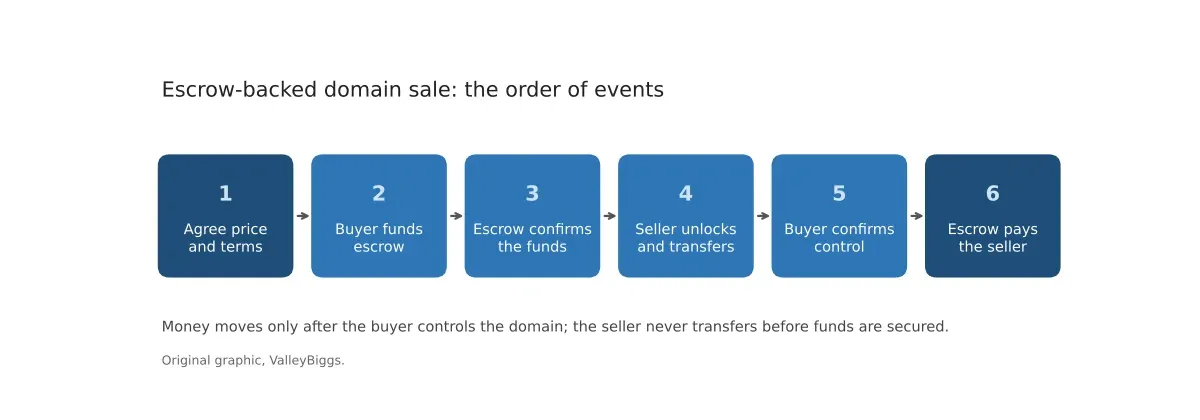
- Open the escrow transaction with the domain, price, fee split and a short inspection period.
- Wait for the escrow service to confirm that the buyer’s payment has cleared, not just that it was sent.
- Transfer the domain: either push it to the buyer’s account at the same registrar, or unlock it and provide the authorization code so the buyer can move it to their registrar.
- Approve any confirmation email from your registrar so the transfer is not delayed.
- Let the buyer confirm the domain is in their account, then the escrow service releases your funds.
Check registrar locks before you promise a date. Under ICANN’s Transfer Policy, a registrar may refuse to move a generic top-level domain to another registrar within 60 days of its registration or a previous transfer, and many registrars apply a 60-day lock after the registrant details change unless you opt out. ICANN has approved revisions to these rules that registrars are phasing in, so confirm your registrar’s current policy. Country-code extensions follow their own registry rules.
Taxes, Trademarks and Paperwork to Check First
This section is general information, not legal or tax advice. Talk to your CPA and attorney about your situation before a significant sale.
How a domain sale is taxed
- Held as an investment. According to the IRS, gains on capital assets held more than one year are generally long-term capital gains; assets held one year or less produce short-term gains taxed at ordinary rates.
- Used in a business. IRS Chief Counsel Advice 201543014 concluded that purchased domain names used in a business are generally Section 197 intangibles amortized over 15 years. When such a name is sold, the amortization you claimed is generally recaptured as ordinary income.
- Held as inventory. If you buy and sell names regularly as a business, gains are more likely to be treated as ordinary business income.
- Sold with a business. In an asset sale, the price is allocated across asset classes, and the IRS requires buyer and seller to report that allocation on Form 8594.
Trademark and dispute risk
Selling a generic or invented name is legal. The risk arises when a name is identical or confusingly similar to someone else’s trademark. The federal Anticybersquatting Consumer Protection Act allows mark owners to sue people who register, sell or use such names with a bad-faith intent to profit, and the Uniform Domain-Name Dispute-Resolution Policy gives them a faster route to have a name transferred. Run a trademark search before you list, and avoid marketing the name to the brand it resembles.
Selling a Domain as Part of a Business Sale
When the domain is the address of an operating company, the buyer is not purchasing a name; they are buying the business, and the domain is one of the assets that has to arrive intact on closing day. Problems here rarely kill a deal, but they create friction and last-minute delays.
- Ownership. Domains are often registered in a founder’s personal account or a former developer’s account. Move the name into a company-controlled account well before a sale.
- Disclosure. List the domains, related social handles and digital accounts in the confidential information memorandum and in the purchase agreement schedules.
- Diligence. Buyers will ask for registrar records, renewal dates, DNS settings and any disputes, so include them in your due diligence checklist for selling a business.
- Continuity. Email, payment pages and logins depend on DNS. Plan the transfer of mail records, SSL certificates and analytics or search console access so nothing goes dark at closing.
- Rebrands. If the buyer will merge the site into its own brand, permanent redirects from old pages help keep search traffic and links working.
Agree early whether the domain is included in the price. It should be covered at the letter of intent stage so it does not become a renegotiation point later. For ecommerce brands in particular, the domain, store and customer list usually move together in an ecommerce business sale, and the name’s value is reflected in the multiple paid for the business rather than in a separate check.
If you are unsure whether the name or the company is the more valuable asset, an enterprise valuation analysis can show what the operating business is worth before you decide to sell the domain on its own.
Common Mistakes When Selling a Domain
- Pricing from one automated appraisal instead of comparable sales and likely buyers.
- Transferring the domain before escrow confirms the funds.
- Letting the name expire or lapse into a redemption period during negotiations.
- Listing on several platforms with conflicting prices or exclusivity terms.
- Ignoring a trademark conflict that a buyer’s lawyer will find in minutes.
- Selling the domain of a live business separately and weakening the business you may want to sell later.
When to Talk to an Advisor
A bare domain can usually be sold with a marketplace and an escrow service. Bring in specialists when the stakes rise: a domain broker for a premium name with a clear set of end users, a CPA when the sale is large or the name was used in your business, and an attorney when there is any trademark question.
If the domain is the front door of a SaaS, ecommerce or software company, the better question may be what the whole business would sell for. ValleyBiggs works with owners of technology and growth companies on technology business sales and broader sell-side assistance, running a confidential process aimed at qualified buyers. Our step-by-step guide to selling a business explains how that process works from preparation to closing.
Conclusion
Selling a domain well comes down to knowing who would use it, pricing it against real comparable sales, choosing a channel that matches your timeline and closing through escrow. If your domain carries an operating business, step back before you list it and look at the value of the company as a whole. To talk through your options, request a confidential consultation with the ValleyBiggs team.
FAQs
1. What's the best way to sell a domain?
For most names, the best way is to list it on a reputable marketplace with a clear buy-now price and close through escrow. Premium names with obvious end users often sell for more through a domain broker or direct outreach to companies that would use them. Match the channel to the name’s value and to how quickly you need the money.
2. How much is my domain worth?
Your domain is worth what a buyer with a real use for it will pay. Start with comparable sales of names with the same extension, length and meaning, then consider who would build a brand on it. Automated appraisals are a rough reference point only. Investor offers are usually far below what an end user may pay.
3. Is domain flipping illegal?
No. Buying and reselling generic or invented domain names is legal in the US. It becomes a legal problem when a name is identical or confusingly similar to someone else’s trademark and is registered or sold in bad faith, which can lead to a lawsuit under federal cybersquatting law or a UDRP complaint that forces a transfer.
4. Can I sell a domain for free?
Mostly, yes. Many marketplaces let you list a name without an upfront fee and charge a commission only if it sells. You can also sell directly through a for-sale page or inbound inquiries and pay only escrow fees. Avoid any buyer or service that asks you to pay for an appraisal or certificate before a sale.
5. How long does it take to sell a domain name?
It ranges from days to years. A wholesale sale to an investor can close within days, while waiting for the right end user on a marketplace can take months. Once a buyer commits, an escrow transaction usually completes within days to a couple of weeks, depending on payment clearing and the transfer method.
6. Should I sell my domain separately from my business?
Usually not if the domain runs a live business. The company’s revenue, customers and systems are generally worth more than the name, and selling the domain first can weaken that value. Owners of software companies should look at a full sale first; our guide on how to sell a SaaS business explains the options.