

Knowing how to sell your business to a competitor comes down to two jobs: getting paid for the value your company creates inside the buyer’s operation, and making sure the rival cannot use the process against you if the deal dies. A competitor can often outbid a financial buyer because it can cut duplicate costs and keep your customers. It also learns more about you than anyone else could. The answer is a controlled process: an anonymous first approach, an NDA with non-solicit and standstill terms, information released in stages, a clean team for sensitive data, and at least one credible alternative bidder at the table.
Key Takeaways
- A competitor may pay a premium because it values synergies, but it only shares that value with you when it believes another buyer could win.
- Protect yourself with a confidentiality agreement that includes non-solicitation of staff and customers and, for larger deals, a standstill clause.
- Release customer names, pricing and employee data last, ideally after a signed letter of intent and only to a vetted clean team.
- Buyer and seller who compete must also respect antitrust rules on information exchange and premature coordination, known as gun jumping.
- Non-competes, earnouts and the tax allocation of the price matter more in a sale to a rival, so settle them in the LOI rather than later.
Why Would a Competitor Pay More Than Other Buyers?
A competitor is a strategic buyer: it buys your company to make its own business larger, cheaper to run or harder to compete with. A private equity fund or an individual buyer, by contrast, usually prices the business on its own cash flow plus what it can finance. The difference shows up in what each buyer can afford to pay.
The extra value a rival can capture usually comes from four places:
- Cost synergies. One finance team, one office lease, one software stack, combined purchasing.
- Revenue synergies. Selling its products to your customers and yours to its customers.
- Market position. Removing a price competitor, entering a territory or adding a capability it would otherwise build.
- Speed. Buying an existing team and product is often faster than hiring and building one from scratch.
None of that money is promised to you. The buyer starts by valuing your standalone earnings, usually on adjusted EBITDA after normalizing add-backs, and treats synergies as its own upside. How much of the synergy pool it hands over depends on how badly it wants the deal and on who else is bidding.
| Factor | Competitor (strategic) | Private equity | Individual buyer |
|---|---|---|---|
| What it pays for | Standalone earnings plus part of the synergies | Standalone cash flow and growth plan | Owner earnings it can finance |
| Typical funding | Balance sheet cash, stock or corporate debt | Fund equity plus acquisition debt | SBA loan, savings, seller note |
| Information risk to you | High: it competes with you today | Low to moderate | Low |
| Post-close plan | Integrate and remove overlap | Keep the company running, add-ons | Run the business as is |
| What it often asks for | Non-compete, short transition, earnout tied to retention | Rollover equity, management stays | Seller financing, long training period |
What Are the Risks of Selling to a Rival?
The same familiarity that lets a competitor move quickly also makes it dangerous. Owners who have been through a failed process with a rival tend to describe the same problems:
- Fishing expeditions. The buyer asks for detailed pricing, margins by customer and salary data, then walks away.
- Poaching. Your best salespeople or engineers receive offers after the rival learns who they are and what they earn.
- Customer disruption. Rumors that you are for sale give the rival’s sales team a talking point with your accounts.
- Anchoring. A first offer that ignores synergies sets a low frame, especially if you have no other bidder.
- Antitrust exposure. Swapping current prices or coordinating behavior before closing can create legal risk for both companies.
- Integration-driven earnouts. If part of the price depends on results the buyer controls after closing, you carry its integration risk.
How to Sell Your Business to a Competitor in 9 Steps
The process below follows the normal sell-side sequence described in our guide on the full business sale process, with the extra controls a rival buyer requires.
1. Decide whether a competitor belongs on the buyer list
Start with your goals. If you want the highest price and are comfortable with your brand being absorbed, a strategic buyer is often the natural fit. If keeping the team intact or rolling equity into a growth plan matters more, a financial sponsor may suit you better. Write down your minimum acceptable price, the role you want after closing and the date you want to be finished.
2. Get a valuation that shows standalone value and synergy value
Before talking to anyone, know two numbers: what the company is worth to a buyer with no overlap, and what it could be worth to a rival that removes duplicate costs. A formal enterprise valuation analysis gives you the first number and a defensible basis for estimating the second. Without both, you cannot tell whether a competitor’s offer is generous or a lowball dressed as a premium.
3. Build a buyer list that goes beyond your direct rivals
Leverage comes from alternatives. List direct competitors, adjacent companies that sell to the same customers, suppliers and distributors that could integrate forward or backward, and private equity firms with platforms in your sector. Rank each by strategic fit, ability to pay and the damage a leak would cause if they learned about the sale and did not buy.
4. Approach anonymously through an intermediary
A rival should not learn your name from the first email. An advisor sends a one-page blind teaser that describes the sector, size band, growth and why the business fits, without identifying details. Only buyers who respond with genuine interest and pass a basic check on their financial capacity move to the next stage.
5. Sign an NDA with teeth
A standard confidentiality agreement is not enough when the buyer competes with you. Ask your attorney to include:
- Use restriction. Information may be used only to evaluate the transaction.
- Non-solicitation. No hiring or soliciting your employees, and no soliciting your customers, for a set period if the deal does not close.
- Standstill. For larger or more contested deals, a promise not to pursue an unsolicited approach to your shareholders or lenders.
- Return or destroy. Documents come back or are destroyed when talks end, with written certification.
- Named recipients. Access limited to people who need it, with sales and pricing staff excluded.
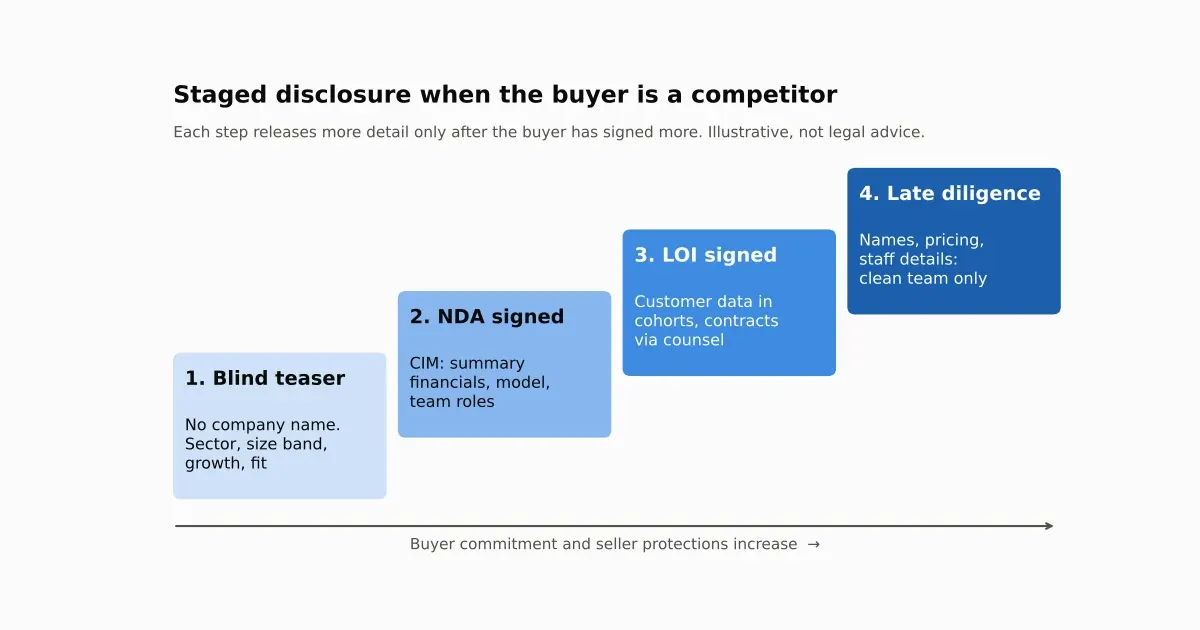
6. Release information in stages
Match disclosure to commitment. Early stages need only enough detail for the buyer to price a range; the most damaging data waits until the buyer has signed a letter of intent and, for competitively sensitive items, a clean team agreement. A detailed confidential information memorandum is usually the main document after the NDA.
| Stage | What you share | What you hold back |
|---|---|---|
| Blind teaser | Sector, revenue band, EBITDA range, growth, reason for sale | Company name, location detail, customer names |
| After NDA | CIM, summary financials, product overview, org chart by role | Individual salaries, customer-level revenue, current pricing |
| After signed LOI | Customer cohorts and concentration, contract terms through counsel, KPIs | Named customer lists, pricing files, source code |
| Late diligence (clean team) | Named customers, pricing, staff details, technical deep dives | Anything not needed to confirm value or plan integration |
7. Use a clean team for competitively sensitive data
A clean team agreement limits who on the buyer’s side can see sensitive information. The Federal Trade Commission’s Bureau of Competition has advised merging parties to share the least information needed for diligence, to tailor what is shared to the stage of the process, and to route competitively sensitive data through clean teams or third-party consultants. FTC staff also say clean teams should not include people responsible for pricing, competitive planning or strategy, and that reports passed back to the business should be aggregated or blinded and reviewed by counsel.
8. Negotiate the letter of intent before you open the books
With a competitor, the LOI is where most of your leverage lives. Settle price, the split between cash at close and deferred payments, the length of exclusivity, the scope of the non-compete, employee commitments and the working capital target before full diligence starts. Our explainer on how a letter of intent works in M&A covers which LOI clauses are binding and which are not.
9. Run diligence, sign and plan the announcement
Prepare the data room in advance so diligence moves quickly; a prolonged process gives a rival more time to learn and more chances for a leak. A seller-side due diligence checklist helps you anticipate requests. Agree with the buyer who tells employees, customers and suppliers, in what order, and on which day.
Antitrust Rules When Buyer and Seller Compete
Antitrust law applies to small deals as well as large ones, and it applies before closing. Two issues come up most often when the buyer is a rival. This section is general information, not legal advice.
- Gun jumping. Until a deal closes, the two companies remain independent competitors. Agreeing on prices, splitting customers, letting the buyer approve your ordinary business decisions or acting as one company early can violate the Sherman Act and, for reportable deals, the waiting period of the Hart-Scott-Rodino (HSR) Act.
- Information exchange. FTC guidance asks parties to consider whether an exchange would harm competition if the merger did not go through. Current prices, margins by customer, bids in progress and future plans are the classic examples that need clean team protection.
- HSR filing. Larger transactions must be reported to the FTC and the Department of Justice and wait for review. The FTC’s 2026 threshold for the size of transaction was $133.9 million, and the figure is adjusted every year based on changes in gross national product, so check the threshold in effect at the time of closing.
- Below the threshold. Deals that do not require a filing can still be investigated if they reduce competition in a local or niche market.
How to Respond to an Unsolicited Offer From a Competitor
Many sales to rivals start with a call from the other side. A measured response keeps the opportunity alive without giving away your leverage:
- Thank them, say you are always open to a conversation, and share nothing else on the first call.
- Ask what they have in mind: structure, valuation approach, timing and how they would fund it.
- Get an NDA signed before any numbers change hands, with the non-solicit and use limits described above.
- Commission your own valuation so you can judge the offer against standalone and synergy value.
- Quietly test the market through an advisor. A single bidder sets its own price; a second one changes the conversation.
- Set a deadline for a written indication of interest so the approach does not drag on as free market research.
Hypothetical Example: How Much of the Synergy Value Reaches the Seller?
Consider a hypothetical B2B services company with $3.0 million of adjusted EBITDA. A financial buyer prices it at 6x, or $18.0 million. A direct competitor estimates $1.2 million a year of synergies, mainly from removing overlapping overhead and cross-selling. At the same 6x, those synergies are worth $7.2 million to the competitor. The numbers are illustrative only; real multiples depend on sector, size, growth and deal terms.
| Scenario | Standalone value | Synergy share paid to seller | Hypothetical price |
|---|---|---|---|
| One competitor, no other bidders | $18.0M | About 10% ($0.7M) | $18.7M |
| Two strategic bidders | $18.0M | About 35% ($2.5M) | $20.5M |
| Broad process with strategics and a PE floor | $18.0M | About 50% ($3.6M) | $21.6M |
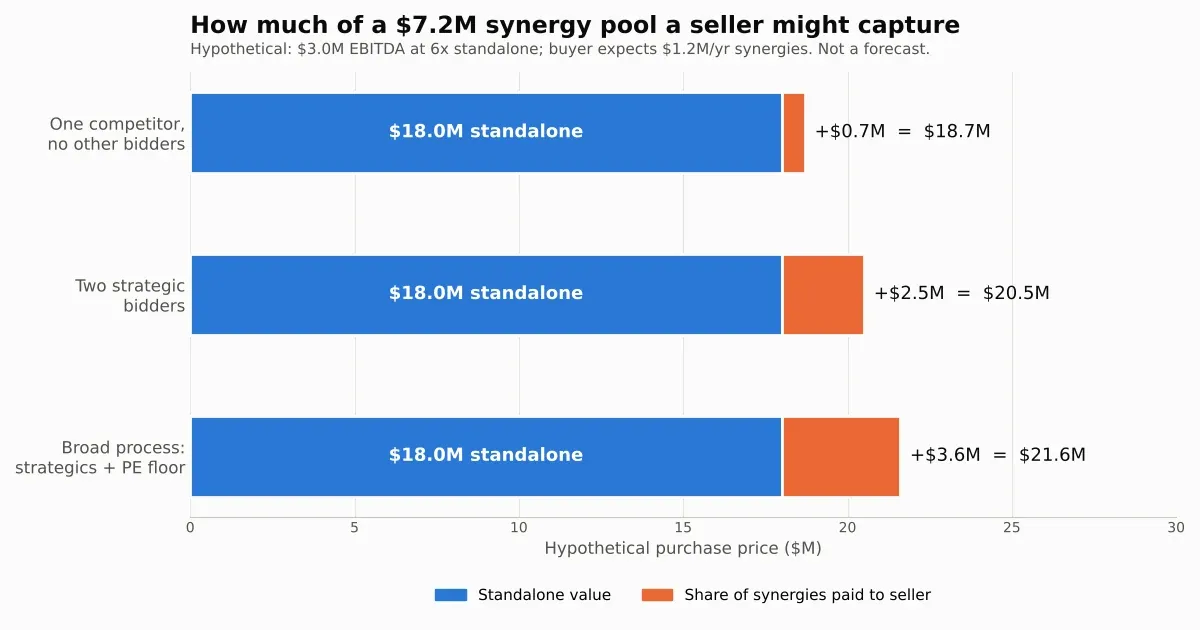
The point is not the exact percentages. It is that the competitor’s walk-away price can sit well above standalone value, and the seller only reaches that zone when the buyer believes someone else might close first. In this example the difference between a single-bidder deal and a competitive process is close to $3 million before considering structure.
Deal Terms That Matter More With a Competitor Buyer
Non-compete and non-solicit covenants
Expect the buyer to ask you not to compete after closing. Courts generally treat non-competes tied to the sale of a business more favorably than employee non-competes; California, for example, keeps a statutory exception for a seller of a business’s goodwill or ownership interest. Scope, geography and length still need to be reasonable, and rules vary by state, so negotiate them with counsel.
Price allocation and tax
In an asset sale, buyer and seller allocate the price across asset classes and report it to the IRS on Form 8594. Amounts allocated to a covenant not to compete are generally ordinary income to the seller, while the buyer amortizes them over 15 years under Section 197, so the two sides have different incentives. Agree the allocation in the LOI and review it with your CPA. This is not tax advice.
Earnouts and deferred payments
A competitor usually integrates quickly, which can make post-closing targets hard to measure. If part of the price is deferred, tie it to metrics the buyer cannot easily dilute, ask for reporting and audit rights, and consider whether a shorter, smaller earnout or a seller note with clear security is a better trade.
Employees and customers
Rival buyers often keep revenue-generating staff and cut overlapping roles. Decide which commitments you need on retention, severance and titles, and when key people will be told. Check customer contracts for change-of-control and assignment clauses early, because a large customer’s consent can become a closing condition.
Selling a Tech, SaaS or Ecommerce Company to a Competitor
Digital businesses carry extra information risk because so much value sits in code, data and growth playbooks. Points that come up in these deals:
- Source code. Use a third-party code review or a time-limited, monitored session rather than handing over repositories.
- Customer data. Check your privacy policy and data processing agreements before sharing user-level data; aggregated cohort tables usually answer the buyer’s questions.
- Pricing and unit economics. Share churn, net revenue retention and CAC payback as ranges or cohorts until the clean team stage.
- Marketing playbooks. Ad accounts, keyword lists and supplier terms are easy to copy, so keep them for late diligence.
If you run a software company, our page on how we sell SaaS businesses to strategic and financial buyers explains how buyer outreach is organized for these assets.
Documents Checklist for a Sale to a Competitor
- Valuation report showing standalone value and an estimate of synergy value
- Blind teaser and confidential information memorandum
- NDA with non-solicitation, use restriction and, where relevant, standstill terms
- Clean team agreement and a list of approved clean team members
- Three years of financial statements and an add-back schedule
- Customer concentration analysis in cohort form
- Key contracts with change-of-control and assignment clauses flagged
- Employee census by role, with names withheld until late diligence
- Draft LOI terms: price, structure, exclusivity, non-compete, transition
- Communication plan for employees, customers and suppliers
Common Mistakes When Selling to a Rival
- Negotiating with one competitor only, which lets the buyer keep most of the synergy value.
- Sending pricing files or customer lists before an LOI is signed.
- Signing a generic NDA with no non-solicit or use restriction.
- Letting the buyer’s sales leaders sit on the diligence team.
- Accepting a long exclusivity period without a firm price and structure.
- Agreeing to an earnout tied to revenue the buyer will merge into its own accounts.
- Telling staff too early, or letting them hear about the deal from the buyer.
When to Talk to an M&A Advisor
A sale to a competitor is one of the cases where an intermediary earns its place. An advisor can approach rivals without naming you, create competition among strategic and financial buyers, control the data room and keep the timeline tight. It makes sense to bring one in when a competitor has already approached you, when the business is large enough that synergies could move the price by millions, or when the buyer universe includes several rivals you would not want to learn about the sale. ValleyBiggs’ sell-side assistance covers valuation, marketing collateral, data room management and negotiations through closing.
Conclusion
A competitor can be the best buyer for your company and the riskiest one to negotiate with. Price your standalone and synergy value first, approach rivals anonymously, protect yourself with a strong NDA and staged disclosure, respect antitrust limits on information exchange, and keep at least one alternative buyer in the process. If you are weighing an offer from a rival or thinking about approaching one, request a confidential consultation and we will help you value the business and plan the approach.
FAQs
1. Should I tell my employees before selling to a competitor?
Usually not until a letter of intent is signed and the timeline is fixed. Early news can push key people to look elsewhere, and a rival buyer may approach them directly. Most sellers brief a small group of essential managers under confidentiality during diligence, then announce to the wider team on a date agreed with the buyer.
2. How long does it take to sell a business to a competitor?
A sale to a competitor often runs six to twelve months from first approach to closing, similar to other mid-market sales. A rival may move faster on diligence because it knows the market, but antitrust review, customer consents and integration planning can add time. Preparing your data room before outreach is the most reliable way to shorten it.
3. What happens to my information if the competitor walks away?
Your protection is the NDA. A well-drafted agreement limits use of the information to evaluating the deal, bars soliciting your staff and customers for a set period, and requires documents to be returned or destroyed. Staged disclosure matters just as much, because the most sensitive data should never have reached the buyer if the deal failed early.
4. Is it better to sell to a competitor or to private equity?
It depends on your goals. A competitor may pay more because it can count on synergies, but it often integrates the business and cuts overlapping roles. Private equity usually keeps the company running and may offer rollover equity. Comparing both requires knowing what your business is worth on a standalone basis first.
5. Can you refuse to sell your business to a competitor?
Yes. A private owner can generally choose not to sell to a particular buyer, including a rival. The main exceptions come from your own agreements: a right of first refusal in a shareholder or operating agreement, partner consent rules, or duties owed to other owners. Review those documents with counsel before you start any sale conversation.
6. How do I approach a competitor about buying my business?
Avoid calling the owner yourself. Have an advisor send an anonymous teaser that describes the business without naming it, and disclose your identity only after the competitor signs an NDA and shows it can fund a deal. Approaching several buyers at once, including non-competitors, keeps the first rival from treating your call as a sign you must sell.