

What is a letter of intent? In a business sale, it is a short document in which a buyer sets out the price, deal structure and main conditions it proposes, and asks the seller for a period of exclusive negotiation. Most of it is non-binding, but a few clauses, such as exclusivity and confidentiality, usually bind both sides the day it is signed.
For an owner, the LOI is the last point where several buyers are still competing for the deal. The terms agreed here frame the purchase agreement, the due diligence that follows and, in the end, how much cash reaches you at closing. This guide explains each clause and what sellers typically push for.
Key Takeaways
- A letter of intent (LOI) records the headline terms of a proposed acquisition before lawyers draft the definitive purchase agreement.
- Price, structure and closing conditions are usually non-binding; exclusivity, confidentiality, expenses and governing law usually are binding.
- The no-shop clause is the seller’s biggest concession, so its length, extensions and exit triggers deserve as much attention as the price.
- Two LOIs with the same headline number can deliver very different cash at closing once seller notes, earnouts, rollover and the working capital peg are counted.
- Detail costs little before signing and a lot after it: the more precisely the LOI defines price mechanics, the less room there is to re-trade later.
What Is a Letter of Intent in a Business Sale?
A letter of intent to purchase a business is a buyer’s written proposal to acquire a company on stated terms, signed by both parties once they agree in principle. It sits between the marketing phase and the binding contract: by the time a buyer writes one, it has usually read the confidential information memorandum (CIM), met management and tested the financials at a high level.
The LOI does three jobs at once. It confirms that buyer and seller agree on the economics, it gives the buyer protected time to spend money on lawyers, accountants and lenders, and it gives both sides’ counsel a blueprint for the purchase agreement. In the ValleyBiggs M&A process, negotiating and signing a non-binding LOI that secures exclusivity typically comes after valuation work and preliminary diligence, and before the deeper review and integration planning.
You will also see the terms “term sheet”, “heads of terms” and “memorandum of understanding”. In practice they describe similar documents; what matters is not the label but which clauses the text says are binding.
How an LOI differs from other deal documents
| Document | When it appears | What it fixes | Binding? |
|---|---|---|---|
| NDA (confidentiality agreement) | Before any confidential data is shared | Use and protection of seller information | Yes |
| Indication of interest (IOI) | After the CIM, often in round one | A value range and basic structure, so the seller can shortlist | No |
| Letter of intent (LOI) | After management meetings, with one chosen buyer | Price, structure, key conditions, timeline and exclusivity | Mostly no; a few clauses yes |
| Purchase agreement (APA or SPA) | After confirmatory due diligence | Every term, including reps, warranties, indemnities and closing mechanics | Yes |
What Goes Into a Letter of Intent to Purchase a Business
A typical LOI for a lower middle market company runs a few pages. The clauses below appear in most of them. The right-hand column is the version sellers commonly ask for; whether a buyer accepts it depends on how much competition there is for the deal.
| Clause | What it says | Usually binding? | What sellers usually ask for |
|---|---|---|---|
| Purchase price | Enterprise value, often on a cash-free, debt-free basis | No | A fixed number, the earnings figure and multiple it rests on, and the add-backs already accepted |
| Consideration mix | Cash at close, seller note, earnout, rollover equity, buyer stock | No | The share paid in cash at closing stated as a dollar amount, not just a percentage |
| Working capital | A target (peg) delivered at close, with an adjustment up or down | No | The method and reference period for the peg written down now, including how deferred revenue is treated |
| Financing | How the buyer will fund the deal and whether closing depends on it | No | Evidence of committed equity and debt, or no financing condition at all |
| Due diligence scope and timeline | Areas to be reviewed and target dates | No | A defined list and a firm calendar, so diligence cannot drift |
| Indemnity and escrow | How much of the price is held back and for how long, and whether R&W insurance is used | No | Headline caps, survival periods and escrow size stated in the LOI |
| Employment and non-compete | Owner’s role after closing and restrictive covenants | No | Length and scope of any non-compete and transition period, with pay |
| Exclusivity (no-shop) | Seller stops talking to other buyers for a set period | Yes | A short window, one extension at most, and termination if the buyer cuts the price |
| Confidentiality | Deal terms and data stay private | Yes | Mutual obligations that survive if the deal dies |
| Expenses, governing law, termination | Who pays costs, which state’s law applies, how the LOI ends | Yes | Each side pays its own costs; a clear end date for the whole LOI |
Is a Letter of Intent Binding?
Usually only in part. A well-drafted non-binding letter of intent states plainly that neither party is obliged to complete the transaction until a definitive agreement is signed, and then lists the specific paragraphs that are binding. Those paragraphs are normally exclusivity, confidentiality, expenses, governing law and termination of the LOI itself.
Problems start when the document is vague. If an LOI never says which parts are binding, or if the parties behave as though the deal is done, a court may look at the wording and the conduct to decide what was agreed. That is why the binding and non-binding paragraphs should be labelled clause by clause rather than covered by one sentence at the end.
A clause that obliges the parties to “negotiate in good faith” deserves particular care. In SIGA Technologies v. PharmAthene, the Delaware Supreme Court held that a party that breached an agreement to negotiate in good faith in line with an agreed term sheet could be liable for expectation damages, meaning the benefit the other side would have received from the deal. Courts in other states treat these clauses differently, so whether to include one, and how to word it, is a question for deal counsel.
A binding letter of intent, where both sides are committed to close on the stated terms, is rare in private company sales because the buyer has not yet finished diligence. For larger deals, the LOI can still have legal effect beyond the parties: federal premerger rules allow a Hart-Scott-Rodino filing to be based on an executed letter of intent or agreement in principle, with an affidavit of good faith intention to complete the transaction.
The No-Shop Clause and Exclusivity Period
The no shop clause is the one term the buyer gets for certain. Once it is signed, you stop soliciting or negotiating with other buyers, and often must tell the buyer if anyone approaches you. Your leverage falls the day it starts, so the details matter more than the label.
- Length. Law firms advising sellers commonly describe exclusivity windows in the 30 to 60 day range for private deals, with longer periods where financing or regulatory work is complex. Tie the length to a written diligence calendar.
- Extensions. Prefer extensions that need your written consent. If you accept an automatic extension, limit it to one and make it conditional on the buyer hitting milestones, such as delivering a first draft of the purchase agreement.
- Early termination. Ask for the right to end exclusivity if the buyer proposes a lower price or worse terms than the LOI, or misses an agreed milestone.
- Scope. Make sure the clause covers only a sale of the company, not ordinary customer contracts, financing or hiring you need to run the business.
- Notice obligations. If you must disclose unsolicited approaches, agree how much detail you share; naming a rival bidder can weaken your position.
How an LOI Works in a Real Sale
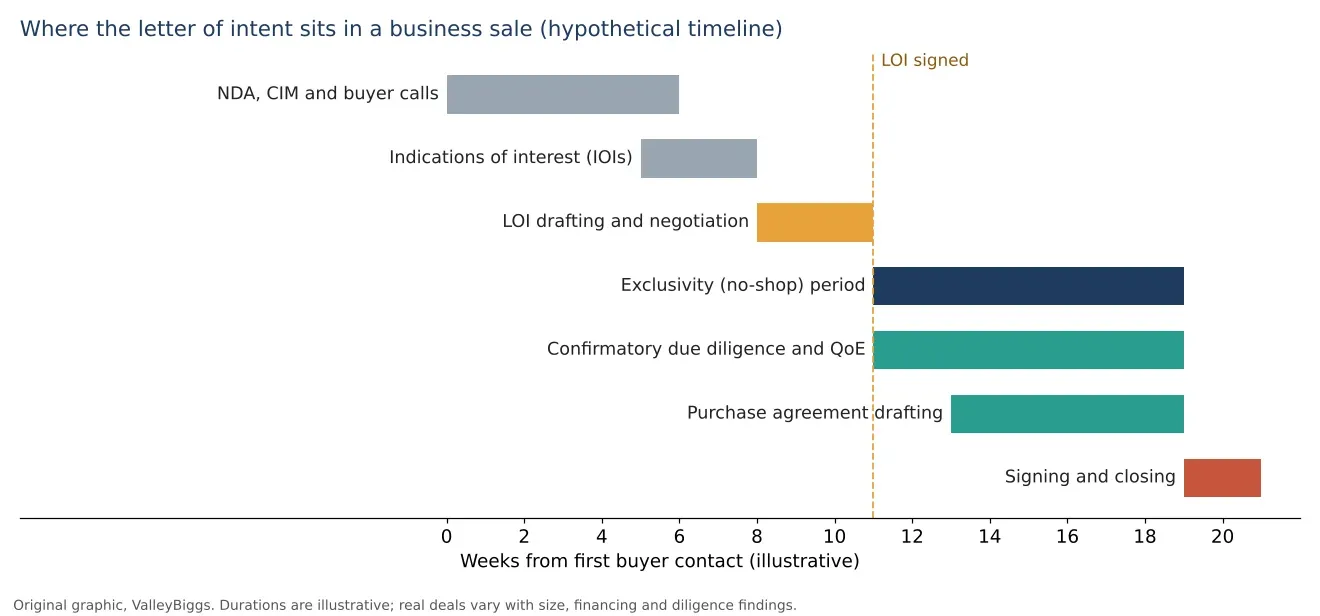
The sequence below is typical for a founder-led technology or services company sold through a managed process. Timing varies with size, financing and how clean the books are.
| Stage | Typical activity | Illustrative timing |
|---|---|---|
| Marketing | Teaser, NDA, CIM and first calls with buyers | 4 to 8 weeks |
| First-round offers | Indications of interest; seller shortlists buyers | 1 to 3 weeks |
| Management meetings | Shortlisted buyers meet the team and ask follow-up questions | 2 to 4 weeks |
| LOI negotiation | Buyers submit LOIs; seller negotiates terms and picks one | 1 to 3 weeks |
| Exclusivity and diligence | Financial, legal, tax, tech and commercial review; quality of earnings | 6 to 10 weeks |
| Purchase agreement and closing | Drafting, disclosure schedules, consents, signing and funding | Overlaps diligence; 2 to 6 weeks at the end |
Preparation shortens the post-LOI phase more than anything else. A seller who already has clean monthly financials, signed customer contracts and the items on a due diligence checklist for selling a business gives the buyer fewer reasons to ask for more time or a lower price.
Example: Comparing Two LOIs for the Same Company
Consider a hypothetical SaaS company with about $3.5 million of adjusted EBITDA and two offers on the table. On headline price alone, Offer A looks $1.5 million better. Read clause by clause, the gap almost disappears and the risk moves to the seller.
| Term (hypothetical) | Offer A | Offer B |
|---|---|---|
| Headline price | $14.0M | $12.5M |
| Cash at closing | $9.8M (70%) | $11.25M (90%) |
| Seller note | $1.4M over 3 years, subordinated to bank debt | None |
| Earnout | Up to $2.8M tied to ARR growth over 2 years | None |
| Rollover equity | None | $1.25M into the buyer’s holding company |
| Working capital peg | “A normal level, to be agreed” | Trailing 12-month average, with deferred revenue method stated |
| Exclusivity | 90 days plus automatic 30-day extension | 45 days, one extension by mutual consent |
| Value if the earnout pays half and the note is repaid | About $12.6M | About $12.5M, with $1.25M in illiquid equity |
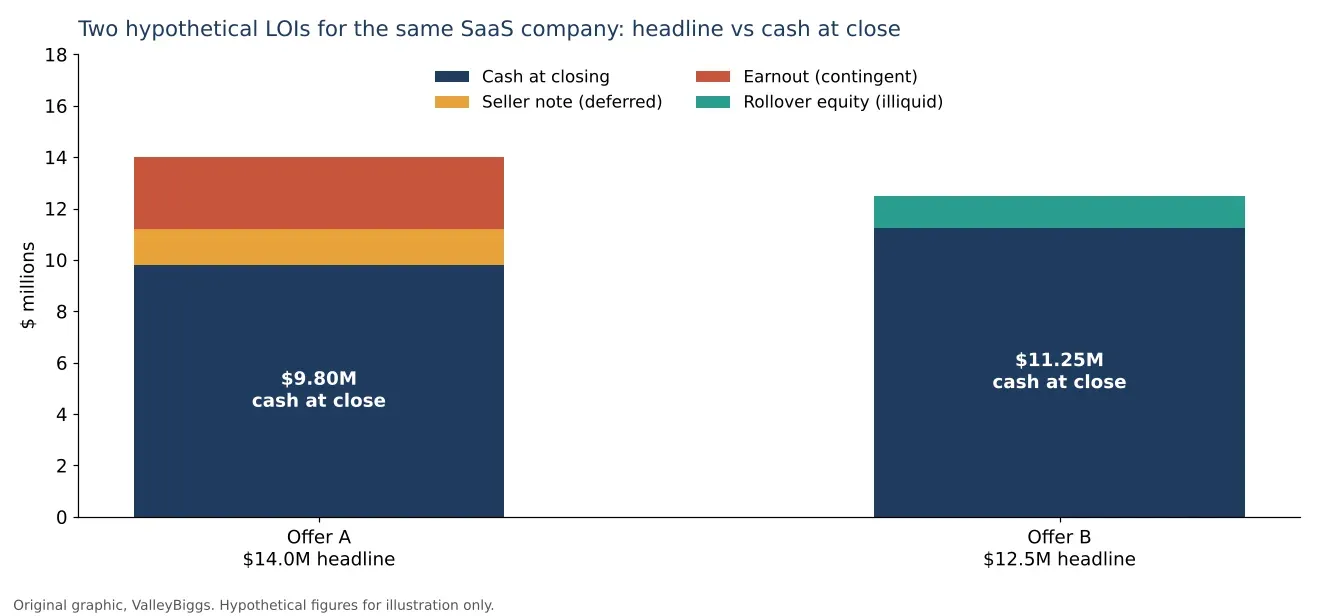
The lesson is not that Offer B always wins. A seller who believes strongly in next year’s ARR growth may prefer the earnout. The point is that the LOI is where these trade-offs are set, and a vague peg or a long no-shop in Offer A could still shave the number further during diligence. Details on how deferred payments work are in our guide to seller financing and seller notes.
LOI Terms That Matter Most for Tech, SaaS and Ecommerce Sellers
Digital businesses raise issues that generic LOI templates skip. If you run a software, marketplace or online retail company, check that the letter addresses these points before you grant exclusivity.
- Revenue definitions. If price is a multiple of ARR, define ARR: contracted recurring revenue only, how churned or paused accounts are treated, and the measurement date.
- Deferred revenue. Annual prepaid subscriptions create a liability the buyer must service. Agree whether it counts as debt, as working capital, or is excluded, because each choice moves cash at close.
- Key people. Buyers often want retention packages for engineers or product leads. Keep the LOI clear on who funds them, so retention does not come out of your price.
- IP and code. Confirm that founder and contractor IP assignments are in place; an LOI that makes closing conditional on “satisfactory IP review” without detail gives the buyer an easy exit.
- Customer and platform consents. Change-of-control clauses in enterprise contracts, and account transfers on marketplaces or app stores, can take weeks. Name them in the LOI timeline.
- Inventory and ad accounts for ecommerce. State how inventory is counted and valued at close and whether advertising and marketplace accounts transfer with the business.
Owners preparing a software exit can read more about buyer expectations on our sell your SaaS business page.
Seller vs Buyer View of the LOI
Both sides want an LOI, but for different reasons. Understanding the buyer’s goals makes it easier to trade concessions instead of simply resisting them.
| Issue | Seller’s priority | Buyer’s priority |
|---|---|---|
| Detail | Pin down price mechanics, peg and structure now | Keep terms flexible until diligence is done |
| Exclusivity | Short, with clear exit triggers | Long enough to finish diligence and financing |
| Consideration | Cash at close | Deferred and contingent payments that share risk |
| Conditions | Few, objective conditions to closing | Broad conditions, such as satisfactory diligence |
| Confidentiality | Protect employees, customers and data | Freedom to share data with lenders and co-investors |
Common LOI Mistakes Sellers Make
- Signing the first LOI received without testing it against other buyers.
- Accepting a headline price without the earnings definition and add-backs behind it.
- Leaving the working capital peg “to be agreed”, which invites a price cut at closing.
- Granting long or automatically renewing exclusivity with no milestones.
- Ignoring the binding clauses because the letter is described as non-binding.
- Telling staff or customers about the deal before confidentiality and timing are settled.
- Letting the owner’s post-closing role, non-compete and pay stay undefined.
Related Deal Terms
Several deal terms connect directly to the LOI: the CIM that comes before it, the quality of earnings review and purchase agreement that follow it, and structures such as a management buyout, which often uses the same LOI format with the owner’s own team as buyer. The step-by-step guide to selling a business shows where the LOI fits in the whole sale, from preparation to closing.
When to Talk to an Advisor Before Signing
Bring in your M&A advisor and deal counsel before you sign, not after. The best time is when the first LOIs arrive, because that is when you still have alternatives. An advisor can compare offers on cash at close rather than headline value, test the price against an independent enterprise valuation, and push for detail on the peg, earnout and exclusivity while buyers are still competing. ValleyBiggs’ sell-side assistance team works with your attorney and CPA through this stage. This article is general information, not legal or tax advice.
If an LOI is on your desk, or you expect one soon, request a confidential consultation and we will walk through the terms and what they mean for your proceeds before you commit to exclusivity.
FAQs
1. What does LOI stand for in business?
LOI stands for letter of intent. In mergers and acquisitions it is the document in which a buyer proposes the price, structure and key conditions for buying a company and asks for a period of exclusive negotiation. Similar documents are called term sheets, heads of terms or memorandums of understanding, depending on the industry and the parties.
2. Do I need a lawyer for a letter of intent?
Yes, in most business sales. Even a non-binding LOI contains binding clauses, such as exclusivity and confidentiality, and its wording frames the purchase agreement that follows. A deal attorney can label each clause correctly and spot terms that shift risk to you, while your M&A advisor focuses on price, structure and competing offers.
3. Can a buyer back out after signing an LOI?
Usually yes. Because price and closing are normally non-binding, a buyer can walk away or propose new terms after due diligence, which is often called a re-trade. What the buyer cannot do is ignore the binding clauses. Clean financials, precise LOI wording and a short exclusivity window make walking away or cutting the price harder.
4. How long does it take to close after an LOI is signed?
For a private lower middle market company, closing often comes roughly two to four months after the LOI, though complex deals take longer. The pace depends on how quickly diligence requests are answered, whether the buyer needs bank financing, third-party consents and, for larger deals, antitrust review. A clear diligence calendar in the LOI helps keep the timeline on track.
5. Who writes the letter of intent, the buyer or the seller?
The buyer usually drafts and sends the LOI, because it states what the buyer is offering. In a managed sale process the seller’s advisor may supply a template or a list of points every bidder must address, which makes offers easier to compare. Either way, the seller and its counsel mark up the draft before anything is signed.
6. Should I tell my employees after signing an LOI?
Generally not right away. Most sellers share the news with a small group of key managers who are needed for diligence, under confidentiality, and wait for a signed purchase agreement or closing before a wider announcement. Timing and messaging are often discussed with the buyer, since retention of key staff can be a condition of the deal.
7. What does a sample letter of intent to buy a business include?
A sample LOI typically covers the parties, purchase price and how it is paid, the treatment of cash, debt and working capital, financing, due diligence scope and timing, key closing conditions, the owner’s role after closing, exclusivity, confidentiality, expenses and governing law. It ends with a statement of which paragraphs are binding and a signature block for both sides.