

Net working capital is the cash a business has tied up in daily operations: receivables, inventory and prepaid costs, minus payables and accrued bills. When you sell a company, the buyer turns that number into a price term. Both sides agree on a target level, called the peg, and the purchase price moves up or down, dollar for dollar, with the working capital you actually deliver at closing.
For many owners this is where real money changes hands after the headline price is agreed. This guide explains how the peg is set, which balance sheet lines count, how the post-closing true-up works and what to negotiate, with a hypothetical $30 million example that runs from the offer to the final check.
Key Takeaways
- In an M&A deal, net working capital usually excludes cash and debt and covers only operating items such as receivables, inventory, payables and accruals.
- The working capital peg is the normal level the business needs to run. Deliver more at closing and the price goes up; deliver less and it goes down.
- Sellers benefit from a lower, well-supported peg; buyers push for a higher one. Seasonality, growth and accounting choices drive most of the gap.
- The final number is usually settled 60 to 120 days after closing through a closing statement, a review period and, if needed, an independent accountant.
- A precise definition, a sample calculation attached to the purchase agreement and clean monthly accrual books prevent most disputes.
What Is Net Working Capital?
Net working capital (NWC) is current assets minus current liabilities. It shows how much short-term money a company needs to fund its operating cycle, from buying inventory or paying staff to collecting cash from customers. Positive NWC means operations are funded with the company’s own short-term assets.
The textbook net working capital formula takes every current asset and liability on the balance sheet. Deal teams use a narrower version, because in a cash-free, debt-free sale the seller keeps the cash and pays off the debt separately. What is left is operating working capital, the part a buyer needs on day one to keep the business running.
| Version | Formula | Where it is used |
|---|---|---|
| Accounting NWC | Total current assets − total current liabilities | Lenders, liquidity ratios, financial statements |
| Operating NWC (M&A) | (Current assets − cash) − (current liabilities − debt and debt-like items) | Purchase agreements, pegs, quality of earnings work |
| Trade working capital | Accounts receivable + inventory − accounts payable | Quick buyer screens and cash conversion analysis |
If you are wondering how to calculate net working capital for a sale, start with the operating version: pull your month-end balance sheets, remove cash and interest-bearing debt, then remove anything that is not part of normal trading, such as income taxes payable, loans to owners or deal-related bonuses. The table below shows how buyers usually sort the lines.
| Usually included | Usually excluded | Often negotiated |
|---|---|---|
| Accounts receivable, net of a bad-debt reserve | Cash and cash equivalents | Deferred revenue and customer deposits |
| Inventory, net of obsolete stock | Bank debt, lines of credit, accrued interest | Accrued bonuses and commissions |
| Prepaid expenses that benefit the business | Income taxes payable or receivable | Aged payables past normal terms |
| Accounts payable within normal terms | Related-party balances not on arm’s-length terms | Accrued vacation and payroll taxes |
| Accrued wages, rent and utilities | Transaction fees and change-of-control payments | Inventory in transit and consignment stock |
Why Net Working Capital Matters When You Sell a Business
Buyers value a company on its earnings, usually as a multiple of EBITDA. That price assumes the business comes with a normal amount of receivables, inventory and payables. If you collected every invoice early, ran inventory down and held back supplier payments in the final month, the buyer would inherit a company that needs a cash injection right away, while you would walk off with extra cash. The working capital mechanism stops that.
It also protects you. Working capital rises and falls with the calendar, so a closing date that happens to land after a big shipment or before a payroll run should not change what the company is worth. Most buyers raise the topic early, and the letter of intent often states that the price assumes a normal level of working capital, with the exact peg set during diligence.
- Dollar-for-dollar impact: every $1 of shortfall against the peg usually reduces your proceeds by $1.
- Late discovery: the peg is often fixed weeks after the price, when sellers have less leverage.
- Post-closing exposure: part of the price is commonly held back until the final statement is agreed.
- Dispute risk: working capital disagreements are among the most frequent post-closing claims in private deals.
What Is a Working Capital Peg?
A working capital peg, also called the target, is the agreed amount of net working capital the buyer expects to receive at closing. It is meant to represent the normal level the business needs, not a high or low point. At closing, the actual figure is compared with the peg and the difference is added to or subtracted from the price.
The incentives run in opposite directions. A seller is better off with a lower net working capital peg, because any amount delivered above it is paid back as extra price. A buyer prefers a higher peg, because any shortfall reduces what it pays. A fair peg sits where the business can operate normally on day one without either side gaining from the timing of the closing.
How the peg is calculated
- Pull monthly balance sheets for at least the trailing 12 months, ideally 24, on an accrual basis.
- Apply the deal definition to every month: strip out cash, debt, taxes and other excluded items.
- Normalize the months. Book year-end entries evenly, add reserves the books never carried and remove one-time items. The result is normalized working capital.
- Choose the averaging period. A trailing 12-month average is the default, but a shorter or forward-looking period may fit a fast-growing or changing business better.
- Test it against the closing month. Compare the proposed peg with the level expected at the likely closing date to see whether seasonality alone would create an adjustment.
| Peg method | How it works | Best fit | Watch out for |
|---|---|---|---|
| Trailing 12-month average | Average of 12 normalized month-ends | Stable, mildly seasonal businesses | Strong growth makes the average look low to the buyer |
| Trailing 3- or 6-month average | Average of recent months only | Businesses whose model or terms changed recently | Can lock in a seasonal high |
| Month-matched (seasonal) peg | Target set for the expected closing month | Retail, ecommerce, seasonal services | Closing date slips into a different season |
| Forward-looking peg | Based on forecast balances at closing | Fast-growing companies | Depends on a forecast the buyer must accept |
| Collar or range | No adjustment while NWC stays inside a band | Any deal where small swings are expected | How the band is applied once exceeded |
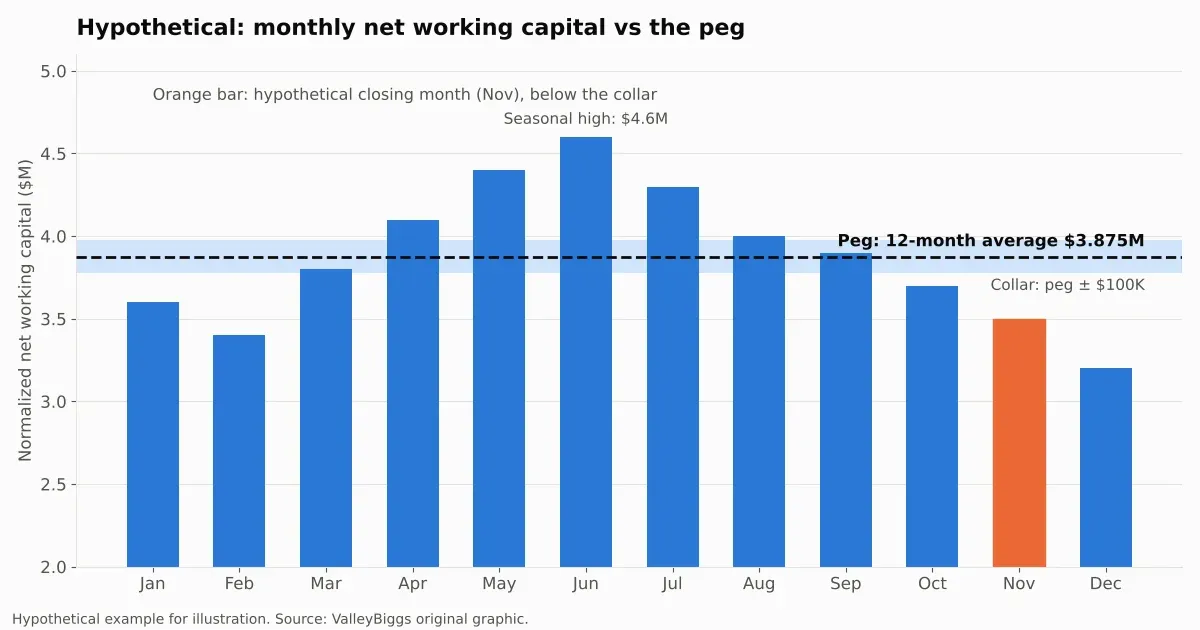
The chart shows why the averaging method matters. In this hypothetical company, working capital peaks in early summer and falls in the winter. A 12-month average is fair across the year, but a closing in November would show a shortfall that comes from the calendar, not from anything the seller did. A month-matched peg or a collar would remove most of that noise.
How a Working Capital Adjustment Works at and After Closing
A working capital adjustment usually happens in two steps. The buyer pays a price based on an estimate at closing, then both sides settle the actual figure a few months later. That second step is often called the working capital true up.
| Stage | What happens | Typical timing (varies by deal) |
|---|---|---|
| LOI | Price is stated cash-free, debt-free with a normal level of working capital | Before diligence |
| Diligence | Buyer’s accountants propose the definition and the peg | 4 to 10 weeks |
| Purchase agreement | Definition, accounting principles, sample calculation and dispute process are written in | Final weeks before signing |
| Estimated closing statement | Seller estimates closing NWC; price at closing is adjusted for it | A few days before closing |
| Final closing statement | Buyer prepares the actual closing balance sheet | Often 60 to 120 days after closing |
| Review period | Seller reviews and objects to specific items | Often 30 to 60 days |
| Resolution | Negotiation, then an independent accountant if needed; money moves from escrow or between parties | Weeks to months |
Two contract features shape how much the adjustment can swing:
- Collar or threshold. Small differences are ignored. Under a deductible-style collar only the amount outside the band is paid. Under a tipping collar the full difference is paid once the band is crossed.
- Adjustment escrow. The buyer holds back a slice of the price to cover a possible shortfall. Agree on whether a shortfall comes out of this escrow first, and whether it can reach the general indemnity escrow.
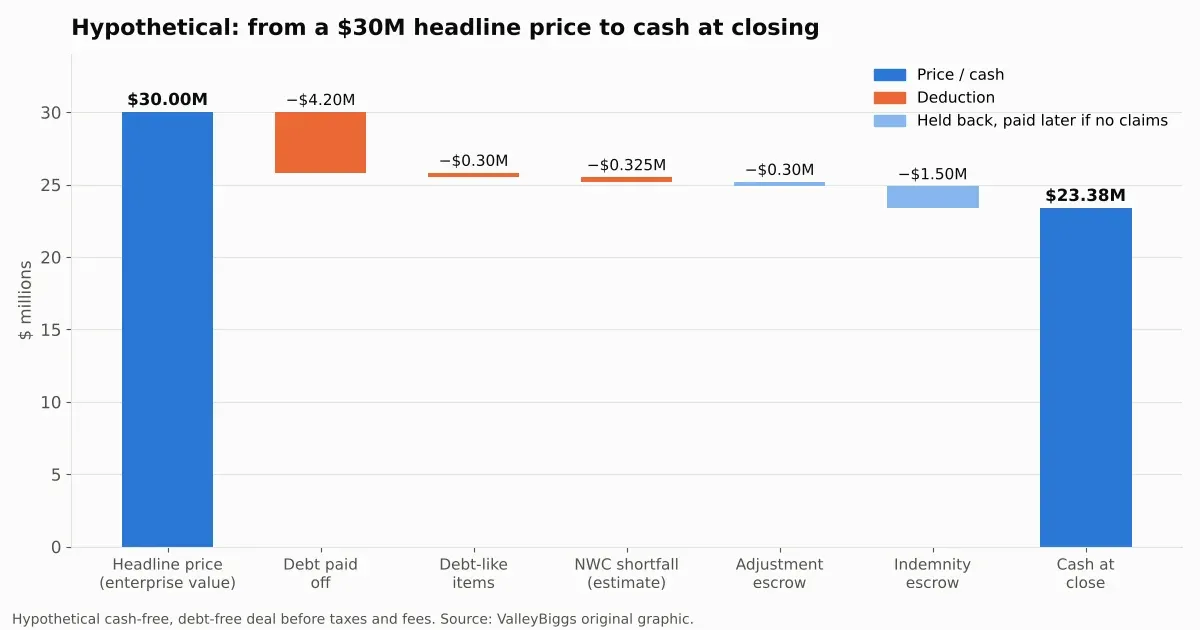
Net Working Capital Example: A Hypothetical $30 Million Sale
Here is how the pieces fit together in a hypothetical cash-free, debt-free sale of a distribution business at a $30 million enterprise value. The peg is the trailing 12-month average from the chart above, $3.875 million, with a $100,000 tipping collar. The deal closes in mid-November.
| Line | Amount | Notes |
|---|---|---|
| Enterprise value (headline price) | $30,000,000 | Agreed in the LOI |
| Less bank debt repaid at closing | ($4,200,000) | Paid directly to the lender |
| Less debt-like items | ($300,000) | Accrued sale bonuses and an old aged payable |
| Estimated closing NWC vs peg | ($325,000) | $3,550,000 estimate vs $3,875,000 peg, outside the collar |
| Less adjustment escrow | ($300,000) | Held for the true-up |
| Less indemnity escrow | ($1,500,000) | Held for claims under the purchase agreement |
| Cash to seller at closing | $23,375,000 | Before taxes and transaction fees |
Ninety days later the buyer delivers its final closing statement showing working capital of $3,620,000. The final shortfall is $255,000, not the $325,000 estimated, so the buyer owes the seller $70,000 and the $300,000 adjustment escrow is released. If the buyer had instead booked a new inventory reserve that the seller’s books never carried, the final figure could have dropped well below the estimate, which is exactly the kind of change a consistency clause and a sample calculation are written to prevent.
Seller vs Buyer: Where the Negotiation Happens
| Issue | What sellers usually want | What buyers usually want |
|---|---|---|
| Peg level | Lower peg, based on an average that reflects seasonality | Higher peg, often based on recent or peak months |
| Accounting principles | Same methods used in the historical statements | GAAP, or the buyer’s own policies |
| Reserves | No new reserves that were never booked | Full bad-debt and obsolete inventory reserves |
| Deferred revenue | Excluded, or inside NWC rather than treated as debt | Treated as debt or a debt-like item |
| Collar | A band wide enough to absorb normal swings | Narrow or no collar |
| Recourse | Shortfall paid only from the adjustment escrow | Access to indemnity escrow or direct payment |
The accounting clause matters as much as the number. Many agreements say closing working capital must be prepared on the same basis as the peg, using the same policies and estimates. In Chicago Bridge & Iron v. Westinghouse (2017), the Delaware Supreme Court read a purchase price true-up as a narrow tool for measuring changes since signing, not a way to reopen the accounting behind the financial statements the buyer had already accepted. Clear consistency language gives you that protection on paper.
How Working Capital Differs in SaaS, Ecommerce and Service Businesses
The concept is the same in every industry, but the lines that drive the fight change with the business model.
- SaaS and subscription companies often bill annually in advance, so deferred revenue can make working capital negative. Buyers may argue deferred revenue is debt-like because they must deliver the service without the cash. Sellers counter that the cost to serve is far below the billed amount. Agree on the treatment early, especially if you plan to sell a SaaS business with heavy annual prepayments.
- Ecommerce and Amazon sellers carry inventory that swings with peak season, product launches and supplier lead times. Agree on how inventory in transit, marketplace balances held by the platform and slow-moving stock are counted, and plan a physical count close to closing.
- Agencies, IT services and contractors have work in progress, unbilled revenue and customer deposits. Each needs a clear rule, because a few large projects can move the balance by hundreds of thousands of dollars in a single month.
Tax and Legal Points Sellers Should Know
The working capital adjustment changes the final purchase price, which affects your tax reporting. In an asset sale, buyer and seller report the allocation of the price on IRS Form 8594. According to the IRS instructions, when the consideration increases or decreases after the purchase date, both parties reallocate the change among the asset classes, and a supplemental Form 8594 is filed for each year in which an increase or decrease occurs. In a stock sale, the adjustment changes the amount realized on the shares. In both cases, ask your tax advisor how escrows and post-closing payments will be reported and in which year.
On the legal side, the purchase agreement should name the independent accountant who will decide disputes, limit that accountant to the items in dispute and to the range between the two parties’ positions, and say who pays the fees. This section is general information, not legal or tax advice.
Common Mistakes Sellers Make With Net Working Capital
- Accepting the buyer’s peg without rebuilding it month by month from your own balance sheets.
- Keeping cash-basis books, so the buyer’s accrual adjustments surprise you late in the process.
- Ignoring seasonality and agreeing to a trailing average that does not match the expected closing month.
- Leaving the definition vague, with no list of included accounts and no sample calculation attached to the agreement.
- Letting deferred revenue or accrued bonuses be counted twice, once as debt and again inside working capital.
- Running the business differently in the final months, such as delaying supplier payments, which buyers spot and price in.
How to Prepare Your Working Capital Before a Sale
Most of the protection is built in the 6 to 12 months before you go to market. A short checklist:
- Close the books monthly on an accrual basis, with consistent cut-off for revenue, payables and payroll.
- Book realistic bad-debt and inventory reserves now, so the history already reflects them.
- Track days sales outstanding, days inventory outstanding and days payables outstanding by month, and explain any big moves.
- Clean up related-party balances, old payables and aged receivables you do not expect to collect.
- Prepare your own normalized monthly working capital schedule and peg proposal before buyers start diligence.
- Model the price-to-cash bridge for several closing months so you know what a slipping timeline would cost.
A sell-side enterprise valuation analysis can include a working capital review, and our due diligence checklist for selling a business lists the balance sheet records buyers ask for. For the wider sequence of steps, see how to sell a business.
Related Deal Terms
- Cash-free, debt-free: the seller keeps excess cash and repays debt, and the buyer receives a normal level of working capital.
- Debt-like items: obligations treated like debt and deducted from the price, such as deferred compensation, unpaid taxes or deal bonuses.
- Quality of earnings: an accounting review of adjusted EBITDA that usually includes the working capital analysis.
- Leveraged buyout: in a leveraged buyout, lenders also test working capital, because the business must fund its own debt service from day one.
- Escrow and holdback: part of the price held back to cover adjustments and indemnity claims.
When to Talk to an Advisor About Working Capital
Bring in help before you sign a letter of intent if your business is seasonal, growing fast, bills customers in advance or carries significant inventory. Those are the cases where the peg method alone can move proceeds by a meaningful share of the price. An advisor running sell-side assistance can rebuild the peg from your records, argue the definition, model closing scenarios and review the buyer’s closing statement line by line. For larger transactions with private equity or strategic buyers, M&A investment banking support adds a competitive process, which tends to give sellers more room on terms like the peg and the collar.
Conclusion
Net working capital rarely makes headlines in a deal, but it decides how much of the agreed price you keep. Set the definition early, support your peg with clean monthly numbers, protect yourself with consistency language and a collar, and check the closing statement as carefully as you checked the offer. If you are planning a sale and want to know what your working capital target should be, schedule a confidential consultation with ValleyBiggs.
FAQs
1. Does a seller want a higher or lower working capital peg?
A seller generally wants a lower peg. The peg is the bar the business has to clear at closing, so a lower target makes a shortfall less likely and turns any extra working capital into added price. The peg still has to be defensible, because buyers rebuild it from your monthly balance sheets during diligence.
2. Is cash included in net working capital in M&A?
Usually not. Most private company sales are priced cash-free and debt-free, so the seller keeps excess cash and repays interest-bearing debt at closing. Working capital then covers only operating items such as receivables, inventory, payables and accruals. Some deals leave a minimum cash balance in the company, which should be written into the agreement.
3. What happens if working capital is below the peg at closing?
The price is reduced by the shortfall, usually dollar for dollar once any collar is exceeded. An estimate is deducted at closing and the final amount is settled after the buyer’s closing statement, often from an adjustment escrow. If the true-up comes in better than the estimate, the buyer pays the difference back to the seller.
4. How long does the working capital true-up take after closing?
Many agreements give the buyer roughly 60 to 120 days to deliver a final closing statement, then give the seller about 30 to 60 days to review it and object. Undisputed items are paid promptly, while disputed ones go to negotiation and, if needed, an independent accountant. Plan for the escrow to stay in place for several months.
5. Can net working capital be negative?
Yes. Companies that collect cash before they deliver, such as subscription software firms or businesses that take customer deposits, often run negative working capital. That is not a weakness in itself. In a sale it means the peg may be a negative number, and the treatment of deferred revenue becomes one of the main negotiation points.
6. Is deferred revenue part of working capital in a SaaS sale?
It depends on the deal. Some buyers keep deferred revenue inside working capital, others treat part of it as debt-like and deduct it from the price. Sellers often argue only the cost to deliver the service should count. Settle the treatment before the letter of intent if you plan to sell a SaaS company with large annual prepayments.