

Most privately held US companies with at least $1 million of EBITDA sell for roughly 4x to 8x EBITDA, and larger, recurring-revenue or fast-growing businesses can clear 10x. An EBITDA multiple is enterprise value divided by EBITDA, so the number a buyer offers you depends on two things: the earnings figure it accepts and the multiple it is willing to pay on it.
This guide explains how the EBITDA multiple works in a private sale, what recent deal surveys show by company size and sector, why a public-company multiple is the wrong yardstick for your business, and which changes actually move your multiple before you go to market. A hypothetical worked example shows how the two levers combine.
Key Takeaways
- Enterprise value = adjusted EBITDA x EBITDA multiple. Buyers argue about both numbers, so owners should prepare both.
- Size is the strongest single predictor: median multiples in an IBBA survey ran from about 4.0x for $2M to $5M deals to 5.8x for $5M to $50M deals, and private equity paid an average of 6.1x to 10.7x across $10M to $500M deals, per GF Data.
- Public-company averages near 17x EBITDA are not a benchmark for a private company; liquidity, scale and risk explain most of the gap.
- Recurring revenue, low customer concentration, a management team that runs without the owner and a competitive sale process push a multiple toward the top of its band.
- The headline multiple is not what you bank. Debt, working capital, earnouts and seller notes decide how much of the price arrives as cash at closing.
What Is an EBITDA Multiple?
An EBITDA multiple tells you how many years of current operating earnings a buyer is paying for. It is calculated as enterprise value divided by EBITDA (earnings before interest, taxes, depreciation and amortization). Analysts often write it as EV/EBITDA, and the EV/EBITDA multiple and the EBITDA multiple are the same ratio.
In a sale, owners usually run the formula in reverse:
- EBITDA multiple = enterprise value / EBITDA
- Enterprise value = EBITDA x EBITDA multiple
- Equity value (roughly what the owner receives before taxes and fees) = enterprise value, minus debt and debt-like items, plus excess cash, plus or minus the working capital adjustment
Buyers like the ratio because it ignores how a company is financed and taxed, so a debt-free business and a heavily leveraged one can be compared on the same footing. That is also its weakness: EBITDA adds back depreciation, so it can flatter a business that has to keep spending on equipment, servers or inventory just to stand still.
Which EBITDA Do Buyers Multiply?
The multiple only means something once both sides agree on the earnings base. In most lower middle market deals that base is trailing twelve-month (TTM) adjusted EBITDA: reported EBITDA plus documented add-backs for one-time costs, above-market owner pay and expenses a new owner will not carry. How those add-backs are built and defended is covered in our guide to what buyers accept as adjusted EBITDA.
| Earnings base | What it means | When buyers use it |
|---|---|---|
| TTM adjusted EBITDA | Last 12 months, normalized for one-time and owner items | The default for most profitable private companies |
| Run-rate EBITDA | Recent quarter annualized, or TTM plus contracted changes | Fast-growing companies; buyers usually discount it |
| Forward (next-year) EBITDA | Budgeted or projected earnings | Rarely used to set price in private deals; may appear in earnout targets |
| Seller's discretionary earnings (SDE) | EBITDA plus one owner's full compensation | Owner-operated businesses, usually below about $1M of earnings |
A useful rule: the more speculative the earnings figure, the lower the multiple a buyer will apply to it. A seller who asks for a forward-looking multiple on projected EBITDA usually ends up with an earnout instead of cash.
How Many Times EBITDA Is a Business Worth?
There is no single answer, but survey data gives clear ranges by size. The figures below come from two different groups of buyers: the IBBA and M&A Source Market Pulse survey reflects deals closed by business brokers and M&A advisors, while GF Data tracks private equity-sponsored acquisitions.
| Deal size | Typical EBITDA multiple | Source and period |
|---|---|---|
| $2M to $5M deal value | About 4.0x (median) | IBBA & M&A Source Market Pulse, Q2 2026 |
| $5M to $50M deal value | About 5.8x (median) | IBBA & M&A Source Market Pulse, Q2 2026 |
| $10M to $25M enterprise value | 6.1x (average, PE buyers) | GF Data, year to date through Q2 2026 |
| $25M to $50M enterprise value | 7.3x (average, PE buyers) | GF Data, year to date through Q2 2026 |
| $50M to $100M enterprise value | 7.7x (average, PE buyers) | GF Data, year to date through Q2 2026 |
| $100M to $250M enterprise value | 8.3x (average, PE buyers) | GF Data, year to date through Q2 2026 |
| $250M to $500M enterprise value | 10.7x (average, PE buyers) | GF Data, year to date through Q2 2026 |
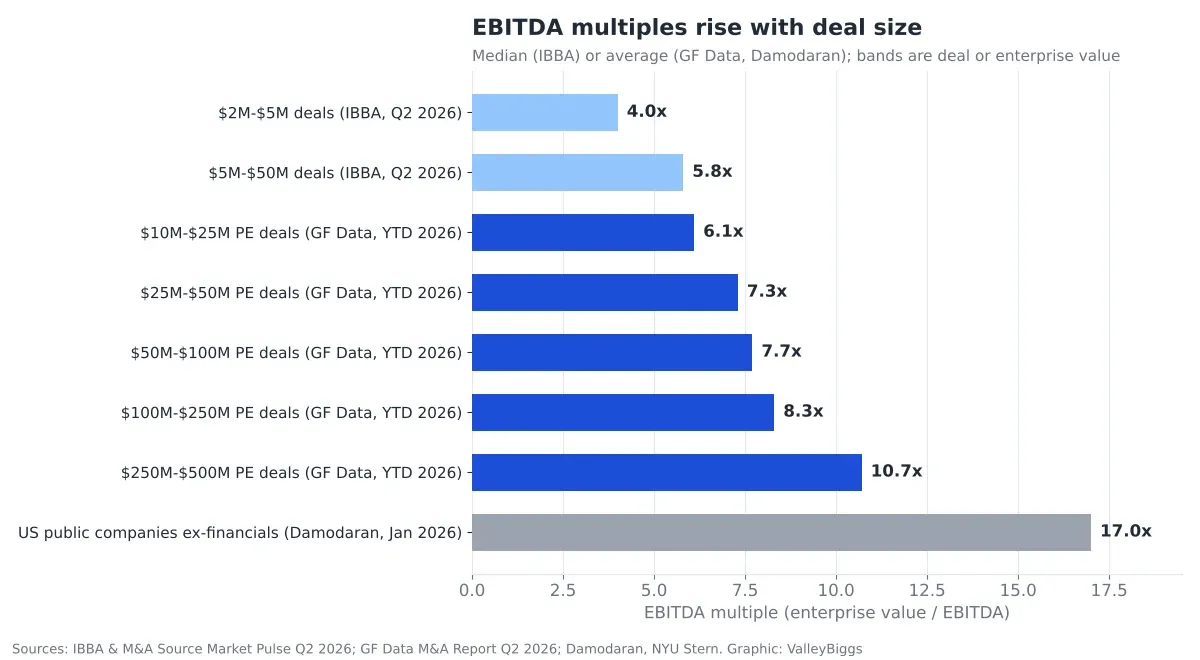
Three points help read these numbers correctly. First, the bands are deal or enterprise value, not revenue, so a $20 million revenue company with $2 million of EBITDA belongs in the $10M to $25M band, not a higher one. Second, these are central figures; individual deals in every band close well above and below them. Third, multiples move with credit markets. ACG reported that the GF Data average slipped to 7.0x TTM adjusted EBITDA in the second quarter, from 7.3x in the first, as buyers became more selective.
If you want to see how the ranges translate into dollars at specific sizes, our worked guides on valuing a $10 million company and what a $20 million company is worth apply them to example earnings.
EBITDA Multiples by Industry: Useful, With Limits
Sector matters, but less than most published tables suggest. Many lists of EBITDA multiples by industry are built from public-company data, which sits far above what private companies of the same type sell for. Damodaran's January data set for US companies with positive EBITDA shows how high those public figures run:
| Sector (US public companies) | EV/EBITDA, positive-EBITDA firms | What it suggests for private sellers |
|---|---|---|
| Software (system and application) | About 24.5x | Recurring software earns a premium, but private deals price on size, growth and retention |
| Business and consumer services | About 14.3x | Contracted, repeat services trade above project work |
| Computer services | About 14.1x | IT services multiples depend heavily on managed, recurring contracts |
| Advertising | About 12.0x | Agencies with client concentration sell at a steep discount to this |
| Information services | About 11.5x | Data and subscription assets are prized; project research is not |
| Healthcare support services | About 11.2x | Reimbursement and regulatory risk weigh on smaller operators |
| Trucking | About 10.4x | Capital intensity makes EBITDA look better than free cash flow |
| All US companies excluding financials | About 17.0x | A ceiling for comparison, not a target for a private sale |
The ranking across sectors is more useful than the levels. Buyers of privately held companies tend to pay more for the same profile the public market rewards: recurring revenue, high gross margin, low capital needs and visible growth. Within a single industry, the spread between a well-run company and an average one is often wider than the spread between industries.
Tech companies need one extra caution. Many SaaS businesses that are growing quickly or reinvesting their profits are valued on annual recurring revenue rather than EBITDA, with metrics such as net revenue retention doing much of the work. If that describes your company, start with our page on selling a SaaS business before leaning on an EBITDA table.
Why Private Companies Sell for Lower Multiples Than Public Ones
Owners who read that public companies trade near 17x EBITDA often wonder why their buyer offers a third of that. The gap is not a lowball tactic; it reflects real differences in risk:
- Liquidity. A public shareholder can sell tomorrow. A buyer of a private company is locked in for years.
- Scale. Smaller companies have fewer customers, fewer products and thinner management, so one bad year hurts more.
- Key-person risk. When relationships, pricing decisions or technical knowledge sit with the owner, the buyer prices in the cost of replacing that person.
- Information quality. Audited, quarterly-reported numbers carry more weight than reviewed or tax-basis financials.
- Financing cost. Many buyers fund part of the price with debt. Lenders cap leverage, and that cap limits what a financial buyer can pay, a dynamic explained in our guide to the leveraged buyout. GF Data put average total debt at about 3.8x EBITDA in its 2026 year-to-date figures.
What Is a Good EBITDA Multiple?
A good EBITDA multiple is one in the upper part of the range for your size band, earned on adjusted EBITDA the buyer has verified. For a company with about $2 million of EBITDA, 6x may be a strong result. For a $25 million EBITDA platform, 6x would usually be disappointing.
Judge an offer against three reference points rather than a single number:
- The survey range for your deal size, adjusted for your growth and revenue quality.
- What the buyer's financing can support, since that sets a practical ceiling for financial buyers.
- Competing offers. The best evidence of a good multiple is a price that several qualified buyers bid toward independently.
What Moves an EBITDA Multiple Up or Down
Buyers start from a size-based range and then adjust for risk and growth. The factors below come up in almost every lower middle market negotiation.
| Factor | Pushes the multiple up | Pushes the multiple down |
|---|---|---|
| Revenue quality | Subscriptions, contracts, high renewal rates | One-off projects, unpredictable orders |
| Customer concentration | No customer above roughly 10% of revenue | One or two customers carrying the business |
| Growth | Consistent growth with a believable plan | Flat or declining sales, hockey-stick projections |
| Owner dependence | A second layer of management runs daily operations | The owner holds key relationships and decisions |
| Financial reporting | Reviewed or audited statements, monthly closes, clean add-backs | Tax-basis books, commingled personal expenses |
| Capital needs | Low capex, modest working capital | Heavy equipment or inventory reinvestment |
| Sale process | Several qualified buyers bidding on a timeline | A single buyer negotiating exclusively from the start |
Performance shows up in the data too. GF Data reported that buyouts of above-average financial performers averaged 7.1x in its 2026 year-to-date figures, against 6.8x for other buyouts, a premium of about 0.3x. On a company with $5 million of EBITDA, that small-looking gap is worth $1.5 million of enterprise value.
Hypothetical Worked Example: Two Levers on One Company
Consider a hypothetical B2B services company with $14 million in revenue and $2.5 million of adjusted EBITDA. Its owner plans a sale in about 18 months. The figures below are illustrative, not a forecast or a quote.
| Scenario | Adjusted EBITDA | EBITDA multiple | Enterprise value |
|---|---|---|---|
| Today: owner-led, top client is 28% of revenue, books on a tax basis | $2.5M | 5.0x | $12.5M |
| Lever 1: add-backs documented, pricing reset, a quality of earnings review done | $3.0M | 5.0x | $15.0M |
| Lever 2: general manager in place, top client below 15%, several buyers bidding | $3.0M | 6.0x | $18.0M |
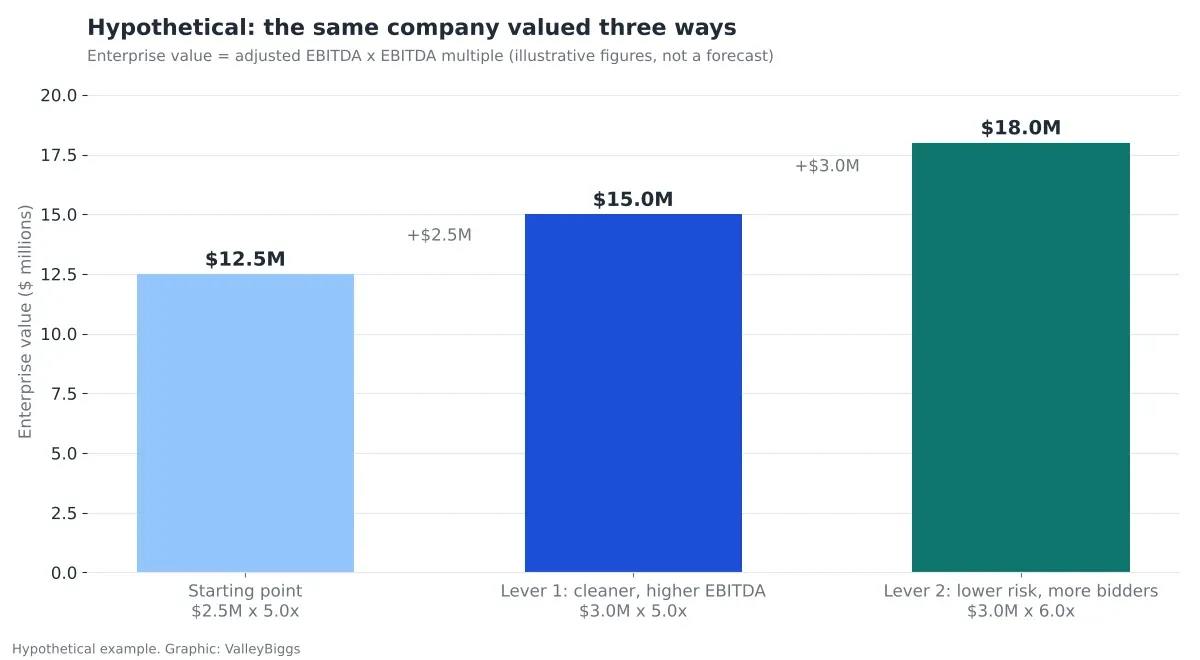
The second lever added more value than the first, even though EBITDA did not change, because a full turn of multiple applies to every dollar of earnings. Now take the $18.0 million headline to the owner's pocket. If the company carries $1.5 million of debt and the buyer requires a normal level of working capital, equity value before taxes and fees falls to about $16.5 million. The structure of that payment then matters as much as the price.
How Deal Structure Changes the Multiple You Actually Receive
Two offers at 6.0x can be worth very different amounts. In the Q2 2026 Market Pulse survey, deals of $5 million to $50 million were paid about 83% in cash at closing, with roughly 6% seller financing, 7% earnouts and 4% retained equity. Those deferred and contingent pieces carry risk, and a seller should value them below face. Our guide to seller notes and seller financing explains how the deferred part of a price is usually documented.
- Earnouts raise the headline multiple but pay only if future targets are met, often on accounting the buyer controls.
- Seller notes are a loan to the buyer, usually subordinated to the bank.
- Rollover equity can produce a second payday at the buyer's exit, or nothing if the plan fails.
- Working capital pegs can quietly move value between the parties at closing.
EBITDA Multiple vs Revenue Multiple vs SDE Multiple
EBITDA multiple valuation is not the only method a buyer will use. Which one dominates depends on the business:
| Method | Best fit | Main weakness |
|---|---|---|
| EBITDA multiple | Profitable companies with roughly $1M or more of EBITDA | Ignores capex and working capital needs |
| SDE multiple | Owner-operated businesses where one owner's pay is part of earnings | Hard to compare once a management team is in place |
| Revenue multiple | High-growth software or companies reinvesting all profit | Says nothing about whether the business can make money |
| Discounted cash flow | Companies with predictable, long-term cash flows | Highly sensitive to assumptions; buyers rarely price on it alone |
For a broader view of how these methods fit together, see our overview of how much a business is worth.
Common Mistakes Owners Make With EBITDA Multiples
- Quoting a public-company or headline-deal multiple as the expected price for a private company.
- Applying a multiple to projected earnings, then treating the result as a cash number.
- Stacking aggressive add-backs and assuming the buyer will pay the full multiple on all of them.
- Forgetting that debt, transaction costs and taxes come out of enterprise value before the owner is paid.
- Comparing offers by multiple alone instead of by cash at closing and risk-adjusted total value.
- Running a one-buyer process, which removes the competition that supports a higher multiple.
How to Raise Your EBITDA Multiple Before a Sale
Most of the work that changes a multiple takes 12 to 24 months, which is why preparation starts well before a listing:
- Move to monthly closes and, where the size justifies it, reviewed or audited financial statements.
- Commission a sell-side quality of earnings review so add-backs are tested before a buyer tests them.
- Reduce dependence on the largest customers and get key contracts in writing, with assignment terms that survive a sale.
- Hire or promote a second layer of management and document how the business runs.
- Shift revenue toward recurring or contracted work where the market allows it.
- Plan a process that reaches several qualified buyer types at once, strategic and financial.
When to Talk to an M&A Advisor
Talk to an advisor before you share numbers with any buyer, and ideally a year or more before you intend to sell. An advisor can benchmark your multiple against comparable transactions, prepare defensible adjusted EBITDA, and run the competitive process that supports a stronger price. ValleyBiggs provides an enterprise valuation analysis for owners who want a grounded range, and its sell-side advisory team manages the sale itself.
Conclusion
An EBITDA multiple is a shorthand for risk and growth: the safer and more scalable your earnings look to a buyer, the more years of them it will pay for today. Start with the size-based ranges, prepare earnings a buyer will accept, and work on the factors that move the multiple long before you need the money. When you are ready to see where your company sits, request a confidential consultation with ValleyBiggs.
FAQs
1. How do you calculate an EBITDA multiple?
Divide enterprise value by EBITDA. If a company with $3 million of adjusted EBITDA sells for an enterprise value of $18 million, the multiple is 6.0x. In a sale, owners usually work backward instead: estimate the multiple a buyer will pay for a company like theirs, then multiply it by the adjusted EBITDA the buyer is likely to accept.
2. How many times EBITDA should a business sell for?
Most private companies with $1 million to $10 million of EBITDA sell somewhere between about 4x and 8x, with size doing most of the work. Larger private equity deals average higher, and exceptional companies beat their band. The right figure for your business depends on growth, revenue quality, concentration and how many buyers compete. An enterprise valuation analysis narrows it down.
3. What does a 10x EBITDA multiple mean?
It means a buyer is paying ten years of current EBITDA for the business. A company with $5 million of EBITDA valued at 10x has an enterprise value of $50 million. Private companies usually reach 10x only with significant scale, strong growth, recurring revenue or a strategic buyer who expects meaningful savings or cross-selling after the deal.
4. Is 3x EBITDA a low multiple for a small business?
Not necessarily. Very small, owner-run businesses are usually priced on seller’s discretionary earnings rather than EBITDA, and in the IBBA Market Pulse survey, deals under about $2 million closed at medians of roughly 2x to 3x SDE. For a company with $2 million or more of reliable EBITDA and a management team in place, 3x EBITDA would usually sit at the low end.
5. Does the EBITDA multiple include the company's debt?
Yes, indirectly. The multiple produces enterprise value, which is the value of the whole operating business before debt is paid. Most private deals are priced cash-free and debt-free, so the seller repays debt from the proceeds and keeps excess cash. That is why equity value, the amount the owner receives, is usually lower than the headline enterprise value.
6. Do SaaS companies sell on EBITDA multiples?
Profitable, slower-growing SaaS companies often do. Fast-growing ones that reinvest their profit are usually valued on annual recurring revenue instead, with growth, gross margin and net revenue retention driving the multiple. Many buyers test both views and use the Rule of 40 to judge whether growth and profitability are in reasonable balance.