

Enterprise value is the price a buyer puts on your whole operating business, before anyone looks at the bank balance or the loans. Equity value is what is left for you, the shareholder, after the deal settles cash, debt, debt-like items and working capital. In most private company sales the offer is quoted as enterprise value, and the wire you receive reflects equity value.
This guide explains enterprise value vs equity value from the seller’s side of the table: how the bridge between the two numbers works, which balance sheet items buyers try to treat as debt, how escrows, seller notes and earnouts change the cash you see at closing, and what to negotiate before you sign a letter of intent. A hypothetical worked example and two charts show the math step by step.
Key Takeaways
- Enterprise value prices the operating business for every capital provider. Equity value is the part that belongs to shareholders after debt is repaid and cash is counted.
- Most offers for private companies are stated as enterprise value on a cash-free, debt-free basis with a normal level of working capital, so the headline is not your payout.
- The bridge is enterprise value plus excess cash, minus funded debt, minus debt-like items, plus or minus the working capital adjustment.
- Definitions decide the outcome. Whether deferred revenue, accrued bonuses or unpaid taxes count as debt can move the final number by more than a turn of EBITDA multiple.
- Cash at closing is lower again once escrows, seller notes and earnouts are carved out. SRS Acquiom data puts the median indemnity escrow at about 10% of transaction value when no R&W insurance is used.
- Negotiate the bridge definitions in the letter of intent, not in the final week before closing.
Enterprise Value vs Equity Value: The Short Answer
Think of enterprise value as the value of the engine and equity value as the owner’s share of that engine once the lenders are paid. Two companies with identical earnings and identical multiples can have the same enterprise value and very different equity values, because one carries a term loan and the other sits on surplus cash.
| Question | Enterprise value (EV) | Equity value |
|---|---|---|
| What it measures | The operating business, independent of how it is financed | The shareholders’ claim on the business after debt and cash |
| Who it belongs to | All capital providers: lenders and owners | Owners only (common and, where relevant, preferred holders) |
| Where you see it | The headline price in an indication of interest or LOI | The purchase price in the closing funds flow |
| Multiples it pairs with | EV/EBITDA, EV/revenue, EV/SDE in smaller deals | Price/earnings, price/book value |
| Changes when you borrow or repay | No, the operations are the same | Yes, every dollar of net debt moves it |
| Formula in a private sale | Adjusted EBITDA x agreed multiple (or another valuation method) | EV + excess cash – debt – debt-like items +/- working capital adjustment |
What Is Enterprise Value in a Private Company Sale?
In a sale of a privately held company, enterprise value is usually the product of an earnings figure and a multiple. For most companies above roughly $1 million of earnings, buyers start from adjusted EBITDA after owner and one-time add-backs and apply a multiple that reflects size, growth, margins, customer concentration and recurring revenue. Our guide to how EBITDA multiples are set in private deals covers that side of the equation.
Buyers anchor on enterprise value for a practical reason. They plan to refinance the company with their own capital structure, so your existing loans are irrelevant to what the business is worth to them. Pricing the operations first lets a private equity fund or strategic acquirer compare your company with others it is reviewing, regardless of how each owner chose to fund growth.
Enterprise value also assumes the business comes with what it needs to operate on day one: its customers, staff, systems, intellectual property and a normal level of working capital. That last assumption matters more than most owners expect, and it is covered below.
What Is Equity Value, and Why Is It the Number Owners Keep?
For a public company, equity value is simply market capitalization: share price times shares outstanding. A private company has no quoted share price, so equity value has to be built up from enterprise value through a set of agreed adjustments. That calculation appears in the purchase agreement as the purchase price mechanism and, in practice, in the funds flow memo that tells the paying agent who receives what on the closing date.
Equity value is the number that pays off your shareholder loans, covers your share of transaction costs and reaches your personal account. It is still a pre-tax figure, and part of it may arrive later rather than at closing. But it is the right starting point when you compare offers, plan your next venture or decide whether a deal is worth doing at all.
How Do You Get From Enterprise Value to Equity Value?
The enterprise value to equity value bridge follows the same order in nearly every private transaction. Each line is negotiated, and each line is defined in the purchase agreement.
- Start with enterprise value, the headline price agreed in the letter of intent.
- Add cash that the buyer agrees to pay for, usually cash above an operating minimum the business needs to run.
- Subtract funded debt: bank loans, lines of credit, equipment notes and capital or finance leases, including accrued interest and any prepayment penalties triggered by the payoff.
- Subtract debt-like items: obligations that are not labelled as debt but will cost the buyer cash after closing.
- Adjust for working capital: add any excess over the agreed target, or subtract any shortfall.
- Subtract amounts owed to preferred holders or other senior equity, if the company has them, to reach what common shareholders receive.
Written as a formula: equity value = enterprise value + excess cash – funded debt – debt-like items +/- working capital adjustment. The formula is simple. The definitions behind each term are where sellers win or lose real money.
Cash: what counts as excess?
Buyers rarely pay dollar for dollar for every cent in your accounts. Expect them to exclude a minimum operating cash balance, trapped cash such as customer deposits held for a specific purpose, and uncleared checks. If your business is seasonal, the date you close can change how much cash looks excess, so model several closing months before you agree to a cash definition.
Debt and debt-like items
Funded debt is rarely disputed. Debt-like items are where the bridge gets contentious, because every item a buyer reclassifies as debt reduces your equity value one for one. The table below lists the items that come up most often and the positions each side usually takes.
| Item | Buyer’s typical position | Seller’s typical argument |
|---|---|---|
| Accrued but unpaid bonuses and commissions | Debt-like: they relate to the period you owned the business | Already in working capital, so counting them twice is double-dipping |
| Income taxes for pre-closing periods | Debt-like: the company will pay them after closing | Agree a clear estimate and avoid overlap with working capital accruals |
| Deferred revenue and customer prepayments | Debt-like, because the buyer must deliver service without new cash | Only the cost to serve, not the full revenue, should count; or treat it within working capital |
| Capital and finance leases | Debt, as they finance assets | Operating leases for premises are normal running costs, not debt |
| Deferred compensation and unfunded retirement promises | Debt-like | Limit to amounts actually vested and payable |
| Change-of-control and transaction bonuses | Seller cost, paid out of proceeds | Agree upfront who bears them and how they appear in the funds flow |
| Deferred capital expenditure or overdue maintenance | Sometimes argued as debt-like after diligence | Should be reflected in the multiple or diligence findings, not added as debt |
None of these positions is automatically right. What matters is that the list is written down early, the definitions do not overlap with working capital, and both sides understand which items are already reflected in the multiple.
Working capital against the peg
Most buyers assume the business will be delivered with a normal level of working capital, measured against a target often called the peg. Deliver less and the shortfall comes off the price; deliver more and you may receive a credit. Because the peg interacts with cash and debt definitions, it deserves its own analysis. Our article on net working capital targets and true-ups in M&A walks through how the peg is set and how the post-closing true-up works.
What Does “Cash-Free, Debt-Free” Mean in Your Letter of Intent?
“Cash-free, debt-free” is the shorthand most offers use for the bridge above. It means the buyer is paying for the business without its financing: you keep (or are paid for) the cash, and outstanding debt is paid off from the proceeds at closing so the buyer inherits a clean balance sheet. It is almost always paired with “assuming a normal level of working capital.”
The phrase is short, and that is the problem. A letter of intent that says only “cash-free, debt-free” leaves every definition open for later, when the buyer has exclusivity and you have fewer alternatives. Owners who ask for the main definitions in the LOI, or at least a sample bridge, tend to see fewer surprises in the purchase agreement.
- Ask for the working capital peg, or the method and period used to set it, in the LOI.
- Ask the buyer to list the debt-like items it expects to deduct, even if only in summary.
- Agree on the minimum operating cash the business must leave behind.
- Clarify who pays transaction bonuses, payoff penalties and the cost of any tail insurance.
- Confirm whether a seller note, earnout or rollover is part of the headline enterprise value or on top of it.
Hypothetical Worked Example: $24M Headline, $15.4M at Closing
The example below is hypothetical. It describes a B2B software and services company with $4 million of adjusted EBITDA that accepts an offer at 6.0x, or $24 million of enterprise value. The numbers are illustrative only and are not a forecast for any real company.
| Bridge line | Amount | Running total |
|---|---|---|
| Enterprise value (6.0x $4.0M adjusted EBITDA) | $24,000,000 | $24,000,000 |
| Add: cash above the agreed $500K operating minimum | +$1,200,000 | $25,200,000 |
| Less: bank term loan payoff, accrued interest and prepayment fee | -$3,100,000 | $22,100,000 |
| Less: equipment loans and finance leases | -$400,000 | $21,700,000 |
| Less: accrued bonuses and pre-closing income taxes | -$600,000 | $21,100,000 |
| Less: customer deposits treated as debt-like | -$300,000 | $20,800,000 |
| Less: working capital delivered $300K below the peg | -$300,000 | $20,500,000 |
| Equity value (purchase price for the shares) | $20,500,000 | |
| Less: seller’s legal, accounting and advisory costs (hypothetical) | -$700,000 | $19,800,000 |
| Less: indemnity escrow, 10% of enterprise value, released later if no claims | -$2,400,000 | $17,400,000 |
| Less: seller note paid over time | -$2,000,000 | $15,400,000 |
| Cash received at closing, before personal taxes | $15,400,000 |
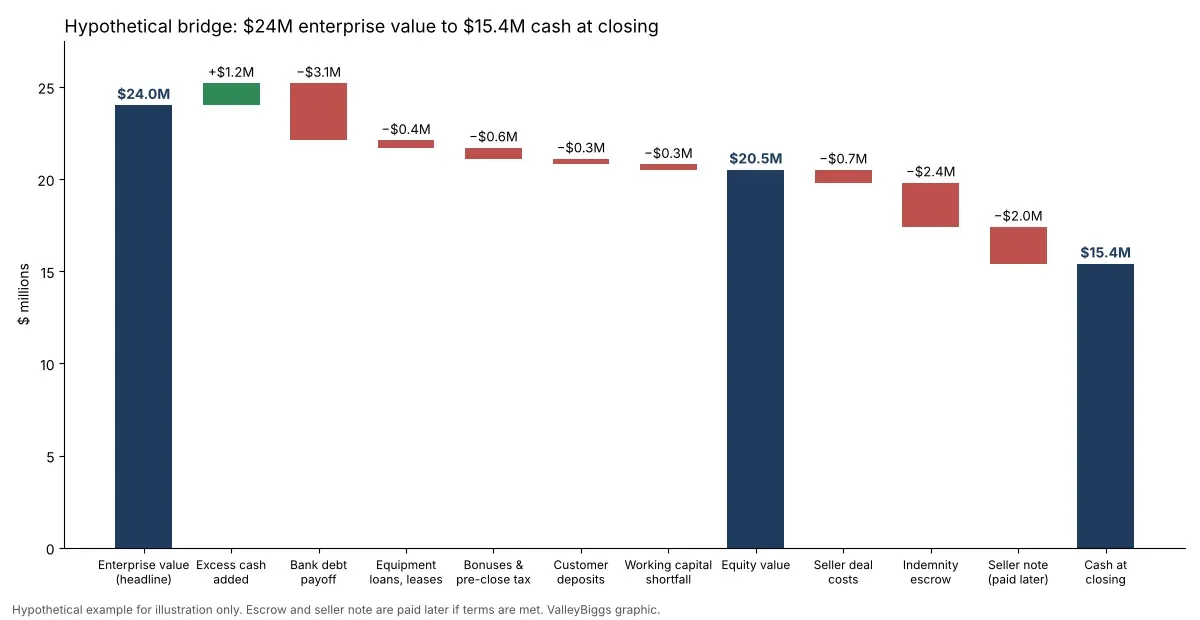
Two points stand out. First, the owner is not “losing” $8.6 million: $4.4 million of the gap is escrow and seller note that should arrive later if the business performs and no claims are made, and most of the rest repays obligations the company already had. Second, the items that look small add up. The debt-like items and the working capital shortfall together cost $1.2 million, about one-third of a turn of EBITDA in this example. At this deal size, the same logic applies whether the buyer is a sponsor or a strategic; see what drives value for a $20 million company for the buyer side of that range.
Why Can the Same Enterprise Value Produce Different Equity Values?
Because equity value moves with the balance sheet, not the income statement. In the chart below, three hypothetical companies each receive a $20 million enterprise value. The one with surplus cash ends up with equity value above enterprise value. The one financed heavily with debt ends up with less than half.
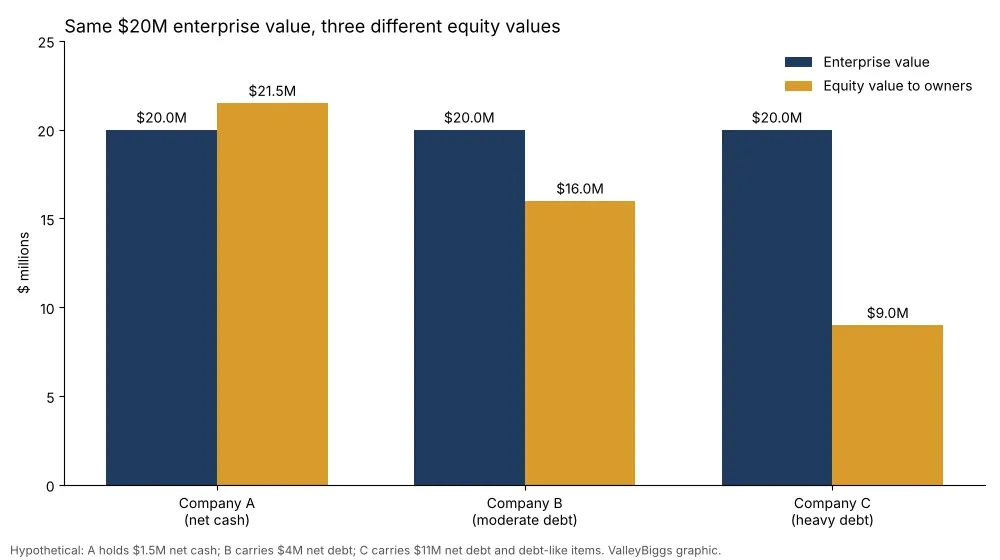
This also answers a common question: yes, enterprise value can be lower than equity value. It happens whenever a company holds more cash than debt, which is typical of profitable founder-owned software and services businesses that never needed to borrow. In that case the bridge adds value rather than subtracting it, provided the cash definition is drafted in your favor.
How Does Deal Structure Change What You Receive, and When?
Equity value tells you what the shares are worth on paper. Deal structure decides how much of that value arrives at closing and how much depends on future events. The main components, and when they usually pay out, are summarized below.
| Component | What it is | When the seller is paid | Main risk to the seller |
|---|---|---|---|
| Cash at closing | Equity value less all holdbacks and deferred pieces | Closing day | Lowest risk once wired |
| Indemnity escrow or holdback | Part of the price held by an agent to cover breach-of-warranty claims | Typically released 12 to 24 months after closing, less any claims | Claims reduce the release |
| Working capital adjustment escrow | Smaller amount held for the post-closing true-up | After the final closing statement, often within a few months | Disputes over accounting policies |
| Seller note | Part of the price paid in installments with interest | Over the note term | Buyer credit risk and subordination to senior lenders |
| Earnout | Contingent payment tied to future revenue or EBITDA targets | After each measurement period | Targets missed or measured differently than expected |
| Equity rollover | Seller reinvests part of the proceeds in the buyer’s new entity | At a future exit by the buyer | Value depends on the buyer’s next sale |
Escrow size is one of the larger swing factors. According to the latest SRS Acquiom M&A Deal Terms Study, which covers 2025 transactions, the median general indemnity escrow on private-target deals without representations and warranties insurance has held at about 10% of transaction value, while deals that use R&W insurance carry much smaller escrows. If a buyer proposes insurance, ask how it changes the escrow and who pays the premium. A seller financing arrangement deserves the same scrutiny: its interest rate, security and subordination terms determine whether that part of your equity value is likely to be collected in full.
Asset Sale vs Stock Sale: Where Does the Bridge Show Up?
The bridge works slightly differently depending on how the deal is structured, and the structure also drives the tax on your equity value. This section is general information, not legal or tax advice; your CPA and transaction attorney should model your specific case.
- Stock (or membership interest) sale. You sell the shares, the company keeps its assets and liabilities, and the bridge adjusts the price for the debt and cash that transfer with it. Gains on shares held more than one year are generally long-term capital gains for individual owners.
- Asset sale. The company sells selected assets and the buyer assumes only agreed liabilities. The company usually keeps its cash and pays off its own debt from the proceeds, so the bridge happens inside the selling entity before money reaches you. Buyer and seller each file IRS Form 8594 to report how the price is allocated among asset classes, and that allocation affects how much of the gain is taxed as ordinary income.
- C corporation asset sales. Gain is taxed at the corporate level first and again when proceeds are distributed to shareholders, which is why structure matters so much for C corporation owners.
For context, the IRS lists federal long-term capital gains rates of 0%, 15% and 20% depending on taxable income, and higher-income taxpayers may also owe the 3.8% net investment income tax. State taxes are on top. Two offers with the same enterprise value can produce noticeably different after-tax proceeds once structure is taken into account.
Which Multiples Go With Which Value?
A frequent mistake in owner-led valuations is mixing an equity measure with an enterprise measure. The rule is to keep both sides of the ratio in the same world.
| Multiple | Pairs with | Why |
|---|---|---|
| EV / EBITDA | Enterprise value | EBITDA is earned before interest, so it belongs to lenders and owners alike |
| EV / revenue | Enterprise value | Revenue is a whole-business figure, common for SaaS and high-growth companies |
| EV / SDE | Enterprise value | Seller’s discretionary earnings price smaller owner-operated businesses |
| Price / earnings (P/E) | Equity value | Net income is after interest, so it belongs to shareholders |
| Price / book value | Equity value | Book value is shareholders’ equity on the balance sheet |
If a friend tells you a company in your sector sold for “eight times,” ask whether that was eight times EBITDA on enterprise value or eight times net income on equity value. The two can describe very different prices.
Common Mistakes That Shrink Equity Value
- Comparing offers on headline enterprise value alone, without modelling the bridge and the structure behind each one.
- Accepting “cash-free, debt-free, normal working capital” in the LOI with no definitions or sample calculation.
- Letting the same liability appear twice, once in the working capital peg and again as a debt-like item.
- Sweeping cash out of the business right before closing and then delivering working capital below the peg.
- Forgetting payoff costs: prepayment penalties, accrued interest and lender fees on early repayment.
- Treating escrow, seller notes and earnouts as if they were cash at closing when planning personal finances.
- Leaving tax structure until after the price is agreed, when the buyer has little reason to accommodate changes.
How to Protect Your Equity Value Before You Sign
Most of the work that protects equity value happens months before a buyer appears. A practical checklist:
- Build a trailing 12 to 24 month working capital history so you can defend a fair peg.
- List every liability that could be argued as debt-like and decide your position on each.
- Clean up related-party loans, shareholder advances and old equipment financing where it makes sense.
- Reconcile deferred revenue and customer deposits, and estimate the real cost to serve them.
- Ask your CPA for a pre-sale estimate of income taxes owed for pre-closing periods.
- Prepare a pro forma bridge for each serious offer so you compare net cash, not headlines.
An independent enterprise valuation analysis before you go to market gives you a defensible enterprise value range and an early view of the adjustments buyers are likely to raise.
When to Talk to an M&A Advisor
Bring in an advisor once you have an unsolicited offer, before you sign any LOI, or when you start planning a sale within the next 12 to 24 months. An experienced sell-side team will translate each offer into expected cash at closing and total expected proceeds, push for clear bridge definitions in the LOI, and keep competitive tension alive while those terms are still negotiable. ValleyBiggs provides sell-side M&A assistance for founders of tech, SaaS, ecommerce and other growth companies, working alongside your CPA and attorney.
Conclusion
Enterprise value is the price of the business; equity value is the price of your shares. The distance between them is made of definitions, and definitions are negotiable when you still have alternatives. Before you react to a headline number, model the bridge, the escrow and the structure, and compare offers on the cash you are likely to keep. If you are weighing an offer or planning to sell your business, request a confidential consultation and we can review the numbers with you.
FAQs
1. How do you calculate equity value from enterprise value?
Start with enterprise value, add the cash the buyer agrees to pay for, then subtract funded debt and debt-like items such as unpaid pre-closing taxes or accrued bonuses. Finally, add or subtract the difference between the working capital you deliver and the agreed peg. The result is the equity value paid for the shares, before escrows, seller notes and personal taxes.
2. Can enterprise value be lower than equity value?
Yes. When a company holds more cash than debt, its net debt is negative, so equity value ends up higher than enterprise value. This is common for profitable, founder-owned software and services companies that never needed to borrow. Sellers benefit only if the purchase agreement defines excess cash fairly and does not lock most of it up as required operating cash.
3. Is the price in a letter of intent enterprise value or equity value?
In most private company sales, the headline price in an indication of interest or letter of intent is enterprise value on a cash-free, debt-free basis with a normal level of working capital. The equity value you receive is calculated later through purchase price adjustments, so ask for the key definitions before you sign.
4. What is the difference between enterprise value and fair market value?
Enterprise value describes what is being valued: the whole operating business before financing. Fair market value is a standard of value, described by the IRS in Revenue Ruling 59-60 as the price between a willing buyer and a willing seller, neither under compulsion and both reasonably informed. You can estimate the fair market value of either enterprise value or equity value.
5. Is deferred revenue treated as debt in a business sale?
It depends on the deal. Buyers often argue that deferred revenue is debt-like because they must deliver the service without receiving new cash. Sellers counter that only the cost to serve those obligations should count, or that deferred revenue belongs in the working capital calculation. Agree the treatment in writing early, especially for SaaS and subscription businesses.
6. What are the three main business valuation methods?
The three main approaches are the income approach, which discounts expected cash flows; the market approach, which applies multiples from comparable companies or transactions; and the asset approach, which values net assets. In private sales, buyers usually set enterprise value with a market multiple of EBITDA or SDE and test it against cash flow, as an enterprise valuation analysis does.