

An indemnification clause is the part of a purchase agreement in which the seller promises to repay the buyer for specific losses that surface after closing, such as a breached warranty, an unpaid pre-closing tax or a lawsuit about something that happened on the seller’s watch. In a business sale it decides how much of the price you keep once the deal is done. The clause sets what is covered, how small claims are filtered out, the maximum the seller can owe, and how long the buyer has to make a claim. This guide explains each of those terms from the seller’s side, with market data, a hypothetical worked example and the points worth negotiating early.
Key Takeaways
- An indemnification clause turns the seller’s promises about the business into money: if a representation proves untrue and the buyer loses money, the clause says who pays and how much.
- The main levers are scope, basket, cap, survival period and the source of payment (escrow, holdback, set-off or insurance).
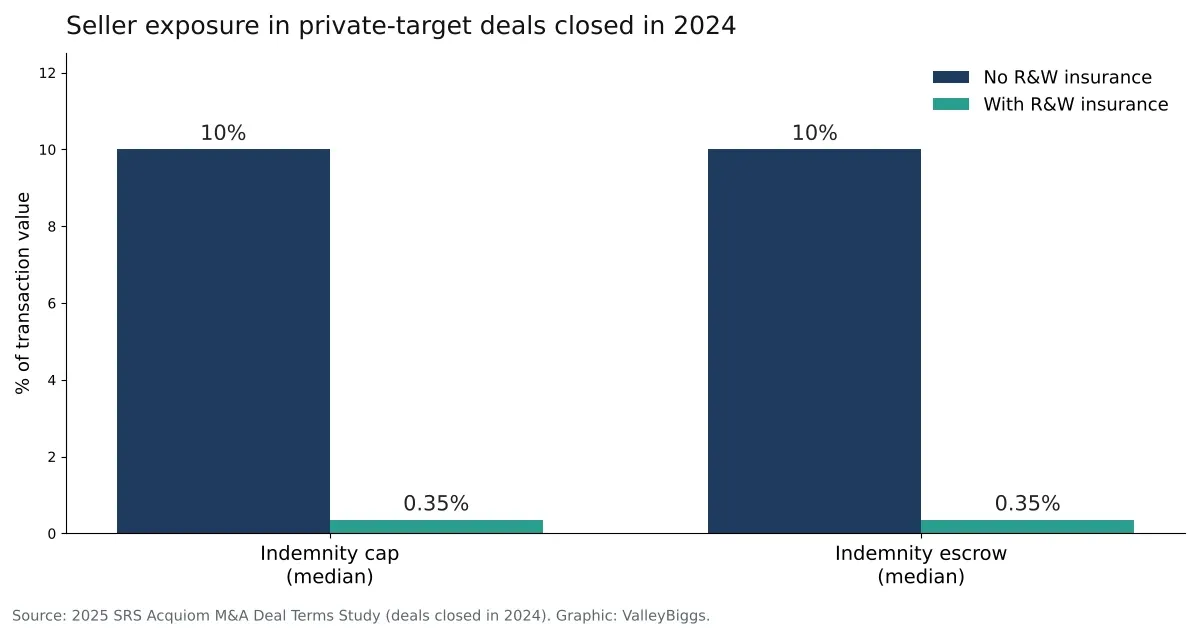
- In private-target deals closed in 2024 without rep and warranty insurance, the median indemnity cap and the median escrow were both about 10% of transaction value, according to SRS Acquiom data.
- Fundamental representations, taxes and fraud usually sit outside the general cap and survive longer.
- Most of the seller’s protection is won at the letter of intent stage and through disclosure schedules, not in the last week before closing.
- Nothing here replaces advice from your own M&A attorney or tax adviser on a specific deal; treat it as background, not legal or tax advice.
What Is an Indemnification Clause?
An indemnification clause is a contract promise by one party (the indemnitor) to compensate the other party (the indemnitee) for defined losses. In the sale of a company, the seller is almost always the indemnitor and the buyer is the indemnitee, although a well-drafted agreement also gives the seller some protection in return.
The clause rarely stands alone. It works together with the representations and warranties, which are the factual statements the seller makes about the company: its financial statements are accurate, it owns its intellectual property, it has paid its taxes, it is not facing undisclosed litigation, its key contracts are valid. If one of those statements turns out to be wrong and the buyer suffers a loss, the indemnity section is the mechanism that moves the cost back to the seller.
Owners searching for “what is an indemnification clause” often find examples from leases, vendor contracts or construction agreements, where the focus is injuries and third-party lawsuits. A business sale is different. The bigger exposure is a direct claim by the buyer that the business was not as described, which is why the size of the price, the escrow and the survival period matter so much more here.
Indemnification vs a hold harmless clause
A hold harmless clause is a promise not to hold the other party responsible for certain losses. In most purchase agreements the phrase appears as “indemnify, defend and hold harmless,” and the three verbs are read together. Courts in some states treat indemnify and hold harmless as meaning the same thing, while others, California among them, treat them as separate obligations. That difference can affect when payment is due, so it is a drafting point for counsel rather than boilerplate to skip.
How an Indemnification Clause Works in a Business Sale
The clause follows the deal timeline. It is shaped in the letter of intent, tested in diligence, written into the purchase agreement and enforced, if at all, after closing.
- Letter of intent. The buyer’s LOI usually signals the indemnity package in a sentence or two: escrow size, cap, survival period, and whether rep and warranty insurance will be used. Pinning these down in the letter of intent is the best chance a seller has to set the terms while competing offers still exist.
- Due diligence. The buyer tests every representation. Problems found here are usually priced, fixed or handled with a special indemnity rather than left to the general clause. Working through a due diligence checklist for selling a business before launch lets you spot those issues first.
- Disclosure schedules. The seller lists exceptions to each representation. Anything fairly disclosed is generally not a breach, so complete schedules are one of the strongest seller protections in the whole agreement.
- Signing and closing. Part of the price may go into an indemnity escrow or be held back by the buyer. The agreement may also set a separate, smaller escrow for the working capital true-up, which is a different mechanism from indemnity.
- Claims period. If the buyer finds a loss, it sends a claim notice within the survival period. The seller can dispute it, and the agreement sets procedures for third-party claims, including who controls the defense.
- Release. At the end of the survival period, the remaining escrow is paid to the seller, minus any amounts paid or still in dispute.
The Building Blocks of a Seller Indemnity
Every seller indemnity is assembled from the same parts. The labels vary between law firms, but the economics do not.
| Term | What it does | Seller-friendly position | Buyer-friendly position |
|---|---|---|---|
| Scope (covered matters) | Lists what triggers payment: breach of representations, breach of covenants, taxes, named issues | Limited to breaches of representations and covenants | Adds broad “any liability relating to pre-closing operations” language |
| Basket | Minimum total loss before the buyer can claim | Deductible basket: seller pays only the amount above the threshold | Tipping (first-dollar) basket: once crossed, seller pays from the first dollar |
| De minimis threshold | Ignores individual claims below a set amount | Higher per-claim threshold | No threshold |
| Cap | Maximum amount the seller can owe for general breaches | Equal to the escrow, so recovery is limited to that fund | Higher cap, or the full purchase price |
| Survival period | How long the buyer has to make a claim | 12 months or less, or a walk-away deal with no survival | 18 to 24 months, with fundamental and tax reps to the statute of limitations |
| Materiality scrape | Reads “material” out of representations when counting breach or loss | No scrape, or scrape for loss only | Double scrape for breach and loss |
| Sandbagging | Whether the buyer can claim for a breach it knew about before closing | Anti-sandbagging language | Pro-sandbagging language |
| Exclusive remedy | Whether the indemnity is the buyer’s only route to recovery | Indemnity as sole remedy, except for fraud | Indemnity plus other contract and tort claims |
Baskets and de minimis thresholds
An indemnity basket keeps minor issues out of the claims process. With a deductible basket of $60,000, a buyer with $115,000 of eligible losses recovers $55,000. With a tipping basket of the same size, it recovers the full $115,000. In the 2025 edition of the SRS Acquiom Deal Terms Study, covering private-target deals that closed through 2024, 38% of 2024 deals used a deductible basket, 39% a first-dollar basket and 22% had no basket at all. Where there was a basket, 59% were set at 0.5% of transaction value or less.
The indemnification cap
The indemnification cap is the most visible number in the clause. SRS Acquiom reports a median cap of 10% of transaction value across 2024 deals, both for all deals and for deals without rep and warranty insurance. When the buyer had an R&W policy, the median cap dropped to 0.35%, because the insurer, not the seller, absorbs most of the risk above a small retention.
Caps usually come in layers. General representations sit under the general cap. Fundamental representations, typically title to the shares, authority to sign, capitalization and brokers’ fees, are often capped at the purchase price. Fraud is commonly uncapped.
Survival periods
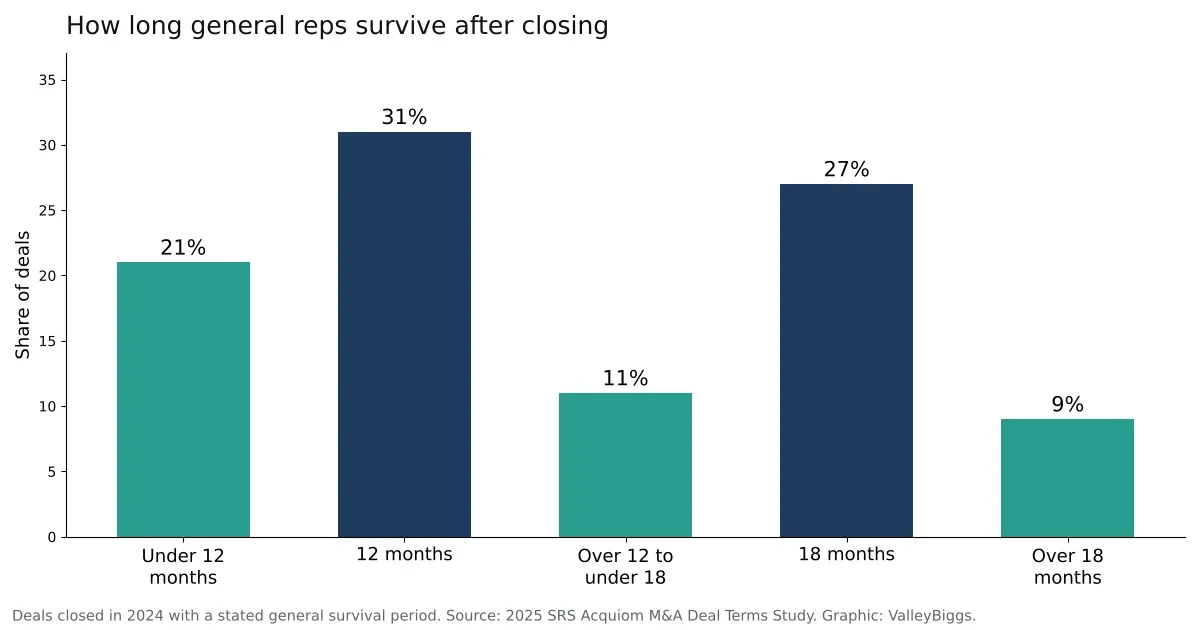
The survival period is the window in which the buyer can bring a claim. The SRS data shows 12 months as the most common general survival period in 2024 deals, followed by 18 months. Representations survived closing in 82% of deals without R&W insurance, and the share of walk-away structures (no survival at all) rose to 33% of all 2024 deals.
Tax representations survive to the statute of limitations in about 80% of deals in that study. State law also matters: Delaware, for example, allows parties to a written contract involving at least $100,000 to agree a claims period of up to 20 years, so a survival clause that looks open-ended deserves a hard look.
Special indemnities
A special indemnity is a dollar-for-dollar promise covering a known issue, whether or not it breaches a representation. Typical examples are pre-closing taxes, a pending lawsuit, a sales tax exposure in states where the company had nexus, or a product recall. In the SRS study, stand-alone tax indemnities appeared in 86% of 2024 deals and litigation indemnities in 72%. Special indemnities usually sit outside the basket and the general cap, so the seller’s real negotiation is over scope, a separate cap and a dedicated escrow.
Indemnification Clause Example: A Hypothetical Sale
The figures below are hypothetical and simplified. They show how the same set of losses produces different outcomes depending on how the clause is drafted.
A founder sells a B2B software company for an enterprise value of $12 million. The purchase agreement includes a 10% general cap ($1.2 million), a 10% escrow held for 18 months, a basket of 0.5% of the price ($60,000), and a special indemnity for an identified sales tax exposure with its own $150,000 escrow. No rep and warranty insurance is used.
Within the first year, the buyer finds three problems:
- A customer contract described as freely assignable actually required consent. The customer leaves, and the buyer documents $95,000 of losses.
- A software vendor claims unpaid license fees for pre-closing use, settled for $20,000.
- A state sales tax audit covering pre-closing periods produces a $130,000 assessment.
| Item | Deductible basket | Tipping basket |
|---|---|---|
| General claims (contract + license fees) | $115,000 | $115,000 |
| Less basket | -$60,000 | $0 (basket crossed, paid from first dollar) |
| Paid from general escrow | $55,000 | $115,000 |
| Sales tax under special indemnity (no basket) | $130,000 | $130,000 |
| Total paid by seller | $185,000 | $245,000 |
| General escrow released at 18 months | $1,145,000 | $1,085,000 |
The $60,000 gap comes entirely from one word in the basket definition. If the agreement had also included a $25,000 per-claim de minimis threshold, the $20,000 license claim would not count at all, and the seller’s general exposure would fall further. That is why the definitions deserve as much attention as the headline cap. For the full picture of how escrows and deferred payments reduce cash at closing, see how enterprise value turns into equity value and cash at closing.
Seller vs Buyer: What Each Side Wants
Both sides are pricing the same risk. The buyer wants the seller to stand behind the business as described. The seller wants a clean break and certainty that the price is the price.
| Issue | What the buyer argues | What the seller argues |
|---|---|---|
| Escrow size | Needs a fund it can reach without suing | Every dollar in escrow is a dollar not received at closing |
| Survival period | Some problems take a full audit cycle to surface | After 12 months, new issues reflect the buyer’s own management |
| Basket type | Should not lose the first dollars of a real loss | Ordinary-course noise should not reopen the deal |
| Materiality scrape | Small breaches add up and should count | Scraping materiality turns minor errors into claims |
| Sandbagging | It priced the deal on the reps as written | It should not close and then claim for issues it already knew about |
| Losses defined | Include diminution in value and lost profits | Exclude multiple-based damages and consequential losses |
Pros and cons for the seller
Accepting a standard indemnity package is not a sign of weakness. It is often the price of a higher headline number.
- Pros: supports a higher price, reassures lenders and sponsors, limits the buyer’s remedies to a defined process, and replaces open-ended litigation risk with a known cap.
- Cons: part of the proceeds is delayed or at risk, claims can arrive long after you have stepped back, and badly drafted definitions can expose you to losses well beyond the escrow.
How Rep and Warranty Insurance Changes the Picture
Rep and warranty insurance (RWI) is a policy, usually bought by the buyer, that pays for losses from breaches of the seller’s representations. When it is used, the seller’s indemnity often shrinks to a small retention or disappears for general reps, which is why the median cap in insured deals in the SRS data is a fraction of a percent.
RWI is not a blanket release. Policies typically exclude issues the buyer knew about, forward-looking statements, purchase price adjustments and certain known risks. Those exclusions are exactly where buyers ask for special indemnities. Ask early who pays the premium and the retention, and whether the buyer will agree that its recourse against you is limited to fraud and to items the policy does not cover.
What Owners Should Negotiate
The best time to negotiate the indemnity is before you grant exclusivity. A practical list:
- Put escrow size, cap, basket and survival period in the LOI rather than “customary for a transaction of this type.”
- Tie the general cap to the escrow, so your maximum exposure for general reps is the money already set aside.
- Ask for a deductible basket and a reasonable de minimis threshold.
- Limit “fundamental” representations to the true basics: title, authority, capitalization and brokers.
- Define “losses” to exclude multiple-based damages, punitive damages (except those paid to third parties) and consequential losses.
- Require losses to be reduced by insurance proceeds and tax benefits, and require the buyer to mitigate. SRS reports insurance-proceeds offsets in 83% of 2024 deals.
- Make the indemnity the exclusive remedy, with a carve-out limited to fraud. In the same study, indemnity was the exclusive remedy in 92% of 2024 deals.
- Give special indemnities their own cap, escrow and end date.
- Build complete disclosure schedules, and keep a record of what you shared in the data room.
How these terms land also depends on your other deal mechanics. A seller note, for example, gives the buyer a second pot to reach through set-off rights, so the note terms and the indemnity need to be read together.
Common Mistakes Sellers Make
- Negotiating price hard and treating the indemnity section as boilerplate.
- Agreeing in the LOI to “customary” terms that are then read in the buyer’s favor.
- Signing broad representations without knowledge qualifiers on matters you cannot verify.
- Thin disclosure schedules that leave known issues unlisted.
- Allowing set-off against a seller note or earnout without a cap or dispute process.
- Missing the difference between the general cap and fundamental or tax caps.
- Planning personal finances as if the escrow will certainly be released.
- Forgetting the tax side: purchase agreements often treat indemnity payments as an adjustment to the purchase price, which can affect how your gain is reported. Confirm the treatment with your tax adviser.
Related Deal Terms
Indemnification connects to most of the other terms in a sale. These guides cover them in more detail:
- The confidential information memorandum, whose statements about the business should match the representations you later sign.
- The letter of intent, where the indemnity package is first agreed.
- Net working capital and the purchase price adjustment, which is handled separately from indemnity.
- Seller financing and earnouts, which buyers may try to use for set-off.
- Enterprise value vs equity value, which shows where escrows sit in the bridge to cash at closing.
When to Talk to an Advisor
Bring in an M&A attorney while the letter of intent is still a draft, not after the buyer’s lawyers circulate the purchase agreement. A sell-side advisor helps on the commercial side: comparing indemnity packages across competing offers, judging whether a higher price with heavier indemnities is worth more than a lower price with a clean exit, and keeping several buyers engaged so the terms stay negotiable. A valuation analysis before going to market also helps you separate issues that should affect price from issues that belong in a special indemnity.
ValleyBiggs’ sell-side advisory team works with owners from preparation through closing. If you are thinking about selling your business and want a second view on an offer or a draft agreement, our advisors can walk through the numbers with you. ValleyBiggs does not provide legal or tax advice; we work alongside your attorney and CPA.
Conclusion
An indemnification clause decides how much of your sale price is truly yours after closing. The headline cap matters, but so do the basket type, the survival period, the definition of losses and the carve-outs that sit outside the cap. Agree the key terms in the LOI, disclose fully, and judge each offer by the cash you can realistically expect to keep. To review an offer or plan your exit, request a confidential consultation with ValleyBiggs.
FAQs
1. Should I agree to an indemnification clause when selling my business?
In most sales you will need to accept some indemnity, because buyers rarely close without one. The aim is a fair package: a defined scope, a deductible basket, a cap tied to the escrow, a short survival period and indemnity as the exclusive remedy. Settle these points early, as part of the wider steps in how to sell a business.
2. What is a simple example of indemnity in a business sale?
Say a seller represents that all sales taxes were paid, and a year after closing a state audit finds $80,000 owed for earlier periods. The buyer sends a claim under the indemnity and is reimbursed, often from the escrow. The seller carries a cost that arose while it owned the company, which is the core idea of indemnity.
3. Is a hold harmless clause the same as indemnification?
Often the two appear together as “indemnify and hold harmless” and are read as one promise. Some states, though, give hold harmless its own meaning, which can change when payment is due or release certain claims. In a purchase agreement, the cap, basket, survival period and definition of losses usually matter far more than the label.
4. What is a typical indemnification cap in M&A?
In SRS Acquiom data on private-target deals closed in 2024, the median cap was 10% of transaction value without rep and warranty insurance and 0.35% with it. Fundamental representations, taxes and fraud are frequently carved out and carry higher limits, sometimes up to the full purchase price, so read the carve-outs as closely as the headline cap.
5. How long does seller indemnification last after closing?
General representations commonly survive 12 to 18 months after closing. Fundamental and tax representations often run until the statute of limitations expires, and special indemnities follow their own negotiated end dates. Some deals, especially insured ones, use a walk-away structure in which general representations do not survive closing at all.
6. Does rep and warranty insurance replace seller indemnification?
Largely for general representations, but not completely. A buy-side policy usually leaves a retention, excludes known issues and purchase price adjustments, and does not protect a seller who commits fraud. Buyers often ask for special indemnities to cover excluded items, so agree in the LOI what recourse, if any, the buyer keeps against you.
7. Can a seller owe more than the indemnification cap?
Yes, in several situations. Fraud is usually uncapped, fundamental representations may be capped at the purchase price, and special indemnities can sit outside the general cap. Set-off rights against a seller note or earnout can also widen exposure. Review every carve-out from the cap with your attorney before you sign.