

A company with $50 million in annual revenue is usually worth somewhere between about $12 million and well over $100 million, and adjusted EBITDA decides where in that range it falls. When owners ask how much is a $50 million company worth, buyers answer with a multiple of earnings, and at this size the multiple itself starts to climb because the company has crossed into the middle market.
This guide covers the numbers a professional buyer will use: sourced multiples by deal size, a value table by margin, the earnings it takes to be worth $50 million, how software companies are priced differently, and a hypothetical comparison of two real-world offer structures.
Key Takeaways
- At $50 million in revenue, value is adjusted EBITDA times a multiple. Margin, not sales, sets most of the price.
- Size pays: GF Data reported average platform buyout multiples of 6.6x for $25 million to $50 million deals and 8.7x for $50 million to $100 million deals in the first nine months of 2025.
- To be worth $50 million on enterprise value, a company typically needs roughly $5 million to $8 million of adjusted EBITDA, depending on the multiple.
- Buyers at this size are institutional: private equity platforms, larger strategics and well-funded family offices, and they expect audited numbers and a quality of earnings review.
- Rollover equity, rep and warranty insurance and escrow terms can move cash at closing by millions, so compare offers on structure, not headline price.
How Much Is a $50 Million Company Worth? Two Ways to Read the Question
Owners use the phrase in two ways, and the answer changes with each one:
- $50 million in revenue. Most owners mean annual sales. Revenue tells a buyer how big the business is, but the price comes from earnings, so a $50 million revenue company can be worth far less or far more than $50 million.
- A $50 million valuation. Some owners want to know what it takes for the business to be worth $50 million. That is an earnings target, covered in its own section below.
Both questions run through the same formula: adjusted EBITDA multiplied by a market multiple gives enterprise value, and debt, working capital and deal terms then decide what you take home. If you have not yet normalized your earnings, start with our guide to adjusting EBITDA for owner pay and one-time costs, because every number below depends on it.
Why $50 Million in Revenue Puts You in the Middle Market
A company at this revenue level with a healthy margin generates somewhere around $3 million to $12 million of EBITDA. That moves it out of the lower middle market, where individual buyers and SBA-financed deals are common, and into the range that institutional capital is built to buy. Compared with a company at $20 million in revenue, a few things change at once:
- More buyers can finance the deal. Lenders are more comfortable with larger, diversified earnings, and GF Data reported total debt on platform deals averaging about 3.2x EBITDA through the third quarter of 2025.
- The buyer pool shifts toward larger private equity funds, corporate development teams at strategic acquirers and family offices that write bigger checks.
- Expectations rise. Buyers expect audited or at least reviewed financial statements, monthly reporting, a management team below the founder and a clean legal record.
- Deal mechanics get more sophisticated: competitive auctions run by an investment bank, third-party diligence reports and transaction insurance become standard.
What EBITDA Multiples Do Middle Market Companies Sell For?
Private company multiples are not published like stock prices, so the best evidence comes from transaction databases that collect data from deal participants. GF Data, which tracks private equity transactions between $10 million and $500 million, gives the clearest view of how multiples change with size:
| Deal size (enterprise value) | Average EBITDA multiple | Where a $50M-revenue company fits |
|---|---|---|
| $10 million to $25 million | 5.9x | Low-margin companies (EBITDA under about $3.5M) |
| $25 million to $50 million | 6.6x | Companies with roughly $4M to $7M of EBITDA |
| $50 million to $100 million | 8.7x | Companies with roughly $6M to $11M of EBITDA |
| $100 million to $250 million | 10.0x | High-margin or fast-growing companies at the top of the range |
Source: GF Data, private equity platform buyouts, first nine months of 2025. Averages blend industries and deal types; individual deals vary widely around them.
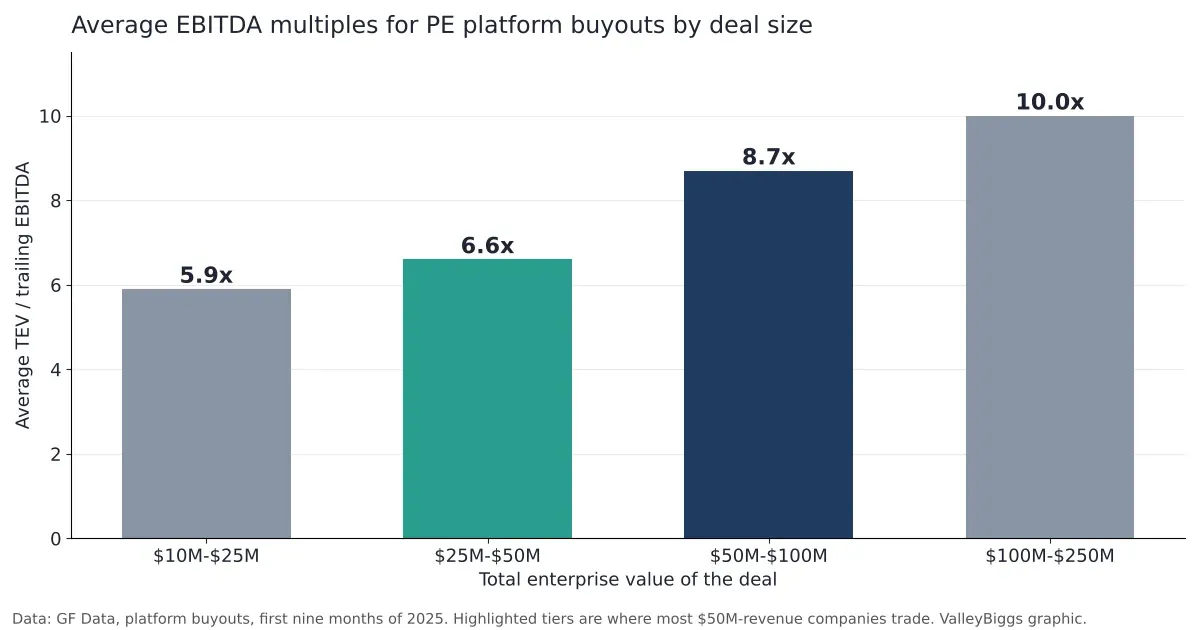
Two findings from the same data matter for owners at this size. First, GF Data put the gap between platforms above and below $100 million of enterprise value at 2.8 turns of EBITDA, above its long-term average of 2.6 turns. Second, the premium for above-average financial performance had narrowed to its lowest level in GF Data’s history, about 7.3x against 7.1x for other buyouts. Put simply, buyers were paying more for scale than for a slightly better margin.
Sorted by EBITDA rather than deal value, GF Data’s 2025 figures show companies with more than $10 million of EBITDA averaging about 8.3x, against roughly 6.7x for companies with $3 million to $5 million. For a wider market reference, the IBBA and M&A Source Market Pulse survey reported a median of 5.8x EBITDA for deals priced between $5 million and $50 million in the second quarter of 2026. That survey covers many smaller, non-sponsored deals, which is one reason its median sits below GF Data’s sponsor-backed averages.
How Much Is a Company With $50 Million in Revenue Worth at Different Margins?
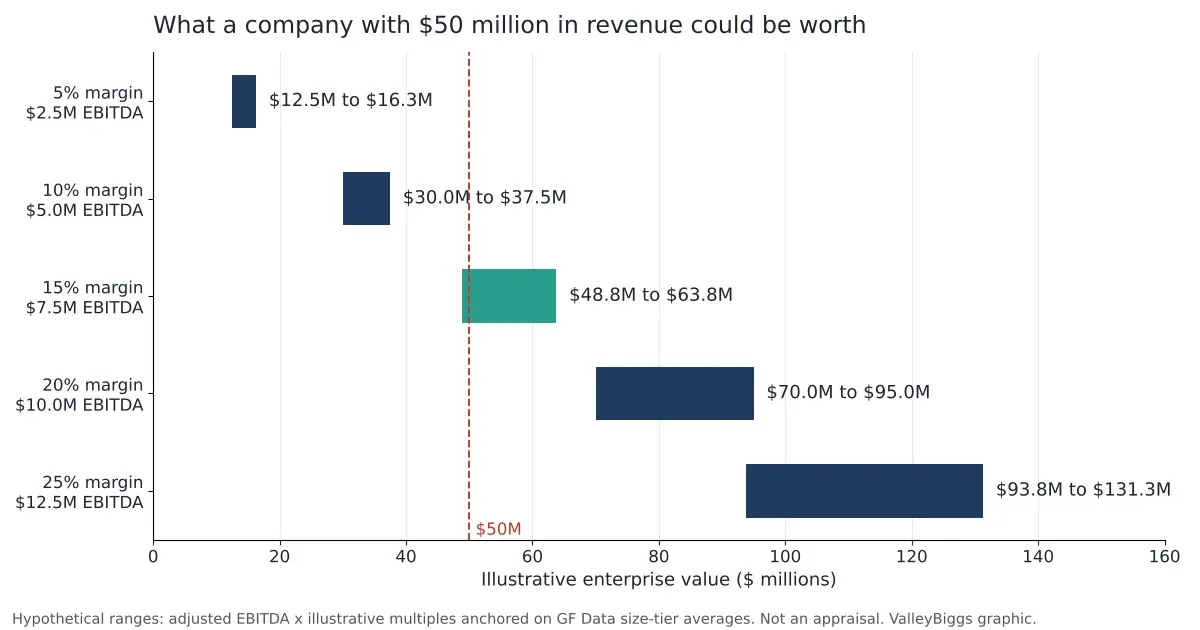
The table applies hedged multiple ranges, anchored on the GF Data size tiers, to five margin levels. Notice how the multiple range rises with EBITDA as well as the earnings figure itself, so value grows faster than margin.
| Adjusted EBITDA margin | Adjusted EBITDA | Illustrative multiple range | Illustrative enterprise value |
|---|---|---|---|
| 5% (distribution, contracting) | $2.5M | 5.0x to 6.5x | $12.5M to $16.3M |
| 10% | $5.0M | 6.0x to 7.5x | $30.0M to $37.5M |
| 15% | $7.5M | 6.5x to 8.5x | $48.8M to $63.8M |
| 20% | $10.0M | 7.0x to 9.5x | $70.0M to $95.0M |
| 25% (often software or specialized services) | $12.5M | 7.5x to 10.5x | $93.8M to $131.3M |
These ranges are hypothetical and show the arithmetic only. A low-margin distributor with customer concentration can land below the bottom of its band, while a business with contracted recurring revenue and a credible add-on strategy can clear the top.
What Earnings Does It Take for a Company to Be Worth $50 Million?
If your goal is a $50 million enterprise value, divide the target by the multiple you can realistically expect. The lower the multiple your industry and risk profile support, the more EBITDA you need:
| Multiple achieved | Adjusted EBITDA needed for $50M enterprise value | Revenue needed at a 15% margin |
|---|---|---|
| 6.0x | $8.3M | $55.6M |
| 7.0x | $7.1M | $47.6M |
| 8.0x | $6.3M | $41.7M |
| 9.0x | $5.6M | $37.0M |
| 10.0x | $5.0M | $33.3M |
Keep in mind that a $50 million enterprise value is not $50 million in your bank account. Debt, cash, the working capital peg and transaction costs all sit between the headline and your proceeds, as our explainer on the difference between enterprise value and equity value walks through step by step.
When Is a $50 Million Company Valued on Revenue Instead?
Software and other high-growth recurring revenue businesses are often priced on revenue or ARR, because current EBITDA understates what the company will earn once growth spending slows. The market data is far more cyclical than EBITDA multiples:
- Aventis Advisors’ private SaaS transaction data shows a median of 3.8x revenue for 2025 deals and 3.1x for the first quarter of 2026.
- In the same data set, medians were flat at about 3x for deals up to $50 million and rose to 6.1x for deals of $50 million to $100 million, another sign of the size effect.
- Public SaaS companies traded at a median of 4.6x enterprise value to revenue in August 2026, according to S&P Capital IQ figures cited by Aventis.
Where a software company lands depends on growth, net revenue retention, gross margin and the Rule of 40. Our breakdown of the SaaS metrics buyers check before an acquisition explains how each one shows up in the price, and founders weighing a sale can see how we approach it on our page for owners who want to sell a SaaS business.
Who Buys Companies With $50 Million in Revenue?
The buyer universe at this size is broader and better funded than for smaller companies, and each group prices risk and structure differently:
| Buyer type | What they look for | Typical structure |
|---|---|---|
| Private equity platform investor | A defensible market position, a management team that stays, room to grow through acquisitions | Majority purchase with leverage; seller often rolls a minority stake |
| Add-on buyer (company owned by a larger fund) | Customers, geography or capabilities that bolt onto an existing platform | Mostly cash; buyer may pay for synergies |
| Strategic acquirer | Products, talent or market share it cannot build quickly | Full purchase, sometimes with retention packages or an earnout |
| Family office or long-term holding company | Durable cash flow and a long holding period | Majority or full purchase, often with less debt |
| Minority or growth investor | Growth capital needs or a partial liquidity event | Minority stake; founder keeps control |
A sixth path, selling to an employee stock ownership plan, can suit companies with strong cash flow and a broad workforce. Under Section 1042 of the Internal Revenue Code, shareholders of a C corporation who sell to an ESOP that ends up owning at least 30% of the company may be able to defer capital gains tax, subject to the IRS rules.
How the Sale Process Changes at This Size
Middle market M&A is usually run as a structured, competitive process, often by an investment bank, because the buyers on the other side do this full time. A typical sequence looks like this:
- Sell-side quality of earnings report. An accounting firm tests your adjusted EBITDA before buyers see it, so add-backs are defended early instead of renegotiated late.
- Marketing materials and data room. A teaser, a confidential information memorandum and a financial model go to a targeted list of buyers under NDA.
- First-round indications of interest. Buyers submit non-binding ranges, and the field is narrowed to the most credible bidders.
- Management meetings and second round. Finalists meet the leadership team, run deeper diligence and submit letters of intent with full terms.
- Confirmatory diligence and insurance. The chosen buyer completes legal, tax, IT and commercial diligence; if rep and warranty insurance is used, an underwriter reviews the same materials.
- Purchase agreement and closing. The parties negotiate the definitive agreement, the working capital peg and indemnity terms, then close.
Timelines vary with complexity; ValleyBiggs describes the M&A process as taking anywhere from six months to several years from preparation to finalization. For transactions of this size and complexity, our M&A investment banking team works with institutional buyers and investors.
A Hypothetical Example: Two Offers for the Same $50 Million Company
Consider a hypothetical B2B services company with $50 million in revenue and $7.0 million of diligenced adjusted EBITDA, carrying $4.0 million of bank debt. It receives two letters of intent. The figures below are before taxes and transaction fees.
| Term | Offer A: strategic buyer | Offer B: private equity platform |
|---|---|---|
| Multiple | 8.0x | 9.0x |
| Enterprise value | $56.0M | $63.0M |
| Less debt repaid at closing | -$4.0M | -$4.0M |
| Rollover equity in the buyer’s holding company | None | -$14.0M |
| Indemnity escrow | -$5.6M (10%, no insurance) | -$0.2M (about 0.35%, with rep and warranty insurance) |
| Cash to the seller at closing | $46.4M | $44.8M |
| Deferred or at-risk value | $5.6M escrow | $0.2M escrow plus a $14.0M equity stake |
The 10% and 0.35% escrow levels mirror medians reported in SRS Acquiom’s 2025 Deal Terms Study for deals without and with rep and warranty insurance. Offer B has the higher headline price but pays less cash at closing, because $14 million is reinvested. If the platform grows and sells again, that stake could be worth more than $14 million; if it struggles, it could be worth less, and the seller usually has little control over the timing. Offer A pays more cash now, but more of it sits in escrow for a year or longer.
Neither offer is better on its own. The right answer depends on your appetite for a second exit, your role after closing, the tax treatment of each structure and how much you trust the buyer’s plan.
What Moves the Multiple Up or Down at $50 Million?
Within any size band, buyers adjust the multiple for risk and upside. The factors below come up in almost every middle market diligence process:
| Pushes the multiple up | Pushes the multiple down |
|---|---|
| Contracted or recurring revenue with documented retention | Project-based revenue that must be resold every year |
| A management team that runs the business without the founder | Founder holds key customer, supplier or technical relationships |
| No customer above roughly 10% of revenue | One or two customers drive a large share of profit |
| Audited financials and monthly reporting that reconcile to tax returns | Cash-basis books, late closes, unexplained adjustments |
| A pipeline of add-on acquisitions in a fragmented market | Limited room to grow without heavy capital spending |
| Clean IT, cybersecurity and data privacy controls | Recent breaches, unlicensed software, weak access controls |
Because the GF Data numbers show that buyers have been paying more for scale than for small margin gains, the improvements that widen the buyer pool, such as a stronger second layer of management and fewer concentration risks, often do more for value than shaving costs in the final year.
Alternatives to a Full Sale at This Size
A $50 million company has options that smaller businesses rarely get. Owners who want liquidity without leaving entirely often look at:
- Majority recapitalization. Sell control to a financial sponsor, keep a meaningful stake and stay involved through the next phase of growth.
- Minority investment. Take capital off the table or fund growth while keeping control and the board seat that comes with it.
- Dividend recapitalization. Borrow against the company’s cash flow and distribute part of the proceeds to shareholders, at the cost of a more leveraged balance sheet.
- ESOP transaction. Sell some or all shares to employees through a trust, often over time and with potential tax advantages for qualifying sellers.
Tax and Structure Points to Raise Early
At this size, tax structure can change after-tax proceeds by several million dollars, so involve your tax advisor before you sign a letter of intent. Common issues include:
- Asset sale versus stock sale. Buyers often prefer assets for the stepped-up tax basis, while sellers usually prefer stock. In an asset sale, both sides report the price allocation to the IRS on Form 8594.
- Federal long-term capital gains are taxed at up to 20%, and the 3.8% net investment income tax can also apply depending on the seller’s involvement in the business.
- Rollover equity can sometimes be structured to defer tax on the reinvested portion, which requires careful drafting.
- State income tax varies widely and can be a significant part of the total bill.
This section is general information, not legal or tax advice. Your own facts decide the answer.
How to Prepare a $50 Million Company for Sale
The most valuable preparation starts 12 to 36 months before a process. A practical checklist:
- Get two to three years of audited financial statements, or at least reviewed statements, and close the books monthly.
- Commission a sell-side quality of earnings review and fix the issues it finds before buyers arrive.
- Strengthen the management team and put incentive plans in place so key leaders stay through and after the sale.
- Analyze normalized working capital so you can negotiate the peg from data, not from the buyer’s draft.
- Review customer and supplier contracts for change-of-control and assignment clauses.
- Clean up the cap table, corporate records, licenses and any open litigation.
- Document your growth plan, including add-on targets if your market is fragmented.
- Review tax structure with an advisor, including entity type and any state-level exposure.
An independent enterprise valuation analysis is a useful first step: it shows where the company sits today and which of these changes would move the number most.
When to Talk to an M&A Advisor
Owners of $50 million companies sell to buyers who complete deals every year. It is worth starting a confidential conversation when:
- you receive an unsolicited offer and want to know whether the price and structure are competitive;
- you are deciding between a full sale, a recapitalization and a minority investment;
- you are comparing a strategic buyer against a private equity offer with rollover equity;
- you are one to three years from a possible exit and want to know which improvements will matter most.
ValleyBiggs offers sell-side M&A assistance for owners ready to run a process, and works with founders of technology, ecommerce and other digital businesses. For a broader view of valuation methods at every size, see our guide to how much a business is worth.
Conclusion
A $50 million company is worth its adjusted EBITDA multiplied by a middle market multiple, and that multiple tends to rise as earnings grow. Margin sets the starting point, scale and quality decide the multiple, and the structure of the offer decides how much of the price you receive at closing. If you want to see where your company sits in that range, request a confidential valuation consultation with the ValleyBiggs team.
FAQs
1. How much is a business worth with $50 million in sales?
It depends mostly on adjusted EBITDA. At a 10% margin, $5 million of EBITDA at roughly 6x to 7.5x suggests $30 million to $37.5 million of enterprise value; at a 20% margin, the same revenue can support $70 million or more. Revenue sets the scale, but buyers price earnings, risk and growth.
2. What EBITDA multiple does a $50 million company sell for?
Sponsor-backed deals of this size have averaged roughly 6.6x to 8.7x EBITDA, based on GF Data figures for $25 million to $100 million transactions in 2025. Where a specific company lands depends on growth, recurring revenue, customer concentration, management depth and how many credible buyers compete for it.
3. How much EBITDA does a company need to be worth $50 million?
Divide $50 million by the multiple you expect. At 6x you need about $8.3 million of adjusted EBITDA, at 8x about $6.3 million and at 10x about $5 million. That figure is enterprise value, so debt, cash and working capital still adjust what the owner actually receives.
4. Who buys companies with $50 million in revenue?
Mostly institutional buyers: private equity funds buying a platform, larger companies owned by private equity looking for add-ons, strategic acquirers and family offices. Some owners also bring in minority investors or sell to an employee stock ownership plan. Running several of these groups in parallel is what creates real price competition.
5. Do I need audited financial statements to sell a $50 million company?
Not always, but most institutional buyers and lenders expect them, and an audit removes a common reason to cut the price late in diligence. Many sellers at this size also commission a sell-side quality of earnings review so the adjusted EBITDA figure has already been tested by an independent accounting firm.
6. What is rollover equity in a business sale?
Rollover equity is the part of the sale price a seller reinvests in the buyer’s new holding company instead of taking as cash. It keeps the seller aligned with the new owner and can pay off if the company is sold again at a higher value, but it is illiquid and carries real risk.
7. Is a $50 million company valued differently from a $10 million company?
Yes. Larger companies usually attract more buyers and cheaper financing, so they tend to trade at higher multiples, and the sale process is more formal. Our guide to how much a $10 million company is worth covers the smaller end, where individual buyers and smaller funds are more common.