

To sell an Amazon business, you prepare 12 to 24 months of clean, SKU-level financials, value the company on seller’s discretionary earnings or adjusted EBITDA, choose a sale route, run a confidential process to a signed letter of intent, survive due diligence and then hand over the brand, listings and inventory in a way Amazon accepts. The part most owners underestimate is the last one: Amazon treats seller accounts as generally non-transferable, so the deal structure decides how the business actually moves. This guide walks through how to sell an Amazon business step by step, with what buyers check, a hypothetical offer and a documents checklist.
Key Takeaways
- Amazon describes seller accounts as generally not transferable. Most sales either keep the account inside the legal entity that is sold or move listings, Brand Registry and inventory to the buyer’s own account.
- Buyers price the earnings that survive them: SKU-level contribution margin after all Amazon fees, advertising dependence, account health and how much of the business rests on one ASIN or one supplier.
- The trademark and Brand Registry are often the most valuable transferable assets. A registered mark is assigned together with the goodwill it represents and the assignment is recorded with the USPTO.
- Headline price and cash at close are different numbers. Inventory, escrow and earnouts can move a large share of the value into separate or later payments.
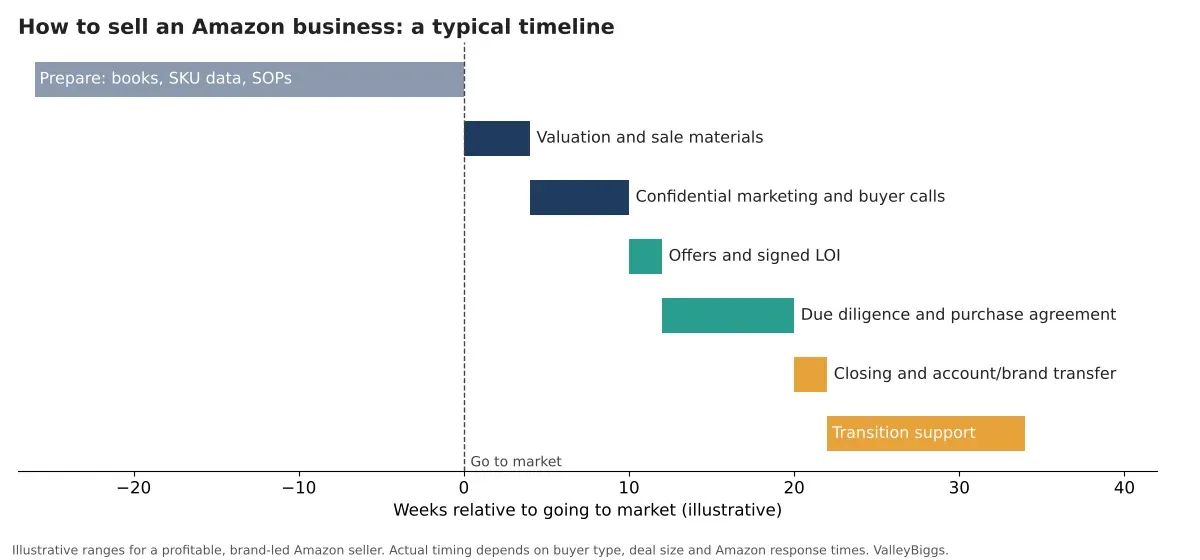
- A well-run process usually takes about four to six months from going to market to closing, plus months of preparation before it and a transition period after it.
What You Are Actually Selling When You Sell an Amazon Business
An Amazon business is not the storefront. It is a bundle of assets, contracts and data that sit in different places, and each one moves differently. Before you talk to a buyer, list every piece, who owns it today and how it would change hands.
| Asset | How it usually transfers | What to check first |
|---|---|---|
| Trademark (USPTO registration or application) | Written assignment with goodwill, recorded with the USPTO | Owner of record matches the selling entity; status and deadlines |
| Amazon Brand Registry | Buyer is added to the brand roles, then Amazon updates the brand owner | Who holds the Rights Owner and Administrator roles today |
| Listings (ASINs), content and reviews | Stay with the catalog; the buyer’s account becomes the selling account | Listing control, variation structure, any suppressed or flagged ASINs |
| Seller Central account | Usually stays with the legal entity; changed only through Amazon’s own processes | Account health, open policy cases, linked accounts |
| Inventory at FBA and 3PLs | Counted and paid at close; FBA stock is removed and re-sent or sold through | Aged inventory, stranded units, landed cost by SKU |
| Supplier and manufacturing relationships | Contract assignment or a new agreement with the buyer | Molds, tooling and specs ownership; exclusivity; lead times |
| Off-Amazon channels | Domain, Shopify store, email list and social accounts move by account transfer | Customer data consent, platform rules, ad account history |
| Advertising data and processes | Bulk files, reports, SOPs and dashboards are handed over | PPC structure and the share of sales that depends on paid traffic |
If the business also sells through its own site, wholesale or other marketplaces, the buyer will look at the whole channel mix. Our guide on selling a multichannel e-commerce company covers the off-Amazon side in more detail.
Can You Transfer an Amazon Seller Account?
Amazon’s Seller Central help describes seller accounts as generally not transferable, and Amazon does not move FBA inventory directly from one seller account to another. That does not stop a sale. It means the transaction is built around one of two structures, and your attorney, CPA and buyer need to agree on which one early, ideally at the LOI stage.
| Point | Sale of the legal entity (stock or membership interests) | Asset sale (buyer’s own seller account) |
|---|---|---|
| What the buyer acquires | The company that owns the seller account, brand and contracts | Only the assets listed in the purchase agreement |
| Seller Central account | Stays with the entity; the new owners update contact, bank and tax details through Amazon | Buyer sells through an account it already has or opens |
| Brand Registry | Already held by the entity; user roles are updated | Buyer’s account is added to the brand roles, then ownership is updated |
| FBA inventory | Remains in place under the same account | Removal orders and re-shipment, or a planned sell-through |
| Liabilities | Buyer inherits the entity’s history, so diligence and indemnities are heavier | Buyer takes only the liabilities it agrees to assume |
| Typical fit | Clean single-brand entities with good records | Multi-brand sellers, messy entities, or buyers who want a fresh start |
Two practical rules help in either structure. Keep written records of every Amazon support case and its outcome, and never remove yourself from Brand Registry roles until the buyer’s roles are confirmed. Losing control of the brand mid-transfer is one of the few problems that can freeze a closing.
How to Sell an Amazon Business Step by Step
Step 1: Decide what you want from the exit
Write down three things before anything else: the minimum cash you need at close, how long you are willing to stay involved after the sale, and whether you would accept part of the price as an earnout or seller note. These answers decide which buyers fit. A strategic buyer may pay for the brand but ask for a long transition. A private equity-backed platform may want you to roll part of your equity. An individual buyer may need SBA financing, where the 7(a) program caps the loan at $5 million.
Step 2: Rebuild the financials the way a buyer will read them
Most Amazon sellers run on cash-basis books and Seller Central reports. Buyers want accrual-basis profit and loss statements for at least the last 24 months, tied to settlement reports and bank statements, with cost of goods by SKU. Separate personal expenses, reconcile Amazon reimbursements, and document every add-back. If your company is large enough to be priced on EBITDA, read our explanation of how adjusted EBITDA is built and defended before you show a number to anyone.
Step 3: Value the business on earnings that will survive the sale
Smaller, owner-run stores are usually priced as a multiple of seller’s discretionary earnings (SDE). Larger brands with a management team are priced on adjusted EBITDA. In both cases the buyer is pricing risk, not just profit. Flippa reported that e-commerce businesses sold on its marketplace in the first half of 2026 at an average of about 1.55 times annual profit, with the top quartile near 2.75 times. Those are mostly smaller listings, so treat them as a floor for context, not as a price for a larger brand.
An independent enterprise valuation analysis is worth doing before you market the company, because it shows which adjustments a buyer will accept and which risks will cut the multiple. The value drivers section below lists what moves an Amazon FBA business valuation up or down.
Step 4: Choose how you will sell
You can list on an online marketplace, sell directly to a buyer you know, or run a confidential, broker-led process with several qualified buyers. Marketplaces work for smaller, simpler stores. A broker or M&A advisor earns its place when the business is large enough that a better price, better terms or a cleaner transfer outweigh the cost of the process. Ask any advisor how they handle Amazon-specific transfer steps, not just how many buyers they know.
Step 5: Market confidentially and negotiate the LOI
Buyers get a short anonymous summary first and the full confidential information memorandum (CIM) only after signing an NDA. Keep ASINs and the brand name out of early material, because a competitor can identify a store from a single product photo. When offers arrive, compare them on terms, not just price. Our guide to the letter of intent in a business sale explains which clauses to settle before exclusivity starts, including inventory, working capital and the transfer structure.
Step 6: Get through due diligence
Expect the buyer to request read-only access to Seller Central, advertising accounts and your accounting system. They will compare settlement reports with bank deposits, test return and refund rates, review account health history and policy warnings, and check that the trademark, supplier agreements and product compliance documents match what you told them. Every discrepancy usually comes back as a price reduction calculated at the deal multiple, so finding problems yourself first pays.
Step 7: Close, transfer and support the transition
At closing you sign the purchase agreement, inventory is counted and paid, and the transfer plan starts: trademark assignment, Brand Registry roles, account details or listing migration, supplier introductions and handover of SOPs and ad accounts. Plan stock levels so that listings do not run out during the switch. Most buyers ask for a defined transition period with weekly calls and a set number of support hours.
What Drives Amazon FBA Business Valuation
Two stores with the same profit can sell for very different amounts. Buyers mark the multiple up or down for the following factors:
- Brand ownership and protection. A registered trademark, Brand Registry and proprietary product features support a higher multiple than resale or wholesale of other brands’ goods.
- Concentration. Heavy dependence on one ASIN, one supplier or one marketplace is the most common reason for a lower offer or an earnout.
- Advertising dependence. Buyers compare total ad spend with total sales (TACoS) over time and ask how much revenue would remain if ads were cut.
- Margin after every Amazon fee. Referral, fulfillment, storage, inbound placement and return costs all sit between revenue and SDE.
- Account health and policy history. Suspensions, listing takedowns or unresolved intellectual property complaints raise risk directly.
- Trend and seasonality. Stable or rising trailing twelve-month earnings and a manageable seasonal swing support a cleaner valuation.
- Owner dependence. Documented processes and a team or agency that stays make the business easier to finance and to run.
- Off-Amazon demand. A brand site, retail accounts or an email list reduce platform risk and widen the buyer pool.
Who Buys Amazon Businesses in 2027
The buyer universe changed after the aggregator boom. Several roll-ups that raised large amounts of capital to buy Amazon brands later restructured, and Thrasio filed for Chapter 11 protection in February 2024, according to Reuters. Amazon aggregators still exist and still buy, but they tend to be more selective about category, size and terms than in 2021. Strategic buyers and private equity-backed consumer platforms now matter just as much. Our page on how we help owners sell an Amazon business describes the process ValleyBiggs runs for brand owners.
| Buyer type | What they usually want | What to expect in terms |
|---|---|---|
| Individual or search-fund buyer | Profitable store with simple operations | SBA or seller financing; longer diligence on owner dependence |
| Amazon aggregator or roll-up | Brands that fit an existing category or supply chain | Mix of cash, deferred payments and earnouts tied to performance |
| Strategic buyer (consumer brand or manufacturer) | Product line, customers or distribution that fits its brand | Can pay for synergies; may ask for a longer transition |
| Private equity-backed platform | Larger brands with a team and growth beyond Amazon | Adjusted EBITDA pricing, equity rollover, heavier diligence |
Hypothetical Example: How an Offer Turns Into Cash
The numbers below are hypothetical and only show how a headline price is often split. Assume a private-label home goods brand with about $14 million in trailing revenue, 85% of it on Amazon, and $2.4 million of adjusted EBITDA. A buyer offers an enterprise value of $8.4 million, plus inventory at landed cost of $1.6 million, for a headline figure of $10.0 million.
| Component | Amount (hypothetical) | When and how it is paid |
|---|---|---|
| Cash at close | $6.30M | 75% of enterprise value, wired at closing |
| Escrow | $0.84M | 10% held to cover indemnity claims, released after about 12 to 18 months if there are no claims |
| Earnout | Up to $1.26M | 15% paid only if the business hits an agreed gross profit target in the first year |
| Inventory | $1.60M | Counted at close and paid at landed cost; aged or unsellable stock excluded |
| Total if everything is paid | $10.00M | Only $7.90M is certain on closing day |
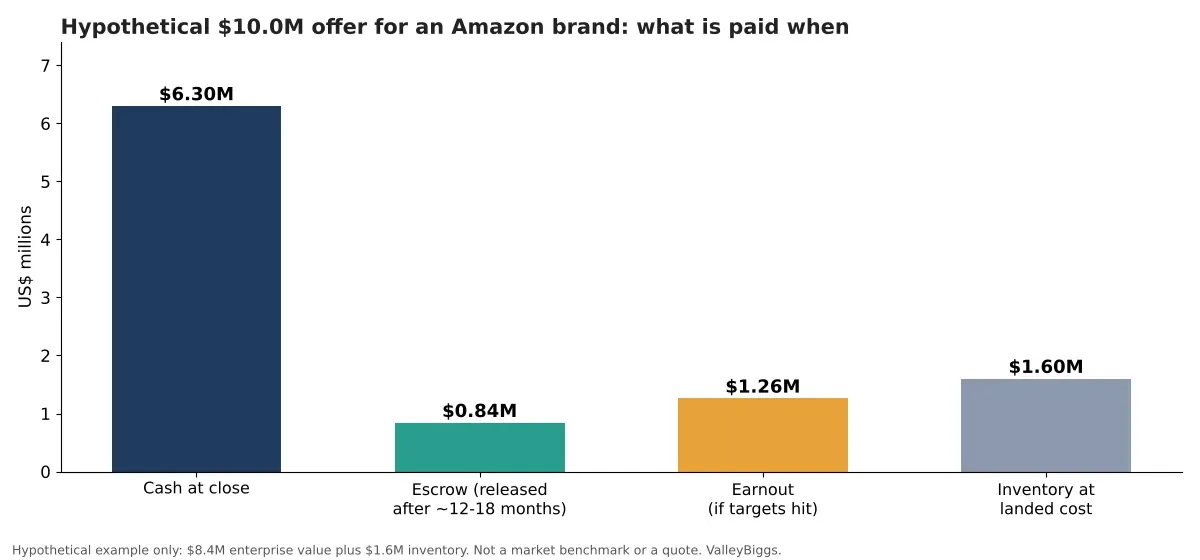
The escrow percentage in this example is in line with the roughly 10% median escrow that SRS Acquiom’s 2025 Deal Terms Study reported for private deals without representations and warranties insurance, but every deal is negotiated. How inventory is counted, which stock is excluded and whether it sits inside a net working capital target can move your proceeds by hundreds of thousands of dollars.
Timeline to Sell an Amazon Business
| Phase | Typical duration | Main outputs |
|---|---|---|
| Preparation | 6 to 24 months before going to market | Accrual P&L, SKU margins, trademark and supplier clean-up, SOPs |
| Valuation and materials | 2 to 4 weeks | Valuation range, teaser, CIM, data room |
| Marketing and buyer calls | 4 to 8 weeks | NDAs, management calls, indications of interest |
| LOI | 1 to 3 weeks | Signed LOI with price, structure, inventory terms and exclusivity |
| Due diligence and purchase agreement | 6 to 10 weeks | Financial, account, IP and supplier diligence; negotiated APA or SPA |
| Closing and transfer | 1 to 3 weeks | Funds flow, inventory count, Brand Registry and account steps |
| Transition | 1 to 6 months | Training, supplier introductions, earnout reporting |
Documents Checklist for Selling an Amazon Business
- 24 to 36 months of accrual-basis P&L and balance sheets, plus federal tax returns
- Amazon settlement reports and payout reconciliation to bank statements
- SKU-level sales, units, returns, landed cost and contribution margin
- Inventory reports from FBA and any 3PL, with aging and stranded units
- Account Health, Inventory Performance and policy-warning history exports
- Advertising bulk files, search term reports and TACoS trend by month
- USPTO registration certificates or application records and Brand Registry role details
- Supplier agreements, purchase orders, tooling ownership and product compliance or test reports
- Brand website, email platform and social account inventory, with admin access lists
- Standard operating procedures and a list of contractors or agencies with their scopes
For the broader diligence list that applies to any company, see our due diligence checklist for sellers.
Common Mistakes When Selling an Amazon Business
- Going to market during a stockout or right after a ranking drop, when trailing numbers look worse than the business really is.
- Showing revenue and a profit number that does not reconcile to settlement reports.
- Agreeing to a price before agreeing how inventory will be counted and paid.
- Assuming the seller account can simply be handed over, then discovering the transfer plan late in diligence.
- Leaving the trademark in the founder’s personal name instead of the selling entity.
- Cutting advertising before the sale to inflate profit, which buyers spot in TACoS and sales trends.
- Sharing ASINs or the brand name with unqualified buyers before an NDA is signed.
Tax and Legal Points to Raise Early
Structure drives tax. In an asset sale, the buyer and seller generally allocate the price across asset classes and each files IRS Form 8594 under Section 1060. The part allocated to inventory is usually taxed as ordinary income, while goodwill and other capital assets held long term may qualify for capital gains rates. A sale of stock or membership interests is taxed differently, and the entity type matters. State sales tax, marketplace facilitator rules and any foreign VAT registrations should also be reviewed before closing. This section is general information, not legal or tax advice. Confirm every point with your own CPA and attorney.
When to Talk to an M&A Advisor
Bring in an advisor once your Amazon business produces meaningful, consistent profit, when more than one type of buyer could be interested, or when you have already received an unsolicited offer. A sell-side advisor can test the valuation, prepare the materials, run a competitive process and coordinate the Amazon-specific transfer steps with your attorney and CPA. For a wider view of the stages that apply to any company, our guide on how to sell a business covers the full sequence.
Conclusion
Selling an Amazon business rewards preparation more than timing. Clean SKU-level numbers, a protected brand, a clear transfer structure and realistic deal terms do more for your result than any single month of sales. If you are planning an exit in 2027, request a confidential consultation and we will help you understand what your brand is worth and which buyers are likely to pay for it.
FAQs
1. Can you sell an Amazon seller account?
Not directly. Amazon describes seller accounts as generally non-transferable, so most deals either sell the legal entity that owns the account and update its details through Amazon, or move the brand, listings and inventory to the buyer’s own account. Agree the structure in the LOI so the transfer plan is not a surprise in diligence.
2. How much is my Amazon business worth?
It depends on earnings that survive the sale and the risk attached to them. Smaller stores are usually priced on SDE and larger brands on adjusted EBITDA, with the multiple shaped by brand protection, concentration, ad dependence, account health and trend. A professional business valuation gives you a defensible range before buyers set one.
3. How long does it take to sell an Amazon FBA business?
Plan for roughly four to six months from going to market to closing for a well-prepared business, plus preparation time before it and a transition period after it. Delays usually come from unreconciled financials, slow trademark or Brand Registry steps, or a buyer’s financing. Smaller marketplace sales can be faster, larger deals slower.
4. Do product reviews transfer when you sell an Amazon business?
Reviews are tied to the product listing (ASIN), not to the seller, so they generally stay with the listing when the buyer takes over selling it. Seller feedback and account performance history stay with the seller account itself. That is why protecting listing control and Brand Registry roles during the transfer matters so much.
5. Are Amazon aggregators still buying brands?
Yes, but more selectively than during the 2021 boom. Several roll-ups restructured, including Thrasio, which filed for Chapter 11 in February 2024. Today aggregators compete with strategic buyers, private equity-backed platforms and individual buyers, and they often use earnouts or deferred payments. Run a process that includes more than one buyer type.
6. Should I sell through a marketplace or an M&A advisor?
Online marketplaces suit smaller, simpler stores where the owner can manage buyers and transfer steps alone. An advisor makes more sense when the business is larger, several buyer types could compete, or the transfer is complex. Our guide on how to sell a business explains what a full sale process involves.
7. Is the sale of an Amazon business taxed as capital gains?
Often only partly. In an asset sale, the price is allocated across asset classes on IRS Form 8594, and the share allocated to inventory is generally ordinary income, while long-held goodwill may qualify for capital gains rates. Entity type and deal structure change the result, so confirm it with your CPA. This is not tax advice.