

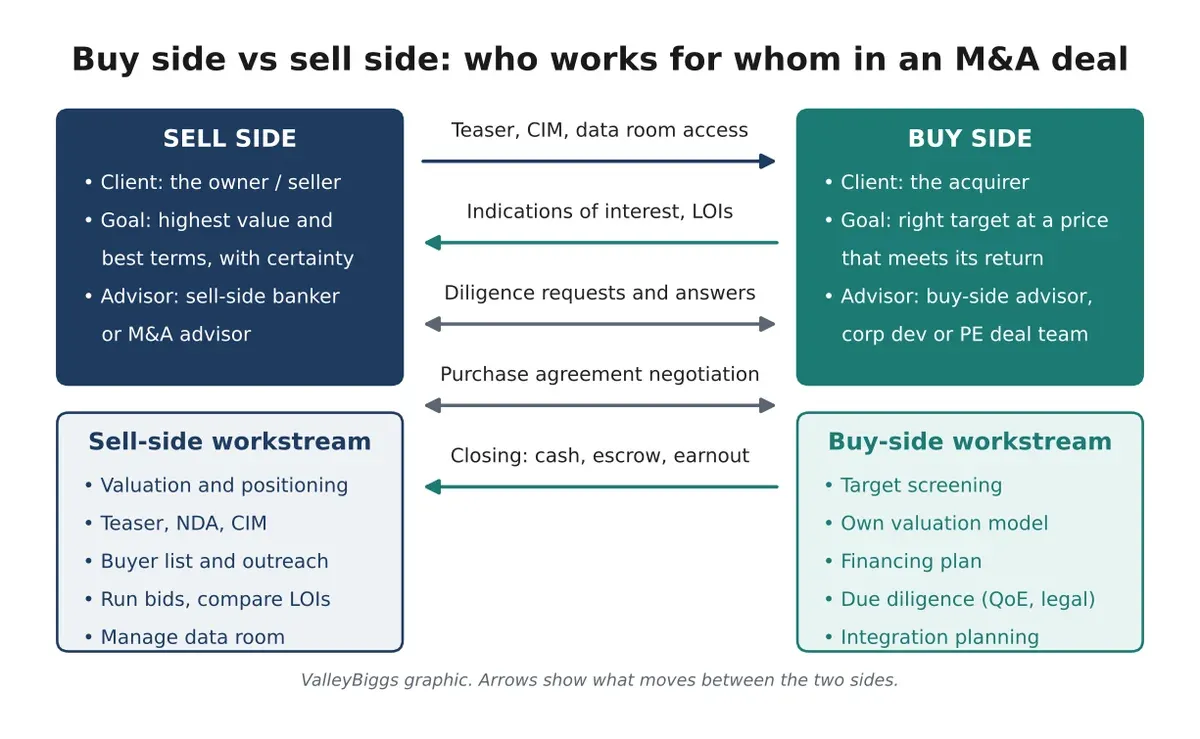
In M&A, the sell side is the owner selling a company and the advisors who work for that owner; the buy side is the acquirer and the advisors who work for it. Both sides look at the same business, but each is paid to win different things: the seller wants the highest value with the most certainty, the buyer wants the right company at a price that still earns its required return. When people search buy side vs sell side they often land on Wall Street career guides, which use the terms differently. This guide is written for owners of private companies who expect to sell, explaining who does what, how each side gets paid, where conflicts arise and how to protect your position.
Key Takeaways
- In a private company sale, “sell side” means the seller and everyone representing the seller; “buy side” means the acquirer and everyone representing the acquirer.
- In the public markets the same words describe something else: banks and brokers that create and sell securities (sell side) versus funds that buy them (buy side).
- A sell-side advisor builds competition among buyers. A buy-side advisor screens targets, models returns and runs diligence for the acquirer.
- The advisor who contacts you on behalf of a buyer is paid to help that buyer, even if the conversation feels friendly.
- Federal law lets an exempt M&A broker represent both parties only with clear written disclosure and written consent from both.
- Most of a seller’s leverage is set before the letter of intent is signed, which is why owners usually bring in their own advisor early.
What Do Buy Side and Sell Side Mean?
The two terms come from finance, and they mean different things depending on the context. That is why so many explanations seem to contradict each other.
In the capital markets, the sell side is the group of firms that create, underwrite, distribute and trade securities: investment banks, broker-dealers, market makers and their research teams. The buy side is the group of investors that put money into those securities, such as mutual funds, pension funds, hedge funds, insurers and private equity funds. Sell-side research analysts publish reports that are distributed to clients and are covered by FINRA Rule 2241 on research analysts and research reports. Buy-side analysts work only for their own fund and its decisions.
In mergers and acquisitions, the words describe who the client is in a single transaction. A sell-side engagement means the advisor works for the company or owner being sold. A buy-side engagement means the advisor works for the party doing the acquiring. The same investment bank can be on the sell side of one deal and the buy side of the next.
| Context | Sell side | Buy side |
|---|---|---|
| Capital markets | Banks and brokers that issue, sell and trade stocks and bonds | Funds and institutions that invest in those stocks and bonds |
| Equity research | Analysts whose reports go out to clients of a bank | Analysts who advise their own fund’s portfolio managers |
| M&A for a private company | The owner selling the business and the owner’s advisors | The acquirer (strategic buyer, private equity fund, family office, search fund) and its advisors |
| Who pays the advisor | The seller, mostly through a success fee at closing | The buyer, often through a retainer plus a fee if a deal closes |
Buy Side vs Sell Side in M&A: Side-by-Side Comparison
For an owner, the useful question is not which side sounds more prestigious but what each side is trying to accomplish at every point in the deal. The comparison below follows a typical sale of a privately held company.
| Point of comparison | Sell side (works for you) | Buy side (works for the acquirer) |
|---|---|---|
| Main objective | Highest value, best terms, high odds of closing | Right target at a price that meets the buyer’s return targets |
| Starting point | One company, many possible buyers | One buyer, many possible targets |
| Key documents | Teaser, confidential information memorandum, data room, management presentation | Acquisition criteria, valuation model, investment committee memo, diligence reports |
| View of the numbers | Normalizes earnings to show what the business can earn for a new owner | Tests every add-back and looks for reasons to reduce price or add protection |
| Biggest risk | Leaving money on the table or a deal that falls apart late | Overpaying or inheriting liabilities it did not price in |
| Leverage tool | Competition between qualified buyers and a firm timeline | Exclusivity, diligence findings and deal structure |
| Usually controls | Process, timing and what information is released | Price adjustments after diligence and the draft purchase agreement in many deals |
What a Sell-Side Advisor Does for an Owner
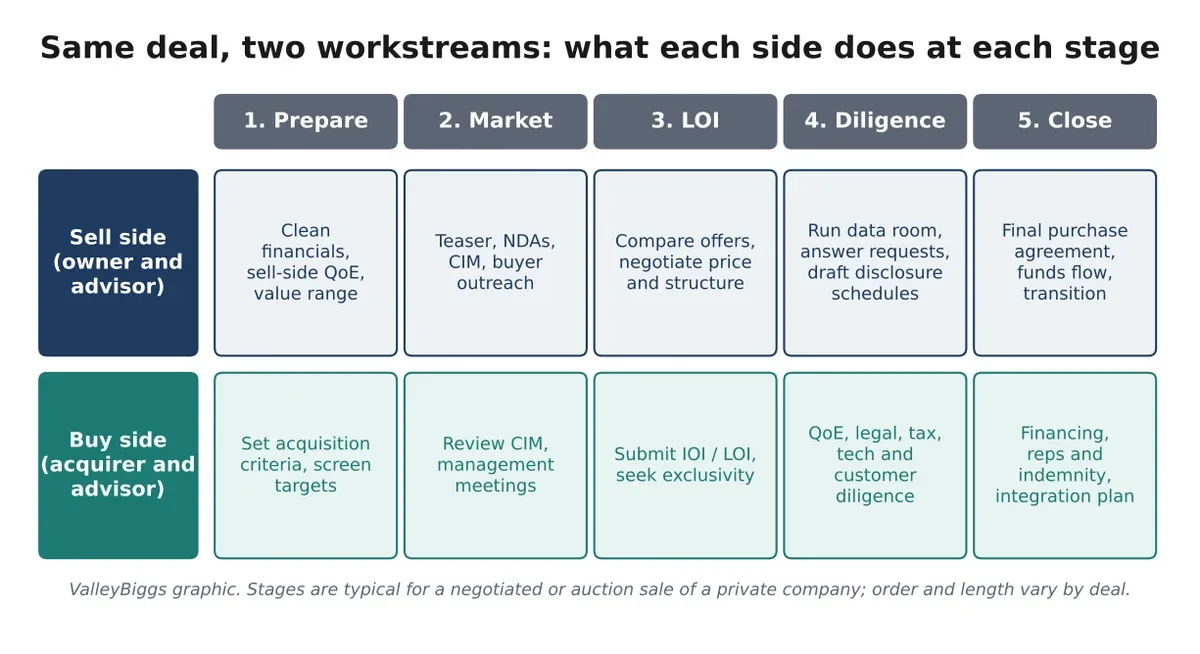
A sell-side advisor, whether an investment bank, an M&A advisory firm or a business broker for smaller deals, represents the seller from preparation through closing. ValleyBiggs describes its sell-side M&A assistance as working with owners to reach their goals and full value, and our own work focuses on technology and internet businesses. The steps below are typical across firms.
- Preparation: cleaning up financial statements, identifying owner-specific expenses, and often commissioning a sell-side quality of earnings review so buyers start from tested numbers.
- Valuation: setting a realistic range before going to market, based on earnings quality, growth, customer concentration and what comparable buyers have paid. An independent enterprise valuation analysis helps set expectations.
- Positioning and materials: a short anonymous teaser, then a confidential information memorandum for buyers who sign a nondisclosure agreement.
- Buyer outreach: building a list of strategic and financial buyers and contacting them in a controlled order so confidentiality holds.
- Running the process: setting deadlines for indications of interest and letters of intent so offers arrive at roughly the same time and can be compared.
- Negotiation and diligence: managing the data room, answering requests and keeping the timeline moving through the purchase agreement.
Our longer guide to the sell-side M&A process covers auction formats and the technology behind data rooms. This article stays on the contrast between the two sides.
What a Buy-Side Advisor Does for an Acquirer
A buy-side advisor works for the acquirer. Larger strategic buyers often have an internal corporate development team that does this work, while private equity funds have deal professionals on staff and hire outside advisors for specific tasks. ValleyBiggs also offers buy-side M&A assistance for companies that want to grow through acquisitions.
- Defining acquisition criteria: industry, size, margins, geography, customer type and integration fit.
- Sourcing targets, including companies that are not for sale. This is where many unsolicited calls to owners come from.
- Building an independent valuation model rather than relying on the seller’s numbers.
- Arranging financing, which in a leveraged buyout means lining up debt that the target’s own cash flow will have to repay.
- Running diligence across accounting, tax, legal, technology, customers and people.
- Negotiating protection in the purchase agreement and planning the integration after closing.
How Deal Terms Look From Each Side
Price is only one line of a deal. The terms below decide how much of that price an owner actually keeps, and the two sides want opposite things on almost every one of them.
| Deal term | What the seller wants | What the buyer wants |
|---|---|---|
| Headline price | Highest number supported by normalized earnings | A number that still works after diligence findings |
| Cash at closing | As much as possible | Less up front, more tied to future performance |
| Earnout | Short, simple, measured on revenue the seller can influence | Longer, tied to profit targets the buyer controls |
| Seller note | Small, short, secured | Larger, subordinated to bank debt |
| Escrow or holdback | Small and released early | Larger and held until claims periods end |
| Working capital target | Set at a normal level for the business | Set high so any shortfall cuts the price |
| Representations and indemnity | Narrow promises, low cap, short survival | Broad promises, high cap, long survival |
| Exclusivity | Short, after price and key terms are fixed | Long, signed early |
Escrow is a good example of how the sides pull apart. In private-target deals that closed in 2024 without representation and warranty insurance, the median escrow was about 10% of transaction value, according to the 2025 SRS Acquiom M&A Deal Terms Study. Our guide to the indemnification clause shows how caps, baskets and survival periods interact with that holdback.
The letter of intent is usually where these positions get fixed. Once an owner signs a letter of intent with exclusivity, the competitive tension ends and the buyer’s advisors take the lead on drafting. That is the main reason sellers want their own representation before, not after, that signature.
A Simple Example: The Unsolicited Offer
Here is a hypothetical case to show how the two sides behave. The owner of a SaaS company with about $3 million of EBITDA receives an email from a private equity firm’s buy-side team. After two calls and a look at summary financials, the firm proposes a price and asks for 60 days of exclusivity.
From the buy side, this is efficient. The firm has one counterparty, no competing bids, and it can set the pace of diligence. Its advisors are doing their job well by keeping the process narrow.
From the sell side, the owner has no way to tell whether the price is strong, because nobody else has seen the business. If the owner hires a sell-side advisor at this point, the advisor typically does three things: tests the offer against a valuation range, contacts a short list of other qualified buyers, and negotiates structure (cash at close, earnout, rollover equity) rather than price alone. The original bidder may still win, but now it is competing.
The same logic applies when a competitor makes an approach. Our guide on how to sell a business to a competitor covers the extra confidentiality steps that situation needs.
Pros and Cons of Hiring Sell-Side Representation
Not every sale needs a full auction. The trade-offs look like this from the owner’s side.
Benefits of a sell-side advisor:
- More buyers see the business, which is the most reliable way to test price and terms.
- Professionals handle diligence requests, which lets the owner keep running the company during the sale.
- Experience with earnouts, working capital targets and indemnity terms usually shows up in the final agreement more than in the headline price.
- A third party can say no to a buyer without damaging the owner’s relationship with that buyer.
Drawbacks and limits:
- Fees reduce net proceeds, so the advisor has to add more value than it costs.
- A wide process can raise confidentiality risk if it is not managed tightly.
- A process takes months of management time even with help.
- Advisors vary widely in sector knowledge and buyer relationships, so the choice of firm matters.
Conflicts of Interest and Dual Representation
An advisor cannot fully push for the highest price and the lowest price at the same time. That is the core problem with dual representation, where one intermediary acts for both buyer and seller in the same deal.
Federal securities law addresses this for a defined group of intermediaries. Section 15(b)(13) of the Securities Exchange Act of 1934 exempts certain M&A brokers from broker-dealer registration when they help transfer ownership of an eligible privately held company. In the statute, an eligible company generally has EBITDA under $25 million or gross revenue under $250 million in the fiscal year before the broker is engaged, and the buyer must control and actively operate the company after the deal. One condition is that an exempt M&A broker may not represent both buyer and seller without clear written disclosure of whom it represents and written consent from both parties.
Practical steps for owners:
- Ask every intermediary in writing whom it represents and who pays it.
- Treat a “free” advisor introduced by the buyer as part of the buy side.
- Read the engagement letter for fee tails, exclusivity periods and any fees the advisor may also receive from buyers.
- Ask your attorney whether any state licensing rules apply to the intermediary in your deal.
This section is general information, not legal advice. Have your own M&A attorney review any engagement or consent letter.
Common Mistakes Owners Make
- Treating a buyer’s advisor as a neutral expert and sharing more information than the stage of the deal requires.
- Signing a letter of intent with long exclusivity before key terms such as working capital, escrow and earnout definitions are fixed.
- Comparing offers by headline price instead of by cash at closing and the risk attached to the rest.
- Hiring a sell-side advisor only after diligence problems appear, when leverage is already gone.
- Ignoring how a buyer’s financing works, even though a heavily leveraged buyer may push for more seller financing or a larger earnout.
- Letting the sale distract from operations, so results dip during diligence and give the buyer a reason to reprice.
Related Terms
- Sell-side M&A: the process of selling a company on the seller’s behalf.
- Buy-side M&A: the process of finding and acquiring companies on a buyer’s behalf.
- Letter of intent (LOI): a mostly nonbinding agreement on price and key terms, often with binding exclusivity.
- Confidential information memorandum (CIM): the detailed document prepared by the sell side for qualified buyers.
- Quality of earnings (QoE): an accounting review of how sustainable reported earnings are, done by either side.
- Leveraged buyout (LBO): an acquisition funded largely with debt, a common buy-side structure for private equity.
- Indemnification: the seller’s promise to cover certain losses after closing, usually backed by escrow or insurance.
- Strategic buyer vs financial buyer: an operating company buying for fit versus an investor buying for return.
When to Talk to an Advisor
The best time to talk to a sell-side advisor is before you speak in detail with any buyer, ideally one to two years before a planned exit so there is time to fix what diligence would find. Other moments that justify a call:
- You have received an unsolicited offer or a letter of intent and need to know whether it is strong.
- A buyer is asking for exclusivity before price, structure and working capital terms are settled.
- You are unsure whether an intermediary works for you or for the buyer.
- You want a defensible value range before deciding whether to sell at all.
ValleyBiggs works with owners of technology, SaaS, ecommerce and other growth companies on both sides of transactions. If you are weighing an offer or planning a sale, request a confidential consultation and we can talk through your options, your likely buyer universe and what your company could be worth before you commit to anything.
FAQs
1. Are investment bankers buy side or sell side?
In the capital markets, investment banks are the classic sell side because they underwrite and distribute securities. In M&A the label depends on the client: a bank hired by the company being sold is on the sell side of that deal, and a bank hired by the acquirer is on the buy side. Many banks do both, just not for the same party in the same deal.
2. What does sell side M&A mean?
Sell-side M&A is the work of selling a company on behalf of its owners: preparing the business, setting a value range, finding and qualifying buyers, running a competitive process and negotiating through closing. The advisor is paid by the seller and owes its effort to the seller’s goals. Our guide on how to sell a business walks through each step.
3. Is private equity buy side or sell side?
A private equity fund is on the buy side when it acquires a company, because it is deploying its investors’ capital. When the same fund later exits that company, it becomes the seller and usually hires a sell-side bank or advisor to run the sale. Owners who take private equity money will meet the fund on both sides over time.
4. Who pays a buy-side advisor in an acquisition?
The buyer pays its own advisor, commonly through a retainer, a fee if a deal closes, or both. A seller should not be paying any part of a buy-side advisor’s fee unless the purchase agreement says so. Check the closing funds flow and any intermediary agreements so you know exactly who is paid what and on whose behalf.
5. Do I need a sell-side advisor if a buyer contacted me directly?
You are not required to hire one, but a single unsolicited buyer sets the pace, the information request and often the price. A sell-side advisor can test the offer against a valuation range, bring in other qualified buyers and negotiate terms such as cash at closing and earnouts. Owners usually get more value from that help before signing a letter of intent.
6. What is the difference between buy-side and sell-side due diligence?
Sell-side diligence is done by or for the seller before going to market, so problems are found and explained early. Buy-side diligence is done by the acquirer to confirm what it is buying and to support price changes or protections. A seller who prepares well, using a due diligence checklist, gives the buyer fewer reasons to reprice.