

The business brokers North Carolina owners hire most often fall into two camps: national advisors with deep buyer lists for tech, software and online companies, and local offices in Charlotte, Raleigh and the Triad that close Main Street and lower middle market deals every year. This guide ranks ten firms active in the state and shows how to match one to the size, sector and likely buyer of your company before you sign an engagement letter.
North Carolina is one of the larger seller markets in the Southeast, with more established small employers than any neighboring state. Below you will find the state’s small business numbers, what a broker actually does here, a scorecard for comparing firms, the ranked list, the sales tax step that can hold up a closing, and a side-by-side look at Virginia, Tennessee, Georgia and South Carolina.
Key Takeaways
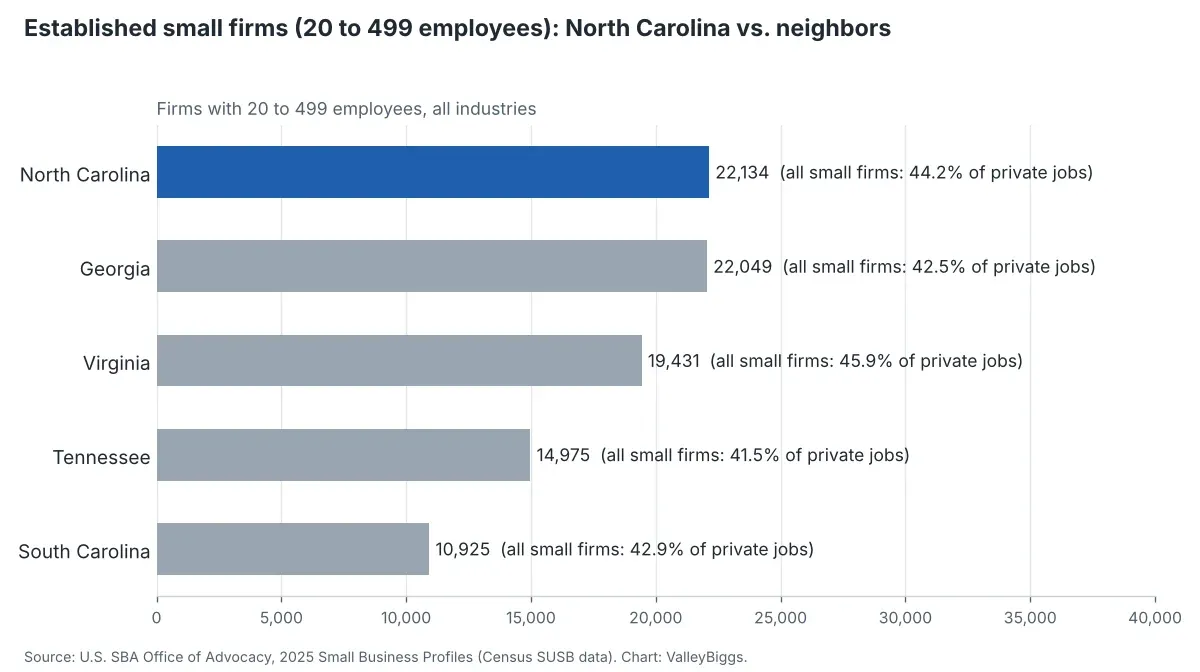
- The SBA Office of Advocacy counts about 1.1 million small businesses in North Carolina, and 22,134 of them have 20 to 499 employees. That band, plus the larger firms with fewer than 20 staff, is where most brokered sales happen.
- Charlotte, the Research Triangle and the Piedmont Triad each draw a different buyer mix, so a broker’s regional track record matters as much as its brand.
- North Carolina has no separate business broker license. Real estate licensing under Chapter 93A of the General Statutes applies when property is part of the deal.
- Under G.S. 105-164.38, a buyer must hold back enough of the price to cover unpaid sales and use tax until the seller shows a statement from the Department of Revenue, and the seller has 30 days to file a final return.
- Compare firms on closed deals similar to yours, who will run your file day to day, how the price estimate was built, and how buyers are screened before they see financials.
North Carolina Business Landscape in 2027
North Carolina’s small business base is large and broad. The SBA Office of Advocacy’s 2025 state profile reports roughly 1.1 million small businesses, 99.6 percent of all firms in the state, employing about 1.8 million people, or 44.2 percent of the private workforce. Most of those businesses have no employees at all. The group that matters for a broker-led sale is smaller: 22,134 firms with 20 to 499 employees, plus the upper end of the 170,817 firms with 1 to 19 staff.
That count of established employers is slightly higher than Georgia’s and roughly double South Carolina’s. For an owner, the practical meaning is a deep local pool of comparable companies, active regional buyers, and plenty of brokerage offices competing for listings, which makes careful selection among North Carolina business brokers more important, not less.
Which industries generate the most North Carolina deals?
Employment is a useful proxy for where sellable companies sit, because buyers pay for teams, customers and repeatable earnings. According to the same SBA profile, these sectors employ the most people at North Carolina small businesses:
- Accommodation and food services: 276,148 employees
- Health care and social assistance: 255,024
- Construction: 191,403
- Retail trade: 156,433
- Manufacturing: 155,318
- Professional, scientific and technical services: 144,439
- Wholesale trade: 93,113
Construction and trades, health care services, manufacturing and distribution tend to attract private equity add-ons and strategic buyers. Professional and technical services, which include IT services and software development, are where tech-focused advisors see the strongest out-of-state interest.
How do North Carolina’s regions differ for sellers?
A broker who closes deals in one corner of the state may have thin relationships in another. Before you shortlist anyone, ask where their recent closings were.
- Charlotte metro: the state’s banking and corporate center, home to Bank of America’s headquarters. Expect financial services vendors, business services firms, logistics and construction companies, with plenty of private equity and family office buyers based locally. When you interview Charlotte business brokers, ask how many of their recent buyers were based in the region.
- Research Triangle (Raleigh, Durham, Chapel Hill): anchored by three research universities and Research Triangle Park. Software, IT services, life sciences suppliers and professional services firms here often draw national strategic buyers. When you meet Raleigh business brokers, ask how often their buyers come from outside the state.
- Piedmont Triad (Greensboro, Winston-Salem, High Point): a manufacturing, furniture and distribution corridor. Owners there can compare notes with our guide for Winston-Salem business owners.
- Coast and mountains (Wilmington, Asheville): tourism, hospitality, marine and home services businesses, plus a growing base of remote-run online companies whose buyers rarely care where the founder lives.
What Does a Business Broker in North Carolina Do?
A broker or M&A advisor runs the sale so the owner can keep running the company. On a typical engagement the firm will:
- Recast your financials into seller’s discretionary earnings (SDE) or adjusted EBITDA and build a defensible asking price or valuation range.
- Write a blind teaser and a confidential information memorandum that present the business without exposing its name.
- Identify buyers (individuals, search funds, private equity platforms, family offices and strategic acquirers) and require signed NDAs before releasing details.
- Screen buyers for financing, experience and fit, then schedule management meetings.
- Collect letters of intent, compare price and structure, and negotiate terms such as cash at close, seller notes, earnouts and working capital targets.
- Coordinate due diligence, lenders, attorneys and accountants through closing.
If you want the full sequence from the seller’s side, our step-by-step guide to selling a business walks through each stage in more detail.
Do business brokers need a license in North Carolina?
North Carolina does not issue a separate business broker license. The state’s Real Estate License Law, Chapter 93A of the General Statutes, does require a real estate broker license for anyone who sells or leases real property for others for a fee, so a firm that handles the building or a lease assignment as part of your deal should have that covered or bring in a licensed partner.
Stock sales can also raise federal securities questions. A 2023 amendment to the Securities Exchange Act created an exemption for M&A brokers in many private company sales, but it has conditions. Ask each firm how it is licensed or exempt for the structure you expect, and confirm the answer with your attorney. This section is general information, not legal advice.
How to Choose Business Brokers North Carolina Sellers Can Rely On
Interview at least three firms. Use the scorecard below in each first meeting and write the answers down, because the differences between firms show up in specifics, not in pitch decks.
| What to ask | A strong answer | A warning sign |
|---|---|---|
| Closed deals like yours | Named sectors, size bands and buyer types from the last few years | Only total deal counts or network-wide figures |
| Who runs your file | One named lead advisor plus analyst support, with clear availability | A senior partner pitches, then hands you to someone new |
| How the price was built | Recast earnings, comparable transactions and a range with reasons | A high number with no math behind it |
| Buyer outreach plan | A target list mixing strategic, private equity and individual buyers | Posting a listing online and waiting |
| Confidentiality controls | Blind teaser, signed NDA, proof of funds before financials | Your name visible in early marketing |
| Engagement terms | Clear term length, tail period and what any upfront fee covers | Long exclusivity with vague exit rights |
| Deal structure experience | Can explain earnouts, seller notes and working capital pegs with examples | Talks only about headline price |
Before the meetings, it helps to know your own number. An independent enterprise valuation analysis gives you a baseline, so you can tell whether a broker’s estimate is grounded or simply designed to win the listing.
Top 10 Business Brokers in North Carolina for 2027
The list mixes national advisors with broad buyer reach and North Carolina offices with long local histories. Each profile reflects what the firm says about itself on its own website, reviewed in November 2026. Office locations, deal ranges and services change, so confirm the details directly before you engage anyone.
| # | Firm | North Carolina presence | Stated focus |
|---|---|---|---|
| 1 | Website Closers | National firm that works with North Carolina sellers | Tech and internet companies |
| 2 | Viking Mergers & Acquisitions | Charlotte, where the firm started in 1996 | Companies valued from about $1M to $150M+ |
| 3 | ValleyBiggs | National firm that works with North Carolina sellers | Software, SaaS, ecommerce and other growth companies |
| 4 | Sunbelt Business Brokers (North Carolina offices) | Charlotte, Fayetteville, Greensboro, Raleigh and Wilmington | Raleigh office: revenues from about $100K to $50M |
| 5 | Transworld Business Advisors of Central NC | Raleigh, serving the Triangle, Greensboro and Pinehurst | Many clients with $1M to $30M in revenue |
| 6 | SellerForce | National firm that works with North Carolina sellers | Online and traditional businesses |
| 7 | VR Business Sales Charlotte | Charlotte office | Business sales and M&A |
| 8 | BMI Mergers & Acquisitions | Uptown Charlotte office | Lower middle market, about $3M to $150M in revenue |
| 9 | DealPipe | National firm that works with North Carolina sellers | Lower middle market online and operating companies |
| 10 | Murphy Business Sales (North Carolina offices) | Charlotte, the Triad and eastern North Carolina | Business sales, M&A and valuations |
1. Website Closers
Website Closers concentrates on internet and technology companies: software and subscription products, ecommerce brands, apps, digital agencies and content properties. It markets those businesses to a national base of strategic acquirers and private equity groups. For a founder in Durham or South End whose most likely buyer is a software platform in another state, that national reach is the main reason to start the conversation early.
2. Viking Mergers & Acquisitions
Viking says it was founded in Charlotte in 1996 and has since grown to more than 20 offices, describing itself mainly as a sell-side advisor for privately held companies. Its Charlotte page splits the work into business brokerage for companies of roughly $1 million to $10 million and M&A advisory for roughly $10 million to $100 million and up. The firm reports more than 950 deals closed and lists recapitalizations and partial liquidity transactions among its services, which suits owners weighing a partial exit.
3. ValleyBiggs
ValleyBiggs works with owners of SaaS, software, ecommerce and other digital and growth companies. Several people on our team built and sold companies of their own before advising sellers. Every client gets a dedicated deal team, and we are paid when a transaction closes, so there is no fee if the sale does not happen. North Carolina founders in IT services, fintech, health tech and consumer brands can see how we run buyer outreach and negotiations on our sell-side assistance page and in our guide to selling a technology business.
4. Sunbelt Business Brokers (North Carolina offices)
Sunbelt lists five North Carolina offices: Charlotte (based in Davidson), Fayetteville, Greensboro/High Point, Raleigh and Wilmington (based in Carolina Beach). Each operates as part of the Sunbelt network. The Raleigh office says it serves companies with annual revenues from about $100,000 to $50 million, names industries from automotive services and manufacturing to construction, pet care and landscaping, and reports a 95 percent close rate since inception. Owners who want a local office with network-wide buyer traffic may find it a natural fit.
5. Transworld Business Advisors of Central NC
The Raleigh-based Transworld office says it serves owners across the Triangle, Greensboro and Pinehurst, and that many of its clients report $1 million to $30 million in annual revenue. Services include sell-side representation, valuations and a more targeted M&A process for larger or strategic deals. It draws on the Transworld franchise network, which reports more than 15,000 businesses sold, and the office cites a 96 percent historical closing ratio. Transworld also lists a Charlotte Metro office.
6. SellerForce
SellerForce lists online businesses next to service companies and storefront operations, and it relies on wide promotion to generate a high volume of buyer inquiries. North Carolina owners who want maximum visibility for a listing may like that approach. Before signing, ask how inquiries are filtered and at what stage a buyer is allowed to see your financial statements.
7. VR Business Sales Charlotte
VR Business Sales Charlotte operates from an office in the Ayrsley area of southwest Charlotte and is part of the VR network, which says it has been selling privately held businesses since 1979. The office handles business sales, buyer representation and M&A, and says each of its advisors has owned a business. It lists memberships including the IBBA, M&A Source and the Carolinas-Virginia Business Brokers Association, which may appeal to owners who want local, association-backed brokers.
8. BMI Mergers & Acquisitions
BMI describes itself as a sell-side and buy-side advisor for lower middle market companies with about $3 million to $150 million in revenue, with offices in Philadelphia, New York and uptown Charlotte. Its listed sectors include manufacturing and distribution, electronics, construction and building services, software and technology services, and business services. Owners of established industrial or B2B services companies in the Carolinas may want to include it on a shortlist.
9. DealPipe
DealPipe works with lower and middle market owners of both digital businesses and companies with staff, facilities and inventory. It gives sellers a structured, trackable view of buyer activity, which suits owners who want to see where each prospect stands at any point in the process. Ask for examples of closed deals in your sector before you commit.
10. Murphy Business Sales (North Carolina offices)
Murphy operates several North Carolina offices. Its Charlotte office handles business sales, purchases and valuations, while the Western and Central Carolinas office says it covers Charlotte, Greensboro, the Triad, Raleigh-Durham, Hickory and Wilmington. In eastern North Carolina, the Murphy Mergers & Acquisitions team presents itself as a business brokerage and M&A group serving Raleigh, Durham, Greenville, New Bern, Wilmington and the Outer Banks. Murphy offers valuations ranging from a broker’s opinion of value to certified reports.
When Should You Sell Your North Carolina Business?
The right time is usually when the business, the market and your personal plans line up. Watch for these signals:
- Earnings have grown for two or three years in a row and the next year’s forecast is credible.
- Revenue is no longer concentrated in one or two customers.
- A management team can run daily operations without you.
- You are receiving unsolicited approaches from competitors or private equity groups.
- Growth now requires capital, hiring or risk you no longer want to take on.
- Personal timing: retirement, health, family or a new venture.
Taxes are part of timing too. North Carolina’s individual income tax rate is 3.99 percent for tax years after 2025, and the Department of Revenue notes further reductions may apply from 2027 if revenue triggers are met. The corporate income tax rate is 2.00 percent for 2026 under a scheduled phase-down. Ask your CPA how the timing of a closing and the deal structure affect your federal and state bill.
Typical Sale Process in North Carolina
Most brokered sales follow the same sequence. The length of each stage depends on deal size, buyer financing and how prepared you are.
- Preparation: clean up financial statements, contracts and corporate records; resolve open tax or legal issues.
- Valuation: recast earnings, review comparable transactions and agree on a pricing strategy with your advisor.
- Marketing: release a blind teaser, collect NDAs and share the confidential information memorandum with screened buyers.
- Buyer meetings and offers: hold management meetings, then compare letters of intent on price, structure and certainty.
- Due diligence: the buyer and its lender review financial, legal, tax, HR and operational records.
- Closing: sign the purchase agreement, settle working capital, transfer licenses and accounts, and file final state returns.
| Stage | What the seller provides | North Carolina detail to plan for |
|---|---|---|
| Preparation | Three years of financials, tax returns, customer and vendor contracts | Confirm your entity is in good standing with the Secretary of State |
| Marketing | Business overview, team chart, growth plan | Decide whether to tell key employees before or after signing |
| Offers | Answers to buyer questions, management availability | Real estate or lease issues may need a licensed real estate broker |
| Due diligence | Data room with financial, legal and HR records | Sales and use tax history; payroll and unemployment insurance filings |
| Closing | Signed agreements, transition plan | Final sales and use tax return within 30 days of transfer (G.S. 105-164.38) |
North Carolina tax steps sellers should plan for
North Carolina places a lien for unpaid sales and use tax on the personal property of a registered business that transfers the business or its stock of goods. Under G.S. 105-164.38, the seller must file the required return within 30 days after the transfer. The buyer must withhold enough of the purchase price to cover taxes due until the seller produces a statement from the Secretary of Revenue showing the taxes are paid or that none are due.
If the buyer skips that holdback and taxes are still unpaid after 30 days, the buyer becomes personally liable up to the greater of the price paid or the fair market value of the business or stock of goods. Buyers and their lenders know this rule, so request the Department of Revenue statement early to keep it from delaying closing. Corporate sellers should also budget for final franchise tax and income tax filings. This is general information, not tax or legal advice.
Compare Neighboring Markets
Many North Carolina companies sell to buyers in nearby states, and owners near the borders often talk to brokers on both sides. Here is how the five markets compare on the SBA’s 2025 figures.
| State | Small businesses | Firms with 20 to 499 employees | Small business share of private jobs | ValleyBiggs state guide |
|---|---|---|---|---|
| North Carolina | about 1.1 million | 22,134 | 44.2% | This guide |
| Georgia | about 1.37 million | 22,049 | 42.5% | Georgia broker rankings |
| Virginia | 880,366 | 19,431 | 45.9% | Not yet published |
| Tennessee | 741,196 | 14,975 | 41.5% | Tennessee broker list |
| South Carolina | 530,402 | 10,925 | 42.9% | South Carolina top 10 |
North Carolina and Georgia have nearly identical counts of established employers, while South Carolina’s is about half as large. For sellers in Charlotte, Rock Hill and the Upstate, buyer pools overlap heavily across the state line. You can browse all of our state and city broker guides to compare other markets.
When to Talk to an Advisor
Bring in an advisor before you tell anyone outside your leadership team that you might sell. Early conversations are most useful when:
- You have received an unsolicited offer and do not know whether it is fair.
- You expect a sale within one to three years and want time to fix weak points.
- Your company is likely to attract private equity or strategic buyers from outside North Carolina.
- The deal may involve real estate, multiple owners or a partial sale.
A good advisor will tell you honestly whether to sell now, wait, or prepare first, and should be comfortable explaining how buyers will view your earnings.
Conclusion
North Carolina offers sellers a large pool of comparable companies and active buyers, along with dozens of brokerage offices competing for listings. Narrow the field by deal size, sector and buyer reach, check every claim against the firm’s closed transactions, and plan early for the sales tax statement your buyer will require. If you own a software, SaaS, ecommerce or other growth company in the state, schedule a confidential consultation with ValleyBiggs to discuss value, timing and buyer interest.
FAQs
1. How much does a business broker charge in North Carolina?
Most business brokers in North Carolina are paid mainly through a success fee at closing, sometimes with a monthly retainer or upfront marketing fee. Structures vary by deal size and firm, so compare full engagement terms, including minimum fees, tail periods and what any upfront payment covers, before you sign. Ask each firm to put the complete fee schedule in writing.
2. Do you need a license to be a business broker in North Carolina?
No separate business broker license exists in North Carolina. A real estate broker license under Chapter 93A of the General Statutes is required when someone sells or leases real property for others for compensation, which can apply when a building or lease is part of the sale. Stock sales may also raise securities questions, so confirm licensing with your attorney.
3. How long does it take to sell a business in North Carolina?
Timing depends on deal size, preparation, buyer financing and how quickly diligence moves, so there is no fixed schedule. Many owners spend months preparing records before going to market, then several more months on marketing, offers, due diligence and closing. Having clean financials, contracts and tax filings ready before launch is the most reliable way to shorten the process.
4. What is the difference between a business broker and an M&A advisor?
Business brokers usually handle smaller companies and often market them more broadly, while M&A advisors run targeted processes for larger companies, reaching private equity firms and strategic acquirers. Many North Carolina firms do both. For companies with several million dollars of earnings, an M&A investment banking process may produce stronger competition among buyers.
5. Does a buyer have to withhold money for sales tax when buying a North Carolina business?
Yes. Under G.S. 105-164.38, the buyer must withhold enough of the price to cover sales and use taxes due until the seller produces a statement from the Department of Revenue showing the taxes are paid or none are due. A buyer who skips this can become personally liable. This is general information, not tax advice.
6. Should I hire a local North Carolina broker or a national firm?
Choose based on who is most likely to buy your company. A local office knows regional buyers, lenders and landlords, which helps for service, retail and trades businesses. A national firm usually reaches more out-of-state strategic and private equity buyers, which matters for software, ecommerce and other tech companies. Many sellers interview both before deciding.