

To sell shares in a private company, you need three things: permission under the company’s own agreements, a buyer who is allowed to buy, and a price both sides can defend. Most sales go to the company itself, to the other owners, or to an outside investor the board approves.
This guide explains how to sell shares in a private company when you are a founder, co-owner or early investor in an established business rather than a startup employee with options. It covers the six realistic routes, the transfer rules that block most sales, how a minority stake is priced, the securities and tax points to raise with counsel, and a step-by-step process with a documents checklist.
Key Takeaways
- Your shareholder agreement, bylaws and any buy-sell agreement decide who can buy your shares, at what price, and with whose consent. Read them before you talk to anyone.
- A right of first refusal lets the company or the other owners match any outside offer, so outside buyers often want it waived before they spend money on diligence.
- A minority stake is usually priced below its pro rata share of company value because the buyer gets no control and limited liquidity. Selling alongside a full company sale avoids most of that gap.
- Shares in a private company are usually restricted securities, so resales rely on exemptions such as Rule 144 or Section 4(a)(7) and typically go to accredited investors.
- Holding period, entity type (C corp or S corp), redemption rules and QSBS status can change your after-tax result by a wide margin. Plan the tax side before you sign.
First, Decide What Kind of Sale You Are Making
The phrase “selling shares” covers very different transactions. Selling a 10% stake to a co-founder is a private negotiation between two people. Selling your 40% stake while the business is acquired is part of an M&A process with a buyer, lawyers and a purchase agreement. The route, the price logic and the paperwork follow from which of these you are in.
| Your situation | Most likely buyer | What usually sets the price |
|---|---|---|
| You want partial liquidity and the company stays independent | The company (buyback) or the other owners | Formula or appraisal in the buy-sell agreement, or a negotiated value with a minority discount |
| A co-owner wants out, or there is a dispute | Remaining owners, often with a note paid over time | Buy-sell formula, independent appraisal, or negotiation |
| The company raises capital and lets early holders sell some shares | New investor in a secondary alongside the round | Price of the new round, often with a discount for common stock |
| The board runs a liquidity program | The company or investors it lines up (tender offer) | A single price set by the company |
| You want a large partial exit while keeping a stake | Private equity or a family office (recapitalization) | Enterprise value from earnings multiples, then the equity split |
| Everyone sells | Strategic acquirer or financial sponsor | Full company value, paid out pro rata under the purchase agreement |
Private company shares come with strings attached. Before you approach a buyer, pull every document that touches your equity and read the transfer provisions line by line. Buyers and their counsel will ask for these first, and a missed consent right can void a transfer after the fact.
- Shareholder or stockholders’ agreement: transfer restrictions, consent rights, right of first refusal, co-sale (tag-along) and drag-along rights, and any lock-up.
- Buy-sell agreement: triggers such as death, disability, divorce, departure or retirement, plus the pricing method and payment terms. In many closely held companies this document, not the market, sets the price.
- Bylaws and articles of incorporation: some companies put transfer limits or board approval requirements here rather than in a separate agreement.
- Stock certificates or the cap table entry: restrictive legends, share class (common or preferred) and the exact number of shares you hold.
- Investor rights and voting agreements: if the company has institutional investors, they may hold their own ROFR or co-sale rights that sit on top of the company’s.
- Option, RSU or restricted stock grants: vesting, repurchase rights for unvested shares, and post-departure exercise windows.
- S corporation status: an S corporation can have no more than 100 shareholders, generally individuals and certain trusts and estates, and only one class of stock, according to the IRS. A sale to a corporation, partnership or nonresident alien can end the S election for everyone, so owners usually restrict who can buy.
- Spousal consent: in community property states, a spouse may need to sign the transfer documents.
Two clauses matter most. A right of first refusal gives the company, and sometimes the other owners, the option to buy your shares on the same terms an outside buyer offered, within a notice window set in the agreement. A drag-along lets a majority force minority holders to sell on the same terms in a company sale, while a tag-along lets you join a sale the majority negotiates. Knowing which of these you hold tells you how much leverage you have.
1. Sell back to the company
A redemption or buyback is often the simplest route because the company already knows the business and controls the approvals. The trade-off is price: the company may offer a formula value, and its ability to pay depends on cash, lender covenants and state law limits on distributions. Payment over time is common.
2. Sell to the other owners
Co-owners are natural buyers, and a buy-sell agreement may require you to offer them the shares first. Buyouts between owners frequently use a down payment plus a promissory note. If the other owners are buying out a founder who runs the business, the structure can look a lot like a management buyout, including outside debt.
3. Join a tender offer or company liquidity program
Some venture-backed companies run a tender offer where the company or selected investors buy shares from many holders at one price. Under SEC Rule 14e-1, a tender offer must stay open for at least 20 business days. You cannot start one yourself, and participation limits are common, so this route depends on the board.
4. Use a secondary platform or broker-dealer
Registered broker-dealers and secondary platforms match sellers of private company stock with accredited and institutional buyers. This works best for well-known, venture-backed companies with demand for their shares. For a profitable private business with no public profile, there is rarely an active order book, and the company still has to approve the transfer.
5. Sell to an outside investor
A family office, private equity fund or strategic investor may buy a meaningful stake, sometimes as part of a recapitalization in which the company also takes on debt or new equity. Expect diligence close to that of a full acquisition, a negotiated shareholder agreement for the new investor, and a price built from earnings multiples rather than a formula.
6. Sell as part of a sale of the whole company
If the majority is open to an exit, selling 100% of the company usually produces the highest price per share, because the buyer pays for control and the discount on a minority stake largely disappears. Each holder receives a share of the equity value left after debt and other adjustments, according to the share classes and the purchase agreement. This is the route where a sell-side advisor adds the most.
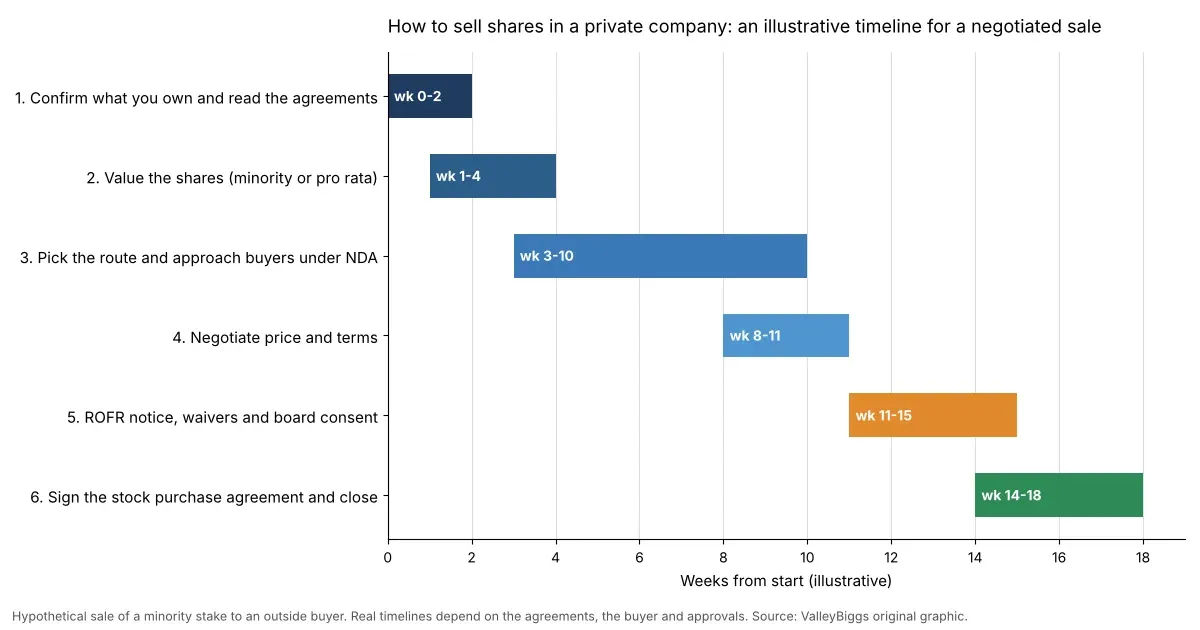
The order below fits a negotiated sale of a stake to another owner or an outside buyer. A tender offer or a full company sale follows its own process, but the first three steps apply to every route.
- Confirm exactly what you own. Match your records to the cap table: number of shares, class, vesting, any liens or pledges, and whether the shares are held personally, by a trust or by an entity.
- Map every restriction and consent. List the ROFR notice period, who holds it, board or shareholder consents, lock-ups, and anything the buyer must sign, such as a joinder to the shareholder agreement.
- Get an independent view of value. Decide whether you are pricing a pro rata slice of the company or a minority interest, and get a valuation that states which. A recent 409A report is a reference point, not a price.
- Choose the route and the buyer universe. Insiders first if the agreements require it, then outside investors who are allowed to own the shares, such as accredited investors and buyers that do not break an S election.
- Share information under an NDA. Get company consent before disclosing financials. Many shareholder agreements limit what a holder can share with third parties.
- Negotiate a term sheet. Agree on price per share, cash at closing versus notes, conditions, and who pays legal and transfer costs. A short, non-binding letter of intent keeps both sides aligned before lawyers draft the full agreement.
- Run the ROFR and approvals. Deliver the formal notice with the buyer’s terms, wait out or obtain waivers of the refusal period, and collect board and any shareholder consents in writing.
- Sign the stock purchase agreement and close. Expect representations about title and authority, a stock power or assignment, an updated cap table, and payment by wire. Keep a full closing set for your tax preparer.
There is no market quote, so price comes from a valuation method both sides accept. For an operating business, that usually starts with company value and works down to your shares.
- Company value first. Buyers of established companies typically apply a multiple to normalized EBITDA or seller’s discretionary earnings, cross-checked against comparable deals. Our valuation team can show which method fits your company.
- Bridge to equity. Subtract debt and debt-like items, add excess cash, and adjust for working capital to reach equity value.
- Allocate by class. Preferred stock with liquidation preferences gets paid before common, so the value of a common share can be well below the headline price per share of the last round.
- Adjust for a minority interest. A buyer of a non-controlling stake cannot set strategy, salaries or distributions and may not be able to resell easily. Appraisers express this as discounts for lack of control and lack of marketability, sized case by case. The IRS publishes guidance for its own valuation staff on marketability discounts, which shows how contested the size of these discounts can be.
The hypothetical example below shows why the route matters as much as the company’s value.
| Hypothetical: 25% stake in a company with $14M enterprise value | Sell the stake alone | Sell with the whole company |
|---|---|---|
| Enterprise value | $14.0M | $14.0M |
| Less net debt | ($2.0M) | ($2.0M) |
| Equity value | $12.0M | $12.0M |
| Pro rata value of 25% | $3.0M | $3.0M |
| Minority and marketability adjustment (assumed 25% for illustration) | ($0.75M) | Not applied |
| Indicative price before fees and taxes | $2.25M | $3.0M, subject to escrow and closing adjustments |
The 25% adjustment is an assumption for this example only. Real discounts depend on the agreements, the company’s distribution history, and who the buyer is. An insider who already controls the company may value your shares differently from an outside investor. A formal enterprise valuation analysis gives you a defensible number before you negotiate.
Shares you received from a private company are usually “restricted securities” because they were issued in a private placement. You cannot offer them to the general public. Resales go through an exemption, and the company’s counsel will normally want to see which one applies before it records the transfer. This section is general information, not legal advice.
- Rule 144. For a company that does not file reports with the SEC, restricted securities generally must be held for at least one year before resale under Rule 144, and holders who are affiliates, such as officers, directors and large owners, face extra conditions.
- Section 4(a)(7). This exemption covers private resales to accredited investors when there is no general solicitation and certain information about the company is available to the buyer.
- Accredited investors. Under the SEC definition, an individual qualifies with income above $200,000 (or $300,000 with a spouse or spousal equivalent) in each of the last two years, net worth above $1 million excluding a primary residence, or certain professional licenses such as the Series 7, 65 or 82.
- No advertising. Posting your shares for sale on social media or a public listing site can break an exemption. Use counsel, the company, or a registered broker-dealer to reach buyers.
Tax Points to Raise With Your CPA
Taxes often decide whether a sale makes sense and how it should be structured. The points below are general and not tax advice; your CPA or tax attorney should run the numbers on your facts.
- Holding period. Gains on shares held more than one year are long-term capital gains, taxed federally at 0%, 15% or 20% depending on income. The 3.8% net investment income tax can also apply above IRS thresholds. Shares held one year or less are taxed at ordinary rates.
- Basis. Your gain is the price minus your basis. Basis from option exercises, gifts, inheritances or S corporation income and distributions needs to be documented before closing.
- Equity compensation. Incentive stock options, nonqualified options and RSUs each have their own rules, and a sale soon after exercise can turn capital gain into ordinary income.
- Buybacks by the company. A redemption is treated as a sale only if it meets one of the tests in Section 302 of the Internal Revenue Code, such as a complete termination of your interest. Otherwise it can be taxed as a distribution, and family attribution rules can apply.
- Qualified small business stock. C corporation stock acquired at original issuance may qualify for the Section 1202 exclusion. For stock issued after July 4, 2025, the exclusion is 50% after three years, 75% after four and 100% after five, with a higher per-issuer cap. Older stock generally needs five years. A buyer of your shares in a secondary sale does not inherit QSBS status.
- Payment over time. If part of the price is a promissory note, the installment method may let you spread the gain across the years you are paid. Pair it with a security interest in the shares or a guarantee; the note terms matter as much as the price.
- State tax. Your state of residence at the time of sale usually decides which state taxes the gain. Moving shortly before a sale draws scrutiny.
Typical Timelines by Route
| Route | Typical timeline (indicative) | Main bottleneck |
|---|---|---|
| Buyback or sale to co-owners under a buy-sell agreement | A few weeks to a few months | Appraisal, financing the payment, board approval |
| Company tender offer | At least 20 business days once launched | Whether and when the board runs one |
| Secondary platform sale | Often one to three months | Buyer demand, ROFR window, company sign-off |
| Outside investor or recapitalization | Often three to six months | Diligence, negotiation of new governance rights |
| Sale of the whole company | Often six months or longer | Marketing, buyer diligence, purchase agreement |
Documents Checklist
- Cap table extract and your share certificates or electronic share records
- Shareholder agreement, buy-sell agreement, bylaws and articles, with all amendments
- Option, RSU or restricted stock grant agreements and exercise records
- Board and shareholder consents for the transfer, plus ROFR notices and waivers
- Latest financial statements and any recent valuation or 409A report the company allows you to share
- NDA with the buyer and the signed letter of intent or term sheet
- Stock purchase agreement, stock power or assignment, and any promissory note and security agreement
- Spousal consent where required
- Basis records and prior tax returns showing how the shares were acquired
If the buyer runs full diligence on the company, our due diligence checklist for selling a business lists what the company itself will be asked to produce.
- Negotiating a price with an outside buyer before checking the ROFR, then losing the deal or the buyer’s goodwill when insiders match it.
- Assuming the 409A value or the last round price is what a buyer will pay for common stock.
- Sharing confidential financials without company consent and breaching the shareholder agreement.
- Selling to a buyer who cannot hold the shares, such as an entity that would end the company’s S election.
- Accepting a long promissory note with no security, no personal guarantee and no default terms.
- Ignoring timing: selling a few weeks before a holding period or QSBS milestone, or just before a full company sale that would have paid more per share.
- Using a pricing formula in an old buy-sell agreement that no longer reflects what the company is worth, without asking for an update first.
If you hold a large stake and the other owners are also thinking about liquidity, compare a stake sale with a sale of the entire business before you commit. A full sale gives every holder the control value and a single negotiation, while a stake sale gives you speed and lets the others keep running the company. Our step-by-step guide on how to sell a business covers the full-company route. If your company is an LLC, you are selling membership interests rather than shares, and the operating agreement plays the role described above; see selling an LLC for that version.
When to Talk to an Advisor
A short call with an advisor is worth it before you sign anything if any of these apply:
- Your stake is worth seven figures or more, or it is most of your net worth.
- The agreements give someone else a refusal right, a drag-along, or a formula price you think is out of date.
- Co-owners disagree about selling, or the sale is tied to a departure or dispute.
- An outside investor or private equity firm has approached the company about a recapitalization.
- The majority might sell the whole company within the next year or two.
A corporate attorney handles the agreements and securities exemptions, a CPA handles basis and tax structure, and an M&A advisor helps with value, buyers and negotiation. ValleyBiggs works with owners of tech, SaaS, ecommerce and other growth companies on exit planning and partial or full exits, and our sell-side assistance covers the process when the whole company goes to market.
Conclusion
Learning how to sell shares in a private company starts with your own paperwork: who must approve the sale, who can match the price, and who is allowed to buy. From there, the route you pick, from a quiet buyback to a sale of the whole business, sets both your price and your timeline. Value the stake on the right basis, line up the tax plan before you sign, and keep the company’s counsel informed at every step.
If you are weighing a partial sale against a full exit, book a confidential consultation with ValleyBiggs and we will help you compare the options for your company.
FAQs
1. How do I sell my private shares?
Start with your shareholder and buy-sell agreements to see who must approve the sale and who holds a right of first refusal. Then get a valuation, offer the shares to the company or other owners if the agreements require it, and approach approved outside buyers through counsel or a registered broker-dealer. Close with a stock purchase agreement and an updated cap table.
2. Why am I not able to sell my shares?
Private company shares usually carry transfer restrictions. The company may require board consent, hold a right of first refusal, impose a lock-up, or limit buyers to accredited investors or owners who keep an S election intact. Securities rules also restrict resales of unregistered shares. Ask the company secretary or counsel which restriction applies to your shares.
3. Can I sell shares in a private company to anyone?
No. Buyers usually need company approval, and resales of restricted securities generally go to accredited investors under exemptions such as Section 4(a)(7) or after the Rule 144 holding period. Advertising the shares publicly can break those exemptions, so outreach should go through counsel, the company or a registered broker-dealer.
4. Can a company force me to sell my shares?
It can if you signed an agreement that allows it. A drag-along clause can require minority holders to join a company sale on the same terms, and a buy-sell agreement can trigger a mandatory sale when an owner leaves, dies or becomes disabled. Unvested shares may also be subject to a company repurchase right.
5. How long does it take to sell shares in a private company?
A buyback or sale to co-owners can close within weeks when the agreement already sets the price. Sales to outside buyers often take one to six months because of valuation, diligence and the refusal period. A sale of the whole company commonly takes six months or more from preparation to closing.
6. Do I pay tax when I sell private company stock?
Usually yes. Gain above your basis on shares held more than a year is long-term capital gain, taxed federally at 0%, 15% or 20%, possibly plus the 3.8% net investment income tax. QSBS may exclude some or all of the gain, and seller financing can spread it over several years. This is not tax advice.