

To sell a website, you prove what it earns, package its assets, choose the right sale channel and transfer everything through a secure closing. For a site that makes $100,000 or more in annual profit, how to sell a website is less about listing it somewhere and more about running a small M&A process: clean books, verified traffic, qualified buyers and a deal structure that turns a headline price into cash in your account.
This guide walks through each step in order, from readiness checks to domain transfer, with a hypothetical worked example, a channel comparison and a timeline you can plan around.
Key Takeaways
- Buyers pay for verified, repeatable profit. Twelve months of clean records is the practical minimum; 24 to 36 months is better for larger sites.
- Most website deals are asset sales: the domain, content, code, email list, social accounts and supplier relationships move to the buyer, not your company.
- Owner-run sites are usually priced on seller’s discretionary earnings (SDE); sites with a team and systems are more often priced on EBITDA.
- Traffic concentration is the biggest discount driver. A site that depends on one search engine, one affiliate program or one ad network will be priced for that risk.
- Compare offers on cash at closing and risk, not on the headline number.
What Selling a Website Actually Means
Search results for this topic mix two very different jobs. One is a web designer selling a new site to a client. The other, covered here, is an owner selling an existing website that already earns money: a content and affiliate site, an online store, a lead generation site, a membership or digital product site, or a small software tool with a marketing site attached.
When you sell that kind of website, you are almost always selling a set of business assets rather than shares in a company. The buyer acquires the income stream and everything needed to keep it running. If the domain itself is the main asset and there is little revenue, the process looks different; our guide on selling a domain name on its own covers that case.
| Asset | How it usually transfers | What the buyer checks |
|---|---|---|
| Domain name | Registrar push or transfer after funds clear escrow | Registration history, renewal date, trademark conflicts |
| Content, code and design files | Server or CMS migration, repository access | Ownership of written content, licensed themes and plugins |
| Hosting and software accounts | Account handover or rebuild on the buyer’s accounts | Monthly costs, contracts that cannot be assigned |
| Email list and customer data | Export and import, subject to your privacy policy | List size, consent records, engagement rates |
| Revenue relationships | New agreements in the buyer’s name (affiliate, ad network, suppliers) | Whether each partner allows a transfer or requires a new application |
| Social profiles and brand assets | Ownership change per each platform’s rules | Real engagement, platform policy on transfers |
Is Your Website Ready to Sell?
Before you think about price, check whether a careful buyer could underwrite the site. Serious buyers for sites in the six- and seven-figure range will ask for proof on each of the points below, and gaps here cost more than almost anything you can fix later in negotiation.
- Earnings history: at least 12 months of revenue and expenses you can document month by month, with no unexplained spikes.
- Verifiable traffic: analytics and search console data that match the revenue story, with read access you can grant to a buyer.
- Stable or rising trend: the last three to six months should not show a decline you cannot explain.
- Clear ownership: you own the domain, the content and the code, and freelancers have assigned their work to you in writing.
- Known owner hours: you can say how many hours a week the site needs and which tasks a buyer would take over.
- Clean compliance: no manual search penalties, no policy strikes on ad or affiliate accounts, and a privacy policy that allows a transfer of subscriber data in a sale.
How to Sell a Website in 9 Steps
The sequence below fits a site with roughly $100,000 or more in annual profit. Smaller sites can compress some steps, but skipping them entirely tends to show up later as a lower offer or a deal that falls apart in diligence.
1. Decide what you want from the sale
Write down your goals before anyone gives you a number: the minimum cash you need at closing, how long you are willing to stay on for a handover, whether you would accept part of the price over time, and whether you plan to keep working in the same niche. That last point matters because most buyers will ask for a non-compete.
2. Rebuild your profit and loss statement
Separate the website from everything else you run. Many owners pay for several projects out of one bank account and one set of software subscriptions, which makes the site’s real profit hard to see. Produce a monthly profit and loss statement for the last 12 to 36 months, then list add-backs: personal or unrelated costs, one-time expenses such as a redesign, and any salary you pay yourself. Each add-back needs a receipt or invoice behind it.
3. Prepare proof of traffic and revenue
Buyers want to see the same numbers from more than one source. Prepare read-only access to your analytics property and Google Search Console, plus exports or screenshots from affiliate dashboards, ad networks, payment processors and your store platform. Note that Universal Analytics stopped processing new data in July 2023, so older history may only exist in exports you saved; collect those now.
4. Reduce the risks a buyer will price in
Look at the site the way a skeptical buyer would. If one search engine sends most of your visitors, a single algorithm update can change the business overnight. Google said its March 2024 core update and related spam policies were expected to cut low-quality, unoriginal content in results by 40%, and many content sites saw large swings that year. AI Overviews, which Google rolled out to US users in May 2024, add another variable for informational traffic. You cannot remove these risks, but you can lower them: grow the email list, add a second traffic channel, spread income across more than one partner, and document the processes that keep the site running.
5. Get a realistic valuation
Free website valuation calculators give a rough starting point, but they cannot see your traffic mix, contract terms or trend. For a site in the high six figures or above, an independent enterprise valuation analysis gives you a defensible range before you talk to buyers. The next section explains how website value is usually calculated.
6. Choose your sale channel
Your options range from public marketplaces to curated platforms, website brokers, M&A advisors and direct outreach to a strategic buyer. The right choice depends mostly on size and on how much confidentiality you need. A comparison table follows later in this guide.
7. Market the site confidentially and qualify buyers
Keep the URL private until a buyer signs a non-disclosure agreement and shows they can fund the deal. Publicly revealing a profitable niche invites copycats. A short teaser describing the business model, profit range and growth levers is enough to start conversations; a fuller information package, similar to a confidential information memorandum, comes after the NDA.
8. Negotiate the letter of intent and deal structure
Once a buyer is serious, terms go into a letter of intent: price, how much is paid at closing, any seller financing or earnout, the handover period, the non-compete and the exclusivity window. Push for clarity here, because vague terms in the letter tend to become disputes in the purchase agreement.
9. Close through escrow and migrate the site
After due diligence, both sides sign an asset purchase agreement. The buyer funds escrow, you transfer the assets, the buyer confirms receipt, and escrow releases the funds. Then comes the training period, usually a few weeks, during which you answer questions and introduce the buyer to writers, suppliers and partners.
How Much Is My Website Worth?
Most profitable websites are valued as a multiple of their annual earnings. Which earnings figure is used depends on how the site is run.
- SDE (seller’s discretionary earnings) is used when the owner does a meaningful share of the work. It equals net profit plus the owner’s pay and verified add-backs, and it shows what a single owner-operator would earn.
- EBITDA is more common once a site has a manager or team doing the daily work and the buyer is a fund or a larger company. Our explainer on the EBITDA multiple shows how buyers use it.
Published ranges are wide. Empire Flippers, a curated marketplace, says it usually sets listing prices at about 1.7 to 5 or more times the last 12 months of net profit, and it reported that content sites sold on its platform in 2025 averaged a 2x multiple, with an average sale price of $313,406. Those figures describe one marketplace and mostly smaller sites. Larger businesses with diversified traffic, recurring revenue and a team in place can attract a wider buyer pool and different pricing, so treat any single multiple as a starting point rather than a promise. The table below shows what usually moves a website up or down within a range.
| Factor | Pushes the multiple up | Pushes the multiple down |
|---|---|---|
| Age and track record | Three or more years of steady earnings | Under 12 months, or recent sharp growth with no history |
| Trend | Rising revenue and traffic over the last 6 to 12 months | Decline after an algorithm update or partner change |
| Traffic sources | Mix of search, email, direct and referral | One search engine or one social platform drives most visits |
| Revenue sources | Several partners, products or recurring subscriptions | One affiliate program or one ad network |
| Owner involvement | Documented processes, contractors or staff in place | Owner writes, sells and manages everything |
| Assets | Large engaged email list, original content, own products | Thin or AI-spun content, rented audiences |
| Records | Clean P&L with documented add-backs | Mixed accounts, missing months, unverifiable claims |
Whatever range you start from, the final number is set by the offers you can attract and the terms attached to them, which is why the next sections matter as much as the multiple.
Hypothetical Example: A Content Site With $240,000 in SDE
The figures below are hypothetical and only illustrate the math. Picture a seven-year-old review and buying-guide site that earns from affiliate commissions, display ads and a small paid course. The owner spends about 15 hours a week on editing and partner management, and freelancers write most new articles.
| Line item (trailing 12 months) | Amount |
|---|---|
| Revenue: affiliate, display ads, course sales | $410,000 |
| Operating expenses: writers, editing, hosting, tools, paid ads | ($190,000) |
| Net profit | $220,000 |
| Add-back: one-time site redesign | $14,000 |
| Add-back: software used for the owner’s other project | $6,000 |
| Seller’s discretionary earnings (SDE) | $240,000 |
| Illustrative value at 2.5x to 3.5x SDE | $600,000 to $840,000 |
Now suppose three buyers make offers. The headline prices differ, but so does the share of the price you receive on closing day and the share that depends on how the site performs after you leave.
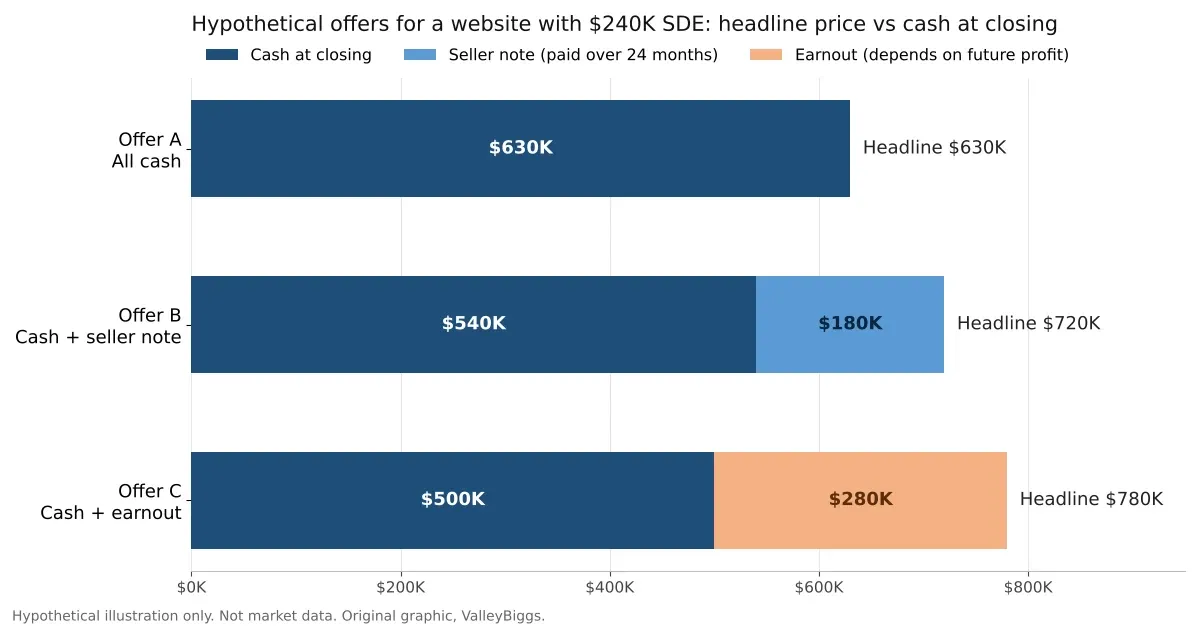
Offer A pays $630,000 in cash. Offer B adds $90,000 to the headline but defers $180,000 into a two-year note, so your result depends on the buyer’s ability to pay. Offer C has the highest headline, yet $280,000 rests on future profit that a new owner will control. Which one is best depends on your cash needs, your confidence in the site’s trend and the protections in the agreement, such as security over the domain until a note is paid.
Where to Sell a Website: Channels Compared
Where you list shapes who sees the opportunity and how much work lands on you. Sellers asking where to sell a website often start with a marketplace by default, but for larger sites the buyer who would pay the most may never browse a marketplace at all.
| Channel | Usual fit | Who vets the numbers | Confidentiality | Your workload |
|---|---|---|---|---|
| Open auction marketplace | Small sites and starter projects | Mostly the buyer | Low; listings are often public | High: you answer questions and run the transfer |
| Curated marketplace | Established sites, roughly five to low seven figures | The platform, then the buyer | Medium; URL hidden until buyers are verified | Medium |
| Website broker | Six- and seven-figure online businesses | Broker, then the buyer | High; NDA first | Medium to low |
| M&A advisor | Larger digital businesses, teams in place, strategic interest | Advisor prepares a full package; buyer runs diligence | High; controlled outreach | Low on process, high on preparation |
| Direct sale to a known buyer | When a competitor or partner has already shown interest | The buyer | High if handled under NDA | High: you negotiate and document everything |
A specialist website broker or advisor earns its fee by widening the buyer pool, preparing the numbers before diligence starts and keeping several bidders engaged at once. For profitable online stores and digital product businesses, our ecommerce sale services follow the same logic. If most of your revenue runs through Amazon, the platform-specific steps in how to sell an Amazon business also apply.
Who Buys Websites With $100K+ in Profit
Knowing who will look at your site helps you prepare the right materials and the right story.
- Individual operators who want to replace a salary with an online business. They focus on owner hours, stability and financing terms.
- Portfolio buyers and holding companies that run many sites with shared writers and tools. They look for cost savings and content they can scale.
- Private equity-backed platforms that buy brands or publishers in a category. They care about EBITDA, systems and the team that stays.
- Strategic buyers such as a brand, retailer, software company or media group that gains customers, data or search visibility from your site. These buyers can sometimes justify more because of what the site adds to their own business.
Due Diligence: What Buyers Will Check
Diligence on a website moves faster than on a traditional company, but buyers still test every claim in your listing. Expect requests for:
- Live screen-shares or direct login access to analytics, search console, affiliate and payment dashboards
- Bank statements that tie deposits to reported revenue
- Traffic by page, channel and country, and how concentrated traffic is on the top 10 pages
- Backlink profile and any history of paid links or penalties
- Contracts with writers, developers, suppliers and sponsors, and whether each can be assigned
- Proof that content, images and code are original or properly licensed
- Email list consent records and the privacy policy in force when subscribers signed up
Our due diligence checklist for sellers covers the wider document set if your website is part of a larger company.
Transferring the Website Safely
The handover is where small mistakes create real losses, so agree on the order of steps in writing. A typical sequence is: buyer funds escrow, you transfer the domain and hosting, you hand over content, code and accounts, the buyer confirms everything works, and escrow releases payment.
A few points catch sellers out. Many registrars apply a 60-day transfer lock after a change of registrant or a recent registrar transfer, so check the domain’s status early and plan whether to move it between accounts at the same registrar instead. Many affiliate and ad programs do not allow accounts to be transferred, which means the buyer may need to apply in their own name, and revenue can dip during that changeover; agree in advance how that affects any earnout. Finally, keep your own copies of financial records before you hand over dashboards, since you will need them for your tax return.
Taxes and Legal Points to Raise Early
This section is general information, not legal or tax advice. Bring in a CPA and a transaction attorney before you sign a letter of intent.
- Purchase price allocation: in an asset sale, buyer and seller generally each file IRS Form 8594 to report how the price is allocated across asset classes. The allocation affects your tax bill, so negotiate it in the agreement rather than leaving it to the end.
- Capital gain or ordinary income: goodwill and other intangibles you have held for more than a year can qualify for long-term capital gain treatment, while amounts tied to inventory, consulting after the sale or a non-compete may be taxed differently.
- The buyer’s side: buyers can generally amortize acquired goodwill and similar intangibles over 15 years under Section 197 of the Internal Revenue Code, which is one reason they prefer asset deals.
- Non-compete scope: non-competes tied to the sale of a business are treated more favorably than employee non-competes in most states, including California, but scope and length still need to be reasonable under state law.
- Intellectual property: confirm that writers and developers assigned their rights to you. Without written assignments, a buyer may ask for a price reduction or a special indemnity.
How Long Does It Take to Sell a Website?
Timing varies with size, channel and how ready your records are. Empire Flippers, for example, reports that its vetting usually takes three to four weeks and that the average business on its marketplace sells in 131 days. Larger sites sold through a broader process can take longer because of deeper diligence. The phases below give a planning view.
| Phase | Typical duration | Main tasks |
|---|---|---|
| Preparation | 1 to 6 months | Clean P&L, add-backs, traffic proof, risk reduction |
| Valuation and packaging | 2 to 4 weeks | Valuation, teaser, information package, buyer list |
| Marketing and offers | 4 to 12 weeks | NDAs, buyer calls, competing offers |
| Letter of intent and diligence | 3 to 8 weeks | Data requests, account access, contract review |
| Closing and migration | 1 to 4 weeks | Escrow, asset transfer, buyer confirmation |
| Handover and training | 2 to 8 weeks after closing | Introductions, process walkthroughs, earnout tracking |
Common Mistakes When Selling a Website
- Selling right after a traffic drop. Buyers price the current trend. If you can wait for a recovery or diversify first, you usually get a better result.
- Pitching potential instead of proof. Untested ideas for growth rarely raise an offer; documented results do.
- Revealing the URL too early. Share it only after an NDA and a proof-of-funds check.
- Letting the site slip during the sale. Keep publishing and maintaining partners until closing; a decline during diligence often leads to a price cut.
- Accepting the highest headline price without reading the terms. Check cash at closing, the security behind any note and how an earnout is measured.
- Ignoring tax allocation until the last week. By then the buyer’s draft agreement usually sets it in the buyer’s favor.
When to Talk to an M&A Advisor
You can sell a small site yourself. Outside help starts to pay for itself when the website earns enough that a few multiple points mean a large dollar difference, when it is part of a larger company with staff and contracts, when a strategic buyer has approached you directly, or when you are weighing structured offers with notes and earnouts. ValleyBiggs focuses on the tech and internet sector, and our technology business sales team and sell-side assistance service handle valuation, buyer outreach, negotiation and closing for owners of digital businesses.
Conclusion
Selling a website well comes down to three things: proof that the profit is real and repeatable, a buyer pool wide enough to create competition, and a deal structure you understand before you sign. Start with clean records and an honest look at your traffic risks, then choose a channel that fits the size of the site. If your website earns six figures or more and you want to know what it could sell for, request a confidential consultation with our team.
FAQs
1. How much is a website worth to sell?
Most profitable websites sell for a multiple of annual earnings, usually SDE for owner-run sites and EBITDA for sites with a team. One curated marketplace says it typically lists sites at about 1.7 to 5 or more times trailing 12-month net profit. Age, trend, traffic mix and owner hours decide where a site lands. An enterprise valuation analysis gives a defensible range.
2. Can I sell a website that makes no money?
Yes, but buyers then pay for the domain, content, design and traffic rather than an income stream, so prices are usually far lower than for a profitable site. If the domain name is the main asset, selling it on its own through a domain channel can make more sense than listing the site as a business.
3. How much does it cost to sell a website?
Costs usually include a success fee if you use a marketplace, broker or advisor, escrow fees on the transaction, and legal and accounting fees for the purchase agreement and tax planning. Fee structures differ widely by channel and deal size, so ask every provider for its full fee schedule in writing before you sign an engagement or listing agreement.
4. How long does it take to sell a website?
Plan on roughly three to six months from listing to closing for an established site, plus preparation time beforehand. One curated marketplace reports an average of 131 days to sale. Clean records shorten diligence, while larger deals, structured offers and buyer financing tend to add weeks. The handover and training period then runs for several weeks after closing.
5. Do I pay taxes when I sell my website?
Usually yes. In an asset sale, the price is allocated across asset classes and reported on IRS Form 8594, and that allocation decides how much is taxed as capital gain versus ordinary income. Goodwill held for more than a year often qualifies for long-term capital gain rates. This is general information, not tax advice, so confirm your position with a CPA.
6. Should I tell my audience that my website is for sale?
Generally not until the deal closes. Announcing a sale can unsettle readers, customers, writers and affiliate partners, and it reveals your niche and numbers to competitors. Keep the URL private until buyers sign an NDA and prove funds. After closing, the buyer usually decides how and when to tell the audience about the new ownership.
7. Do I need a website broker to sell my site?
Not always. Small sites often sell directly or on open marketplaces. A website broker or M&A advisor becomes more valuable as profit grows, because a wider buyer pool, prepared financials and competing offers can change the price and terms materially. It also helps when the site is part of a larger company with staff, contracts and inventory.