

There are three families of business valuation methods: the market approach, which prices a company off comparable sales; the income approach, which turns expected cash flow into a present value; and the asset approach, which adds up what the company owns minus what it owes. Which one fits depends less on theory than on your company’s size, profit profile and the reason you need the number.
This guide is a decision tool, not a textbook: it explains each method in plain terms, shows which one buyers lean on for different companies, and runs one hypothetical business through five methods side by side.
Key Takeaways
- Valuation methods fall into three approaches: market (multiples from real deals), income (DCF and capitalized earnings) and asset (adjusted net assets or liquidation value).
- For a profitable private company being sold, buyers usually anchor on a multiple of SDE or adjusted EBITDA and use a DCF as a cross-check, not the other way around.
- The purpose of the valuation decides the standard of value. A sale price, an estate tax filing and a financial statement can each call for a different number.
- The asset approach is mostly a floor for profitable companies, but it becomes the main method for holding companies and businesses that are losing money.
- Different methods rarely agree. A good valuation explains the gap and weights the methods, instead of averaging them blindly.
What Are the Main Valuation Methods?
If you are working out how to value a business for the first time, it helps to know that appraisers, bankers and buyers all work from the same three approaches. Inside each approach sit a handful of specific methods, and most valuation reports use more than one of them. Professional standards, including the Uniform Standards of Professional Appraisal Practice (USPAP) and the AICPA’s valuation standard (VS Section 100), expect the analyst to consider all three approaches and explain why any of them was set aside.
| Method | Approach | How it works in one line | Best fit | Main weakness |
|---|---|---|---|---|
| SDE multiple | Market | Owner’s total cash benefit times a multiple from similar small-business sales | Owner-operated companies with under about $1M of profit | Rewards owner effort that a new owner may not be able to repeat |
| EBITDA multiple (precedent transactions) | Market | Adjusted EBITDA times multiples paid in comparable private deals | Profitable companies with a management team | Good deal data on private companies is thin and averages hide wide ranges |
| Comparable company analysis (public comps) | Market | Trading multiples of listed peers, discounted for size and liquidity | Larger companies with clear public peers | Public giants are rarely comparable to a private firm |
| Revenue or ARR multiple | Market | Sales or recurring revenue times a multiple | Fast-growing SaaS and subscription businesses | Ignores profit, so it can flatter weak margins |
| Discounted cash flow (DCF) | Income | Forecast free cash flow, discount each year back to today, add a terminal value | Companies with predictable, forecastable cash flow | Small changes in the discount rate move the answer a lot |
| Capitalization of earnings | Income | One year of normalized cash flow divided by a capitalization rate | Stable, mature businesses with steady growth | Assumes growth stays constant forever |
| Adjusted net assets | Asset | Assets and liabilities restated to fair market value | Asset-heavy, holding or real estate companies | Misses goodwill, customer relationships and brand |
| Liquidation value | Asset | What assets would bring in an orderly or forced sale, less debts and costs | Distressed or winding-down businesses | Not a going-concern value at all |
Start With the Purpose: Why Do You Need a Valuation?
Before choosing a method, decide what the number is for. The purpose sets the standard of value, and the standard of value narrows the methods that make sense. Owners who skip this step often end up with a figure that is technically sound but useless for the decision in front of them.
| Purpose | Standard of value | Methods usually emphasized |
|---|---|---|
| Selling the company | Investment or strategic value (what a specific buyer would pay) | Transaction multiples, DCF with buyer synergies, deal structure |
| Estate, gift or trust planning | Fair market value under IRS Revenue Ruling 59-60 | Income and market approaches, plus discounts for lack of control and marketability |
| Financial reporting (purchase price allocation, impairment) | Fair value under FASB ASC 820 | Income approach for intangibles, market inputs where observable |
| Buyer financing with an SBA 7(a) loan | Value supported for the lender’s credit decision | Market and income approaches, prepared by a credentialed appraiser when the SBA rules require it |
| Shareholder buyout or divorce | Fair value or fair market value, depending on state law and the agreement | Varies; the governing agreement or court sets the rules |
Revenue Ruling 59-60 defines fair market value as the price at which property would change hands between a willing buyer and a willing seller, when neither is under any compulsion and both have reasonable knowledge of the relevant facts. A sale value is narrower: it is what a real buyer, with its own synergies and cost of capital, will put in a letter of intent. That gap is why an estate appraisal and an M&A valuation of the same company can differ by a wide margin.
Market Approach: Pricing a Company Off Real Deals
The market approach asks a simple question: what have buyers paid for businesses like this one? It is the method most private-company buyers trust, because it reflects real negotiated prices rather than a forecast.
SDE multiple for owner-operated businesses
Smaller companies are usually priced on seller’s discretionary earnings, which add the owner’s salary, benefits and one-time costs back to pre-tax profit. In BizBuySell’s 2025 sold-business figures, typical small-business subsectors averaged somewhere between 2x and 3.5x SDE. That level of multiple reflects a buyer who is purchasing a job as well as a business.
EBITDA multiple for companies with a management team
Once a company has managers who run it day to day, buyers switch to adjusted EBITDA and its normalizing add-backs. Multiples step up with size. GF Data, which tracks private equity-backed deals between $10 million and $500 million in enterprise value, put the average deal at about 7.0x trailing adjusted EBITDA for Q2 2026, and its smallest size bracket closer to 6x. Our guide to the factors behind a higher or lower EBITDA multiple covers the drivers in more depth.
Revenue and ARR multiples
For most companies, pricing on sales alone misleads: one firm can turn $10 million of revenue into $2 million of profit while a rival keeps almost nothing. Sales-based multiples earn their place in subscription software, where buyers price recurring revenue, retention and growth before profit is fully visible. If that describes your company, see how buyers approach a SaaS company sale.
The market approach works best when there are enough comparable transactions and when your company is close to the middle of the pack. It works poorly for unusual business models, for companies with no profit, and when the only comparables are public companies many times your size.
Income Approach: DCF and Capitalized Earnings
The income approach values a company by what it is expected to earn, adjusted for risk and the time value of money. It is the most flexible approach and the one most exposed to assumptions.
Discounted cash flow
A discounted cash flow valuation projects free cash flow for a forecast period, usually five years, then estimates a terminal value for everything after that. Each year is discounted back at a rate that reflects the risk of the cash flow. For a private company, that rate is often far higher than for a public one, because small size, customer concentration and owner dependence all add risk.
The table below shows the mechanics for the hypothetical company used later in this guide, at a 20% discount rate and 3% long-term growth.
| Year | Free cash flow | Discount factor at 20% | Present value |
|---|---|---|---|
| 1 | $1.60M | 0.833 | $1.33M |
| 2 | $1.76M | 0.694 | $1.22M |
| 3 | $1.94M | 0.579 | $1.12M |
| 4 | $2.13M | 0.482 | $1.03M |
| 5 | $2.34M | 0.402 | $0.94M |
| Terminal value | $14.19M at the end of year 5 | 0.402 | $5.70M |
| Indicated value | about $11.3M |
Half of that value sits in the terminal year. Move the discount rate to 18% and the answer rises to about $13.0 million; move it to 22% and it falls to about $10.1 million. That sensitivity is why buyers treat a seller’s DCF with caution and why they rarely let it set the headline price for a private company.
Capitalization of earnings
For a mature company with steady growth, a single-period shortcut does the same job. Take next year’s normalized cash flow and divide it by a capitalization rate, which equals the discount rate minus the long-term growth rate. With $1.7 million of cash flow and a 16% capitalization rate, the indicated value is about $10.6 million. The method is quick and transparent, but it assumes the business grows at one steady rate indefinitely.
Asset Approach: Adjusted Net Assets and Liquidation Value
An asset-based valuation starts with the balance sheet and restates each asset and liability to current market value. Equipment is marked to what it would sell for, real estate is appraised, and obsolete inventory is written down. The result is adjusted net asset value.
- When it leads: holding companies, real estate entities, investment firms and businesses whose earnings are too low to support a value above their assets.
- When it is a floor: manufacturing, distribution and other asset-heavy companies, where buyers check that the earnings-based price is not below what the assets are worth.
- When it barely matters: software, services and digital companies, where most of the value is goodwill, code, customer relationships and people that the balance sheet does not capture.
- Liquidation value: the price assets would fetch in an orderly or forced sale. It is the right lens only when the business is not expected to continue.
A hybrid worth knowing is the excess earnings method, which values tangible assets separately and capitalizes any earnings above a fair return on them as goodwill. The IRS described the formula in Revenue Ruling 68-609 but says it should be used only when there is no better basis for valuing intangibles, so treat it as a supporting method rather than the main one.
Which Valuation Method Fits Your Company?
Buyers do not pick among the methods of valuing a business at random. They use the one that matches how they will finance and run the business, then test it with a second method. The guide below reflects how that choice usually plays out.
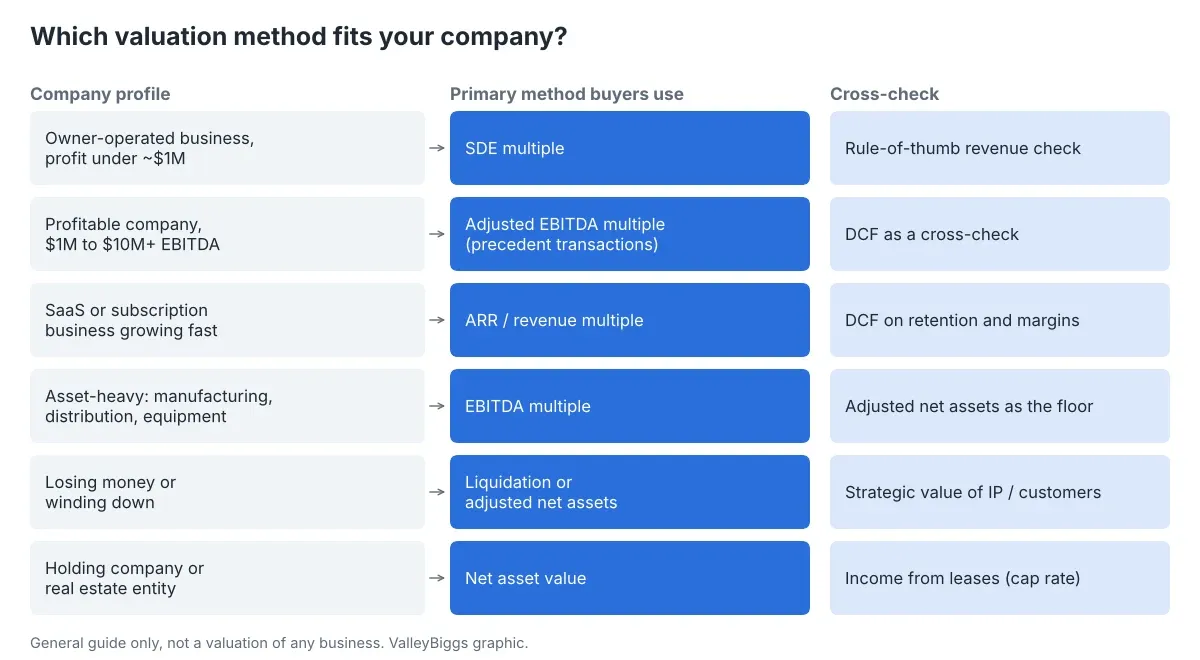
- Owner-operated, profit under about $1 million: an SDE multiple drawn from similar small-business sales. As profit grows past that level, the buyer pool and the earnings measure both change.
- Profitable company with a management team: adjusted EBITDA times a multiple from comparable private deals, checked with a DCF.
- Recurring-revenue software: an ARR or revenue multiple tied to growth and retention, checked with a DCF built on cohort data.
- Asset-heavy operator: an EBITDA multiple, with adjusted net assets as the floor and an equipment appraisal behind it.
- Loss-making or winding down: adjusted net assets or liquidation value, plus any strategic value a buyer might see in the intellectual property or customer list.
Size changes the answer too. A $10 million company and a $50 million company may use the same EBITDA method, but the buyer pool, the multiple and the diligence differ. Our breakdown of what a $10 million company is worth shows how that plays out at one size.
One Company, Five Methods: A Hypothetical Example
To see how the methods compare in practice, take a hypothetical tech-enabled services company with $14 million of revenue, $2.4 million of adjusted EBITDA, $1.6 million of year-one free cash flow growing about 10% a year, and $3.1 million of adjusted net assets. All figures below are illustrative, not a quote for any real business.
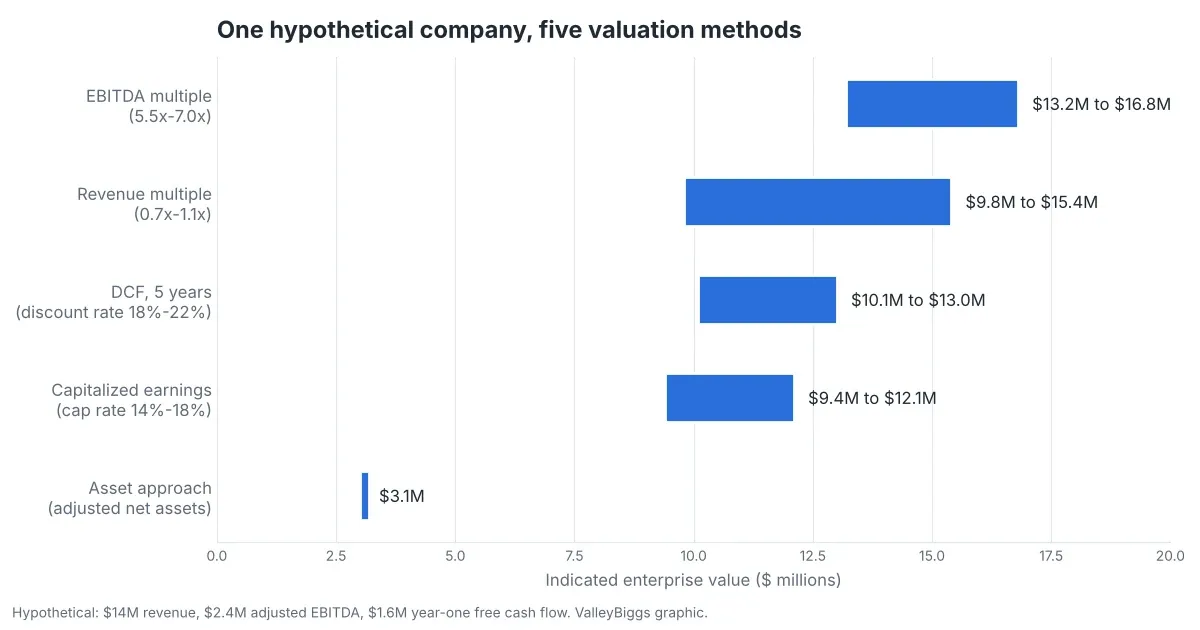
| Method | Inputs (hypothetical) | Indicated value |
|---|---|---|
| EBITDA multiple | $2.4M x 5.5 to 7.0 | $13.2M to $16.8M |
| Revenue multiple | $14M x 0.7 to 1.1 | $9.8M to $15.4M |
| DCF | 5-year forecast, 18% to 22% discount rate, 3% terminal growth | $10.1M to $13.0M |
| Capitalized earnings | $1.7M / (14% to 18%) | $9.4M to $12.1M |
| Adjusted net assets | Assets at market value less liabilities | $3.1M |
Three lessons stand out. First, the asset approach is far below the others, which tells you most of this company’s value is goodwill and earning power. Second, the income methods land lower than the transaction multiple, because a high private-company discount rate is conservative while deal multiples include competition among buyers. Third, the revenue multiple produces the widest range, which is why it is a sanity check here rather than a pricing tool.
A buyer would most likely open near the lower half of the EBITDA range and use the DCF to argue for it. A seller’s job is to show why the company deserves the upper half: reviewed financial statements, no single customer carrying the revenue, contracted or subscription income, and managers who will stay on under new ownership.
Why Valuation Methods Disagree, and How Buyers Reconcile Them
A spread between methods is normal. What matters is understanding where it comes from. The usual causes are:
- Different risk views: a DCF bakes risk into one discount rate, while a multiple absorbs it from what other buyers accepted.
- Synergies: a strategic acquirer may pay for cost savings or cross-selling that a stand-alone DCF ignores.
- Normalization: one method may use reported profit and another adjusted EBITDA, so the starting earnings differ.
- Enterprise versus equity value: most methods produce enterprise value, and debt, cash and working capital then decide what the owner keeps. Our article on enterprise value vs equity value walks through the bridge.
- Deal structure: the same headline price can mean very different cash at closing once earnouts, seller notes and escrow are counted.
Professional appraisers reconcile the results by weighting each method according to how reliable its inputs are, then explaining the weights in writing. In a sale, the market sets the weights for you: the price is whatever the strongest buyer will commit to, and the methods are the arguments each side uses to get there.
Common Mistakes When Choosing a Valuation Method
- Using an online rule of thumb as if it were a valuation, without checking whether your margins match the businesses behind the average.
- Building a DCF with optimistic growth and a public-company discount rate, then expecting buyers to accept it.
- Applying a public company’s multiple to a private business without adjusting for size and liquidity.
- Valuing a software company on its balance sheet, or a holding company on its earnings.
- Averaging every method equally instead of weighting the ones with the most reliable inputs.
- Ignoring add-backs, or claiming add-backs that a buyer’s quality of earnings review will not accept.
Formal Appraisal, Broker Opinion or M&A Valuation?
The method is only part of the decision. Who prepares the valuation, and for what audience, matters just as much.
| Type | Typically prepared by | Used for | What to expect |
|---|---|---|---|
| Formal appraisal report | Credentialed appraisers (for example ASA, ABV or CVA holders) | Tax filings, litigation, SBA lending, ESOPs | A documented report that follows professional standards and can be defended |
| Broker opinion of value | Business brokers | Setting an asking price for a smaller company | A market-based range drawn from comparable sales |
| M&A valuation analysis | M&A advisors and investment bankers | Preparing to sell to strategic or financial buyers | Several methods, buyer-specific scenarios and a view on deal structure |
For SBA-financed purchases, lenders generally rely on an independent valuation from a qualified source under the SBA’s lending rules. Those rules were updated in 2026, so a buyer should confirm the current requirements with the lender.
When to Talk to an Advisor
A rough estimate is enough to decide whether a sale is worth exploring. Bring in an advisor when you are within two years of a sale, when a buyer has made an unsolicited approach, when partners disagree on value, or when the company does not fit neatly into one method. ValleyBiggs prepares an enterprise valuation analysis using several methods, including discounted cash flow, and our sell-side assistance team then tests that number against what buyers are actually paying. For a broader starting point, read what a business is worth and which earnings figure applies.
This article is general information, not tax, legal or appraisal advice. Use a credentialed appraiser for any filing or legal matter.
Conclusion
The right valuation method is the one that matches how a buyer will look at your company: SDE multiples for owner-run businesses, EBITDA multiples backed by a DCF for established companies, revenue multiples for fast-growing software and the asset approach where the balance sheet is the business. Knowing which method applies, and why the others disagree, puts you in a stronger position before the first offer arrives. If you are weighing a sale, start with a confidential conversation about selling your business, or contact ValleyBiggs to request a valuation.
FAQs
1. What are the five methods of valuation?
For a private company, the five methods you will meet most often are the SDE multiple, the EBITDA multiple based on comparable deals, the revenue or ARR multiple, the discounted cash flow, and adjusted net assets. They belong to three broader approaches: market, income and asset. Most professional valuations use at least two of them and reconcile the results.
2. What is the most common way to value a small business?
Most small businesses are valued with a multiple of seller’s discretionary earnings, taken from sales of similar companies. SDE adds the owner’s pay and one-time costs back to profit, so it shows the full cash benefit to one owner-operator. Larger companies with a management team are usually priced on adjusted EBITDA instead.
3. How do you calculate the value of a company?
Start by normalizing earnings, then apply the method that fits the business. For a profitable private company that usually means adjusted EBITDA times a multiple from comparable deals, cross-checked with a discounted cash flow. Subtract debt and add excess cash to move from enterprise value to the amount the owners receive.
4. What is a valuation multiple?
A valuation multiple is the ratio between a company’s value and a financial measure such as SDE, EBITDA or revenue. If similar businesses sold for six times EBITDA, a company with $2 million of EBITDA would indicate about $12 million of enterprise value. Our guide to EBITDA multiples explains what pushes the number up or down.
5. Which valuation method is best for selling a business?
For a sale, the market approach usually carries the most weight because it reflects what buyers have actually paid. A DCF is useful to support the price and to show the value of growth, while the asset approach sets a floor. The best result comes from several methods that point to a defensible range.
6. Do buyers use DCF to value private companies?
Yes, but mostly as a cross-check. Private equity firms and strategic acquirers build their own cash flow models to test returns, synergies and debt capacity. Because a private company’s discount rate is high and the terminal value carries much of the result, buyers rarely let a seller’s DCF set the headline price.
7. What is the difference between fair market value and fair value?
Fair market value is the tax standard from IRS Revenue Ruling 59-60: the price between a willing buyer and willing seller, both informed and under no compulsion. Fair value has two meanings: the accounting measure in FASB ASC 820, and a legal standard some states use in shareholder disputes. The right one depends on the purpose.