

A business exit strategy is a written plan for how and when you will leave your company, who will own it next and how much cash you need from the transition. The strongest plans start three to five years before a sale, because value-building work needs time to show up in the trailing results buyers pay for.
Most owners start much later: in the IBBA and M&A Source Market Pulse survey for Q2 2026, 60% to 90% of sellers, depending on deal size, had done under a year of formal exit planning or none. Below are eight practical steps, a timeline, a worked example and a checklist.
Key Takeaways
- Start three to five years out. Buyers credit improvements only after they show up in two or three years of verified results.
- Define your number first: the cash you need after taxes, debt and deal costs. Compare it with a baseline valuation to see your value gap.
- Let your goals pick the route. Outside buyers tend to pay most of the price at closing, while insiders and family usually pay over several years.
- Fix tax structure, entity issues and contract problems before a letter of intent, when you still have leverage and time.
- Protect against a forced exit now with a funded buy-sell agreement, key-person coverage and a written emergency plan.
- Budget about a year for the sale itself: deals of $1 million and up took 10 to 12 months on average in Q2 2026, per the IBBA and M&A Source.
What a Business Exit Strategy Plan Covers
An exit plan is not the same as choosing an exit type. The types (strategic sale, private equity, management buyout, ESOP, family succession, liquidation) are covered in our guide to exit strategy definitions and types. This article is about the plan that sits around that choice: the goals, numbers, people and deadlines that decide whether the exit works for you.
A complete plan answers five questions in writing:
- Goals: When do you want to step back, what role (if any) do you want afterward, and what do you want for your employees and customers?
- Value: What is the company worth today, and what would it need to be worth to fund the life you want after the sale?
- Route: Which two or three exit routes fit those goals, and which one is the primary path?
- Readiness: What has to change in the business before a buyer will pay full value for it?
- Protection: What happens if you have to leave early because of illness, a dispute or another event you did not plan for?
For owners of tech, SaaS, ecommerce and other growth companies, the same five questions apply, but buyers will also look closely at recurring revenue quality, retention, code ownership and security practices. Those items take longer to fix than most owners expect, which is one more reason to start early.
The Business Exit Planning Timeline at a Glance
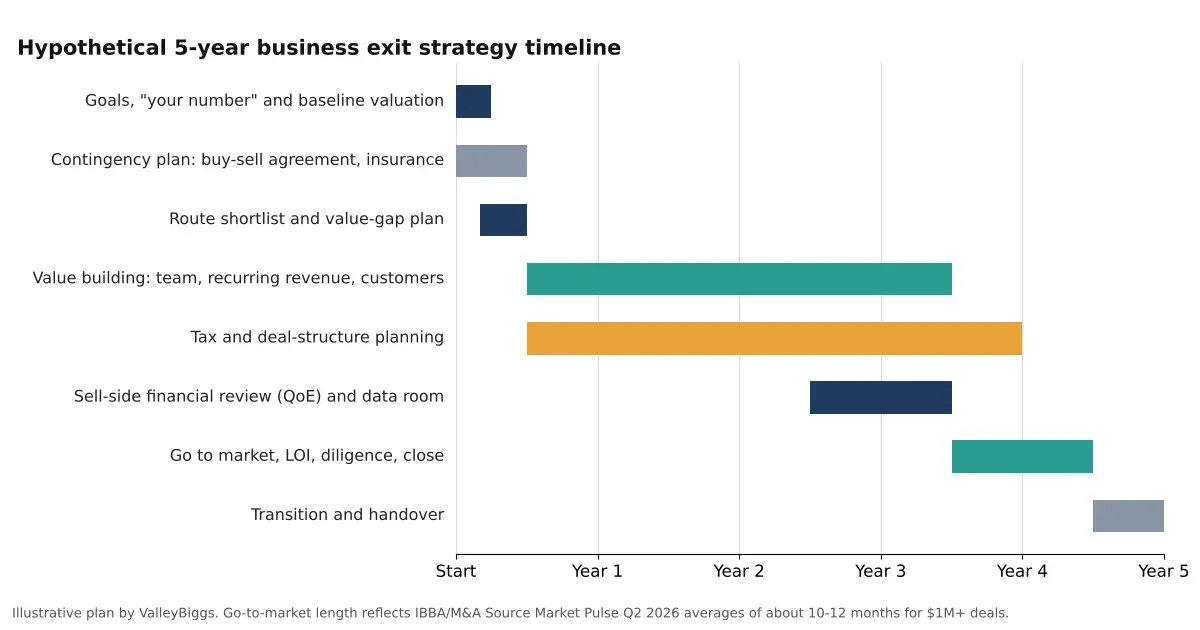
The table below lays out a hypothetical five-year plan. Few owners follow it exactly, and a well-prepared company can compress it, but the order of the work rarely changes: goals and protection first, value building in the middle, then the sale and handover.
| Phase | When (hypothetical) | Main work | What you have at the end |
|---|---|---|---|
| Set goals | Months 0 to 3 | Personal and financial goals, your number, baseline valuation | Written goals and a current value range |
| Protect | Months 0 to 6 | Buy-sell agreement, insurance, emergency leadership plan | Signed contingency documents |
| Choose the route | Months 2 to 6 | Shortlist exit routes, rank value-gap priorities | A primary route, a backup route and a work list |
| Build value | Year 1 to mid-year 3 | Management team, recurring revenue, customer mix, systems | Trailing results a buyer can verify |
| Tax and structure | Year 1 to year 4 | Entity review, estate planning, after-tax modeling | An after-tax estimate for each route |
| Get sale-ready | Second half of year 3 | Sell-side quality of earnings review, data room, legal clean-up | Diligence-ready files |
| Sell | Mid-year 3 to mid-year 4 | Buyer outreach, letter of intent, due diligence, closing | A signed purchase agreement |
| Transition | Final 6 months | Handover, any earnout period or consulting role | A finished exit |
Step 1: Set Your Personal and Financial Goals
Exit planning starts with you, not the company. Owners who skip this step often run a good sale process toward the wrong outcome: a high price with a three-year earnout they did not want, or a buyer who plans to fold their team into another business.
Write short answers to these questions before you talk to any buyer:
- How much cash do you need after taxes, debt payoff and transaction costs to fund retirement or your next venture? This is your number.
- By what date do you want to be fully out, and how long are you willing to stay on after closing?
- Do you want to keep a minority stake, or do you want a clean break?
- Who would you like to own the company next: an outside buyer, your managers, your employees or family?
- What matters to you beyond price, such as keeping the brand, protecting jobs or staying in your city?
A financial planner can turn your lifestyle goals into a specific after-tax figure. Treat that figure as a planning target, not a promise: market conditions, interest rates and buyer appetite will move what any company sells for.
Step 2: Get a Baseline Valuation and Measure the Value Gap
Your baseline valuation tells you where you stand today. For most companies with $1 million or more of earnings, buyers will price the business on adjusted EBITDA, meaning earnings before interest, taxes, depreciation and amortization after normalizing owner pay and one-time costs. Smaller owner-operated companies are usually priced on seller’s discretionary earnings (SDE). An independent enterprise valuation gives you a defensible range and shows which factors are holding the multiple down.
Market data helps frame the range. The latest IBBA and M&A Source survey showed both the multiple and the share of the price paid at closing changing with deal size:
| Deal size (purchase price) | Median multiple, Q2 2026 | Earnings basis | Average share paid in cash at close | Average months to close |
|---|---|---|---|---|
| Under $500K | 2.0x | SDE | 88% | 6 |
| $500K to $1M | 2.8x | SDE | 92% | 8 |
| $1M to $2M | 3.1x | SDE | 91% | 10 |
| $2M to $5M | 4.0x | EBITDA | 84% | 12 |
| $5M to $50M | 5.8x | EBITDA | 83% | 11 |
Source: IBBA and M&A Source Market Pulse, Q2 2026 (255 brokers and M&A advisors, 181 closed deals). Medians hide wide ranges: growth, margins, recurring revenue and owner dependence can put a company well above or below them.
Hypothetical example: measuring the value gap
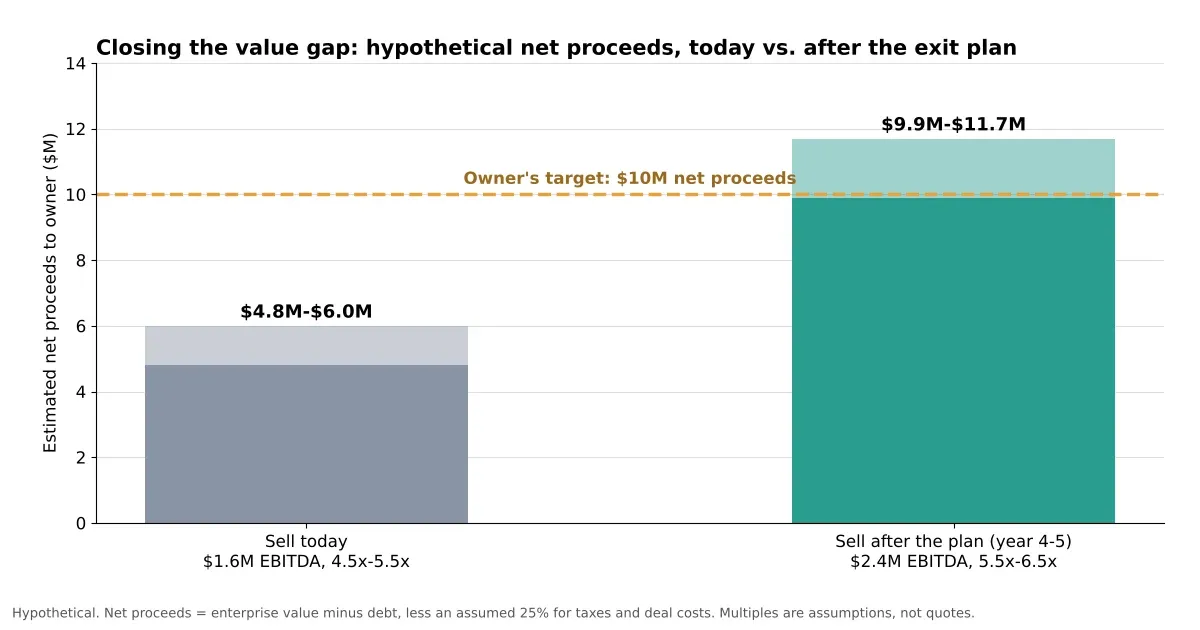
Consider a hypothetical managed IT services company with $14 million in revenue and $1.6 million in adjusted EBITDA. The owner, 56, wants to be out within five years and needs $10 million in net proceeds. Her largest client is 30% of revenue, and two senior managers still route most decisions through her. The table uses assumed multiples and an assumed 25% combined allowance for taxes and deal costs to keep the arithmetic simple.
| Line item | Sell today | Sell after the plan (year 4 to 5) |
|---|---|---|
| Revenue | $14.0M | $18.0M |
| Adjusted EBITDA | $1.6M | $2.4M |
| Assumed multiple | 4.5x to 5.5x | 5.5x to 6.5x |
| Enterprise value | $7.2M to $8.8M | $13.2M to $15.6M |
| Debt repaid at closing | $0.8M | $0 |
| Net proceeds after assumed 25% for taxes and costs | $4.8M to $6.0M | $9.9M to $11.7M |
| Position against the $10M target | $4.0M to $5.2M short | $0.1M short to $1.7M ahead |
In this example the multiple rises because the plan cuts the top client below 15% of revenue, moves more customers onto multi-year managed contracts and gives the two managers real authority, with retention agreements. Earnings rise because of that growth and better pricing. None of these figures are market quotes; they show how a value gap is measured and why it usually takes years, not months, to close.
Step 3: Shortlist the Exit Routes That Fit Your Goals
Once you know your number and your gap, rank the exit routes against them. The table shows general tendencies, not rules; individual deals vary widely.
| Exit route | How the buyer usually pays | Cash at closing | Your likely role afterward | Fits best when |
|---|---|---|---|---|
| Strategic buyer | Buyer’s cash and credit, sometimes stock | Usually high; earnouts are common when customer retention is a concern | Short transition, often months | The buyer gains customers, products or territory |
| Private equity | Fund equity plus acquisition debt | High, often with rollover equity | Often stays to lead the next growth phase | Earnings are large and stable enough to carry debt |
| Management buyout | Bank loan, manager equity, seller note | Lower; part is paid over years | Lender to the new owners | A capable team already runs daily operations |
| ESOP | Company borrowing, often with seller notes | Varies; sales are often staged | Can stay involved for years | Profits are steady and the workforce is large enough |
| Family succession | Gift, installment sale or both | Low | Often long and gradual | A family member is ready and wants to lead |
| Liquidation | Asset buyers | Asset value only | None | No buyer will pay for the earnings stream |
If an insider route is on your list, test early whether the buyers can afford it. Managers rarely have the full price in cash, so a management buyout usually depends on outside lending plus seller notes that leave you as a creditor of the company you just sold. ESOPs are more common than many owners assume: the National Center for Employee Ownership counted 6,609 plans with about 15.1 million participants in 2023 filings, the latest year available, and about two-thirds of the privately held plans sat in S corporations.
Keep a fallback in view. Work that readies the company for a private equity buyer also makes it more credible to strategic acquirers, and a second option strengthens your hand at the negotiating table.
Step 4: Close the Value Gap Before You Sell
This is the longest phase and the one that changes the outcome most. Focus on the issues buyers discount most heavily, in roughly this order:
- Owner dependence. Move key customer relationships, pricing decisions and vendor contacts to managers. Buyers pay less, or push more of the price into an earnout, when the founder is the business.
- Customer concentration. Grow smaller accounts so no single customer dominates revenue. Many buyers start asking hard questions once one customer passes 10% to 20% of sales.
- Recurring and contracted revenue. Convert project work to subscriptions, retainers or multi-year contracts where your market allows it.
- Financial reporting. Move to accrual accounting with a monthly close, separate personal expenses and document every add-back you will claim.
- Management depth and retention. Put key people on retention or incentive plans that survive a sale, so the team is still there after closing.
- Transferable assets. Confirm that contracts can be assigned, intellectual property is owned by the company and licenses are current. For software companies, this includes code ownership, open-source compliance and security documentation.
Owners of software, IT and digital companies can see how buyers weigh these factors in their sector on our page about selling a technology business.
Step 5: Plan Taxes and Deal Structure Early
Two offers with the same headline price can leave you with very different amounts after tax. Most structural choices are far cheaper to make before a letter of intent is signed. Points to raise with your CPA and attorney:
- Asset sale or stock sale. Buyers often prefer to buy assets for tax reasons, while sellers, especially of C corporations, often prefer a stock sale. Your entity type shapes this negotiation, and changing it takes time.
- Installment sales. If part of the price is paid in a later tax year, the IRS installment method generally spreads the gain over the years you collect it (Form 6252), although any depreciation recapture is taxed up front in the sale year (IRS Topic 705).
- ESOP sales. Under Internal Revenue Code Section 1042, an owner selling C corporation stock to an ESOP may defer gain if the ESOP holds at least 30% after the sale, the shares were held at least three years and proceeds are reinvested in qualified replacement property within the window the law sets.
- Gifting and estate planning. The 2025 federal tax law set the estate and gift tax exemption at $15 million per person, indexed for inflation in later years. Transfers to family can mix gifts and sales, and they need an independent valuation.
- Qualified small business stock. Some C corporation shareholders may exclude part or all of their gain under Section 1202, subject to holding periods and caps that changed for stock issued after July 4, 2025.
- State taxes. Residency and state rules can add meaningfully to the bill. Plan any move well before the sale and get advice on how your state treats it.
This section is general information, not legal or tax advice. Tax rules change, and the right structure depends on your entity, state and goals.
Step 6: Assemble Your Exit Planning Team
No single advisor covers every part of an exit. The table shows who usually does what. Firms that offer structured exit planning support often coordinate these roles so the valuation, tax model and sale plan stay consistent.
| Role | What they do in the plan | When to bring them in |
|---|---|---|
| M&A advisor or investment banker | Valuation range, buyer universe, sale process, negotiation | Planning stage for strategy; 6 to 12 months before going to market for the sale |
| CPA or tax advisor | After-tax modeling, entity review, financial clean-up | Year 1 |
| M&A attorney | Buy-sell agreement, contract review, purchase agreement | Year 1 and again at the letter of intent |
| Financial planner | Your number, post-sale investment and income plan | At the start |
| Estate planning attorney | Gifts, trusts and family transfers | Year 1 if family or estate goals matter |
| Independent valuation professional | Baseline value, required appraisals for ESOP or gift transactions | At the start, and when a transaction requires it |
Step 7: Protect Against a Forced Exit
Exit planners often describe the events that force an unplanned exit as the five Ds: death, disability, divorce, disagreement between owners and financial distress. Any of them can turn a planned sale into a rushed one. A short list of documents keeps you in control:
- A buy-sell agreement among owners that sets a valuation method and a funding source, often life or disability insurance.
- Key-person insurance on the people the business cannot run without.
- A written emergency plan naming who leads, who signs and where account access, passwords and key contracts are kept.
- Powers of attorney and an updated estate plan that match the ownership documents.
Step 8: Pick Your Timing and Run the Sale
The best time to sell is when three things line up: the business shows rising trailing results, buyers in your sector are active, and you are personally ready. Retirement drives most sales; in the Q2 2026 Market Pulse it was the leading reason in every deal-size segment, from 45% of sales under $500,000 to 72% of sales between $1 million and $2 million.
When the plan has done its work, the sale itself follows a standard sequence: preparation, valuation, confidential marketing, offers, letter of intent, due diligence and closing. Our step-by-step guide to selling a business covers each stage in detail. Expect structure to matter more as deals get larger: in the $5 million to $50 million segment, earnouts averaged 7% and retained equity 4% of deal value in Q2 2026, per the same survey.
Exit Strategies for Small Business Owners vs. Larger Companies
The plan’s shape changes with size. A company selling for under $2 million is usually valued on SDE and bought by an individual owner-operator, often with a bank loan. Planning focuses on clean books, a transferable lease and a smooth owner handover, and two to three years is often enough.
Companies with several million dollars of EBITDA draw strategic and private equity buyers, who look at management depth, growth and margins. Planning for them runs longer and includes sell-side financial reviews, rollover equity decisions and more complex tax structures. In both cases, a business exit strategy started early widens the set of buyers who will take the company seriously.
Business Exit Plan Checklist
Use this list to check whether your business exit strategy is complete or still a set of intentions. Each item should have an owner and a date.
- Written goals: exit date, post-sale role and your after-tax number
- Baseline valuation with the main value drivers and discounts identified
- Value gap calculated against your number
- Primary and backup exit routes chosen
- Funded buy-sell agreement and key-person insurance in place
- Emergency leadership and access plan documented
- Management team with authority and retention agreements
- Customer concentration and contract terms reviewed
- Accrual-basis financials with documented add-backs for at least three years
- Entity, tax and estate plan reviewed with your CPA and attorney
- Intellectual property, licenses and key contracts confirmed as transferable
- Data room started well before going to market
Common Exit Planning Mistakes
- Starting when you are already tired. Burnout shows in the numbers, and buyers notice slowing growth.
- Anchoring on a number from a peer or a headline. Your value depends on your earnings quality, not someone else’s deal.
- Comparing headline prices only. Cash at closing, earnout terms and the security of any seller note matter as much as the price.
- Leaving tax structure until after the letter of intent. By then, most options are closed.
- Keeping managers in the dark for too long. A team that learns about the sale during diligence is a retention risk.
- Letting performance slip during the process. Buyers price the trailing results, and a weak quarter during diligence can reopen the price.
When to Bring In Outside Help
You can start Steps 1 and 7 on your own. Bring in experienced help when you need a defensible valuation, when an unsolicited offer arrives, when insiders want to buy, or when your company is large enough to attract private equity. Our exit advisory services cover strategy, valuation and the transaction itself, so the plan you build is the plan you sell on.
Conclusion: Start the Plan Before You Need It
A business exit strategy works best as a multi-year project with a target number, a chosen route and a list of fixes, reviewed every year. Owners who start early usually have more buyers, more leverage and more choice about how they leave. If you would like to know where your company stands today and how large your value gap is, request a confidential consultation with the ValleyBiggs team.
FAQs
1. How many years before selling should I start an exit plan?
Three to five years is a sensible window for most owners. Buyers value a company on its trailing two or three years of results, so improvements need time to show in the numbers. Insider routes such as management buyouts, ESOPs and family succession often need longer, because the next owners must be trained and financed.
2. How do I exit a small business?
Most small business owners exit by selling to an individual buyer, a competitor or their managers, usually with help from a broker or M&A advisor. Start by setting your after-tax goal, getting a valuation, cleaning up your financial records and reducing how much the business depends on you. If no buyer will pay for the earnings, an orderly wind-down is the fallback.
3. What is the best exit strategy for an owner who wants to retire?
It depends on how much cash you need at closing and how long you are willing to stay. A sale to a strategic or private equity buyer usually pays most of the price up front, while a sale to managers, employees or family protects continuity but is often paid over several years.
4. Should I tell my employees about my exit plan?
Usually not at the start. Most owners share the plan first with a small group of key managers, often alongside retention or incentive agreements, and tell the wider team close to or after closing. A broad early announcement can unsettle staff and customers and may reach competitors before a deal is certain.
5. Can I sell my business and keep some ownership?
Yes. Private equity buyers often ask sellers to roll part of their proceeds into equity in the new company, and some owners sell a majority stake while keeping a minority. Retained equity can pay off in a later sale, but it is not cash, and it carries risk because the new majority owner sets strategy and timing.
6. What if my business is worth less than I need?
You have three main levers: grow and de-risk the company before selling, adjust your post-sale plans to lower the target, or extend the timeline. An independent valuation early in the plan shows the size of the gap while there is still time to close it.