

To sell an insurance agency, you confirm what you actually own, clean up two to three years of commission and retention data, get a realistic valuation, pick a buyer type, negotiate a letter of intent and then work through diligence, carrier consents and a client transition that protects renewals. Price is rarely a single cash number: most agency deals mix cash at close with retention-based earnouts or other deferred pieces. This guide shows how to sell an insurance agency step by step, how buyers price commission revenue and EBITDA, what a hypothetical offer turns into in cash, and which documents to have ready before the first buyer call.
Key Takeaways
- Buyers pay for renewal commissions that will still be there after you leave, so retention, carrier diversity and producer agreements move the price more than headline revenue.
- Selling an insurance agency is usually priced on a multiple of commission revenue for smaller firms and on adjusted EBITDA once profits reach institutional size.
- Private equity-backed and hybrid buyers completed 73% of the 695 announced U.S. and Canadian agency deals OPTIS Partners counted in 2025, so most sellers face consolidators rather than local competitors.
- Carrier agreements, state licensing and appointments add steps that a typical business sale does not have; start those conversations before you sign an LOI.
- Earnouts in agency deals are often measured on revenue retention or growth, so define the metric, the period and the data source in writing.
What Are You Selling: the Agency, the Book or the Entity?
Before you think about price, decide what is actually changing hands. A whole agency includes the client relationships, staff, systems, carrier contracts, office lease and brand. A book of business is narrower: the policies, expirations and renewal commission streams for a defined group of clients, often carved out of a larger firm or sold by a producer who is retiring. The choice affects the buyer pool, the structure and how much of the value survives the move.
| Option | What transfers | When it fits | Points to check |
|---|---|---|---|
| Stock or membership interest sale | The legal entity, with its licenses, appointments and contracts | Owner wants a full exit and the entity is clean | Change-of-control clauses in carrier agreements; liabilities stay with the entity |
| Asset sale of the whole agency | Expirations, client files, goodwill, staff offers, equipment | Buyer wants to avoid inherited liabilities | Each carrier may need to approve or re-appoint; tax allocation on Form 8594 |
| Book of business sale | A defined set of policies and renewal rights | Producer retirement, niche carve-out, partial exit | Who owns the expirations; non-solicitation terms; client consent letters |
| Merger or rollover into a platform | Agency joins a larger firm, seller keeps a stake | Owner wants liquidity now and upside later | Value and liquidity of the rolled equity; governance rights |
First, Confirm You Own What You Plan to Sell
Ownership of expirations is the first fact a serious buyer checks. Independent agencies typically own their expirations under their carrier agency agreements, which is why their books can be sold. Captive agents often work under contracts where the carrier controls the client relationship, and the agent’s saleable interest may be limited to whatever the contract allows. Read the agreement, not a summary of it.
Look inside the agency too. Producer employment agreements should say who owns the accounts, what non-solicitation or non-piracy terms apply and what happens to commissions if a producer leaves. If a top producer can walk out with a third of the revenue, buyers will either price that risk in or tie a large share of the price to retention.
How to Sell an Insurance Agency Step by Step
Step 1: Set your exit goals and timing
Decide whether you want a clean exit within a year, a two- to three-year transition, or a partial sale with rolled equity. Your answer narrows the buyer list. An owner who wants to keep producing for several years will look different to a consolidator than one who wants to hand over the keys at closing. If you have not built a plan yet, our guide to a business exit strategy and timeline walks through the earlier planning steps.
Step 2: Rebuild the numbers the way a buyer reads them
Agency buyers want to see revenue by carrier, line of business, producer and client segment, plus retention by year. Reconcile your financial statements to carrier commission statements and your agency management system (AMS). Separate recurring renewal commissions from new business, contingent or profit-sharing income, fees and one-time items. Then normalize EBITDA by replacing owner pay with a market salary for the role you play and removing personal or non-recurring expenses.
Step 3: Get a realistic valuation range
Valuation sets your walk-away number and helps you judge offers that look similar on paper but pay very differently. A formal enterprise valuation analysis should show the range under more than one method, the assumptions behind it and the effect of retention, contingent income and producer risk.
Step 4: Choose the sale route
You can negotiate with one buyer who approached you, run a targeted process with a handful of consolidators, or run a broader confidential auction. One-buyer deals are faster but give you little leverage. A run process takes longer but tends to reveal how far apart buyers really are on price, cash at close and earnout terms. Selling to a nearby agency is another option, but it means sharing client data with a direct rival, so stage disclosures carefully.
Step 5: Market confidentially and negotiate the LOI
Share a blind profile first, sign NDAs, then release detail in stages. Most of the economic terms get fixed in the letter of intent: price, cash at close, earnout metric and period, any rollover equity, your post-closing role, non-compete scope and exclusivity length. Push for clarity here, because these terms are hard to reopen once diligence starts.
Step 6: Work through diligence and carrier consents
Expect the buyer to test commission data against carrier statements, review E&O claims history, interview key staff and check licensing. In parallel, carriers may need to approve the transfer or appoint the buyer. Keep a log of every carrier, its contract terms on assignment or change of control, the contact person and the status. A standard due diligence checklist for selling a business covers the general items; the insurance-specific ones are listed later in this article.
Step 7: Close and protect the renewals
The hardest work starts after signing. Plan the client letters, the order in which large accounts are introduced to the new owner, and who services each account during the first renewal cycle. When part of your price depends on retention, the transition plan is effectively part of your compensation.
How Buyers Value an Insurance Agency
Two pricing methods dominate. Smaller agencies are often priced as a multiple of annual commission revenue, adjusted for quality. Larger agencies with meaningful profit are usually priced on adjusted EBITDA, which is how private equity-backed platforms compare targets with their own valuation. For background on that method, see our explainer on the EBITDA multiple.
| What is being sold | Common pricing basis | Ranges cited in industry sources (hedged) |
|---|---|---|
| Book of business only | Multiple of annual commission revenue | Roughly 1.0x to 1.5x commissions, according to buyer-published agency guides |
| Smaller independent agency (under about $5M revenue) | Multiple of commission revenue, cross-checked to EBITDA | Often quoted around 1.5x to 2.5x commission revenue for well-run agencies, per the same guides |
| Agency with about $1M+ adjusted EBITDA | Multiple of adjusted EBITDA | Industry coverage of Sica | Fletcher sell-side data reported an average near 11.8x for the first half of 2025 |
| Large, high-quality broker | EBITDA, compared with public brokers | Sica | Fletcher has written that 10x to 12x EBITDA may look reasonable for a large broker in the current rate environment |
Treat these figures as context, not a quote. Headline multiples often include earnouts and rolled equity, and published averages lean toward the agencies that consolidators compete hardest for. Your own number depends on the factors below.
What moves an insurance agency valuation up or down
- Retention. The average independent agency retains about 84% of clients a year, according to Liberty Mutual’s 2026 Independent Agency Growth Study. Agencies well above that figure are worth more because the revenue a buyer pays for is more likely to last.
- Commercial versus personal lines mix. Commercial and specialty books are often valued higher than personal lines books because accounts are larger and relationships deeper.
- Carrier concentration. Heavy reliance on one carrier makes the agency exposed to that carrier’s appetite, commission changes and consent decisions.
- Producer and owner dependence. Revenue tied to one person without enforceable agreements is discounted or pushed into an earnout.
- Organic growth. Buyers look at new-business growth separately from rate increases, since premium inflation can make a flat book look like it is growing.
- Data quality. Clean AMS records that reconcile to carrier statements shorten diligence and remove a reason to cut the price.
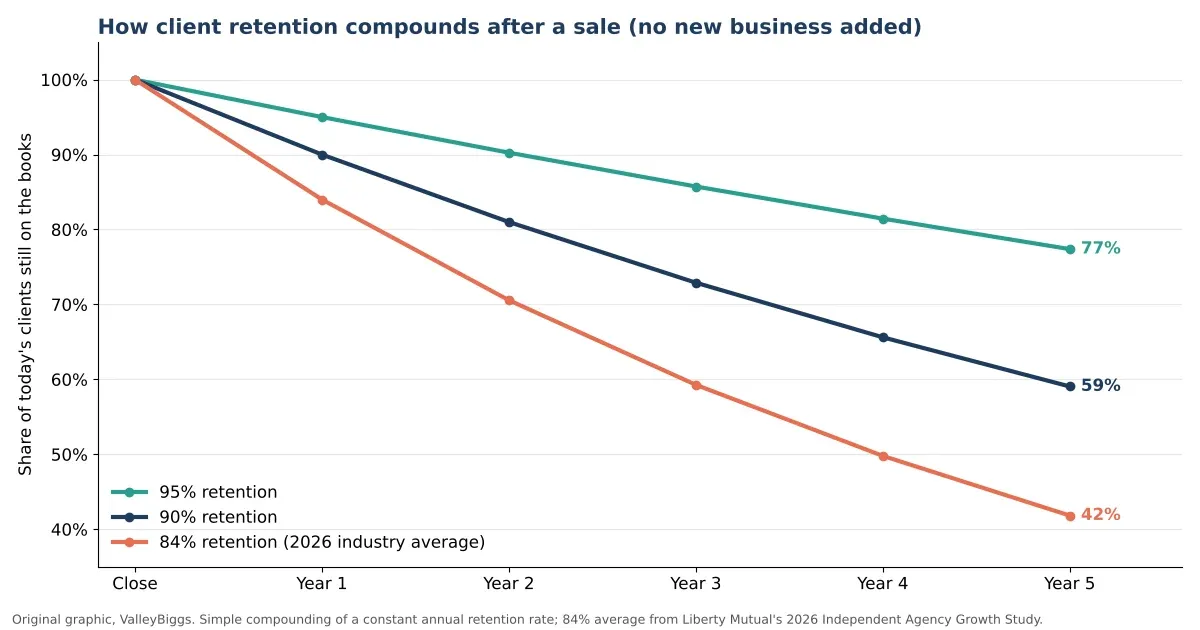
The chart explains why buyers obsess over retention. At the 84% average, fewer than half of today’s clients would still be on the books after five years if no new business were added. At 95%, more than three quarters remain. The difference is the reason two agencies with the same revenue can receive very different offers.
Who Buys Insurance Agencies in 2027?
The buyer universe for selling an insurance agency is concentrated. OPTIS Partners, an investment bank that tracks agent and broker deals, counted 695 announced U.S. and Canadian transactions in 2025, 12% fewer than in 2024. Private equity-backed and hybrid buyers accounted for 73% of them. Each buyer type brings different priorities:
- Private equity-backed platforms and aggregators buy frequently, pay on EBITDA and often offer rolled equity alongside cash and earnouts.
- Publicly traded brokers tend to focus on larger agencies or specialty capabilities and use their own stock or cash.
- Privately owned regional agencies may value local fit and staff retention and can be more flexible on the seller’s role after closing.
- Internal successors, such as producers or family members, usually need seller financing; our guide to seller financing in a business sale explains how those notes work.
- Individual buyers purchasing a first agency or a book often rely on lender financing and need a longer hand-off.
Hypothetical Example: Turning an Offer Into Cash
Consider a hypothetical commercial-heavy agency with $3.0 million of annual commission revenue, adjusted EBITDA of $900,000 and 91% retention. A consolidator offers a total of $8.1 million, or 9.0x adjusted EBITDA. The structure matters as much as the headline:
| Component | Amount | When the seller receives it | Main risk |
|---|---|---|---|
| Cash at close | $5.67M (70%) | At closing, less any escrow | Escrow or holdback for indemnity claims |
| Earnout | Up to $1.62M (20%) | Over two to three years | Revenue retention or growth falls short of the target |
| Rollover equity | $0.81M (10%) | On a later sale or recapitalization of the buyer | Value and timing depend on the buyer’s own exit |
| Total headline price | $8.1M | Only the cash portion is certain at closing |
If retention slips and only half of the earnout is earned, the seller receives $7.29 million plus whatever the rolled equity is eventually worth. A competing offer of $7.6 million with 85% at closing would put $6.46 million in hand on day one. Compare offers on guaranteed cash, earnout realism and the terms behind the equity, not on the headline. These figures are illustrative and not a market quote.
Carrier Appointments, Licensing and Compliance
Insurance is regulated state by state, which adds steps to any sale. Under the NAIC Producer Licensing Model Act, which most states follow in some form, an agency licensed as a business entity must designate a licensed producer who is responsible for its compliance. When ownership or that person changes, state filings usually need to be updated, and individual producers keep their own licenses and continuing education obligations.
- Pull every carrier agreement and note any assignment, change-of-control or termination language.
- Check whether the buyer already holds appointments with your carriers; if not, ask how long new appointments typically take.
- Confirm licensing for every producer and the entity in each state where you write business, and identify who will become the designated responsible producer.
- Review E&O coverage, open claims and the tail coverage you will need after closing.
- Check how client data, including any health or financial information, will be transferred under applicable privacy rules.
These are general points, not legal advice; your state insurance department and counsel will know the specific filing steps.
Timeline to Sell an Insurance Agency
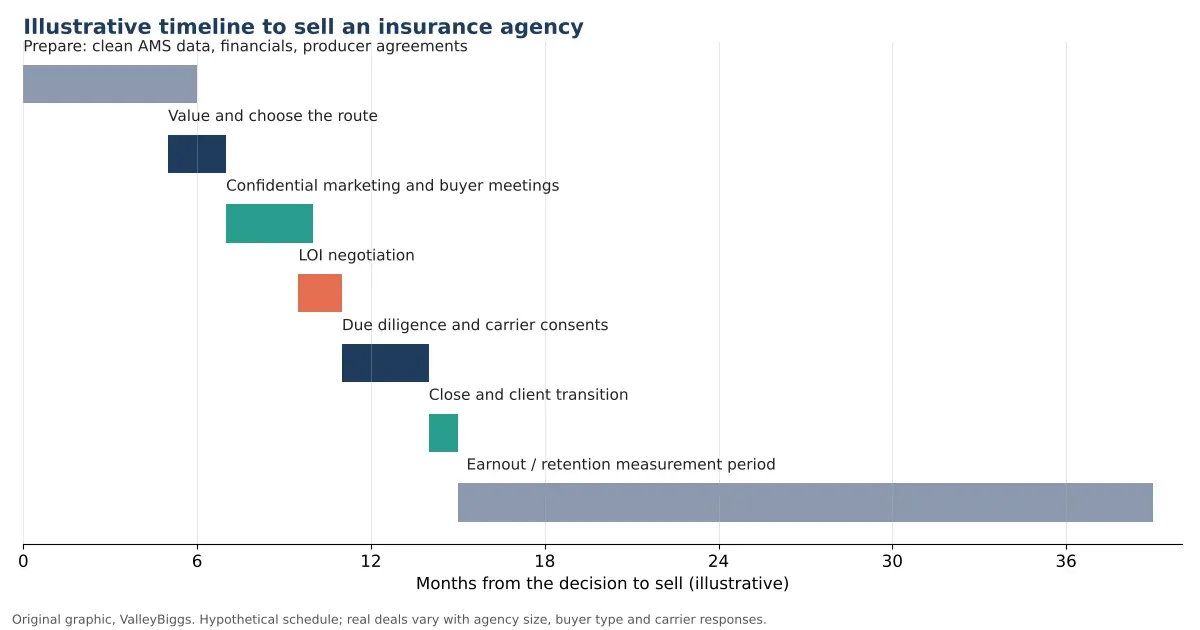
A prepared agency can move from first buyer contact to closing in a few months, but most owners spend longer on preparation than on the sale itself. The table below is a typical range for an agency that runs a structured process.
| Phase | Typical duration | Key output |
|---|---|---|
| Preparation | 3 to 12 months | Reconciled financials, retention reports, producer agreements, carrier list |
| Valuation and route | 2 to 6 weeks | Value range and buyer strategy |
| Marketing and buyer meetings | 1 to 3 months | Indications of interest and management meetings |
| LOI negotiation | 2 to 6 weeks | Signed LOI with economic terms |
| Due diligence and consents | 1 to 3 months | Confirmed data, carrier approvals, definitive agreement |
| Closing and transition | Closing day plus 6 to 12 months | Client letters, staff onboarding, system migration |
| Earnout period | Often 2 to 3 years | Retention or growth measured against targets |
Documents Checklist for Selling an Insurance Agency
- Three years of financial statements and tax returns, plus trailing twelve months
- Carrier commission statements reconciled to revenue, including contingent and profit-sharing income
- AMS exports showing revenue by client, line, carrier and producer
- Retention reports by year, by count and by revenue
- Carrier agency agreements and appointment records
- Producer and staff employment agreements, commission plans and non-solicitation terms
- Entity and individual license records for each state
- E&O policy, claims history and any regulatory correspondence
- Office lease, vendor and technology contracts
- Organization chart with who services the top 20 accounts
Common Mistakes When Selling an Insurance Agency
- Talking to a single buyer and treating the first offer as the market price.
- Ignoring contingent income volatility, then watching the buyer exclude it from earnings.
- Leaving producer agreements vague, which turns key relationships into an earnout risk.
- Agreeing to an earnout without defining how retention is measured, which accounts count and who controls servicing.
- Telling staff or carriers too early, before terms are settled.
- Underestimating the time needed for carrier consents and licensing changes.
Tax and Legal Points to Raise Early
Structure drives your after-tax result. In an asset sale, buyer and seller generally allocate the price across asset classes and report it on IRS Form 8594, and the allocation affects how much is taxed as capital gain versus ordinary income. Payments for a non-compete agreement are generally ordinary income to the seller, while goodwill held long term is usually taxed as capital gain. Deferred payments, including many earnouts and seller notes, may qualify for installment sale treatment. Raise these points with your CPA and attorney before the LOI, since the price allocation is part of the negotiation. This is not legal or tax advice.
When to Talk to an M&A Advisor
Bring in an advisor once the agency has enough revenue to attract institutional buyers, when you have received an unsolicited offer, or when you are weighing rolled equity against cash. An experienced sell-side advisor can prepare the data the way consolidators read it, create competition among buyers and keep the earnout and consent terms from eroding the price late in the process. ValleyBiggs describes itself as a full-service, performance-based M&A firm focused on lower middle-market companies, with a particular focus on technology, internet and digital businesses; owners of larger, well-run agencies can review how we work on our sell my business page. For the broader process across industries, see our guide on how to sell a business.
Conclusion
Selling an insurance agency comes down to proving that the commissions a buyer pays for will keep renewing once you step back. Clean data, enforceable producer agreements, early carrier conversations and a clear earnout definition protect that value. If you are considering a sale in the next one to three years, request a confidential consultation to get a valuation range and a view on which buyers fit your agency.
FAQs
1. How much is an insurance agency worth?
It depends mostly on how much commission revenue will keep renewing after the sale. Smaller agencies are often priced on a multiple of commission revenue, while agencies with about $1 million or more of adjusted EBITDA are usually priced on EBITDA. Retention, lines mix, carrier spread and producer risk move the number, and a formal valuation analysis narrows the range.
2. Can a captive agent sell their book of business?
Sometimes, but only to the extent the agent contract allows. Many captive arrangements give the carrier control of the client relationship, so the agent may be limited to selling an interest the carrier approves or to receiving contract-based termination payments. Read the agreement and confirm with the carrier before you market anything as a saleable book.
3. How long does it take to sell an insurance agency?
A prepared agency often takes four to nine months from first buyer contact to closing, and preparation can add several months before that. Carrier consents, licensing updates and diligence on commission data are the usual sources of delay. If part of the price is an earnout, the full payout period commonly runs two to three more years.
4. Do insurance carriers have to approve the sale of an agency?
Often, yes. Many agency agreements contain assignment or change-of-control clauses that require notice or consent, and an asset buyer may need its own appointments with each carrier. Collect every carrier agreement early, note the relevant clause and expected timing, and discuss the transfer with carriers once the buyer and terms are settled.
5. Should I sell to a private equity-backed aggregator?
It depends on your goals. Private equity-backed buyers completed most announced agency deals in 2025 and often pay strong EBITDA multiples, but offers commonly include earnouts and rolled equity. A regional agency or internal successor may offer more control over staff and clients. Compare guaranteed cash, earnout terms and your post-closing role across buyer types.
6. How are earnouts measured in insurance agency sales?
Earnouts in agency deals are usually tied to revenue retention or growth over a set period, often two to three years. The contract should define which accounts count, how commissions are calculated, how contingent income is treated and who controls servicing. Vague definitions are the most common reason sellers collect less than they expected.
7. Will my staff and producers keep their jobs after the sale?
Most buyers want to keep the people who service clients, because losing them puts renewals at risk. Expect retention agreements for key producers and account managers, and possibly new employment contracts with non-solicitation terms. Negotiate staff commitments in the letter of intent and plan announcements so clients hear about the change from people they know.