

A holdback is the part of a business’s purchase price that the buyer does not pay at closing and instead keeps back, either in its own account or with a neutral escrow agent, to cover claims or price corrections that surface after the deal closes. Whatever is not used is paid to the seller later.
For an owner, that means the headline price and the cash that arrives on closing day are two different numbers. This guide explains how holdbacks and escrows work in a business sale, how large they usually are, when the money comes back, how taxes treat it, and which terms are worth negotiating before you sign.
Key Takeaways
- A holdback delays part of the price rather than cutting it: if no valid claims are made, the full amount is released to the seller at the end of the agreed period.
- With an escrow, a third-party agent holds the money under a written escrow agreement; with a buyer holdback, the buyer keeps it, which leaves the seller exposed to the buyer’s credit and goodwill.
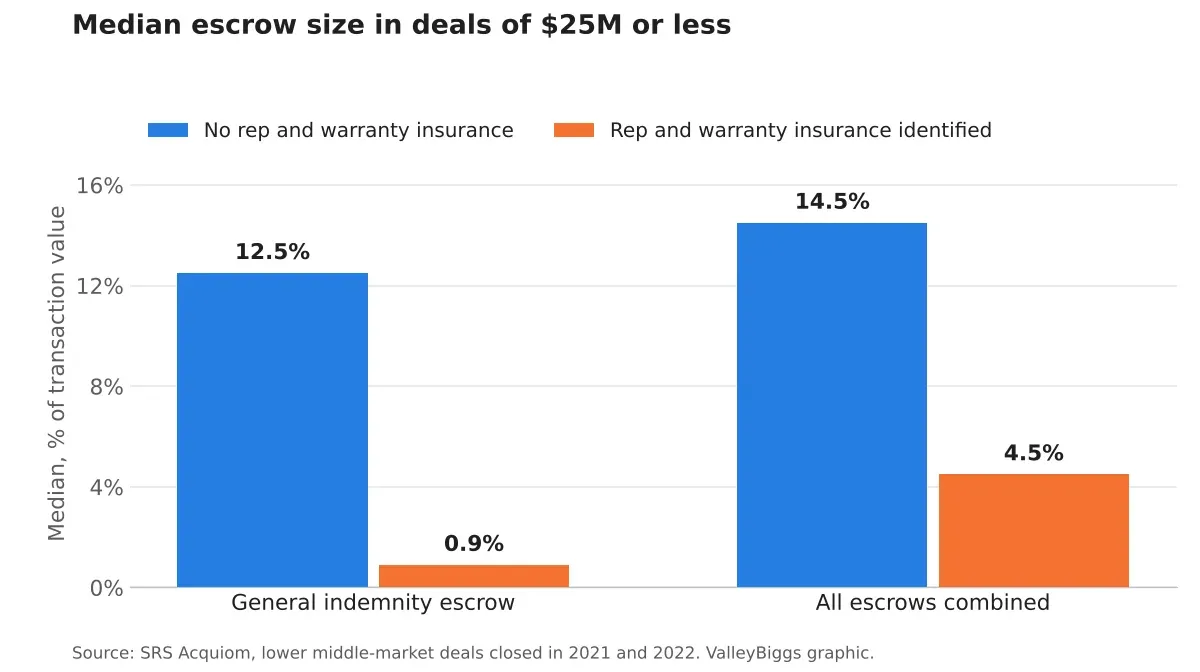
- In SRS Acquiom data on private deals of $25 million or less, the median general indemnity escrow was 12.5% of transaction value when no rep and warranty insurance was identified, and 0.9% when a policy was in place.
- The median survival period for claims in lower middle-market deals was 15 months, so most owners should plan for indemnity money to come back between one and two years after closing.
- Amount, scope, duration and release mechanics matter more together than any single percentage. A clean release process can be worth more than a lower headline figure.
What Is a Holdback in a Business Sale?
In a business sale, a holdback (sometimes called a purchase price holdback or retention) is a deferred slice of the price that secures the seller’s promises in the purchase agreement. The buyer pays most of the price at closing, sets aside an agreed sum, and draws on that sum only if a covered problem appears, such as a representation that proves untrue, a working capital shortfall or a known tax exposure that turns into a bill.
The idea is simple: the buyer wants a pool of money it can reach without suing the seller, and the seller wants a clear limit on what can be taken and a date when the rest is paid. A well-drafted holdback gives both. A poorly drafted one leaves part of your price in limbo while the parties argue about what the clause meant.
This deferred amount is rarely a standalone term. They sit alongside the indemnification terms that decide who pays for post-closing losses, the working capital adjustment and any deferred consideration, and together these decide how much of the agreed price you actually keep.
Escrow vs Holdback: Who Holds the Money
People often use the two words interchangeably, and some purchase agreements even say “escrow holdback.” The practical difference is custody. In an escrow, a bank or trust company acts as escrow agent and releases funds only on the terms of a separate escrow agreement, usually against joint written instructions from buyer and seller. In a pure holdback, the buyer simply pays less at closing and owes the balance later.
| Feature | Third-party escrow | Buyer holdback |
|---|---|---|
| Who holds the funds | Escrow agent (bank or trust company) | The buyer, often in its general accounts |
| Seller’s main risk | Disputed claims slow the release | Buyer insolvency, a sale of the buyer or simple delay |
| How releases happen | Joint instructions, a court order or an automatic date in the escrow agreement | Buyer pays when it agrees the conditions are met |
| Cost and paperwork | Agent fees, onboarding checks on both parties, a separate agreement | Lower cost, fewer documents |
| Leverage in a dispute | More balanced, since neither side controls the cash | Tilts toward the buyer, which already has the money |
| Where it is common | Private equity and strategic deals, most deals above a few million dollars | Smaller deals, related-party sales, some add-on acquisitions |
When a buyer proposes a holdback instead of an escrow, the seller can ask for protections that close the gap: a parent guarantee, a security interest, interest on the deferred amount, or a short list of events (a sale of the buyer, missed payments) that make the balance due immediately. This is the core of the holdback vs escrow decision for most owners.
How a Holdback Works From LOI to Final Release
These terms appear early and harden late. Knowing where each step happens helps you push back while your leverage is highest.
- Letter of intent. A buyer’s offer usually signals the indemnity package in a line or two: the escrow size, how long it lasts and whether rep and warranty insurance will be used. If you are comparing offers, read this line as closely as the price; our guide to what a letter of intent should spell out covers the other clauses.
- Due diligence. Every issue the buyer finds can become a reason for a larger general escrow or a dedicated special escrow. A clean, well-organized data room is the cheapest way to keep the number down.
- Purchase agreement and escrow agreement. The purchase agreement sets amount, scope, caps, survival periods and claim procedures. The escrow agreement tells the agent how to hold, invest and release the funds.
- Closing. The buyer wires the closing payment to the seller and the escrowed amounts to the agent, or simply keeps back the deferred amount.
- Working capital true-up. Within roughly two to four months, the final closing balance sheet is settled and any adjustment escrow is paid out or applied.
- Claims period. The buyer may send written claim notices until the survival date. Disputed amounts are reserved; the rest stays in the pool.
- Release. On the release date, the remaining balance, minus pending claims, is paid to the seller. Reserved amounts follow once each dispute is settled.
Types of Holdbacks and Escrows in M&A
Many transactions use more than one pool. In the lower middle-market data SRS Acquiom published on 2021 and 2022 deals, 92% of deals of $25 million or less had at least one escrow or holdback, and 44% had two or more. Each M&A escrow tends to serve a single job:
| Type | What it covers | Typical shape (varies by deal) |
|---|---|---|
| General indemnity escrow | Breaches of representations, warranties and covenants | The largest pool; often near the indemnity cap and released after the survival period |
| Purchase price adjustment escrow | A shortfall in closing working capital, cash or debt against the agreed target | Small, around 1% of value in the lower middle-market data; released after the true-up |
| Special or specific escrow | A known issue: a sales tax exposure, pending litigation, a customer consent not yet received | Sized to the estimated exposure; released when the issue resolves |
| Retention escrow with insurance | The deductible (retention) on a rep and warranty insurance policy | Usually a fraction of a percent of value; released when the retention period ends |
| Performance or transition holdback | The seller staying on, completing a handover or meeting a non-compete | Released on completion of the obligation; distinct from an earnout tied to revenue or EBITDA |
An indemnity escrow is the one that decides most of the outcome. Keeping the other pools narrow and clearly labeled stops a small working capital dispute from freezing money that was meant for something else.
How Big Is a Typical Holdback, and How Long Does It Last?
There is no fixed rule, but there is good market data. SRS Acquiom, which administers escrows and payments on private-target deals, reports that holdbacks of 10% or more of the purchase price are common and that general indemnity escrows in deals without M&A insurance often exceed 10%. Its research says nearly 90% of deals closed in 2025 had at least one escrow, and roughly half had two or more.
The firm’s report on lower middle-market deals (transaction values of $50 million or less, closed in 2021 and 2022) gives a closer view for owner-led companies:
| Measure (deals of $25M or less) | No RWI identified | RWI identified | All deals |
|---|---|---|---|
| Median general indemnity escrow, % of value | 12.5% | 0.9% | 12.0% |
| Median of all escrows combined, % of value | 14.5% | 4.5% | 12.0% |
| Deals with an indemnity escrow | 84% | 60% | 81% |
| Deals with a price adjustment escrow | 39% | 80% | 44% |
The same report puts the median survival period for these deals at 15 months and notes that releases can fall anywhere from a few months to 36 months after closing. SRS Acquiom describes 12 to 18 months as a common escrow period, usually matched to how long the buyer has to bring warranty claims. Insurance was less common at this size: it was identified on 11% of deals of $25 million or less and 31% of deals between $25 million and $50 million.
Two things push your number up or down more than anything else: what diligence uncovers and whether the buyer buys rep and warranty insurance. A seller with clean books, documented contracts and few open issues has a far stronger case for a small, short escrow.
Holdback Example: A Hypothetical $20 Million Software Sale
The following example is hypothetical and simplified. A founder agrees to sell a B2B software company for an enterprise value of $20 million. The buyer is not using rep and warranty insurance and has found an unresolved sales tax question in two states.
| Line | Amount | Notes |
|---|---|---|
| Headline price (enterprise value) | $20,000,000 | Agreed in the letter of intent |
| General indemnity escrow (10%) | ($2,000,000) | Held 15 months for warranty claims |
| Working capital adjustment escrow (1%) | ($200,000) | Held until the final closing statement |
| Special escrow for the sales tax question | ($300,000) | Released when filings are cleared or the exposure is paid |
| Cash to seller at closing | $17,500,000 | Before debt repayment, transaction costs and taxes |
| Month 4: working capital true-up | +$200,000 | Final working capital matches the target, so the full adjustment escrow is released |
| Month 9: buyer claim for an undisclosed refund obligation | ($90,000) | Paid from the general escrow after the seller agrees the claim |
| Month 14: sales tax voluntary disclosures settled | +$165,000 | $135,000 paid to the states; balance released |
| Month 15: general escrow release | +$1,910,000 | No other claims pending |
| Total received by the seller | $19,775,000 | 98.9% of the headline price, spread over 15 months |
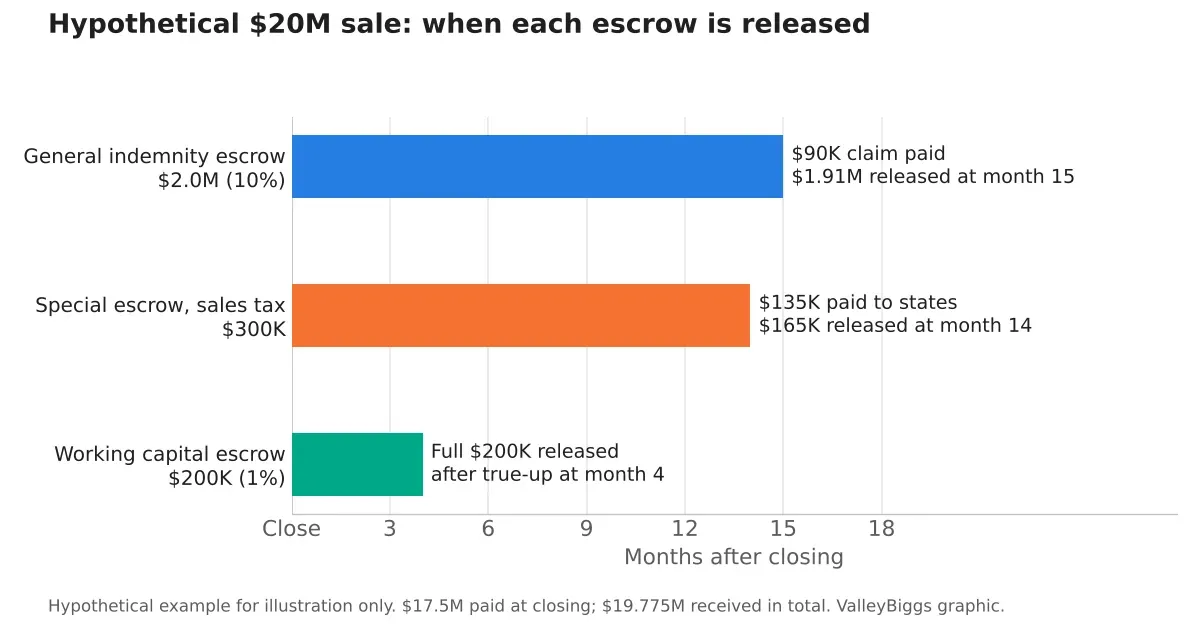
In this case the three escrows cost the founder $225,000 in claims and delayed $2.5 million for up to 15 months. Had the general escrow been 15% for 24 months with loose claim language, the same deal could have tied up $3 million for two years. That is why the terms around the escrow deserve as much attention as the price. For how debt, cash and adjustments change the figure further, see our explanation of enterprise value versus equity value.
Seller vs Buyer: What Each Side Wants
This is a negotiation over risk and timing. Each party’s starting position is predictable, which makes it easier to prepare.
| Term | Seller’s goal | Buyer’s goal |
|---|---|---|
| Amount | Sized to identified risks, not a round number | A large pool, often equal to the indemnity cap |
| Custody | Third-party escrow | Buyer holdback, or escrow with buyer-friendly release terms |
| Duration | Matched to the survival period, with staged releases | One long period, sometimes 18 to 24 months |
| Scope | Only claims under the indemnity, with the agreed basket and cap | Any amount owed under the agreement, including adjustments |
| Pending claims | Only the claimed amount is reserved | The whole balance stays until every claim is resolved |
| Exclusive remedy | Escrow is the buyer’s only source of recovery for general claims, except fraud | Escrow is a first source, with recourse to the seller above it |
Pros and cons for the seller
- Pro: a capped escrow that is the buyer’s sole remedy limits your exposure for general claims to a known number.
- Pro: agreeing a reasonable escrow can keep a buyer from cutting the price or asking for broader warranties.
- Con: money you have earned sits idle, often without meaningful interest, for a year or more.
- Con: a pool of cash within the buyer’s reach can encourage marginal claims, especially near the release date.
How Escrowed Sale Proceeds Are Taxed
Tax treatment depends on the structure of the deal and how the escrow is drafted, so take this section as orientation, not tax advice. In general, IRS rules on installment sales (Topic 705 and Form 6252) can allow a seller to report gain on deferred payments in the year they are received rather than at closing, as long as the funds are genuinely at risk and the seller has no right to them until release. An escrow that the seller effectively controls may be treated as paid at closing.
Three other points come up in most deals. First, the parties must decide who is treated as the owner of the escrow account for income tax purposes and who reports any interest it earns. Second, when part of the price is paid well after closing without stated interest, tax rules can recharacterize a portion of that payment as interest. Third, in an asset sale, both parties report the price allocation on IRS Form 8594, and a later change in the price, such as a claim paid from escrow, may require a supplemental filing. Ask your tax advisor to review the escrow agreement before signing.
What to Negotiate Before You Sign
Most of the value in this negotiation comes from a handful of drafting points:
- Size each pool to a risk. Ask the buyer to tie the general escrow to the indemnity cap and to price any known issue in a separate, smaller special escrow.
- Prefer escrow to a buyer holdback. If a holdback is unavoidable, ask for a guarantee, interest and acceleration if the buyer is sold or misses a payment.
- Match duration to survival. The release date should not run past the date by which general claims must be made.
- Stage the release. A partial release at 6 or 12 months, with the balance at the survival date, returns money as the risk fades.
- Reserve only what is claimed. A pending claim should hold back the amount in the notice, not the whole pool.
- Require specific claim notices. Each notice should state the facts, the provision breached and a good-faith estimate of the loss.
- Agree investment and interest. Decide whether the account earns interest and who reports it.
- Keep pools separate. A working capital shortfall should come from the adjustment escrow first, not the general indemnity pool.
These points connect to the rest of the deal. A tight working capital peg and true-up process reduces the need for a large adjustment escrow, and a deferred seller note or earnout adds another layer of payments that depend on the buyer after closing.
Common Mistakes Sellers Make With Holdbacks
- Comparing offers on headline price only, without converting each one into cash at closing and cash at risk.
- Accepting a round 15% or 20% figure in the letter of intent and only discovering in the purchase agreement that it is uncapped or open-ended.
- Leaving diligence findings unresolved, which turns each one into a special escrow or a larger general pool.
- Allowing automatic releases without checking whether claim notices have been sent, which invites disputes on the release date.
- Forgetting that buyer holdbacks depend on the buyer still being solvent and cooperative a year or more later.
- Ignoring the tax and interest terms of the escrow agreement until after closing.
Preparing early is the best defense. Working through a due diligence checklist for selling a business before you go to market gives buyers fewer reasons to ask for a large escrow.
Related Deal Terms
- Indemnification: the promise to repay the buyer for covered losses; the holdback is usually its funding source.
- Survival period: how long after closing the buyer can bring warranty claims; it typically sets the escrow release date.
- Basket and cap: the minimum loss before claims count and the maximum the seller can owe for general breaches.
- Working capital adjustment: the post-closing correction of the price for the actual closing balance sheet.
- Earnout: deferred price paid only if the business hits targets after closing, which rewards performance rather than securing promises.
- Rep and warranty insurance: a policy that shifts most warranty risk to an insurer and usually shrinks the escrow to the retention.
When to Talk to an Advisor
Bring in an experienced M&A team before you sign a letter of intent, not after the purchase agreement arrives. Escrow size and duration are easiest to move while several buyers are still interested, and a professional valuation analysis helps you compare offers on cash value rather than headline price. ValleyBiggs provides sell-side assistance for owners of established companies, including SaaS founders preparing to sell a software business, and works alongside your attorney and tax advisor on deal terms such as escrows and indemnities. This article is general information and not legal or tax advice.
Conclusion
Holding back part of the price does not reduce what your business is worth, but it changes when and whether you receive part of the price. The owners who keep the most are the ones who treat escrow size, scope, duration and release mechanics as core terms, prepare for diligence early and compare offers on cash rather than headline value. If you are weighing an offer or planning a sale, request a confidential consultation to review how the proposed holdback affects your proceeds.
FAQs
1. What is a 10% holdback?
A 10% holdback means the buyer keeps back one tenth of the purchase price at closing, usually in escrow, to cover claims or adjustments that come up after the sale. On a $5 million deal that is $500,000. If no valid claims are made during the agreed period, often 12 to 18 months, the seller receives the full amount.
2. How does escrow work when selling a business?
At closing, the buyer sends part of the price to a bank or trust company acting as escrow agent instead of to the seller. The agent holds it under a written escrow agreement and pays it out on joint instructions, a court order or a set date. Whatever is left after valid claims goes to the seller.
3. Is a holdback the same as an earnout?
No. A holdback secures promises the seller has already made about the business, and the seller receives it unless a covered claim arises. An earnout is additional price paid only if the business reaches revenue, EBITDA or other targets after closing, so the seller has to earn it through future performance.
4. Can a buyer keep the entire holdback?
Only if valid claims use it up, or if the agreement lets the whole balance stay frozen while any claim is pending. Sellers usually limit this by requiring detailed written claim notices and reserving only the amount claimed, so undisputed funds are still released on schedule. Our guide to the indemnification clause explains caps and baskets.
5. Does rep and warranty insurance replace the escrow?
Usually it shrinks the escrow rather than removing it. With a policy in place, the escrow often covers only part of the policy retention. In SRS Acquiom data on deals of $25 million or less, the median general indemnity escrow was 0.9% of value with insurance, against 12.5% without it.
6. When is money held in escrow taxed?
It depends on the deal structure and how the escrow is drafted. When the funds are genuinely at risk and the seller cannot reach them, gain on that portion is often reported when it is released under installment sale rules. An escrow the seller effectively controls may be taxed at closing, so confirm the treatment with a tax advisor.